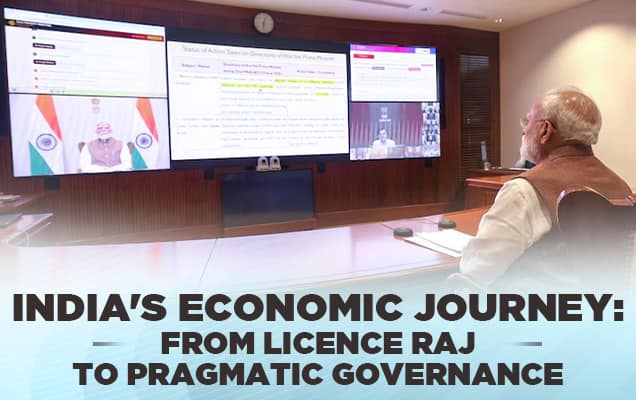
The Prime Minister, Shri Narendra Modi addressed the Viksit Bharat Viksit Jammu Kashmir program in Srinagar, Jammu & Kashmir today. He dedicated to the nation Holistic Agriculture Development Programme worth about Rs 5000 crores and launched multiple projects related to the tourism sector worth more than Rs 1400 crore under Swadesh Darshan and PRASHAD scheme including the project for ‘Integrated Development of Hazratbal Shrine’, Srinagar. The Prime Minister also launched the ‘Dekho Apna Desh People’s Choice Tourist Destination Poll’ and ‘Chalo India Global Diaspora Campaign’ and announced tourist destinations selected under Challenge Based Destination Development (CBDD) Scheme. distributed appointment orders to about 1000 new Government recruits of Jammu and Kashmir and will also interact with beneficiaries of various government schemes including women achievers, lakhpati didis, farmers, entrepreneurs etc.

Nazim Nazeer from Pulwama who is a beekeeper described his journey to the Prime Minister about expanding his business by availing benefits from the government where he bought 25 boxes for beekeeping at a 50 percent subsidy. He also threw light on his economic growth throughout the journey where he gradually expanded to 200 boxes for beekeeping by availing Rs 5 lakhs under Prime Minister’s Employment Generation Programme. This led to Mr Nazeer building a brand for himself and creating a website that further generated thousands of orders worth about 5000 kilograms across the nation, growing his business to almost 2000 beekeeping boxes and engaging about 100 youth from the region. He further informed the Prime Minister about receiving an FPO in 2023 which has only helped him grow his business. He also thanked the Prime Minister for launching the Digital India initiative that has transformed the fintech landscape in the country. The Prime Minister lauded Mr Nazim’s effort for leading the way to a sweet revolution in Jammu & Kashmir and congratulated him on his success. Upon the Prime Minister’s enquiry about getting initial support from the government to establish the business, Mr Nazim said that even though he faced initial difficulty, the Department of Agriculture came forward and supported his cause. Noting that the business of beekeeping is a fairly new sector, the Prime Minister highlighted its benefits and said that bees, in a way, work like farm laborers making it beneficial for crops. Mr Nazim said that landowners are ready to offer land for beekeeping at no cost as the process is also beneficial for the farmers. The Prime Minister suggested Mr Nazim research the honey produced in Central Asia around the Hindu Kush mountains and also asked him to look towards crafting a new taste for honey by growing specific flowers around the boxes as it is a niche market. He also mentioned similar successful efforts in Uttarakhand. Prime Minister Modi expressed delight at Acacia Honey’s price going up to Rs 1000 per kg from Rs 400 per kg due to high demand across the world. The Prime Minister lauded the clarity of thought and vision, and the courage shown by Mr. Nazim in running his business and also congratulated his parents. He said that Mr Nazim is also giving direction to the youth of India and becoming an inspiration.

Ahtesham Majid Bhat of Srinagar is a bakery entrepreneur who through a food technology skill development programme brought in new innovations in bakery. She was supported by the incubation center at Government Polytechnic for Women Skill Development. Government single window system helped her and her team in getting all the NoCs from various departments. The Prime Minister told her that in the last 10 years, the government has been providing all the support to the crores of youth in realizing their startup dreams. The Prime Minister praised her for involving her friends from different districts in her entrepreneurial ventures. “It is our efforts that the ideas of our youth do not suffer from the deficiency of resources and finance. They should move with confidence. These daughters of Jammu and Kashmir are creating new inspiring examples for the youth of the entire nation”, the Prime Minister said. He praised them for taking care of the underprivileged daughters.
Hamida Bano of Ganderbal is involved in the dairy business. She informed the Prime Minister that she benefited from National Rural Livelihoods Mission (NRLM) and opened a processing unit for milk products. She employed other women also. She also informed the Prime Minister about the quality check, packaging and marketing of products. Her milk products are devoid of preservatives and she informed the Prime Minister about the elaborate way of marketing her fragile product. The Prime Minister praised her for her business acumen and also for carrying on the work of nutrition. He also complimented her for taking care of quality and doing her business in an environment-friendly way.

Addressing the gathering, the Prime Minister said that the feeling of arriving in heaven on earth cannot be put into words. “This unparalleled form of nature, the air, the valley, the environment and the love and affection of Kashmiri brothers and sisters”, he remarked. He also acknowledged the presence of citizens outside the venue, and more than 1 lakh people from 285 blocks connected to the event via video link. Underlining that the new Jammu & Kashmir is the one that has been awaited for decades, the Prime Minister said, “Dr Syama Prasad Mookerji had sacrificed for this Jammu and Kashmir.” He stated that the new Jammu and Kashmir has the sparkle for the future in its eyes and the determination to clear all obstacles. “140 crore citizens feel at peace when they see the smiling faces of the people of Jammu & Kashmir”, PM Modi said.
Expressing his gratitude for the affection of the people of Jammu and Kashmir, the Prime Minister said “Modi will not leave any stone unturned to repay this debt of affection. I am doing all this hard work to win your hearts and I believe that I am on the right path. I will continue my efforts to win your hearts. This is Modi’s guarantee and all of you know that Modi’s Guarantee means the guarantee of fulfillment of guarantee”
Recalling his recent visit to Jammu where he started infrastructure and education projects worth Rs 32,000 crores, PM Modi mentioned today’s projects related to tourism and development, and agriculture along with appointment letters that were distributed today. “Power of development, potential of tourism, capabilities of farmers and leadership of the youth of Jammu and Kashmir will pave the way for Viksit Jammu Kashmir”, the Prime Minister said. “Jammu Kashmir is not just a place, Jammu Kashmir is the head of India. And a head held high is a symbol of development and respect. Therefore, Viksit Jammu and Kashmir is the priority of Viksit Bharat”, the Prime Minister added.
The Prime Minister recalled the time when laws implemented in the country were not implemented in Jammu & Kashmir and mentioned schemes for the welfare of the poor that could not be availed by the deprived. Highlighting the change of fortunes, the Prime Minister said that schemes for the entire nation have been launched today from Srinagar and Jammu & Kashmir is leading the way for tourism in the country. Therefore, the Prime Minister said, people from more than 50 places in India have joined the occasion. He touched upon the six projects that are being dedicated to the nation today under Swadesh Darshan scheme as well as the initiation of its next phase. He informed that around 30 projects have been launched for various cities in the country including Srinagar while 3 projects have been inaugurated and 14 others launched under PRASAD scheme. He further stated that the development works being carried out in the holy Hazratbal Dargah for the convenience of the people have also been completed. The Prime Minister informed about the ‘Dekho Apna Desh People’s Choice’ campaign where 40 places have been identified by the government to be developed as tourist destinations in the next 2 years. Under the campaign, the Prime Minister explained that the government would develop the most preferred tourist destinations based on public opinion. He also mentioned the ‘Chalo India’ campaign to encourage NRIs to come to India. Congratulating the citizens of Jammu & Kashmir for the development works of today, the Prime Minister said that it will help in developing the tourism industry of the region and creating new employment opportunities.

The Prime Minister stated, "When intentions are noble and there is a determination to fulfill commitments, results are bound to follow." He highlighted the successful hosting of the G-20 summit in Jammu and Kashmir.
Addressing the transformative growth in tourism, the Prime Minister noted, "There was a time when people questioned who would visit Jammu and Kashmir for tourism. Today, Jammu and Kashmir are breaking all tourism records." He further elaborated, "In 2023 alone, Jammu and Kashmir welcomed over 2 crore tourists, surpassing previous records. Over the past 10 years, the Amarnath Yatra has witnessed the highest number of pilgrims participating, and Vaishno Devi also recorded a significant increase in devotee footfall." Highlighting the surge in foreign tourist arrivals and the growing attraction for celebrities and international guests, the Prime Minister stated, "Now, even prominent celebrities and foreign guests visit the valleys of Jammu and Kashmir to explore and create videos and reels."
Moving on to agriculture, the Prime Minister emphasized the strength of Jammu and Kashmir's agricultural produce, including saffron, apples, dried fruits, and cherries, branding the region as a significant agricultural hub. He said that the Rs 5,000 crore agricultural development program will result in unprecedented growth in the agricultural sector of Jammu and Kashmir over the next 5 years, particularly focusing on horticulture and livestock development. "This initiative will create thousands of new opportunities, especially in the fields of horticulture and animal husbandry", he said.
Additionally, he mentioned direct transfers of nearly ₹3,000 crore under the PM Kisan Samman Nidhi scheme to the accounts of farmers in Jammu and Kashmir. To enhance the storage capacity for fruits and vegetables and ensure their prolonged preservation, significant investments have been made to increase storage facilities in Jammu and Kashmir. Furthermore, the Prime Minister pointed out that the commencement of the ‘world's largest warehousing scheme’, will include the construction of numerous warehouses across Jammu and Kashmir.

Noting the rapid pace of development in Jammu and Kashmir, the Prime Minister mentioned 2 AIIMS as AIIMS Jammu has already been inaugurated and work is going on at AIIMS Kashmir. He talked about 7 new medical colleges, 2 cancer hospitals and institutes like IIT and IIM in the region. He said that 2 Vande Bharat trains are running in Jammu and Kashmir and rail services from Srinagar to Sangaldan and from Sangaldan to Baramul have started. This expansion of connectivity has given a push to economic activities. Referring to new projects to make Jammu and Srinagar as smart cities, the Prime Minister said “In the coming times, the success story of Jammu and Kashmir will become an example for the whole world.”
Recalling his mentions of handicrafts and cleanliness of the region in his Mann ki Baat programme, the Prime Minister underlined Jammu Kashmir’s connection with lotus.
Highlighting the efforts of the government for the development of the youth of Jammu & Kashmir in every field, the Prime Minister said that new opportunities are being created ranging from skill development to sports and mentioned the modern sports facilities being built in every district of Jammu and Kashmir. He gave the example of multi-purpose indoor sports halls built in 17 districts and Jammu & Kashmir hosting many national sports tournaments. “Now Jammu and Kashmir is emerging as the winter sports capital of the country. Nearly 1000 players have participated in the recently held Khelo India Winter Games”, the Prime Minister added.
“Jammu & Kashmir is breathing freely today, hence achieving new heights”, the Prime Minister said noting the abrogation of Article 370 which has led to the respect of the youth’s talent and equal rights and equal opportunities for everyone. He spoke about the refugees from Pakistan, the Valmiki community and sanitation workers getting voting rights, fulfilling the demand of the Valmiki community for SC category, reservation of seats in the assembly for Scheduled Tribes, Paddari tribe, and the inclusion of Paddari tribe, Pahari ethnic group, Gadda Brahmin and Koli communities in the Scheduled Tribes. The Prime Minister also pointed out that dynastic politics in Jammu & Kashmir deprived the right to reservation to other backward classes in Panchayat, Municipality and Municipal Corporation as provided in the government. “Today every class is being returned its rights”, PM Modi added.

Dwelling on the transformation of the J&K Bank the Prime Minister recalled the mismanagement of the past and called it a victim of dynasty politics and corruption. The Prime Minister listed the reforms to restore the health of the bank. He mentioned 1000 crore rupees assistance to the bank and action against wrongful appointments. The Anti Corruption Bureau is still investigating thousands of such appointments. He highlighted the transparent recruitments in the last 5 years. As a result, the J&K Bank profit has reached Rs 1700 crores and business has reached Rs 2.25 lakh crores from Rs 1.25 crore rupees 5 years ago. Deposits also increased from Rs 80,000 crores to Rs 1.25 lakh crores. NPA that had crossed 11 percent 5 years ago has been brought down to below 5 percent. The share of the bank has also seen 12 fold rise to about Rs 140 from Rs 12 5 years ago. “When there is an honest government, the intention is for the welfare of the people, then the people can be brought out of every difficulty”, PM Modi added.
Pointing out that Jammu & Kashmir has been the biggest victim of dynastic politics since independence, the Prime Minister assured the people that the development campaign for Jammu & Kashmir will not stop at any cost and the region will develop more rapidly in the next 5 years.
The Prime Minister concluded his address by extending his best wishes to the entire nation on the holy month of Ramzan. “It is my wish that everyone should get the message of peace and harmony from the month of Ramadan. Tomorrow is Mahashivratri, I wish everyone the best of this holy festival”, PM Modi concluded.

Lieutenant Governor of Jammu & Kashmir, Shri Manoj Sinha and Union Minister of State, Dr Jitendra Singh were present on the occasion among others.
Background
In a step that will provide a major boost to the agri-economy of Jammu and Kashmir, the Prime Minister dedicated ‘Holistic Agriculture Development Programme’ (HADP) to the nation. HADP is an integrated program encompassing the full spectrum of activities in the three major domains of agri-economy viz Horticulture, Agriculture and Livestock husbandry in Jammu and Kashmir. The programme will equip about 2.5 lakh farmers with skill development via a dedicated Daksh Kisan portal. Under the programme, about 2000 Kisan Khidmat Ghars will be established and robust value chains will be put in place for the welfare of the farming community. The programme will lead to employment generation benefiting lakhs of marginal families in Jammu and Kashmir.
The Prime Minister's vision is to improve the overall experience of tourists and pilgrims visiting prominent pilgrimage and tourism sites nationwide by building world-class infrastructure and amenities at these sites. In line with this, the Prime Minister dedicated to the nation and launched multiple initiatives under the Swadesh Darshan and PRASHAD schemes worth more than Rs 1400 crore. The projects being dedicated to the nation by the Prime Minister include development of ‘Integrated Development of Hazratbal Shrine’ in Srinagar, J&K; tourism facilities developed in Northeast circuit in Meghalaya; Spiritual Circuit in Bihar and Rajasthan; Rural and Tirthankar Circuit in Bihar; development of Jogulamba Devi Temple, Jogulamba Gadwal District, Telangana; and development of Amarkantak Temple, Annupur District, Madhya Pradesh.

To create world-class infrastructure and amenities for pilgrims and tourists visiting the Hazratbal Shrine, and to enhance their holistic spiritual experience, the project 'Integrated Development of Hazratbal Shrine' has been executed. The key components of the project include site development of the entire area including the construction of boundary wall of the Shrine; illumination of Hazratbal shrines precinct; improvement of Ghats and Devri Paths around the Shrine; construction of Sufi interpretation center; construction of Tourist Facilitation Centre; installation of signages; multilevel storied car parking; construction of public convenience block and entrance Gateway of the Shrine among others.
The Prime Minister also launched about 43 projects that will develop a wide range of pilgrimage and tourist sites across the country. These include important religious sites like the Annavaram Temple in Kakinada district of Andhra Pradesh; Navagraha Temples in Thanjavur and Mayiladuthurai District of Tamilnadu and Karaikal district of Puducherry; Sri Chamundeshwari Devi Temple, Mysore District, Karnataka; Karni Mata Mandir, Bikaner District Rajasthan; Maa Chintpurni Temple, Una District, Himachal Pradesh; Basilica of Bom Jesus Church, Goa, among others. The projects also include development of various other sites and experience centers like Mechuka Adventure Park in Arunachal Pradesh; Rural Tourism Cluster Experience at Gunji, Pithoragarh, Uttarakhand; Ecotourism zone at Ananthagiri forest, Ananathagiri, Telangana; Meghalayan Age Cave Experience and Waterfall Trails Experience at Sohra, Meghalaya; Reimagining Cinnamara Tea Estate, Jorhat, Assam; Ecotourism experience at Kanjli Wetland, Kapurthala, Punjab; Julley Leh Biodiversity Park, Leh, among others.

During the programme, the Prime Minister announced 42 tourist destinations selected under Challenge Based Destination Development (CBDD) Scheme. The innovative scheme, announced during Union Budget 2023-24, aims to provide end-to-end tourist experiences by catalyzing the development of tourist destinations while also promoting sustainability and ushering competitiveness in the tourism sector. The 42 destinations have been identified in four categories - 16 in Culture & Heritage Destination, 11 in spiritual destinations, 10 in Ecotourism and Amrit Dharohar and 5 in Vibrant Village.
The Prime Minister launched the first-ever nationwide initiative to identify the pulse of the nation on tourism, in the form of ‘Dekho Apna Desh People’s Choice 2024’. The nationwide poll aims to engage with citizens to identify the most preferred tourist attractions and understand tourist perceptions across 5 tourism categories - Spiritual, Cultural & Heritage, Nature & Wildlife, Adventure, and other categories. Besides the four main categories, the 'other' category is where one can vote for their personal favorites and help uncover hidden tourism gems in the form of unexplored tourism attractions and destinations like Vibrant Border Villages, Wellness Tourism, Wedding Tourism etc. This poll exercise is being hosted on the MyGov platform, the citizen engagement portal of the Government of India.
The Prime Minister launched the ‘Chalo India Global Diaspora Campaign’ to inspire the Indian diaspora to become Incredible India ambassadors and promote tourism to India. The campaign is being launched based on the clarion call of the Prime Minister, wherein he requested Indian diaspora members to encourage at least 5 non-Indian friends to travel to India. With more than 3 crore overseas Indians, the Indian diaspora can serve as a powerful catalyst for Indian tourism, acting as cultural Ambassadors.
विकास की शक्ति...
— PMO India (@PMOIndia) March 7, 2024
पर्यटन की संभावनाएं...
किसानों का सामर्थ्य...
और जम्मू-कश्मीर के युवाओं का नेतृत्व...
विकसित जम्मू-कश्मीर के निर्माण का रास्ता यहीं से निकेलगा: PM @narendramodi pic.twitter.com/rZLjfOTqM8
जम्मू-कश्मीर भारत का मस्तक है: PM @narendramodi pic.twitter.com/2QkRBBzNDx
— PMO India (@PMOIndia) March 7, 2024
जम्मू-कश्मीर अपने आप में ही इतना बड़ा ब्रांड है। pic.twitter.com/0oZmfVhtE4
— PMO India (@PMOIndia) March 7, 2024
आज जम्मू-कश्मीर विकास की नई ऊंचाइयों को छू रहा है, क्योंकि जम्मू-कश्मीर आज खुलकर सांस ले रहा है। pic.twitter.com/BVwiAApRy4
— PMO India (@PMOIndia) March 7, 2024