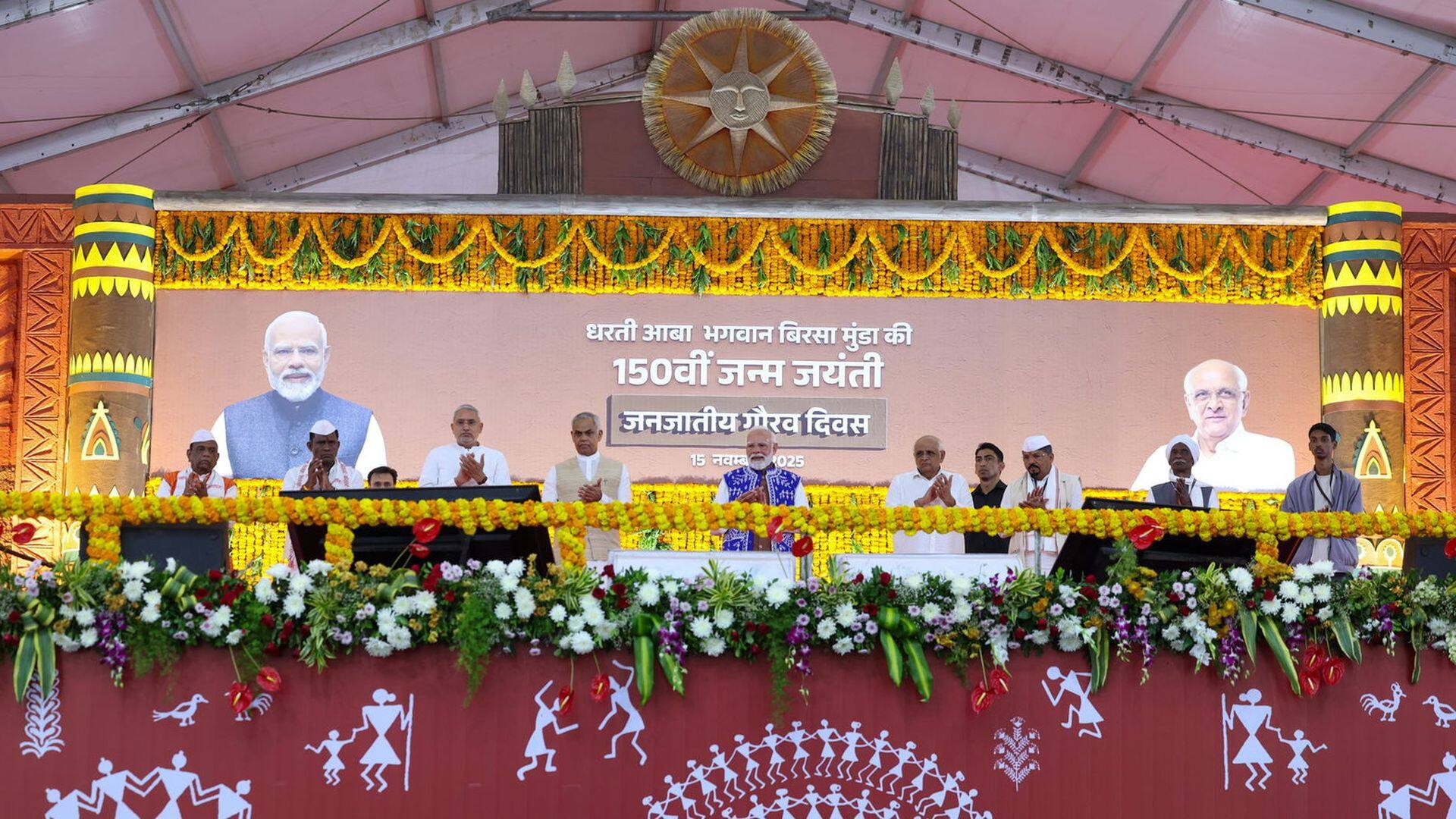


Prime Minister Shri Narendra Modi addressed the Janjatiya Gaurav Diwas programme, marking the 150th Birth Anniversary celebration of Dharti Aaba Bhagwan Birsa Munda, in Dediapada, Gujarat today. On the occasion, he inaugurated and laid the foundation stone of various infrastructure and development projects worth over ₹9,700 crore. Stating that the sacred land of Maa Narmada is today witnessing yet another historic occasion, Shri Modi recalled that on 31st October, the 150th birth anniversary of Sardar Patel was celebrated at the same venue to celebrate India’s unity and diversity, Bharat Parv was initiated. With the grand celebration of the 150th birth anniversary of Bhagwan Birsa Munda today, the Prime Minister remarked that we are witnessing the culmination of Bharat Parv. He paid homage to Bhagwan Birsa Munda on this auspicious occasion. The Prime Minister highlighted that the blessings of Govind Guru, who awakened the spirit of freedom in Gujarat, Rajasthan, Madhya Pradesh, and the entire tribal belt, is also associated with this event. From the dais, he offered his respects to Govind Guru. He further shared that he had the privilege of visiting the shrine of Devmogra Mata a short while ago and once again bowed at her feet.
Highlighting that the region of Dediapada and Sagbara has been inspired by the teachings of Sant Kabir, the Prime Minister mentioned that he is the Member of Parliament from Varanasi, the land of Sant Kabir, and therefore, Sant Kabir holds a special place in his life. From the dais, he also offered his respects to Sant Kabir.

Shri Modi highlighted that several projects related to national development and tribal welfare were inaugurated and foundation stones laid today. Under PM-JANMAN and other schemes, one lakh families in the region have been provided with permanent houses. A large number of Eklavya Model Schools and Ashram Schools have also been inaugurated and their foundation stones laid. The Prime Minister informed that the Shri Govind Guru Chair has been established at the Birsa Munda Tribal University. Several other projects related to health, roads, and transport have also been initiated. He congratulated everyone for these development and service initiatives.
Stating that in 2021, the birth anniversary of Bhagwan Birsa Munda was officially commemorated as Janjatiya Gaurav Diwas, Shri Modi remarked that tribal pride has been an integral part of India’s consciousness for thousands of years. Whenever the nation’s honour, self-respect, and freedom were at stake, the tribal communities stood at the forefront. He highlighted that India’s freedom struggle is the greatest example of this spirit. The Prime Minister noted that countless bravehearts from the tribal community carried forward the torch of freedom. He named Tilka Manjhi, Rani Gaidinliu, Sidho-Kanho, Bhairav Murmu, Buddhu Bhagat, and Alluri Sitarama Raju as inspiring figures from the tribal society. He further mentioned Tantya Bhil from Madhya Pradesh, Veer Narayan Singh from Chhattisgarh, Telanga Khadia from Jharkhand, Rupchand Konwar from Assam, and Laxman Nayak from Odisha as valiant individuals who made immense sacrifices for India’s independence. He emphasized that the tribal community led countless revolts and shed their blood for the nation’s freedom.
Noting that Gujarat has also been home to many valiant patriots from the tribal community the Prime Minister mentioned Govind Guru, who led the Bhagat Movement; Raja Roopsingh Nayak, who fought a prolonged battle against the British government in Panchmahal; Motilal Tejawat, who initiated the Eki Movement; and Dashriben Chaudhary, who brought Gandhiji’s principles to the tribal society. He remarked that numerous chapters of the freedom struggle are adorned with tribal pride and valor.

Shri Modi further emphasized the importance of passing on the tribal community’s contribution to the freedom movement to future generations. He informed that several tribal museums are being established across the country. In Gujarat, a vast tribal museum is being constructed on 25 acres in Rajpipla. He also shared that a few days ago, he visited Chhattisgarh and inaugurated the Shaheed Veer Narayan Singh Tribal Museum there. He also mentioned the jail, where Birsa Munda was imprisoned, being developed into a tribal museum in Ranchi.
Announcing the establishment of the Shri Govind Guru Chair for Tribal Language Promotion Centre, Shri Modi stated that the centre will study the dialects of tribal communities such as Bhil, Gamit, Vasava, Garasia, Konkani, Santhal, Rathwa, Nayak, Dabla, Chaudhary, Kokna, Kumbhi, Warli, and Dodia. Stories and songs associated with these communities will be preserved. The Prime Minister highlighted that the tribal society possesses knowledge acquired through thousands of years of experience. He remarked that their way of life embodies science, their stories reflect philosophy, and their languages carry an understanding of the environment. He affirmed that the Shri Govind Guru Chair will serve to connect the new generation with this rich tradition.
Prime Minister stated that the occasion of Janjatiya Gaurav Diwas also reminds us of the injustice done to crores of our tribal brothers and sisters. He remarked that the opposition party, which ruled the country for six decades, left the tribal communities to their fate. He highlighted that tribal regions suffered from malnutrition, lack of healthcare, inadequate education, and poor connectivity. These deficiencies became the defining features of tribal areas, while previous governments remained inactive. Asserting that tribal welfare has always been the highest priority for their party, Shri Modi affirmed the government’s unwavering resolve to end the injustices faced by tribal communities and to ensure that the benefits of development reach them.
Emphasising that under Shri Atal Bihari Vajpayee Ji’s rule, their party had established a separate ministry for tribal affairs, Shri Modi said however, after Atal Ji’s tenure, the succeeding dispensation neglected this ministry for ten years. He remarked that in 2013, the then government allocated only a few thousand crore for tribal welfare. The Prime Minister stressed that after their government came to power, it renewed its commitment to tribal interests and increased the ministry’s budget. He highlighted that today, the budget for the Ministry of Tribal Affairs has risen multifold for the welfare of the tribal people.

Pointing out that there was a time when the condition of tribal areas in Gujarat was not very good, Shri Modi highlighted that from Ambaji to Umargam, there was not a single science school in the tribal belt. In regions like Dediapada and Sagbara, students did not have the opportunity to pursue higher education. Recalling his tenure as the Chief Minister of Gujarat, he mentioned that he had launched the Kanya Kelavani Mahotsav from Dediapada itself. He shared that many children used to meet him during that time—some expressed their desire to become doctors, others aspired to be engineers or scientists. He said he used to encourage them to move forward and assured them that any obstacles in the path of fulfilling their dreams would be removed.
Underscoring that relentless efforts were made to bring about a change in the prevailing conditions, Shri Modi said that consequently, there are now over 10,000 schools in the tribal belt of Gujarat. Over the past two decades, dozens of science, commerce, and arts colleges have been established in tribal areas. He added that their government has built hundreds of hostels for tribal children and established two tribal universities in Gujarat. The Prime Minister remarked that such efforts have led to significant transformation in the region. He recalled how, twenty years ago, children used to meet him with dreams in their eyes—some aspiring to become doctors, others engineers or scientists. Today, many of those children have become doctors, engineers, and researchers. He emphasized that the government is working day and night to secure a bright future for tribal children. In the past five to six years alone, the central government has allocated over ₹18,000 crore for Eklavya Model Residential Schools across the country. Essential facilities have been provided in schools for girl students. As a result, there has been a 60 percent increase in the number of tribal children enrolling in these schools.
Asserting that when tribal youth are given opportunities, they have the strength to excel in every field, Shri Modi remarked that their courage, hard work, and capability are inherited from tradition. He highlighted that the sports arena today stands as a clear example, with tribal youth making significant contributions to raising the honour of the tricolour across the world. He noted that while names like Mary Kom, Thonakal Gopi, Dutee Chand, and Bhaichung Bhutia were well known, now every major competition sees emerging athletes from tribal regions. The Prime Minister shared that India’s women’s cricket team recently created history by winning the World Cup, and a daughter from the tribal community played a crucial role in that victory. He affirmed that the government is consistently working to identify and promote new talent in tribal areas. He added that sports facilities are also being expanded in tribal regions.
Emphasising that their government works with the vision of prioritizing the deprived, the Prime Minister cited Narmada district as a major example, which was once considered backward. He remarked that the district was given priority, declared an aspirational district, and today it has progressed significantly across various development parameters. He emphasized that this transformation has greatly benefited the tribal community of the region. Shri Modi further noted that several central government schemes are launched directly among tribal-dominated states and deprived sections. Recalling the launch of Ayushman Bharat in 2018 for free medical treatment, he stated that the scheme was initiated from Ranchi, Jharkhand. Today, crores of tribal brothers and sisters across the country are receiving free treatment benefits up to ₹5 lakh under this scheme. He added that the Ayushman Arogya Mandir initiative was also started from tribal-dominated Chhattisgarh, and it is delivering significant benefits to the tribal population.

Underscoring that their government is giving special priority to the most backward among the tribal communities, Shri Modi highlighted that even decades after independence, there were regions without electricity, water supply systems, roads, or hospital facilities. To address the development of such areas, the PM-JANMAN scheme was launched from Khunti in Jharkhand. He informed that ₹24,000 crore is being spent on this initiative. The Prime Minister remarked that the Dharti Aaba Tribal Village Utkarsh Abhiyan is also scripting a new chapter of development in backward tribal villages. He shared that over 60,000 villages across the country have joined this campaign. Thousands of these villages have received piped drinking water for the first time, and hundreds now have access to telemedicine services. He emphasized that under this campaign, Gram Sabhas have been made the pivot of development. Community-driven plans are being formulated in villages focusing on health, education, nutrition, agriculture, and livelihood. The Prime Minister concluded that this campaign proves that with determination, even the most impossible goals can be achieved.
Prime Minister Shri Modi stated that the government is working with a comprehensive approach to address every aspect of tribal life. He informed that the number of minor forest produce items has been increased from 20 to nearly 100, and the MSP on forest produce has been raised. He highlighted that the government is actively promoting coarse grains—Shri Anna—which is benefiting the tribal community. The Prime Minister recalled that the Vanbandhu Kalyan Yojana was launched in Gujarat, which provided new economic strength to the tribal population. Inspired by this, the Janjatiya Kalyan Yojana is now being initiated.
Noting that sickle cell disease has long posed a major threat to tribal communities, the Prime Minister said to combat this, the number of dispensaries, medical centres, and hospitals in tribal regions has been increased. A nationwide campaign is underway to address sickle cell disease, and under this initiative, six crore tribal brothers and sisters across the country have already been screened.
Talking about Education, Shri Modi stated that under the New National Education Policy, provisions have been made for education in local languages. He remarked that tribal children who were previously left behind due to language barriers are now progressing through local language education and contributing more actively to the nation’s development.

Highlighting the rich artistic heritage of Gujarat’s tribal communities, noting that their paintings and artworks are unique, Shri Modi mentioned artist Pareshbhai Rathwa, who has advanced these art forms, and shared that the government has honoured him with the Padma Award.
The Prime Minister emphasized that meaningful participation in democracy is essential for the progress of any society. He stated that it is the government’s aim to see members of the tribal community rise to top positions and lead the nation. He pointed out that today, the President of India is a tribal woman. He added that their party and alliance have consistently worked to elevate tribal leaders to top roles in the party and government. He cited examples including Shri Vishnudev Sai in Chhattisgarh, Shri Mohan Charan Majhi in Odisha, Shri Pema Khandu in Arunachal Pradesh, and Shri Neiphiu Rio in Nagaland, noting that tribal leaders have been made Chief Ministers in several states. He further stated that the party has appointed tribal Speakers in many state assemblies. He highlighted that Shri Mangubhai Patel from Gujarat is currently serving as the Governor of Madhya Pradesh.ok He further added that Shri Sarbananda Sonowal, the former Chief Minister of Assam, is now serving as Union Minister in their cabinet. The Prime Minister affirmed that the service and contributions of these leaders to the nation’s development are unparalleled and extraordinary.
Prime Minister Shri Modi stated that the nation today possesses the strength of the mantra ‘Sabka Saath, Sabka Vikas’. He remarked that this mantra has transformed the lives of crores of people over the years, strengthened national unity, and brought the long-neglected tribal communities into the mainstream. On the sacred occasion of the 150th birth anniversary of Bhagwan Birsa Munda, the Prime Minister called upon everyone to reaffirm their commitment to this mantra. He emphasized that no one should be left behind in development. He said that this is the true tribute to Dharti Aaba. Expressing confidence, he stated that together, we will move forward and fulfill the dream of a developed India and with this resolve, he extended his greetings to all on Janjatiya Gaurav Diwas.
Shri Modi further added that Janjatiya Gaurav Diwas holds the true essence of traditions which is being upheld by the tribal communities and also holds the aspirations for the future generations. Therefore, he said, that across India, on November 15, the birth anniversary of Bhagwan Birsa Munda, is being commemorated as Janjatiya Gaurav Divas. He concluded by adding that we should move with new strength and vigour by being rooted in Indianness and achieve new pinnacles of glory.

Governor of Gujarat, Shri Acharya Devvrat, Chief Minister of Gujarat, Shri Bhupendrabhai Patel were present among other dignitaries at the event.
Background
During the programme in Dediapada, Prime Minister inaugurated and laid the foundation stone of multiple development projects aimed at uplifting tribal communities and improving infrastructure in rural and remote areas of the region.
Prime Minister participated in the Grih Pravesh of 100,000 houses built under Pradhan Mantri Janjati Adivasi Nyaya Maha Abhiyan (PM-JANMAN) and Dharti Aaba Janjatiya Gram Utkarsh Abhiyan (DA-JAGUA).

Prime Minister inaugurated 42 Eklavya Model Residential Schools (EMRS) dedicated to Tribal students worth around ₹1,900 crores; 228 Multi-Purpose Centres to act as hub for community-led activities; Centre of Competence in Assam Medical College, Dibrugarh, and Tribal Research Institute (TRI) building Imphal, Manipur for the preservation of tribal culture and heritage. In addition, Prime Minister flagged off 250 buses for 14 tribal districts of Gujarat to improve connectivity in tribal regions.
Prime Minister also laid the foundation stone for 748 km of new roads to enhance connectivity in tribal areas and 14 Tribal Multi-Marketing Centres (TMMCs) under DA-JAGUA to serve as community hubs. He will also lay the foundation stone of 50 new Eklavya Model Residential Schools, worth over ₹2,320 crore, furthering the government’s commitment to providing quality education for tribal children.
Click here to read full text speech
जनजातीय गौरव हजारों वर्षों से हमारे भारत की चेतना का अभिन्न हिस्सा रहा है।
— PMO India (@PMOIndia) November 15, 2025
जब-जब देश के सम्मान स्वाभिमान और स्वराज की बात आई... तो हमारा आदिवासी समाज सबसे आगे खड़ा हुआ: PM @narendramodi
स्वतंत्रता आंदोलन में ट्राइबल समाज के योगदान को हम भुला नहीं सकते: PM @narendramodi
— PMO India (@PMOIndia) November 15, 2025
आज श्री गोविंद गुरु चेयर जनजातीय भाषा संवर्धन केंद्र की स्थापना भी हुई है।
— PMO India (@PMOIndia) November 15, 2025
यहां भील, गामित, वसावा, गरासिया, कोकणी, संथाल, राठवा, नायक, डबला, चौधरी, कोकना, कुंभी, वर्ली, डोडिया… ऐसी सभी जनजातियों की बोलियों पर अध्ययन होगा।
उनसे जुड़ी कहानियों और गीतों को संरक्षित किया जाएगा: PM…
आदिवासी समुदायों में सिकिल सेल बीमारी एक बहुत बड़ा खतरा रही है। इससे निपटने के लिए जनजातीय इलाकों में डिस्पेंसरी, मेडिकल सेंटर और हॉस्पिटल की संख्या बढ़ाई गई है।
— PMO India (@PMOIndia) November 15, 2025
सिकिल सेल बीमारी से निपटने के लिए राष्ट्रीय स्तर पर अभियान चल रहा है: PM @narendramodi
आज भगवान बिरसा मुंडा की 150वीं जयंती के पावन पर्व पर हमें ‘सबका साथ, सबका विकास’ के मंत्र को मजबूत करने की शपथ लेनी है।
— PMO India (@PMOIndia) November 15, 2025
ना विकास में कोई पीछे रहे...ना विकास में कोई पीछे छूटे।
यही धरती आबा के चरणों में सच्ची श्रद्धांजलि है: PM @narendramodi