Prime Minister Narendra Modi addresses the News9 Global Summit

Published By : Admin | November 22, 2024 | 21:00 IST
Summit is an addition of a new chapter to the Indo-German Partnership: PM
Year 2024 marks the 25th anniversary of the Indo-German Strategic Partnership, making it a historic year: PM
Germany's "Focus on India" document reflects the world recognising the strategic importance of India: PM
India has made significant strides, becoming a leading country in mobile and electronics manufacturing: PM
India is making rapid advancements in physical, social, and digital infrastructure: PM
Prime Minister calls for a partnership between India's dynamism and Germany's precision

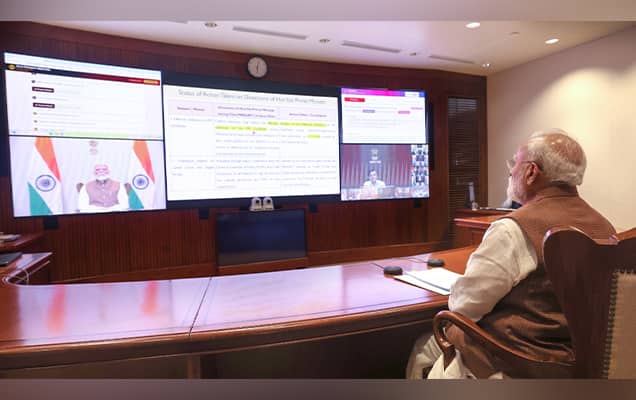
The Prime Minister Shri Narendra Modi addressed the News 9 Global Summit in Stuttgart, Germany, today, through video conference. Addressing the gathering, PM Modi said that this summit is an addition of a new chapter to the Indo-German Partnership. The Prime Minister said, “I am happy that a media group from India is trying to connect with Germany and the German people in today's information age. This will also provide a platform to the people of India to understand Germany and the people of Germany.”

The Prime Minister stated that the summit is organized by India's TV 9 in collaboration with F.A.U. Stuttgart and Baden-Württemberg in Germany. The theme of the summit is "India-Germany: A Roadmap for Sustainable Growth," reflecting the responsible partnership between India and Germany, the PM remarked. The Prime Minister noted that over the past two days, the attendees have engaged in productive discussions on economic issues as well as topics related to sports and entertainment, highlighting the broad scope of collaboration between the two nations.

The Prime Minister Shri Narendra Modi emphasised Europe's strategic importance to India, particularly in terms of geopolitical relations, trade, and investment, with Germany being one of India’s key partners. The year 2024 marks the 25th anniversary of the Indo-German Strategic Partnership, making it a historic year. The Prime Minister highlighted the notable events including Chancellor Scholz’s third visit to India and the Asia-Pacific Conference of German Businesses being held in Delhi after 12 years. Germany also released the "Focus on India" document and its first country-specific "Skilled Labor Strategy for India," further strengthening bilateral ties, the Prime Minister added.

The Prime Minister noted that while the Indo-German Strategic Partnership has existed for 25 years, the relationship between the two countries dates back centuries. Notably, a German created Europe's first Sanskrit grammar books, and German merchants introduced Tamil and Telugu printing to Europe. The Prime Minister said, “today, nearly 300,000 Indians live in Germany, with 50,000 Indian students studying there. In India, over 1,800 German companies have invested $15 billion in the last 3-4 years.” Bilateral trade between the countries stands at around $34 billion, and this trade will continue to grow in the coming years due to the strengthening partnership, the Prime Minister added.

The Prime Minister emphasised India as the world's fastest-growing large economy, with which the world has an interest in partnering for growth. Germany's "Focus on India" document reflects the world recognising the strategic importance of India. This shift is attributed to India’s reforms over the past decade, which have improved business conditions, reduced bureaucracy, and modernised policies across sectors. Key reforms include simplifying the tax system with GST, eliminating over 30,000 compliances, and stabilising the banking sector, the Prime Minister elaborated. Prime Minister Modi added that these efforts have laid a strong foundation for India’s future development, with Germany continuing to be a key partner in this journey.

The Prime Minister highlighted the India's progress towards becoming a major global manufacturing hub, drawing parallels to Germany’s own development in manufacturing and engineering. Under the "Make in India" initiative, the country is offering production-linked incentives to manufacturers. India has made significant strides, becoming a leading country in mobile and electronics manufacturing, the world's largest producer of two-wheelers, and the second-largest producer of steel and cement. This transformation marks India's growing importance in global manufacturing.

The Prime Minister added that India is also the fourth-largest manufacturer of four-wheelers, and its semiconductor industry is poised for global success. This progress is attributed to recent government policies aimed at improving infrastructure, reducing logistics costs, easing business operations, and ensuring stable governance. India is making rapid advancements in physical, social, and digital infrastructure, with a notable global impact from its innovative digital technologies. India now boasts the world's most unique digital public infrastructure.

The Prime Minister Shri Narendra Modi encouraged German companies already established in India to increase their investments and invited those not yet present to consider entering the Indian market. Emphasising that this is the right time to align with India's growth, the Prime Minister called for the partnership between India's dynamism and Germany's precision, engineering, and innovation. The Prime Minister Shri Narendra Modi concluded his address by highlighting how as an ancient civilization India has always welcomed global partnerships and invited all to join in building a prosperous future for the world.

Click here to read full text speech

Explore More
Today, the entire country and entire world is filled with the spirit of Bhagwan Shri Ram: PM Modi at Dhwajarohan Utsav in Ayodhya

Popular Speeches

Today, the entire country and entire world is filled with the spirit of Bhagwan Shri Ram: PM Modi at Dhwajarohan Utsav in Ayodhya
Emerging cities see 42% growth in GCC jobs, outpacing metros: Report

Media Coverage

Emerging cities see 42% growth in GCC jobs, outpacing metros: Report
NM on the go

Nm on the go

Always be the first to hear from the PM. Get the App Now!
...
PM Modi chairs 51st PRAGATI Meeting
May 27, 2026
PM reviews seven critical infrastructure projects across the Railways, Power and Road sectors
Projects reviewed span across 9 States with cumulative investment of around ₹30,000 crore
PM also reviews Ken Betwa Link Project and Swachh Bharat Mission-Urban 2.0
PM says Ken-Betwa River Inter-linking Project should serve as a model for other States to resolve inter-State water issues amicably
PM asks States to expedite the completion of solid waste management-related infrastructure, including waste processing plants and GOBARdhan plants
PM calls for mission-mode rooftop solar coverage in urban areas
Acting upon the advice of PM, system of monthly review of social sector schemes at State level operationalised, starting with review of Swachh Bharat Mission

Prime Minister Shri Narendra Modi chaired the 51st meeting of PRAGATI, the ICT-enabled, multi-modal platform aimed at fostering Pro-Active Governance and Timely Implementation, by seamlessly integrating efforts of the Central and State governments, at Seva Teerth, earlier today.

During the meeting, the Prime Minister reviewed seven critical infrastructure projects across the Railways, Power and Road sectors covering nine States worth around ₹30,000 crore. These projects, pivotal to economic growth and public welfare, were reviewed with a focus on timelines, inter-agency coordination, and timely issue resolution. Prime Minister also reviewed Ken Betwa Link Project and Swachh Bharat Mission-Urban 2.0.

While reviewing power sector projects, Prime Minister emphasized the need to accelerate rooftop solar adoption across urban areas, with a special focus on cities, residential clusters and public institutions. He underlined that rooftop solar should be taken up in mission mode to reduce electricity costs, improve energy security and promote clean energy at the household and community level.

While reviewing road and port connectivity projects, it was emphasised that Vadhavan Port should be developed as a model of port-led, multi-modal development, where every major mode of transport is seamlessly integrated to create a future-ready logistics ecosystem. The project should not be seen merely as a port, but as a national gateway connected through coastal shipping, inland waterways, dedicated freight corridors, high-speed rail connectivity, highways and airport linkages.

Prime Minister emphasised the need for effective implementation of Swachh Bharat Mission 2.0 and underlined that the mission should move beyond infrastructure creation and ensure measurable outcomes through regular monitoring, citizen participation and convergence between various stakeholders. He asked States to expedite the completion of solid waste management-related infrastructure, including waste processing plants and GOBARdhan plants.

While reviewing Ken-Betwa River Inter-linking Project, Prime Minister observed that Ken-Betwa project should serve as a model for other States to resolve inter-State water issues through cooperation, timely clearances, technology-based monitoring and mission-mode execution. States were encouraged to identify similar opportunities where river-linking, water conservation, groundwater recharge and efficient irrigation can be taken up in an integrated manner to ensure long-term water security.

Prime Minister also underlined that the delay in the implementation of public projects leads not only to cost escalation but also deprives citizens of timely access to essential facilities and development benefits. He observed that every delay has a direct impact on people’s lives, regional growth and public resources. He stressed that Ministries, Departments and States must adopt a more proactive and time-bound approach to resolve pending issues, remove bottlenecks and ensure faster execution.

Prime Minister also emphasized that innovative use of canal networks should be explored, including installation of solar panels along canals and over canals for clean electricity generation. This would help optimize land use, reduce evaporation losses, generate renewable energy and create additional economic value from water infrastructure.

At the beginning of the meeting, the Cabinet Secretary informed that, in pursuance of the directions of the Prime Minister, a system of monthly review of social sector schemes at the State level has also been operationalised. This mechanism aims to ensure regular monitoring, faster resolution of implementation issues and greater accountability at the State and district levels. As part of this initiative, Swachh Bharat Mission has been taken up for review at the State level in the first instance.