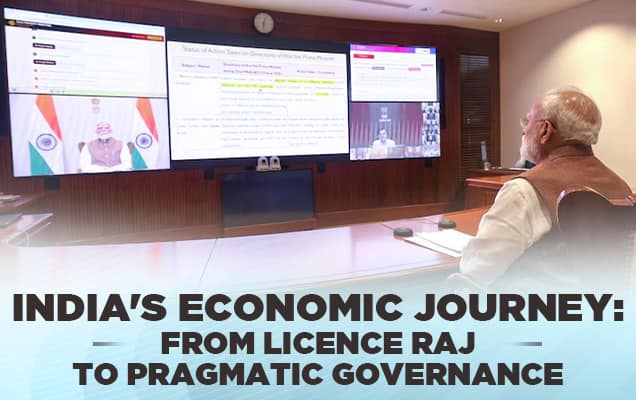
PM addresses National Rozgar Mela

Published By : Admin | July 22, 2023 | 10:30 IST
Distributes more than 70,000 appointment letters to newly inducted recruits in various Government departments and organizations
“There cannot be a better time than today to be recruited by the government”
“A small effort from you can create a huge change in someone’s life”
“Today, India is among the countries whose banking sector is considered to be the strongest”
“The banks known for losses and NPA are being discussed for their record profit”
“People of the banking sector never disappointed me or my vision”
“Poverty can be completely eliminated from India by collective efforts. And Every government employee of the country has a big role in this”

The Prime Minister, Shri Narendra Modi addressed the National Rozgar Mela via video conferencing today and distributed more than 70,000 appointment letters to newly inducted recruits in various Government departments and organizations. The new recruits, selected from across the country will be joining the Government in various Ministries and Departments including the Department of Revenue, Financial Services, Posts, School Education, Higher Education, Defence, Health and Family Welfare, Central Public Sector Undertakings, Water Resources, Personnel & Training and Ministry of Home Affairs among others. 44 places across the country were connected with the Mela during the Prime Minister’s address.

Addressing the gathering, the Prime Minister said that it is not only a memorable day for the young recruits but also a historic day for the nation as today marks the day when the Tiranga was accepted in its current form by the Constituent Assembly for the first time in 1947. The Prime Minister remarked that it is a matter of great inspiration that the new recruits are receiving their appointment letter for government services on this significant day as he encouraged them to take the country’s name forward. He underlined that it is a result of the hard work and determination of the new recruits that they are getting the opportunity to contribute towards the goal of Viksit Bhart at a time when India is celebrating Azadi Ka Amrit Mahotsav. The Prime Minister congratulated the recruits and their families on this momentous occasion.

In the Azadi ka Amrit Kaal, the Prime Minister said that every citizen has taken the resolve to make India a ‘Viksit Bharat’. He emphasized that the next 25 years are extremely crucial for the new recruits and the nation as he stressed making the most out of the trust, significance and attraction towards India from the world in recent years. He highlighted the rise of India in the leading economies as it jumped from the 10th to the 5th largest economy of the world. He also reiterated that India is going to become one of the top 3 economies in the world as stated by most economy experts. “Becoming a top 3 economy in the world will be a monumental achievement for India”, the Prime Minister said as he highlighted that it will give rise to employment opportunities in every sector and also boost the income of the common citizens. He remarked that there cannot be a better time than today to be recruited by the government as the new officers have got the golden opportunity to serve the country in its Amrit Kaal. He suggested that their priorities should lie with serving the people of the country and resolving their issues to increase ease of living, while also aligning themselves with the goals of Viksit Bharat. “A small effort from you can create a huge change in someone’s life”, the Prime Minister said as he reiterated that the populace is the form of God and serving them is like serving God itself. He emphasized that the new appointees should work with the belief of serving others to unlock the greatest feeling of satisfaction.

Talking about the banking sector which had a good number of recruits in today’s programme, the Prime Minister underlined the role of the banking sector in the expansion of the economy. “Today, India is among the countries whose banking sector is considered to be the strongest”, said Shri Modi recalling the journey of the last nine years. He dwelled on the ill impact of political selfishness on the sector in the past. He mentioned ‘phone banking’ of the past when loans were disbursed on the phone calls of the powerful. These loans were never repaid, he said. These scams broke the back of the banking sector of the country, he said. He listed the measures taken after 2014 to retrieve the situation. He mentioned strengthening of management of the government banks, stress on professionalism and consolidation of small banks into large banks. Shri Modi said that by insuring deposits up to 5 lakhs, more than 99 percent of deposits became safe leading to a renewed trust in the banking system. By acts like the Bankruptcy Code, banks were protected from losses. Furthermore, by tightening the grip over those who looted the government property by attaching their property, the banks known for losses and NPA are being discussed for their record profit.

The Prime Minister expressed pride in the hard work of the employees of the banking sector. “People of the banking sector never disappointed me or my vision”, he said. The Prime Minister hailed the efforts of the banking sector in making the Jan Dhan Account scheme a huge success by opening 50 crore Jan Dhan Accounts. This was a great help in transferring money into the accounts of crores of women during the pandemic.

Speaking on the efforts for the betterment of the MSME sector, the Prime Minister mentioned Mudra Yojana which provided collateral-free loans to the enterprising youth. He praised the banking sector for making the scheme a success. Similarly, the banking sector rose up to the occasion when the government doubled the loan amount for women Self Help Groups and helped the MSMe sector by providing loans which saved 1.5 crores jobs by protecting small enterprises. He also thanked the bank employees for making PM Kisan Samman Nidhi a grand success. More than 50 lakh Street Vendors were helped in the SVANidhi Scheme. “I am sure, you will take a ‘Sankalp Patra (resolution letter) for making banking a tool of empowerment of the poor along with your ‘Niyukti Patra’ (appointment letter).

The Prime Minister said the recent NITI report has found that 13 crore Indians were brought above the poverty line in the last 5 years. He acknowledged the hard work of government servants in this and mentioned schemes for pucca houses, toilets and electricity connections. “When these schemes reached the poor, their morale also increased. This success is a symbol of the fact that if together we increase the efforts to remove poverty from India, then poverty can be completely eliminated from India. And certainly, every government employee of the country has a big role in this”, the Prime Minister said.

The Prime Minister highlighted another dimension of decreasing poverty in the country, which is the expansion of the neo-middle class, which is creating new job opportunities. Growing demand and aspirations of the neo-middle class are driving manufacturing. He highlighted that it is the youth of the country who benefit the most from the boosting production in India’s factories and industries. He also mentioned how India is creating new records every day be it mobile phone exports, the number of cars sold in the first 6 months of 2023, and record sales for electric vehicles. “All such activities are boosting employment and employment opportunities in the country”, he added.

“The entire world is keeping an eye on India’s talent”, the Prime Minister said as he noted the issue of a declining working population due to higher average age in many developed economies in the world. Therefore, the Prime Minister said, this is the time for the youth of India to toil and enhance their skills and capabilities. Highlighting the great demand for India's IT talent, doctors and nurses, the Prime Minister said that the respect for Indian talent is continuously growing in every country and every sector. The Prime Minister highlighted that in the last 9 years, the government has focused on skill development where about 1.5 crore youth have been trained under PM Kaushal Vikas Yojana. He also mentioned setting up 30 Skill India International Centers so the youth can be prepared for global opportunities. The Prime Minister also touched upon building new medical colleges, ITIs, IITs and technical institutes across the country and informed that till 2014, there were only about 380 medical colleges in our country whereas this number has increased to more than 700 in the last 9 years. He also mentioned the significant increase in the number of nursing colleges. “Skills that meet global demand are going to create lakhs of new opportunities for the youth of India”, Shri Modi added.

Concluding the address, the Prime Minister underlined that all appointees are joining government service in a very positive environment and the responsibility of taking forward this positive thinking now rests on their shoulders. The Prime Minister also urged them to continue the process of learning and self-development and take maximum advantage of IGoT Karmayogi, an online learning platform prepared by the government.

Background

The Rozgar Mela is a step towards the fulfillment of the Prime Minister’s commitment to accord the highest priority to employment generation. The Rozgar Mela is expected to act as a catalyst in furthering employment generation and providing meaningful opportunities to the youth for their empowerment and participation in national development.

The newly inducted appointees are also getting an opportunity to train themselves through Karmayogi Prarambh, an online module on iGOT Karmayogi portal, where more than 400 e-learning courses have been made available for ‘anywhere any device’ learning format.

Click here to read full text speech

Explore More
Today, the entire country and entire world is filled with the spirit of Bhagwan Shri Ram: PM Modi at Dhwajarohan Utsav in Ayodhya

Popular Speeches

Today, the entire country and entire world is filled with the spirit of Bhagwan Shri Ram: PM Modi at Dhwajarohan Utsav in Ayodhya
With HPV vaccine rollout, AIIMS oncologist says it’s the beginning of the end for cervical cancer in India

Media Coverage

With HPV vaccine rollout, AIIMS oncologist says it’s the beginning of the end for cervical cancer in India
NM on the go

Nm on the go

Always be the first to hear from the PM. Get the App Now!
...
India's Digital Public Infrastructure has today become a subject of global discussion: PM Modi at the Rising Bharat Summit
February 27, 2026
Developed nations are eager to sign trade deals with India because a confident India is rising beyond doubt and despair: PM
In the last 11 years, a new energy has flowed into the nation's consciousness, India is determined to regain its rightful strength: PM
India's Digital Public Infrastructure has today become a subject of global discussion: PM
Today, every move India makes is closely watched and analysed across the world, the AI Summit is a clear example of this: PM
Nation-building never happens through short-term thinking; It is shaped by a long-term vision, patience and timely decisions: PM

The air of Israel has reached here too.

Namaskar!

All journalists of Network 18, all colleagues overseeing this arrangement, all distinguished guests present here, ladies and gentlemen!

You are all discussing Rising India. And in this, your emphasis is on strength within-in simple words, your focus is on the nation’s own inherent capability. In our scriptures it is said: Tat Tvam Asi!-that which we seek in the Brahman is within us, it is us ourselves. The strength lies within us, and we must recognize it. In the past 11 years, India has recognized that very strength, and today the nation is continuously striving to empower it.

Friends,

Strength in a nation does not suddenly emerge; it is built over generations. It is refined through knowledge, tradition, hard work, and experience. But during a long period of history, through centuries of slavery, the very spirit of being strong was filled with inferiority. Imported ideologies instilled deeply into society the belief that we were uneducated and mere followers. Our scriptures say: Yādṛśī bhāvanā yasya, siddhir bhavati tādṛśī-as is one’s belief, so is the accomplishment. When the belief itself was inferior, the accomplishment was also inferior. We copied foreign technologies, waited for foreign approval-this was slavery not just political or geographical, but mental. Unfortunately, even after independence, India could not free itself from this mentality of slavery. And we are still paying the price for it. A fresh example can be seen in the discussions around trade deals. Some people are surprised-how did this happen, why are developed nations so eager to make trade deals with India? The answer lies in a confident India, emerging out of despair and hopelessness. If the country were still stuck in the pre-2014 gloom, counted among the “Fragile Five,” trapped in policy paralysis-who would have made trade deals with us, who would have even looked at us?

But friends,

In the past 11 years, new energy has flowed into the nation’s consciousness. India is now striving to regain its lost strength. Once upon a time, when India had the greatest dominance in the global economy, what was our strength? India’s manufacturing, the quality of Indian products, India’s economic policies. Today’s India is once again focusing on these aspects. That is why we worked on manufacturing, emphasized Make in India, strengthened our banking system, controlled inflation that was running in double digits, and made India the growth engine of the world. It is this strength of India that has developed nations themselves coming forward to make trade deals with us.

Friends,

When the hidden power of a nation awakens, it achieves new milestones. Let me give you some more examples. Whenever I meet heads of government from other countries, they are eager to hear about the immense power of Jan Dhan, Aadhaar, and Mobile. In a country where ATMs arrived much later compared to developed nations, how did India achieve global leadership in digital payments? Where leakage in government aid was accepted as bitter truth, how did India, through DBT, transfer 24 lakh crore rupees-twenty-four trillion rupees-to beneficiaries? India’s digital public infrastructure has today become a subject of global discussion.

Friends,

The world is astonished-how India where until 2014 nearly 30 million families lived in darkness, became one of the top countries in solar power capacity? How did India whose cities had no hope of improved public transport, become the third-largest metro network country in the world? How did India whose railways were known only for delays and slow speed achieve semi-high-speed connectivity with Vande Bharat and Namo Bharat?

Friends,

There was a time when India was only a consumer of new technology. Today, India is also a creator of new technology and is setting new standards. And this has happened because we recognized our own strength-the very strength within you are discussing is an example of this.

Friends,

When we move forward with pride, the way the world looks at us also changes. Remember, just a few years ago, how little global media discussed India’s events. Events in India were not given much importance. And today, see how every action of India is analyzed globally. The AI Summit is an example-it was held right here in this building. More than 100 countries participated. Whether Global North or Global South, all sat together at one table. From large corporations to small startups, all gathered together.

Friends,

In all the industrial revolutions so far, India and the entire Global South were only followers. But in this era of Artificial Intelligence, India is not only a participant in decisions but is also shaping them. Today we have our own AI startup ecosystem, the strength to invest in data centers, and we are working rapidly on the power most needed to store and process AI data. The reforms we have made in the nuclear power sector will also help strengthen India’s AI ecosystem.

Friends,

The organization of the AI Summit was a moment of pride for the whole of India. But unfortunately, the country’s oldest party tried to tarnish this celebration. In front of foreign guests, Congress did not just strip off clothes, but also exposed its ideological bankruptcy. When failure breeds despair and arrogance takes over, such thinking emerges that seeks to defame the nation. Clearly, Congress’s actions have angered the country. To justify its sin, they brought Mahatma Gandhi forward. Congress always does this-when it wants to hide its sins, it puts Bapu forward; when it wants to glorify itself, it gives all credit to one family.

Friends,

Congress has now reduced itself to a mere toolkit of opposition in the name of ideology. This mentality of blind opposition has grown so much that they do not miss any chance to belittle the nation on every stage, every platform. Whatever good happens for the country, whatever auspicious occurs, Congress only knows how to oppose.

Friends,

I have a long list-the new Parliament building was constructed, they opposed it. The lions of the Ashoka pillar atop Parliament-they opposed it. Those whose lions once ran away after eating ordinary citizens’ shoes, were frightened by the teeth of the Parliament’s lions. The Kartavya Path was built, they opposed it. The armed forces carried out surgical strikes, they opposed it. The Balakot air strike happened, they opposed it. Operation Sindoor was conducted, they opposed it. In short, for every achievement of the nation, Congress’s toolkit produces only one thing-opposition.

Friends,

The nation brought down the wall of Article 370, the country rejoiced. But Congress opposed it. We enacted the CAA law-they opposed it. We introduced the Women’s Reservation Bill-they opposed it. We brought a law against triple talaq-they opposed it. We launched UPI-they opposed it. We initiated the Swachh Bharat Mission-they opposed it. The country developed its own COVID vaccine, and even that they opposed.

Friends,

In a democracy, opposition does not mean blind resistance. In democracy, opposition means presenting an alternative vision. That is why the enlightened citizens of the country have been teaching Congress a lesson-not just today, but continuously for the past four decades. What I am about to say, I urge my media colleagues to analyze as well. You will see that Congress’s votes are not being stolen; rather, the people of the country no longer consider Congress worthy of their vote. And this decline began after 1984. In 1984, Congress received 39 percent of the vote and more than 400 seats. In subsequent elections, Congress’s vote share kept declining. And today, Congress’s condition is such that only four states remain where Congress has more than 50 legislators. Over the past 40 years, the number of young voters has increased, and Congress has steadily disappeared. Congress has become a club of people enslaved to one family. That is why first the millennials taught Congress a lesson, and now Gen Z is also ready.

Friends,

Congress and its allies have such a narrow mindset that they have even made long-term vision a crime. Today, when we talk about a developed India by 2047, some people ask-“Why talk about something so far ahead now?” Some even say, “Modi won’t be alive till then.” The truth is that nation-building never happens through short-term thinking. It happens through a grand vision, patience, and timely decisions. Let me present some facts before Network 18’s viewers. Every year, India spends more than 6 lakh crore rupees on freight through foreign ships. On fertilizer imports, we spend 2.25 lakh crore rupees annually. On petroleum imports, we spend 11 lakh crore rupees annually. That means, every year, trillions of rupees are flowing out of the country. If this investment had been directed towards self-reliance 20–25 years ago, today this capital would have been strengthening India’s infrastructure, research, industry, farmers, and youth. Today, our government is working with this very vision. To avoid paying 6 lakh crore rupees to foreign ships, Indian shipping and port infrastructure is being strengthened. To increase domestic fertilizer production, new plants are being set up, and nano-urea is being promoted. To reduce dependence on petroleum, ethanol blending, the Green Hydrogen Mission, solar energy, and electric mobility are being prioritized.

And friends,

We must take decisions today while keeping the future in mind. That is why India is building a semiconductor ecosystem. In defense production, mobile manufacturing, drone technology, the critical minerals sector, and investments therein-we are laying the foundation for economic security in the coming decades. The 2047 goal is not a political slogan. It is also a resolve to correct the historical mistakes where Congress governments failed to invest in time. Today, if we build indigenous ships, produce our own energy, and develop new technologies ourselves, then future generations will not discuss the burden of imports, but the capacity for exports. The progress of a nation is determined not by “today’s convenience” but by “tomorrow’s preparation.” And the hard work done with foresight is the foundation of a self-reliant, strong, and prosperous India in 2047. And no matter how many clothes Congress tears in protest, we will continue to work tirelessly.

Friends,

One very important condition of nation-building is sincerity of intent. Congress and its allies have failed even here. They have never worked with sincerity. They have no concern for the suffering of the poor. For example, in Bengal, the Ayushman Bharat scheme has still not been implemented. If there were sincerity, would they have blocked a scheme that provides free treatment up to 5 lakh rupees for the poor? No. You also know that under the PM Awas Yojana, permanent houses are being built for the poor. Let me give another figure to Network 18’s viewers. In Tamil Nadu, about 9.5 lakh permanent houses have been allocated for poor families-9.5 lakh. But construction of 3 lakh of these houses has stalled. Why? Because the DMK government is not showing interest in building these homes for the poor. And the reason is clear-their intent is not sincere.

Friends,

Let me also give you an example from the agriculture sector. During Congress’s time, farming was left to its fate. Small farmers were ignored, crop insurance was in shambles, the Swaminathan Committee’s report on MSP was buried in files. Congress made announcements in the budget, but nothing happened on the ground-because they lacked sincerity. We began working sincerely for the farmers of the country, and today the world is witnessing the results. Today, India is becoming one of the major agricultural exporters in the world. We have created a safety net for farmers at every level. Through the PM Kisan Samman Nidhi, more than 4 lakh crore rupees have been deposited directly into farmers’ accounts. We set MSP at 1.5 times the cost and made record purchases. Let me give you just one figure-pulses. The UPA government, in 10 years, purchased only 6 lakh metric tons of pulses at MSP-6 lakh metric tons. Our government has already purchased about 170 lakh metric tons of pulses at MSP-nearly 30 times more. Now you decide who truly works for the farmers.

Friends,

The UPA government was also stingy in providing help to farmers through the Kisan Credit Card. In its 10 years, the UPA government gave 7 lakh crore rupees in agricultural loans-7 lakh crore rupees. Whereas our government has given four times more-28 lakh crore rupees. During UPA’s time, only 5 crore farmers benefited from this. Today, the number has more than doubled, reaching nearly 12 crore farmers. That means, for the first time, even small farmers have received help. Our government has also given farmers the protective shield of the PM Fasal Bima Yojana. Under this, about 2 lakh crore rupees have already been provided to farmers in times of crisis. Because we are working with sincerity, the confidence of India’s farmers is rising, their productivity is increasing, and their incomes are growing.

Friends,

A quarter of the 21st century has already passed. The next phase is the decisive period of India’s development. The decisions taken today will determine the direction of the future. We must move forward by recognizing and enhancing our strength. Every individual must aim for excellence in their field, every institution must make excellence its culture. We should not just produce products, but produce best-quality products. We should not just do routine work, but world-class work. We must convert capability into performance. As I said from the Red Fort-this is the time, the right time. This is the time to take India to new heights. Once again, my heartfelt congratulations and thanks to all of you. Namaskar.