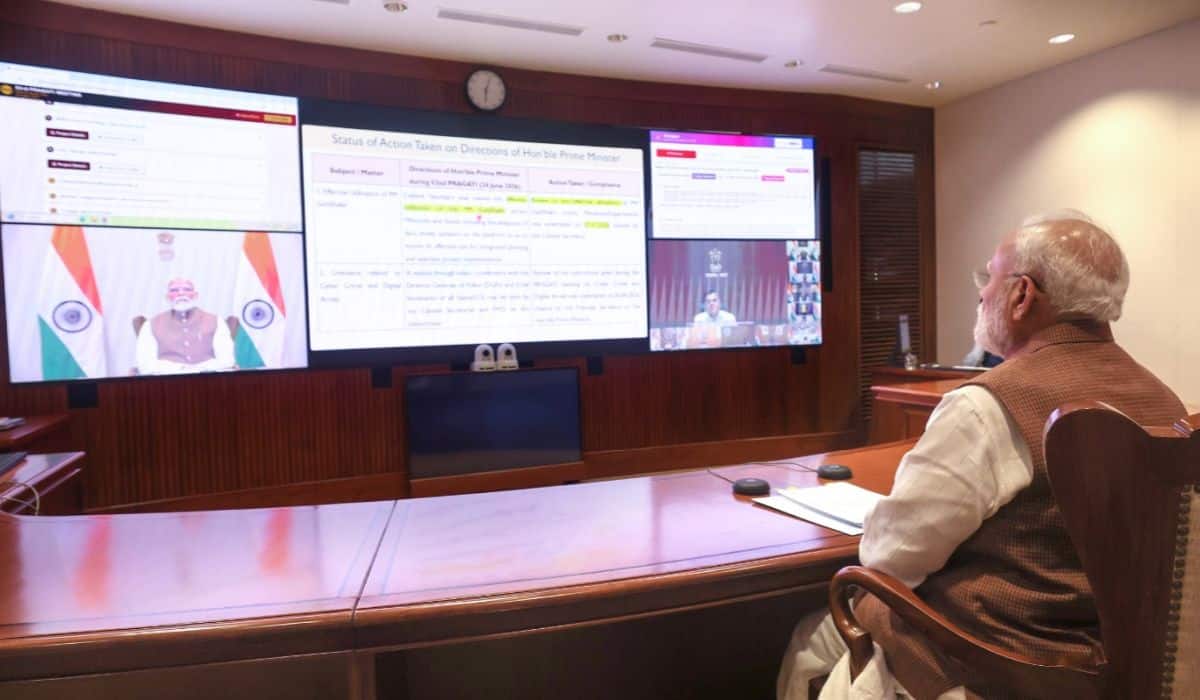
Prime Minister Shri Narendra Modi delivered inaugural address at the virtual India Mobile Congress (IMC) 2020 today through video conference. The theme for IMC 2020 is "Inclusive Innovation - Smart, Secure, Sustainable”. It aims to align to the Prime Minister’s vision to promote ‘AatmaNirbhar Bharat’, ‘Digital Inclusivity’, and ‘Sustainable development, entrepreneurship & innovation’. It also aims to drive foreign and local investments, encourage R&D in the telecom and emerging technology sectors.
Addressing the event, the Prime Minister gave a call to work together to make India a global hub for telecom equipment, design, development and manufacturing. He cautioned, due to technological upgradation, we have a culture of replacing handsets and gadgets frequently. He asked the delegates to ponder whether the industry can form a task-force to think of a better way of handling the electronic waste and create a circular economy. He urged to work together to ensure a timely roll-out of 5G to leapfrog into the future and empower millions of Indians.
The Prime Minister said it is important to think and plan how to improve lives with the upcoming technology revolution. He added that Better healthcare, Better education, Better information and opportunities for our farmers, Better market access for small businesses are some of the goals that can be worked on.

The Prime Minister lauded the delegates from the telecom sector that the world was functional despite the pandemic due to their innovation and efforts. He added that due to their efforts that a son was connected with his mother in a different city, a student learnt from his teacher without being in the classroom, a patient consulted his doctor from his home and a trader connected with a consumer/ from a different geography.
The Prime Minister said for a lot of young techies it is the Code which makes a product special, for some entrepreneurs it is Concept which matters more, investors suggest that Capital is more important to scale a product. He stressed that often what matters the most is the Conviction the youngsters have on their product. Sometimes conviction is all that stands between just a profitable exit and making of a unicorn.
The Prime Minister stressed that it is because of mobile technology that we are able to provide benefits worth billions of dollars to millions of Indians, we were able to help the poor and vulnerable quickly during the pandemic and we are seeing billions of cashless transactions which boost formalisation and transparency and we will also enable a smooth contactless interface on toll booths.
The Prime Minister expressed satisfaction on achieving success in mobile manufacturing in India. He said India is emerging as one of the most preferred destinations for mobile manufacturing. He added the Production Linked Incentive scheme was introduced to promote telecom equipment manufacturing in India. He said that the Government aims to bring high speed fibre-optic connectivity in every village over the next three years. He said that towards this end, focus is made exclusively on places which can make the best out of such connectivity – Aspirational Districts, Left wing extremism affected districts, North Eastern states, Lakshadweep Islands etc. He added that greater spread of fixed line broadband connectivity and public Wi-Fi hotspots will be ensured.
It is important to think & plan how do we improve lives with the upcoming technology revolution.
— PMO India (@PMOIndia) December 8, 2020
Better healthcare,
Better education,
Better information and opportunities for our farmers,
Better market access for small businesses
are some of the goals we can work towards: PM
A patient consulted his doctor from his home
— PMO India (@PMOIndia) December 8, 2020
A trader connected with a consumer/ from a different geography: PM @narendramodi at India Mobile Congress
It is due to your innovation & efforts that the world was functional despite the pandemic.
— PMO India (@PMOIndia) December 8, 2020
It is due to your efforts that
A son connected with his mother in a different city
A student learnt from his teacher without being in the classroom: PM
But often, what matters the most is the Conviction the youngsters have on their product.
— PMO India (@PMOIndia) December 8, 2020
Sometimes conviction is all that stands between just a profitable exit and making of a unicorn: PM
A lot of young techies tell me that it is the Code which makes a product special.
— PMO India (@PMOIndia) December 8, 2020
Some entrepreneurs tell me that it is Concept which matters more.
Investors suggest that it is Capital which is important to scale a product: PM
It is because of mobile technology that we are seeing billions of cashless transactions which boost formalisation and transparency.
— PMO India (@PMOIndia) December 8, 2020
It is because of mobile technology that we will enable smooth contactless interface on toll booths: PM
It is because of mobile technology that we are able to provide benefits worth billions of dollars to millions of Indians.
— PMO India (@PMOIndia) December 8, 2020
It is because of mobile technology that we were able to help the poor and vulnerable quickly/ during the pandemic: PM
Let us work together to make India a global hub for telecom equipment, design, development and manufacturing: PM
— PMO India (@PMOIndia) December 8, 2020
Due to technological upgradation, we have a culture of replacing handsets & gadgets frequently.
— PMO India (@PMOIndia) December 8, 2020
Can the industry form a task-force to think of a better way of handling the electronic waste & create a circular economy: PM
We need to work together to ensure a timely roll-out of 5G to leapfrog into the future and empower millions of Indians: PM
— PMO India (@PMOIndia) December 8, 2020