PM Narendra Modi Working for a Surakshit Bharat for Women

Published By : Admin | March 19, 2019 | 14:04 IST

Prime Minister Narendra Modi, during his first Independence Day  address as prime minister, in 2014, said, “Parents ask their daughters where they were if they return home late. But, do they do the same with their sons? After all a person perpetrating a heinous crime such as rape is also someone’s son. As parents, have we asked our sons where he is going? While we keep questioning our daughters, why not use same yardstick for sons too?

Clearly, for someone to say this on Independence Day shows the deep concern for women’s safety and gender equality. He walked the talk by ensuring that women safety is an integral part of his government’s policymaking, governance and agenda. The nation witnessed some path-breaking announcements that ensured dignity and welfare of this section of the populace, which has been subjected to tokenism for many years. Enabling women-led development, several announcements have been made.

Some such announcements have potentially transformed the safety and security net for women in India.

The Narendra Modi government passed the Muslim Women (Protection of Rights on Marriage) Bill, 2017 in Lok Sabha. This bill makes instant triple talaq (talaq-e-biddat) in any form illegal and void.

This Bill protects right of Muslim women who are vulnerable at the hands of instant triple talaq. It is a far cry from the arbitrary practice of divorcing wives with just an SMS or WhatsApp message. This bill is a beginning towards empowering married Muslim women who have been defenseless if such an event befalls them.

Mahila police volunteers and women’s safety app called HIMMAT reinforce the Government’s commitment to allow women a safe life both in and out of their homes. The Trafficking of Persons (Prevention, Protection and Rehabilitation) Bill, 2018 creates a law for investigation of all types of trafficking, and rescue, protection and rehabilitation of trafficked victims. Anti-Trafficking Units will be established to rescue victims and investigate cases of trafficking. 

Committed to providing a safe and secure growing environment to young girls, the Narendra Modi led government introduced a law to severely punish the criminals from indulging in such heinous crimes. Capital punishment for those found guilty of raping a child under the age of 12 was introduced by the government to deter such crimes and ensure those who breach the dignity of young citizens of India are dealt with an iron hand. Moreover, minimum punishment for rape of a girl less than 16 years increased from 10 years to 20 years.

Swachh Bharat is another social innovation that has multi-faceted social impacts. In the absence of toilets, women had to venture into open fields at odd hours. This posed a huge security threat for them. Criminals could have found these visits into dark fields, as an opportunity to harm women. Women were also at the risk of lurking wild-life and snake bites which could pose a potential threat to their life. Spillover effects of Swachh Bharat are far and beyond just a sanitation initiative. It also restores safety, dignity and provides security to female members of the society.

Similarly, with launch and widespread implementation of Pradhan Mantri Ujjwala Yojana, there is no need for women to venture into forests to get firewood for cooking. Outdoor risks faced by women when they went to get wood are similar to those faced in the absence of a toilet at home.

For women to contribute to the growth of the nation, their participation in the progress of democracy of India and claim of their place in the nation needs to beequal to their male counterparts. For this, we need to start from giving them security net first that makes them feel at home anywhere in their nation. Awareness campaigns like Beti Bachao beti Padhao are directed towards saving girl child, educating her and then making her a self-sufficient citizen. Sex ratio at birth has already improved in 104 identified districts, a statistic that reflects that we are now committed to protecting our daughters even before they are born.

Explore More
Today, the entire country and entire world is filled with the spirit of Bhagwan Shri Ram: PM Modi at Dhwajarohan Utsav in Ayodhya

Popular Speeches

Today, the entire country and entire world is filled with the spirit of Bhagwan Shri Ram: PM Modi at Dhwajarohan Utsav in Ayodhya
'Will walk shoulder to shoulder': PM Modi pushes 'Make in India, Partner with India' at Russia-India forum

Media Coverage

'Will walk shoulder to shoulder': PM Modi pushes 'Make in India, Partner with India' at Russia-India forum
NM on the go

Nm on the go

Always be the first to hear from the PM. Get the App Now!
...
6 Years of Jal Jeevan Mission: Transforming Lives, One Tap at a Time
August 14, 2025
Jal Jeevan Mission has become a major development parameter to provide water to every household.” - PM Narendra Modi

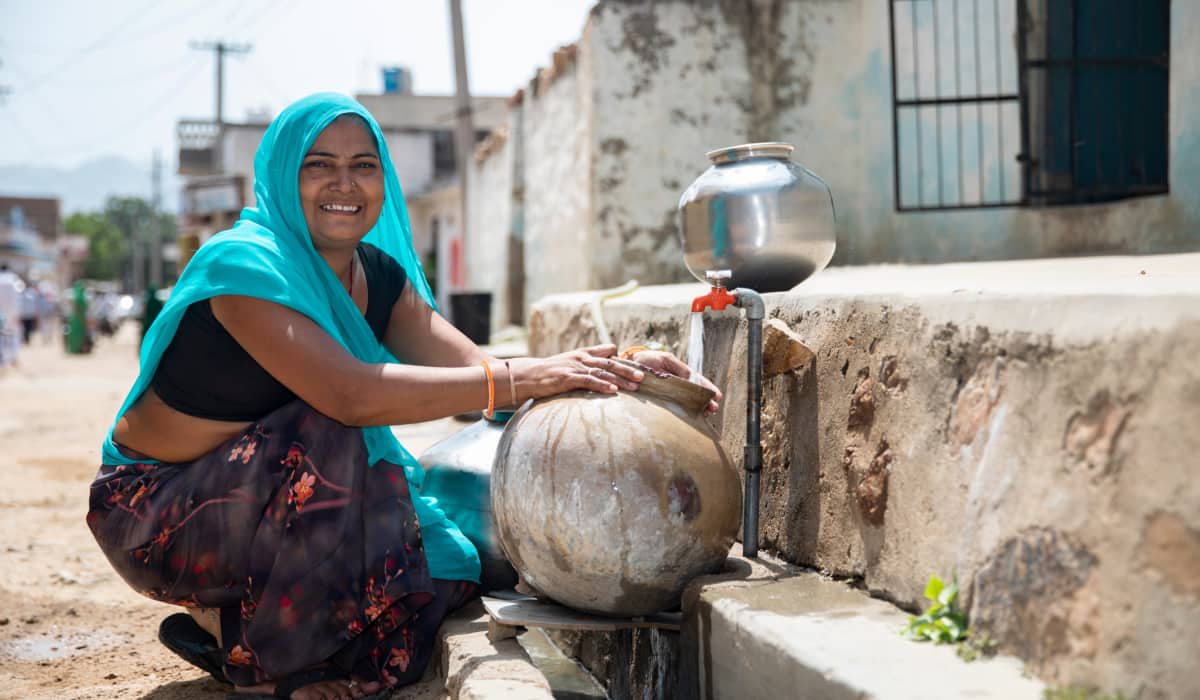
For generations, the sight of women carrying pots of water on their heads was an everyday scene in rural India. It was more than a chore, it was a necessity that was an integral part of their everyday life. The water was brought back, often just one or two pots which had to be stretched for drinking, cooking, cleaning, and washing. It was a routine that left little time for rest, education, or income-generating work, and the burden fell most heavily on women.

Before 2014 water scarcity, one of India’s most pressing problems, was met with little urgency or vision. Access to safe drinking water was fragmented, villages relied on distant sources, and nationwide household tap connections were seen as unrealistic.

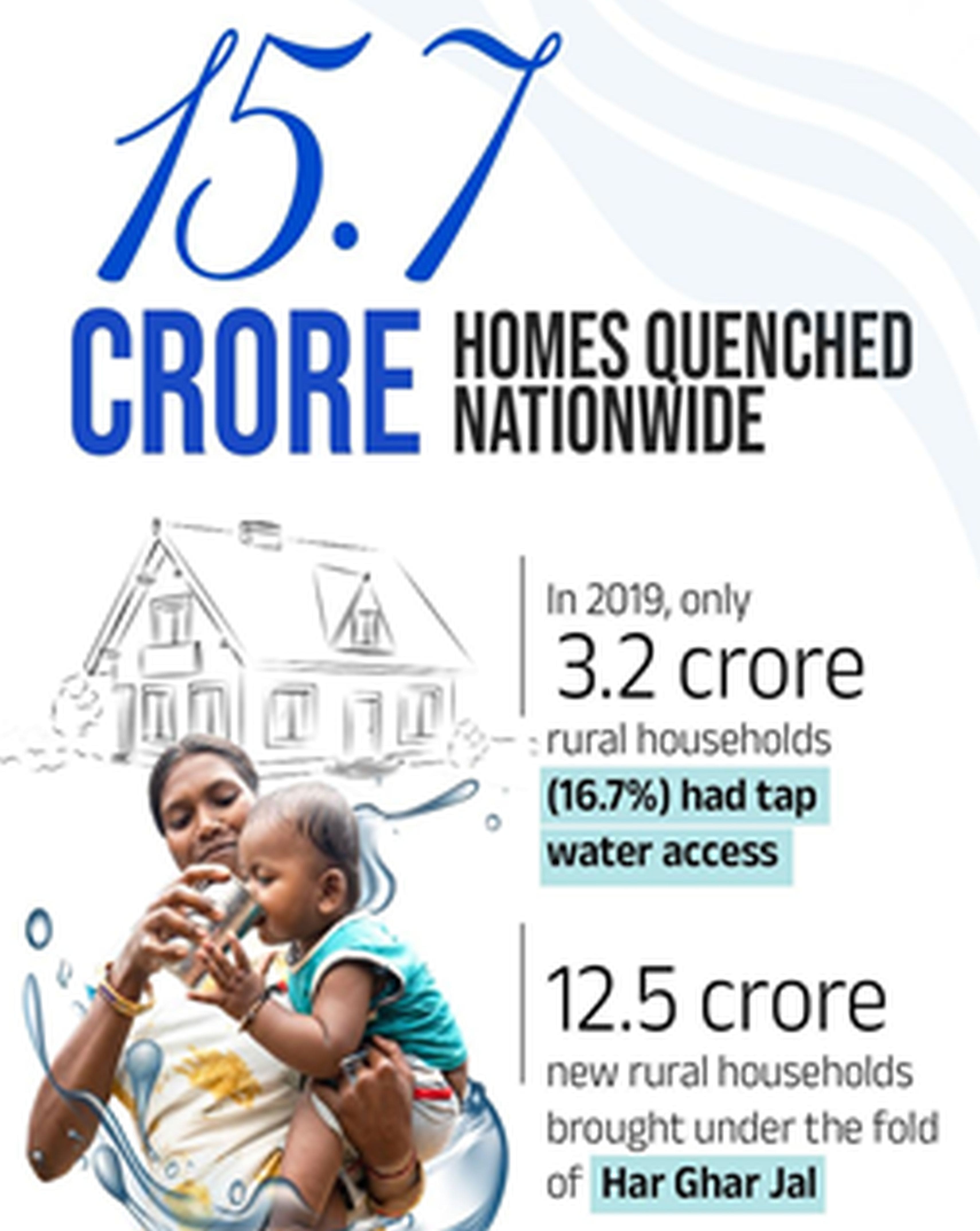
This reality began to shift in 2019, when the Government of India launched the Jal Jeevan Mission (JJM). A centrally sponsored initiative which aims at providing a Functional Household Tap Connection (FHTC) to every rural household. At that time, only 3.2 crore rural households, a modest 16.7% of the total, had tap water. The rest still depended on community sources, often far from home.

As of July 2025, the progress under the Har Ghar Jal program has been exceptional, with 12.5 crore additional rural households connected, bringing the total to over 15.7 crore. The program has achieved 100% tap water coverage in 200 districts and over 2.6 lakh villages, with 8 states and 3 union territories now fully covered. For millions, this means not just access to water at home, but saved time, improved health, and restored dignity. Nearly 80% of tap water coverage has been achieved in 112 aspirational districts, a significant rise from less than 8%. Additionally, 59 lakh households in LWE districts have gained tap water connections, ensuring development reaches every corner. Acknowledging both the significant progress and the road ahead, the Union Budget 2025–26 announced the program’s extension until 2028 with an increased budget.

The Jal Jeevan Mission, launched nationally in 2019, traces its origins to Gujarat, where Narendra Modi, as Chief Minister, tackled water scarcity in the arid state through the Sujalam Sufalam initiative. This effort formed a blueprint for a mission that would one day aim to provide tap water to every rural household in India.

Though drinking water is a State subject, the Government of India has taken on the role of a committed partner, providing technical and financial support while empowering States to plan and implement local solutions. To keep the Mission on track, a strong monitoring system links Aadhaar for targeting, geo-tags assets, conducts third-party inspections, and uses IoT devices to track village water flow.

The Jal Jeevan Mission’s objectives are as much about people as they are about pipes. By prioritizing underserved and water-stressed areas, ensuring that schools, Anganwadi centres, and health facilities have running water, and encouraging local communities to take ownership through contributions or shramdaan, the Mission aims to make safe water everyone’s responsibility..

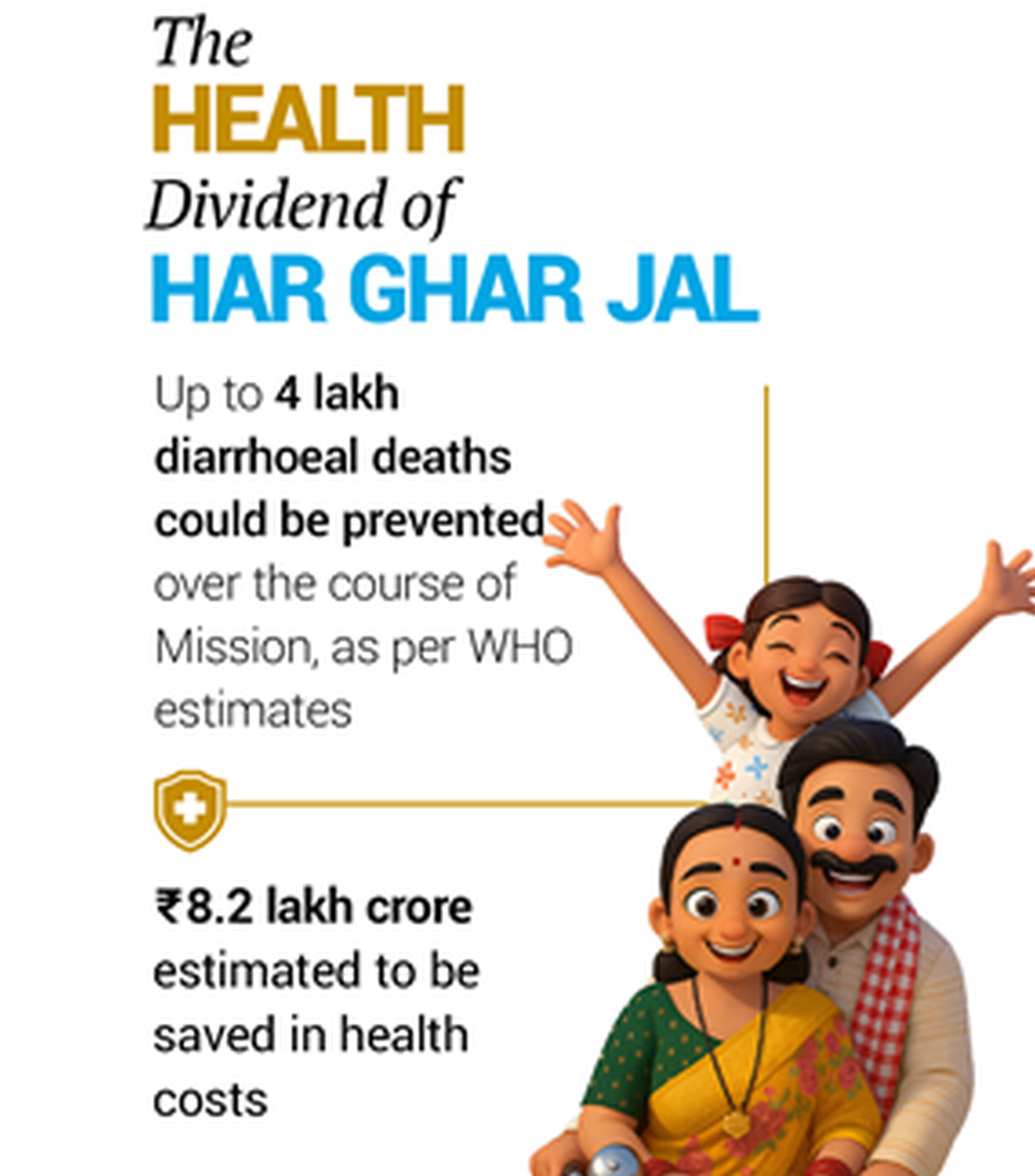
The impact reaches far beyond convenience. The World Health Organization estimates that achieving JJM’s targets could save over 5.5 crore hours each day, time that can now be spent on education, work, or family. 9 crore women no longer need to fetch water from outside. WHO also projects that safe water for all could prevent nearly 4 lakh deaths from diarrhoeal disease and save Rs. 8.2 lakh crores in health costs. Additionally, according to IIM Bangalore and the International Labour Organization, JJM has generated nearly 3 crore person-years of employment during its build-out, with nearly 25 lakh women are trained to use Field testing Kits.

From the quiet relief of a mother filling a glass of clean water in her kitchen, to the confidence of a school where children can drink without worry, the Jal Jeevan Mission is changing what it means to live in rural India.