His Excellency the President of the Swiss Federation,
Honourable Heads of State and Government,
Mr. Klaus Schwab, Founder and Executive Chairman of World Economic Forum,
Senior and reputable entrepreneurs, industrialists and CEOs of the world,
Friends from Media, ladies and gentlemen!
Namaskar,
I am very happy to be present in this forty-eighth annual meeting of the World Economic Forum in Davos. First of all, I would like to appreciate Mr. Klaus Schwab for his initiative and for making the World Economic Forum a strong and a comprehensive forum. He has an ambitious agenda whose purpose is to improve the condition of the world. He has linked this agenda very firmly to economic and political thought. I also want to express my gratitude to the Government of Switzerland and its citizens for the warm welcome and hospitality extended to me.
Friends,
The last Prime Minister of India to have visited Davos was Shri Deve Gowda ji in 1997. In 1997, India's GDP was slightly over 400 billion dollars. Now it has increased almost 6 times after two decades. That year the subject of this forum was "Building a Networked Society". Today, 21 years later, the subject has become outdated considering the achievements in the field of technology in this digital age. Today we are not only a networked society, but also living in the age of big data, artificial intelligence and Cobots. In 1997, the EURO currency was not in vogue; the Asian financial crisis was not known at all, neither was BREXIT expected. In 1997, very few people had heard of Osama bin Laden and the name of Harry Potter was also unknown. At that time the chess players did not have any big fear of losing to a computer while Google was not there in cyber space and Amazon of that time meant only dense forests and river.
Tweeting that time was the task of the birds, not humans. That was the previous century.
Today, after two decades, our world and our society are in a complex network. In that era, Davos was ahead of its time, and this World Economic Forum was a symbol of a futuristic entity. Even today Davos is ahead of its time.
This year's theme is "Creating a Shared Future in a Fractured World". That is, building a shared future in a world full of rifts. With newer changes, the balance of economic power and political power is changing. This shows the image of far-reaching changes in the world arena. There are new and serious challenges to peace, stability and security in front of the world.
Technology driven transformation is deeply impacting our lifestyle, work-style, dealing with issues, conversation and even international groupings, politics and economy. One of the greatest examples of the three dimensions of a Technology viz. connecting, bending and breaking - are found in the use of social media. Today Data is the greatest asset. Both opportunities as well as the biggest challenges are being created by the global flow of data. Mountains of data are being created. There is a race to control them because it is believed that the controller of data will dominate the future.
Similarly, the rapidly changing technology and expansion of destructive forces in the areas of cyber security and nuclear security have become even more serious. On the one hand, the new branches of science, technology and economic progress, have the ability of showing new ways of prosperity to the humanity. On the other hand, these changes have also created fault-lines that can possibly be harmful. Many changes are creating such walls which have made the path of peace and prosperity inaccessible and difficult for the entire humanity. These fractures, these divides and these barriers are the manifestations of lack of development, of poverty, unemployment, lack of opportunities, and monopoly on natural and technical resources. In this environment we have several important questions that demand proper answers for the future of humanity and the heritage of future generations.
Is our world system promoting these fault-lines and distances? Which are those forces that promote separation over unity and promote struggle or conflicts over cooperation? And what are the tools we have? What are the paths through which we can erase these cracks and distances and fulfill the dream of a happy and a shared future?

Friends,
As a representative of India, Indianism and Indian heritage, the topic of this forum for me is the contemporary yet time-transcending. It is eternal because in India we have always believed in uniting human beings from time immemorial, not in breaking relations or dividing them. Thousands of years ago, the Indian thinkers said in Sanskrit texts: "Vasudhaiva kutumbakam", meaning that the whole world is a family. All of us are bound together as a family; our destinies connect us with a common thread. This perception of Kutumbakam is definitely more meaningful to narrow the distances today. But one of the serious challenges of this era is the lack of consensus between us to deal with these challenges. In a family, even if there are some differences and quarrels, there is a sense of harmony and cooperation; the sense of inspiration comes from the family whenever there are challenges. All the members come together and face the challenges and together they share achievements and pleasures. But one matter of concern today is that our differences have made the struggles of the mankind against these challenges even more difficult.
Friends,
The number of challenges I am pointing to is also very high and widespread. Here I will mention only three major challenges which are creating the biggest threat to human civilization. The first danger is Climate Change. Glaciers are retreating. Arctic ice is melting. Many islands have submerged or are in that process. The impact of extreme weather conditions is increasing day by day - extreme heat and extreme cold conditions; heavy rainfall and floods on one hand and droughts on the other. Under these circumstances we should have come out of our limited narrow divisions to get united. But did that happen? If not, then why? And what should we do to improve these conditions? Everyone says that carbon emission should be reduced but how many countries or people want to help out in providing the necessary resources and appropriate technology to the developing countries and communities?
You would have heard many times about deep synergy with nature in the Indian tradition. Thousands of years ago, in our scriptures, the mankind was told – "Bhoomi Maata, Putro aham Prithvyaha " i.e., we the humans are children of the Mother Earth. If we are the children of Mother Earth, then why is there a war between man and nature today?
In the beginning of the most prominent Upanishad 'Ishopanishad', written in India thousands of years ago, the author, 'Tatvadrasta Guru' had told his disciples about the changing world:
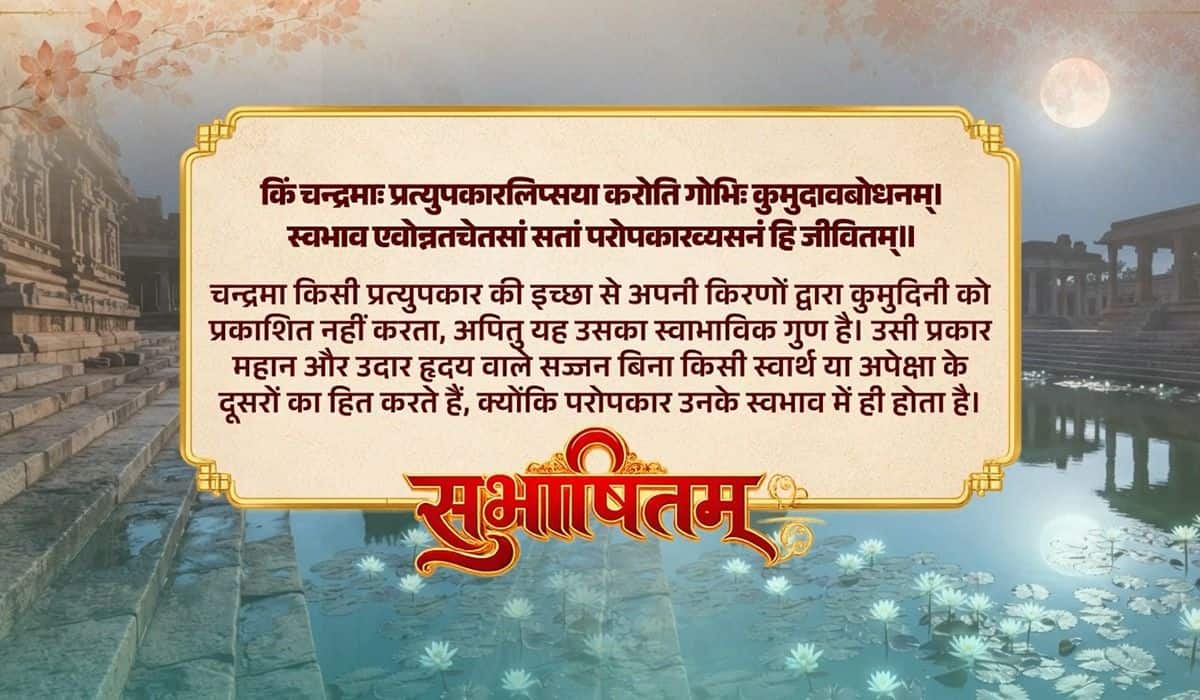
‘तेन त्यक्तेन भुन्जीथा, मागृधःकस्यस्विद्धनम्।
That is, by perceiving Divine presence everywhere, renounce the unreal and enjoy the Real. Do not covet the wealth of any man. Buddha gave a prominent place to the virtue of ‘Aparigraha’ which means use according to the needs (non-greediness), in his principles. The principle of trusteeship of Mahatma Gandhi, the Father of the Nation, was also the same- ‘consumption as per requirement’. He had opposed the exploitation due to greed. One should ponder over the fact that how man has reached at a point where he has started the exploitation of the nature for satiating his greed from a point where he used to sacrifice and consume only as per his needs. Is this our development or collapse? Such a poor state of mind! A horrific peek inside our self-interest! Why don’t we introspect?
There is an absolute remedy against the fierce mismanagement of the environment today - the reconciliation between ancient Indian philosophy of human and nature. Moreover, the overall understanding of Indian traditions such as Yoga and Ayurveda, born from this philosophy, can not only heal the environment and fracture between us, but also provide physical, mental and spiritual health and balance. A massive campaign has been initiated by my government to save the environment and to counter climate change. By 2022 we have to produce 175 Gigawatt renewable energy in India. In the last three years, we have achieved 60GW which is more than one-third of the target.
In 2016, India and France had jointly envisioned a new international treaty based organization. This revolutionary step has now changed into a successful experiment. As an International Solar Alliance, it is now a reality after the necessary Treaty ratification. I am happy that in March this year, French President Emmanuel Macron and leaders of the member countries of the Alliance will participate in the first summit of the Alliance on my joint invitation, in New Delhi.

Friends,
The second major challenge is terrorism. In this regard, you are well aware of the growing and changing nature of this serious threat to India and to the entire humanity in the world. I want to draw your attention to just two dimensions here. First, the artificial distinctions created between good terrorist and bad terrorist is even more dangerous. The second serious aspect on which I want your attention is that today the educated and accomplished youth are radicalized and getting involved in terrorism. I hope that the serious challenges posed by the fault lines of terrorism and violence and the fractures generated by them, and their solutions will be discussed in the forum.
Friends,
The third challenge is that many societies and countries are becoming more and more self-centered. It creates an impression that globalization is shrinking. The consequences of such attitudes and wrong priorities cannot be underestimated by the threat of climate change or terrorism. Although everyone talks about the interconnected world but the glow of globalization is fading. The ideals of the United Nations are still valid. World Trade Organization is also broad-based. But do the structure, system and methodology of the world organizations formed after the Second World War still reflect the aspirations and dreams of today's humanity and today's reality?
There is a big gap between the old system of these institutions and the needs of the developing countries especially in the world today. Contrary to globalization, the forces of protectionism have emerged. Their intent is to not only avoid globalization but also to turn the trend of the natural flow of globalization. As a result, new types of tariffs and non-tariff barriers are seen. Bilateral and multilateral trade agreements and negotiations have been stalled. Cross-border financial investment has decreased in many countries. And the growth of global supply chains has also stopped. The solution to this worrisome situation against globalization is not to remain in isolation. Its solution is to understand and accept the change. It is time to make smart and flexible policies with changing times. The Father of the Nation, Mahatma Gandhi had said, "I do not want the walls and windows of my house closed on all the sides. I want the air of the cultures of all the countries to come to my house easily. But I don’t want this wind to destabilize my feet." Today's India is following Mahatma Gandhi's philosophy and ideas with full confidence and fearlessness, and is welcoming lively waves from all over the world.
Friends, India's democracy is the basis of the country's stability, certainty and sustainable development. Democracy is not just a political system but a life’s philosophy, life style, with different religions, culture, language, dressing-style and variety of food. We Indians know the importance of democratic environment and freedom for the maintenance of unity in diversity very well. Democracy in India does not only sustain our diversity but also provides the necessary environment, road map and template to fulfill the hopes, aspirations, expectations and dreams of more than 125 crore Indians for their proper development.
Democratic value and inclusive economic development and progress have the power to bridge all the rifts. For the first time in 2014, a single political party has been given a full majority by sixty crore voters in India to form government in the center. We resolved not to develop just a single class or a few people, but everyone. My government has a motto: "Sabka sath sabka vikas’ i.e.’collective efforts, inclusive growth.’ Our vision and mission for progress are inclusive. This inclusive philosophy is the basis of every policy of my government - be it financial inclusion for millions of people by opening bank accounts for the first time, or bringing digital technology to the poor by direct benefit transfer or promotion of gender justice through 'Beti Bachao - Beti Padhao'.
We believe that progress or development can happen in true sense only when everyone walks together. These are not minor reforms that we are making in our economic and social policies, but a radical transformation. The path we have chosen is that of ‘reform, perform and transform’. Today, the way we are making the Indian economy suitable for investment, there is no match to it. Consequently, today, investing in India, traveling to India, working in India, manufacturing in India, and exporting products and services from India to the world, everything has become much easier than before. We have tried to get rid of license-permit raj. By removing the red tape we are laying the red carpet. Almost all sectors of the economy are open for Foreign Direct Investment. More than 90 per cent of the investment from automatic route is possible. The Central and State Governments have done hundreds of reforms. We have eliminated over 1,400 old laws, which were posing as hurdle in business, in the administration, and were the cause of worry in the life of the common man.
For the first time in 70 years of independent India's history, an integrated tax system has been implemented in the form of Goods and Service Tax - GST. We are using technology to increase transparency and accountability. Our commitments to transform India and our efforts have been welcomed by the business community around the world. In India, democracy, demography and dynamism are shaping development and destiny. The decades of control had suppressed the capabilities of the people and the youth of India. But now, the bold policy decisions of our government and effective steps have changed the circumstances. In the short span of less than three and- a-half years, the long-term and major changes that have taken place in India and are happening are the successes of the 125 crore Indians' expectations, their foresight and ability to accept the change. Now the people of India, young people of India are capable of building a 5 trillion dollar economy in 2025.
Moreover, you can imagine that when they become job-givers rather than job-seekers through innovation and entrepreneurship, several avenues will be opened for the country and for your business. You all are the world’s leaders, and you are familiar with the changes in the world, the improvement in ranking and ratings of India, and our way ahead. But more importantly, the people of India have welcomed our policies and new initiatives for a changing future and these are golden signals of a good future. Voluntary giving up of subsidy and expressing their faith in our policies and reforms by democratic methods such as elections - Such evidences confirm the widespread support for these unprecedented changes in India.

Friends,
Looking at all these fault-lines in the world, it is imperative that we pay attention to several directions for our shared future. First of all there should be a link and cooperation between the world's greatest forces. The competition among the major countries of the world should not be a barrier against one another. To counter the shared challenges, we have to work together with a strong vision forgetting our differences and working together. Secondly, adherence to the international rules and regulations has become more important than ever at a time when we are going through a period of uncertainty due to the changing world order. The third important point is that there is a great need to improve the world's major political, economic and security related institutions. They should be promoted in accordance with the situation of participation and democratization today. The fourth important thing is that we need to accelerate the economic progress of the world. The recent signs for economic growth in the world are encouraging. Technology and digital revolution increase the likelihood of finding new solutions to age-old problems and challenges like poverty and unemployment.
Friends,
In such efforts, India has always extended her support. Not only from today, not from the time of its independence, but since ancient times has India been able to cooperate with everyone in facing the challenges. In the last century, when the world went through a crisis of two world wars, despite having no personal interest, economic or territorial interests, India stood for the protection of high ideals of peace and humanity. More than 1.5 lakh Indian soldiers sacrificed their lives. These are the same ideals for which India has contributed the largest number of soldiers in UN peacekeeping operations since the establishment of United Nations. These are the same ideals that motivate us to help our neighbours, allied nations and human beings during crisis and natural calamities. Whether there is an earthquake in Nepal, or floods, hurricanes, or any other natural disasters in our neighboring or friendly countries, India considers it as the most sacred duty to help as a first responder. In Yemen, when the flames of violence started to grip the citizens of several countries, we did not only save Indians but also more than 2,000 civilians from other countries. Despite being a developing country herself, India has been collaborating in capacity building and development cooperation. Be it a country of Africa or a neighbour of India, or a country of South East Asia, or of Pacific Islands, our collaboration framework and our projects are based on the priorities and needs of those countries.
Friends,
India does not have any political or geographical ambitions. We do not exploit the natural resources of any country but rather develop it together for that country. The direct result of the cordial coexistence of diversity on the Indian soil for thousands of years is that we believe in multi-cultural world and in multi-polar world order. India has proved that all disputes and differences can be resolved through democracy, respect for diversity, harmony and co-ordination, cooperation and dialogue. This is India's tested recipe for peace, stability and development. Moreover, a predictable, stable, transparent and progressive India will continue to be the good news in an otherwise state of uncertainty and flux. An India where enormous diversity exists harmoniously will be a unifying and harmonizing force. The Indian sages and Munis, from the ancient times used to say, not for India specifically or the Indian psyche: - “Sarve Bhavantu Sukhinaha Sarve Santu Niramayaha, Sarve Bhadrani Pashyantu ma kaschid dukh bhag bhavet" meaning, ‘all should be happy, all should be healthy, be good to everyone and do not get any sorrow’ - this is the dream. And the ideal way to realize this dream is also shown:
सहनाऽवतु, सह नौ भुनक्तु सह वीर्यं करवावहे।
तेजस्विनाधीतमस्तु मा विद्विषावहे।
This thousand year old Indian prayer means that we all should work together, walk together, our talents bloom together and the feeling of jealousy should never enter within us. The great Indian poet and Nobel laureate of last century, Gurudev Rabindranath Tagore, had envisaged a ‘heaven of freedom’ "where the world has not broken up in fragments by narrow domestic walls." Let us together create such a ‘heaven of freedom’ where there is cooperation and coordination, and not rifts and fractures. Let us all together help the world get rid of these fault lines and unnecessary walls.
Friends,
India and Indians have considered the whole world as a family. Thirty million people of Indian origin are living in different countries. When we consider the whole world as our family, then we Indians too are the family of the world. I invite you all to work in India. If you want Wealth with Wellness, work in India; if you want Peace with Prosperity, live in India; if you want Wealth with Wholesome life, be in India. If you come to India, you will always be welcomed. Thank you very much from the bottom of my heart for giving me this valuable opportunity to interact with all of you. I thank the World Economic Forum, Mr. Klaus Schwab and all of you!
I am happy to be in Davos to address the @wef. This Summit seems to find solutions to the various problems the world faces. I thank the people and Government of Switzerland for the warm welcome here: PM @narendramodi #IndiaMeansBusiness https://t.co/plnF2ehgs8 pic.twitter.com/pO40NbSkza
— PMO India (@PMOIndia) January 23, 2018
दावोस में आख़िरी बार भारत के प्रधानमंत्री की यात्रा सन् 1997 में हुई थी, जब श्री देवे गौड़ा जी यहाँ आए थे। 1997 में भारत का GDP सिर्फ़ 400 billion dollar से कुछ अधिक था। अब दो दशकों बाद यह लगभग 6 गुना हो चुका है: PM @narendramodi @wef #IndiaMeansBusiness https://t.co/plnF2ehgs8
— PMO India (@PMOIndia) January 23, 2018
1997 में भी दावोस अपने समय से आगे था, और यह World Economic Forum भविष्य का परिचायक था। आज भी दावोस अपने समय से आगे है: PM @narendramodi at the @wef #IndiaMeansBusiness https://t.co/plnF2ehgs8
— PMO India (@PMOIndia) January 23, 2018
A vital theme chosen by the @wef. #IndiaMeansBusiness pic.twitter.com/JC1h5PPUd6
— PMO India (@PMOIndia) January 23, 2018
Technology is assuming immense importance in this era. @wef #IndiaMeansBusiness https://t.co/plnF2ehgs8 pic.twitter.com/ua1z8tX2oL
— PMO India (@PMOIndia) January 23, 2018
PM @narendramodi at the @wef in Davos. https://t.co/plnF2ehgs8 pic.twitter.com/6nK4P7FIY7
— PMO India (@PMOIndia) January 23, 2018
India has always believed in values of integration and unity. @wef #IndiaMeansBusiness pic.twitter.com/YJCOylAXVN
— PMO India (@PMOIndia) January 23, 2018
Let us think about what we can do to mitigate climate change. @wef #IndiaMeansBusiness https://t.co/plnF2ehgs8 pic.twitter.com/ZrEKuHGVRY
— PMO India (@PMOIndia) January 23, 2018
Care towards the environment is a part of India's culture. @wef #IndiaMeansBusiness pic.twitter.com/imrr47ufJJ
— PMO India (@PMOIndia) January 23, 2018
भारतीय परम्परा में प्रकृति के साथ गहरे तालमेल के बारे में। हजारो साल पहले हमारे शास्त्रों में मनुष्यमात्र को बताया गया- "भूमि माता, पुत्रो अहम् पृथ्व्याः'' यानि, we the human are children of Mother Earth: PM @narendramodi at the @wef
— PMO India (@PMOIndia) January 23, 2018
India is giving great importance to renewable energy. @wef #IndiaMeansBusiness pic.twitter.com/gYkHm1adXp
— PMO India (@PMOIndia) January 23, 2018
Terrorism is dangerous. Worse is when people say there is a difference between 'good' and 'bad' terror. It is painful to see some youngsters getting radicalised: PM @narendramodi at @wef
— PMO India (@PMOIndia) January 23, 2018
PM @narendramodi speaks about globalisation at the @wef. #IndiaMeansBusiness pic.twitter.com/45b5tRcbIs
— PMO India (@PMOIndia) January 23, 2018
PM @narendramodi talks about globalisation and protectionism. @wef. #IndiaMeansBusiness pic.twitter.com/nw4ftbaUtx
— PMO India (@PMOIndia) January 23, 2018
Globalisation के विरुद्ध इस चिंताजनक स्थिति का हल अलगाव में नहीं है। इसका समाधान परिवर्तन को समझने और उसे स्वीकारने में है, बदलते हुए समय के साथ चुस्त और लचीली नीतियां बनाने में है: PM @narendramodi
— PMO India (@PMOIndia) January 23, 2018
We in India are proud of our democracy and diversity. pic.twitter.com/AM9nm91a6G
— PMO India (@PMOIndia) January 23, 2018
The motto of my Government is 'Sabka Saath, Sabka Vikas' says PM @narendramodi. pic.twitter.com/xp912ogJLh
— PMO India (@PMOIndia) January 23, 2018
हम मानते हैं कि प्रगति तभी प्रगति है, विकास तभी सच्चे अर्थों में विकास है जब सब साथ चल सकें।#IndiaMeansBusiness pic.twitter.com/LkSvGPYvVp
— PMO India (@PMOIndia) January 23, 2018
70 साल के स्वतंत्र भारत के इतिहास में पहली बार देश में एक एकीकृत कर व्यवस्था goods and service tax – GST - के रूप में लागू कर ली गई है। पारदर्शिता और जवाबदेही बढ़ाने के लिए हम technology का इस्तेमाल कर रहे हैं: PM @narendramodi
— PMO India (@PMOIndia) January 23, 2018
भारत में democracy, demography और dynamism मिल कर development को साकार कर रहे हैं, destiny को आकार दे रहे हैं: PM @narendramodi
— PMO India (@PMOIndia) January 23, 2018
विश्व में तमाम तरह के फ्रैक्चर और तमाम तरह की दरारों को देखते हुए, यह आवश्यक है कि हमारे साझा भविष्य के लिए हम कई दिशाओं पर ध्यान दें। pic.twitter.com/GLcQnpUCcy
— PMO India (@PMOIndia) January 23, 2018
India has always contributed toward global peace: PM @narendramodi at @wef pic.twitter.com/m1rDxqVyv5
— PMO India (@PMOIndia) January 23, 2018
India in the 21st century. @wef #IndiaMeansBusiness pic.twitter.com/IwsQXJxV5x
— PMO India (@PMOIndia) January 23, 2018
Let us create a 'heaven of freedom', where there is cooperation and not division, fractures. @wef #IndiaMeansBusiness pic.twitter.com/XCaxMOp7Wf
— PMO India (@PMOIndia) January 23, 2018