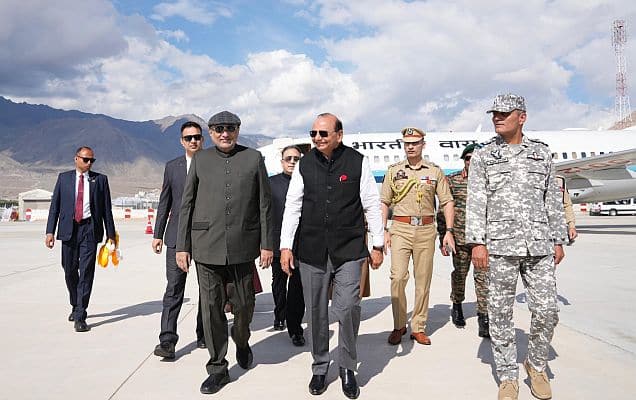
PM Modi addresses concluding session of 47th Governors Conference at Rashtrapati Bhawan
Governors work as catalytic agents in the States, speeding up and improving processes: PM
India only major economy across the world, which is moving ahead strongly despite global economic crisis: PM
India has played a key role in recent global fora such as #COP21 & #WTO: PM
Cooperative federalism must be implemented in letter and spirit: PM Modi
Centre and States must work together as "Team India": PM Narendra Modi

The Prime Minister, Shri Narendra Modi, addressed the concluding session of the 47th Governors Conference at Rashtrapati Bhawan today.

The Prime Minister said Governors occupy a unique high position, owing to their vast years of experience, and the prestigious nature of their post. He said they can hence work as catalytic agents in the States, speeding up and improving processes without themselves becoming a part of them.

The Prime Minister noted that India is the only major economy across the world, which is moving ahead strongly despite the global economic crisis. He said that with the world taking note of India, India is not a mute spectator to global developments, and has played a key role in recent global fora such as CoP-21, and WTO.

The Prime Minister stressed on the importance of cooperative federalism, which he said must be implemented in letter and spirit. He said the Centre and States must work together as "Team India." He added that the spirit of cooperative federalism must also extend to cooperative, competitive federalism, with healthy competition for development among states.

The Prime Minister urged all Governors to think about some form of legacy which they would leave behind at the end of their terms, as their contribution to the States.

Explore More
Today, the entire country and entire world is filled with the spirit of Bhagwan Shri Ram: PM Modi at Dhwajarohan Utsav in Ayodhya

Popular Speeches

Today, the entire country and entire world is filled with the spirit of Bhagwan Shri Ram: PM Modi at Dhwajarohan Utsav in Ayodhya
India’s digital economy enters mature phase as video dominates: Nielsen

Media Coverage

India’s digital economy enters mature phase as video dominates: Nielsen
NM on the go

Nm on the go

Always be the first to hear from the PM. Get the App Now!
...
Cabinet approves increase in the Judge strength of the Supreme Court of India by Four to 37 from 33
May 05, 2026

The Union Cabinet chaired by the Prime Minister Shri Narendra Modi today has approved the proposal for introducing The Supreme Court (Number of Judges) Amendment Bill, 2026 in Parliament to amend The Supreme Court (Number of Judges) Act, 1956 for increasing the number of Judges of the Supreme Court of India by 4 from the present 33 to 37 (excluding the Chief Justice of India).

Point-wise details:

Supreme Court (Number of Judges) Amendment Bill, 2026 provides for increasing the number of Judges of the Supreme Court by 04 i.e. from 33 to 37 (excluding the Chief Justice of India).

Major Impact:

The increase in the number of Judges will allow Supreme Court to function more efficiently and effectively ensuring speedy justice.

Expenditure:

The expenditure on salary of Judges and supporting staff and other facilities will be met from the Consolidated Fund of India.

Background:

Article 124 (1) in Constitution of India inter-alia provided “There shall be a Supreme Court of India consisting of a Chief Justice of India and, until Parliament by law prescribes a larger number, of not more than seven other Judges…”.

An act to increase the Judge strength of the Supreme Court of India was enacted in 1956 vide The Supreme Court (Number of Judges) Act 1956. Section 2 of the Act provided for the maximum number of Judges (excluding the Chief Justice of India) to be 10.

The Judge strength of the Supreme Court of India was increased to 13 by The Supreme Court (Number of Judges) Amendment Act, 1960, and to 17 by The Supreme Court (Number of Judges) Amendment Act, 1977. The working strength of the Supreme Court of India was, however, restricted to 15 Judges by the Cabinet, excluding the Chief Justice of India, till the end of 1979, when the restriction was withdrawn at the request of the Chief Justice of India.

The Supreme Court (Number of Judges) Amendment Act, 1986 further augmented the Judge strength of the Supreme Court of India, excluding the Chief Justice of India, from 17 to 25. Subsequently, The Supreme Court (Number of Judges) Amendment Act, 2008 further augmented the Judge strength of the Supreme Court of India from 25 to 30.

The Judge strength of the Supreme Court of India was last increased from 30 to 33 (excluding the Chief Justice of India) by further amending the original act vide The Supreme Court (Number of Judges) Amendment Act, 2019.