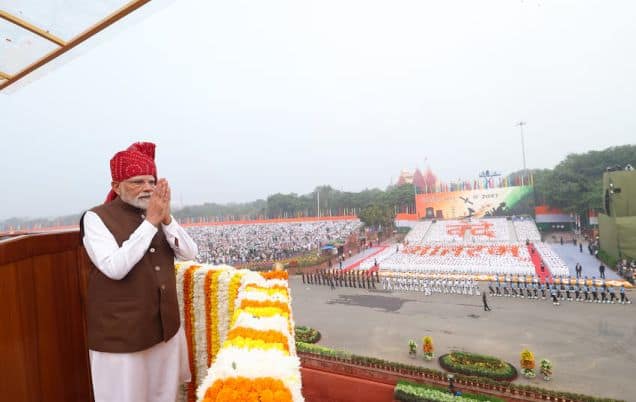
The Cabinet Committee on Economic Affairs, chaired by the Prime Minister, Shri Narendra Modi has approved opening of 85 new Kendriya Vidyalayas (KVs) under Civil/Defence sector across the country and expansion of one existing KV i.e. KV Shivamogga, District Shivamogga, Karnataka to facilitate increased number of Central Government employees by adding two additional Sections in all the classes under the Kendriya Vidyalaya Scheme (Central Sector Scheme). The list of these 86 KVs is annexed.
The total estimated requirement of funds for establishment of the 85 new KVs and expansion of 01 existing nearby KV is Rs. 5872.08 crore (approx.) spread over a period of eight years from 2025-26. This includes capital expenditure component of Rs. 2862.71 crore (approx.) and operational expenditure of Rs. 3009.37 crore (approx.).
As on date, there are 1256 functional KVs, including 03 abroad viz. Moscow, Kathmandu and Tehran and a total number of 13.56 lakh (approx.) students are studying in these KVs.
The administrative structure for implementing the project will require creation of posts at par with the norms fixed by the Sangathan for running of one full fledged KV with a capacity of approximately 960 students. Hence, 960 X 86 = 82560 students would benefit. As per norms in vogue, a full-fledged Kendriya Vidyalaya provides employment to 63 persons and accordingly, approval of 85 new KVs and the expansion of one existing nearby KV, which will add 33 new posts, a total of 5,388 direct permanent employment opportunities will be created. Construction and allied activities associated with augmentation of various facilities in all KVs are likely to generate employment opportunities for many skilled and unskilled workers.
The Government of India approved the Scheme of Kendriya Vidyalayas in November 1962 to provide educational facilities of uniform standard throughout the country for the children of transferable Central Government/Defence employees. Consequently, “Central Schools Organization” was started as a unit of the Ministry of Education of the Government of India. Initially, 20 Regimental Schools in Defence Stations were taken over as Central Schools during the Academic Year 1963-64.
Kendriya Vidyalayas are primarily opened to cater to educational needs of wards of transferable and non-transferable employees of Central Government including Defence and Paramilitary forces and for children of floating population and others including those living in remote and undeveloped locations in the country.
In pursuance of the National Education Policy 2020, almost all Kendriya Vidyalayas have been designated as PM Shri schools, showcasing the implementation of NEP 2020 and acting as exemplar Schools for others. The KVs are some of the most sought after schools, due to their quality teaching, innovative pedagogy and up-to-date infrastructure. There has been continuous increase in the number of students applying for admission to class I in KVs every year and the performance of the students of the Kendriya Vidyalayas in the board examinations conducted by CBSE has consistently been the best among all educational systems.
ANNEXURE
LIST of 86 (85 new and 01 existing) KVs
|
Name of State/UT |
Sl. No |
Name of Proposals |
|
OPENING OF 85 NEW KENDRIYA VIDYALAYAS |
||
|
Andhra Pradesh |
|
Anakapalle, District Anakapalle |
|
Andhra Pradesh |
|
Valasapalle Village, Madanapalle Mandal, District Chittoor |
|
Andhra Pradesh |
|
Palasamudram Village, Gorantala Mandal, District Sri Satya Sai |
|
Andhra Pradesh |
|
Tallapalli Village, Macherla Mandal, District Guntur |
|
Andhra Pradesh |
|
Nandigama, District Krishna |
|
Andhra Pradesh |
|
Rompicherla Village, Narasaraopet Division District Guntur |
|
Andhra Pradesh |
|
Nuzvid, District Krishna (Now Eluru District ) |
|
Andhra Pradesh |
|
Dhone, District Nandyal |
|
Arunachal Pradesh |
|
Pitapool, Lower Subansiri |
|
Assam |
|
Jagiroad, District Morigaon |
|
Chhattisgarh |
|
Mungeli, District-Mungeli |
|
Chhattisgarh |
|
Surajpur, District Surajpur |
|
Chhattisgarh |
|
Bemetara District, Chhattisgarh |
|
Chhattisgarh |
|
Hasoud, District JanjgirChampa |
|
Gujarat |
|
Chakkargarh, District Amreli |
|
Gujarat |
|
Ognaj, District Ahmedabad |
|
Gujarat |
|
Veraval, District Gir-Somnath |
|
Himachal Pradesh |
|
Riri Kuthera, District Kangra |
|
Himachal Pradesh |
|
Gokulnagar, UpparBhanjal, District- Una |
|
Himachal Pradesh |
|
Nandpur, District Una |
|
Himachal Pradesh |
|
Thunag, District Mandi |
|
Jammu & Kashmir (UT) |
|
Gool, District Ramban |
|
Jammu & Kashmir (UT) |
|
Ramban, District Ramban |
|
Jammu & Kashmir (UT) |
|
Bani, District Kathua |
|
Jammu & Kashmir (UT) |
|
Ramkot, District Kathua |
|
Jammu & Kashmir (UT) |
|
Reasi, District Reasi |
|
Jammu & Kashmir (UT) |
|
Katra (Kakriyal), District Reasi |
|
Jammu & Kashmir (UT) |
|
Ratnipora, District Pulwama |
|
Jammu & Kashmir (UT) |
|
Galander (Chandhara), District Pulwama |
|
Jammu & Kashmir (UT) |
|
Mughal Maidan, District Kisthwar |
|
Jammu & Kashmir (UT) |
|
Gulpur, District Poonch |
|
Jammu & Kashmir (UT) |
|
Drugmulla, District Kupwara |
|
Jammu & Kashmir (UT) |
|
Vijaypur, District Samba |
|
Jammu & Kashmir (UT) |
|
Panchari, District Udhampur |
|
Jharkhand |
|
Barwadih, District Latehar (Railway) |
|
Jharkhand |
|
Dhanwar Block, District Giridih |
|
Karnataka |
|
Mudnal Village, Yadgiri District |
|
Karnataka |
|
Kunchiganal Village, District Chitradurga |
|
Karnataka |
|
Elargi (D) Village, Sindhanur Taluk, District Raichur |
|
Kerala |
|
Thodupuzha, District Idduki |
|
Madhya Pradesh |
|
Ashok Nagar, District- Ashok Nagar |
|
Madhya Pradesh |
|
Nagda, District Ujjain |
|
Madhya Pradesh |
|
Maihar, District Satna |
|
Madhya Pradesh |
|
Tirodi, District Balaghat |
|
Madhya Pradesh |
|
Barghat, District Seoni |
|
Madhya Pradesh |
|
Niwari, District Niwari |
|
Madhya Pradesh |
|
Khajuraho, District Chhatarpur |
|
Madhya Pradesh |
|
Jhinjhari, District Katni |
|
Madhya Pradesh |
|
Sabalgarh, District Morena |
|
Madhya Pradesh |
|
Narsinghgarh, District Rajgarh |
|
Madhya Pradesh |
|
CAPT (Central Academy Police Training) Bhopal, Kanhasaiya |
|
Maharashtra |
|
Akola, District Akola |
|
Maharashtra |
|
NDRF Campus, Sudumbare, Pune |
|
Maharashtra |
|
Nachane, District Ratnagiri |
|
NCT of Delhi (UT) |
|
Khajuri Khas District- North East Delhi |
|
Odisha |
|
Railway Titlagarh, District Bolangir |
|
Odisha |
|
Patnagarh, District Bolangir |
|
Odisha |
|
ITBP khurda, District Khurda |
|
Odisha |
|
Athmallik District Angul |
|
Odisha |
|
Kuchinda, District Sambalpur |
|
Odisha |
|
Dhenkanal (Kamakhyanagar) |
|
Odisha |
|
Jeypore, Koraput District |
|
Odisha |
|
Talcher, District Angul |
|
Rajasthan |
|
AFS Phalodi, District Jodhpur |
|
Rajasthan |
|
BSF Satrana, District Sriganganagar |
|
Rajasthan |
|
BSF Srikaranpur, District Sriganganagar |
|
Rajasthan |
|
Hindaun City, District Karauli |
|
Rajasthan |
|
Merta City, District Nagaur |
|
Rajasthan |
|
Rajsamand District Rajsamand |
|
Rajasthan |
|
Rajgarh, District Alwar |
|
Rajasthan |
|
Bhim, District Rajsamand |
|
Rajasthan |
|
Mahwa, District Dausa |
|
Tamil Nadu |
|
Theni, District Theni |
|
Tamil Nadu |
|
Pillaiyarpatti, District Thanjavur |
|
Tripura |
|
Udaipur, District Gomati |
|
Tripura |
|
Dharmanagar, District North Tripura |
|
Uttar Pradesh |
|
Payagpur, District Jaunpur |
|
Uttar Pradesh |
|
Maharajganj, District Maharajganj |
|
Uttar Pradesh |
|
Bijnor District Bijnor |
|
Uttar Pradesh |
|
Chandpur, District Ayodhya |
|
Uttar Pradesh |
|
Kannauj District Kannauj |
|
Uttarakhand |
|
Narendra Nagar, District Tehri Garhwal |
|
Uttarakhand |
|
Dwarahat, District Almora |
|
Uttarakhand |
|
Kotdwar, District Pauri Garhwal |
|
Uttarakhand |
|
Madan Negi, District Tehri Garhwal |
|
EXPANSION OF 01 EXISTING KENDRIYA VIDYALAYA BY ADDING 2 ADDITIONAL SECTIONS IN ALL THE CLASSES |
||
|
Karnataka |
86. |
KV Shivamogga, District Shivamogga |
स्कूली शिक्षा को ज्यादा से ज्यादा सुलभ बनाने के लिए हमारी सरकार ने एक और बड़ा फैसला लिया है। इसके तहत देशभर में 85 नए केंद्रीय विद्यालय खोले जाएंगे। इस कदम से जहां बड़ी संख्या में विद्यार्थियों को लाभ होगा, वहीं रोजगार के भी बहुत सारे नए अवसर बनेंगे।https://t.co/xQmO7rvEFh
— Narendra Modi (@narendramodi) December 7, 2024