Mahatma Jyotirao Phule: A Light That Still Shows India the Way

Published By : Admin | April 11, 2026 | 08:00 IST

Today, 11th April, is a deeply special day for all of us. It is the birth anniversary of Mahatma Jyotirao Phule, one of India’s greatest social reformers and a guiding light for generations. This year, the occasion carries even greater significance, as it marks the beginning of his 200th birth anniversary celebrations.

Mahatma Phule was a great reformer. In addition to that, his was a life of moral courage, restless enquiry and unshakable commitment to social good. Mahatma Phule is remembered for the institutions he built and the movements he led. At the same time, his contribution to our civilisational journey lies in the hope he aroused, the confidence he instilled and the strength his thoughts continue to give to millions of people across the nation.

Born in the great state of Maharashtra in 1827, Mahatma Phule emerged from modest beginnings. But his initial hardships never stood in the way of his learning, his courage or his commitment to society. This is a trait that remained with him forever: whatever the challenges may be, one must work hard, acquire knowledge and mitigate those challenges instead of doing nothing about it. From his school days, young Jyotirao was deeply curious and became a voracious reader, often reading books far beyond what children his age were expected to engage with. Years later, he said, “The more questions we generate, the more knowledge emerges from them.” Clearly, the spirit of enquiry he was blessed with since his childhood remained constant in his journey.

Throughout his life, learning and education became central to Mahatma Phule’s mission. He recognised with rare clarity that knowledge is not a privilege to be guarded, but a force to be shared. At a time when the joys of learning were denied to many, he opened pioneering schools for girls and for those kept out of formal education. He used to say, “Any improvement that comes in children through mothers is deeply valuable. Therefore, if schools are to be opened, they should first be opened for girls.” He worked to create a new social imagination in which the classroom became an instrument of justice and equality..

His vision for education inspires us greatly. Over the last decade, we have worked to make research and innovation a cornerstone for the youth of India. Efforts are being made to create an ecosystem where young minds are encouraged to question, explore and innovate. By investing in knowledge, skills and opportunity, India is empowering its youth to become problem-solvers and drivers of national progress.

Due to his knowledge and wisdom, Mahatma Phule developed a strong understanding of areas such as agriculture, healthcare and rural development. He often said that injustice towards our farmers and workers weakens our society. He saw how social inequalities manifested themselves in daily life, be it in the farms or in villages. Hence, he immersed himself in ensuring dignity for the poor, the downtrodden and the marginalised. At the same time, he made every possible effort to ensure social harmony was maintained.

Mahatma Phule opined, “जोपर्यंत समाजातील सर्वांना समान अधिकार मिळत नाहीत, तोपर्यंत खरे स्वातंत्र्य मिळत नाही” (True freedom cannot be achieved until everyone in society is granted equal rights). And for that, he built institutions that translated this vision into action, contributing to a just society. The Satyashodhak Samaj, founded by him, was one of the most important social reform movements in modern India. It was at the forefront of social reform, community service and furthering human dignity. It became an effective voice for women, youngsters and those living in villages. This movement reflected Mahatma Phule’s intrinsic belief that society could be strengthened by placing at its core justice, respect for every person and a spirit of collective progress.

His personal life, too, carried lessons in courage. Always working and being among the people took a toll on his health. But even the most serious health challenges did not dim his resolve. After suffering a debilitating stroke, he continued to work and fulfil his vision. Yes, his body had been tested, but his commitment to society had not yielded. For millions today, especially those who draw courage from struggle, this remains one of the most powerful dimensions of his life.

No remembrance of Mahatma Phule can be complete without a respectful mention of Savitribai Phule, who was herself one of the tallest reformers of our nation. As one of India’s pioneering women teachers, she played a defining role in advancing education for girls, thus giving them the opportunity to pursue their dreams. After Mahatma Phule’s passing, Savitribai carried forward that torch and, in 1897, during a plague outbreak, she served victims with such devotion that she herself contracted the disease and lost her own life.

Our land has been blessed, time and again, by great men and women who have strengthened society through thought, sacrifice and action. They did not wait for change to arrive from somewhere else. They became its source. For hundreds of years in our land, the clarion call for social betterment has often risen from within society itself, from those who could see suffering clearly and refused to accept it as fate. Mahatma Jyotirao Phule was one such voice.

I fondly recall my visit to Pune in 2022, when I had offered tributes to Mahatma Phule at his grand statue in the city. As we mark the beginning of his bicentenary year, the most fitting tribute to Mahatma Jyotirao Phule is about renewal. Renewal of our commitment to subjects close to his heart, such as education. Renewal of our sensitivity to injustice. Renewal of our faith that society can improve itself from within. His life tells us that the power of community can achieve miracles in India when joined with moral clarity and public purpose. That is why he still gives strength to millions. That is why his words and work still carry hope. And that is why, nearly two hundred years after his birth, Mahatma Jyotirao Phule remains not a figure of the past, but a guide for India’s future.

Explore More
Today, the entire country and entire world is filled with the spirit of Bhagwan Shri Ram: PM Modi at Dhwajarohan Utsav in Ayodhya

Popular Speeches

Today, the entire country and entire world is filled with the spirit of Bhagwan Shri Ram: PM Modi at Dhwajarohan Utsav in Ayodhya
Indonesia To Dubai, IITs And IIMs Are Going Global: The Strategy Behind India's Overseas Campuses

Media Coverage

Indonesia To Dubai, IITs And IIMs Are Going Global: The Strategy Behind India's Overseas Campuses
NM on the go

Nm on the go

Always be the first to hear from the PM. Get the App Now!
...
A life devoted to India’s unity and progress
July 06, 2026

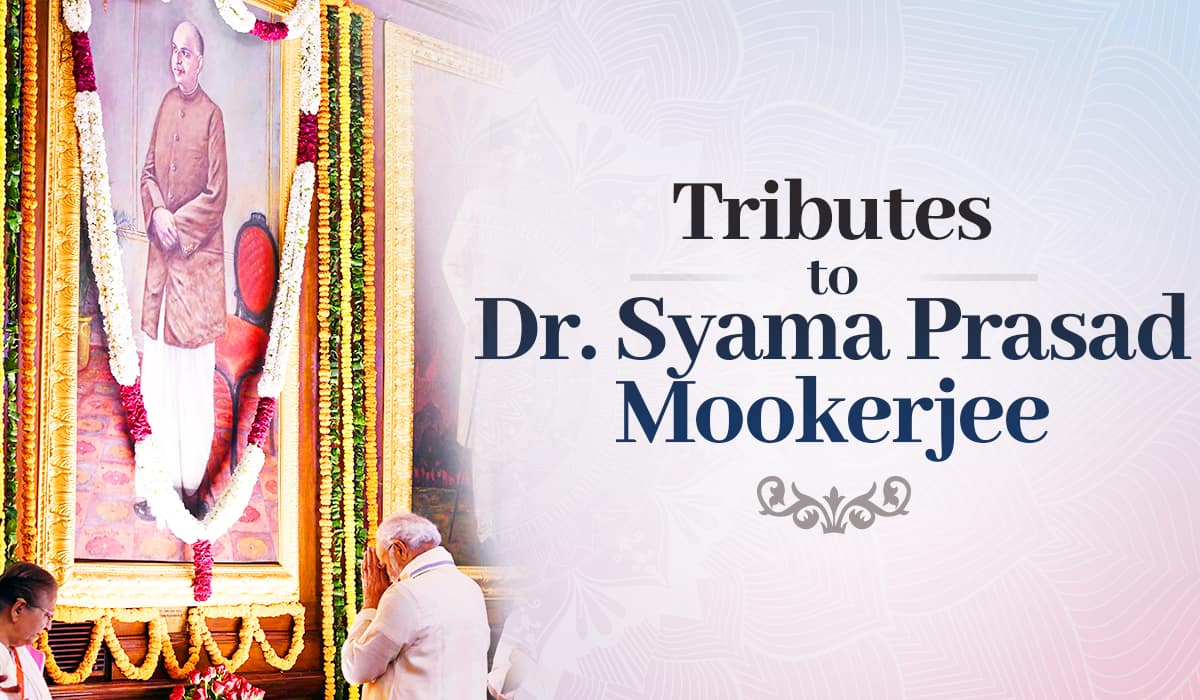
Today, 6th July, is a special day for countless people who cherish the ideals of nationalism and selfless service. We commemorate the 125th birth anniversary of Dr. Syama Prasad Mookerjee, whose life remains a timeless example of courage and unwavering commitment to Maa Bharti. Few leaders in modern India embodied the seamless confluence of intellect, public service and moral conviction as profoundly as Dr. Syama Prasad Mookerjee.

The young Syama Prasad was born into circumstances that could easily have assured him a protected and comfortable life. His father, Sir Ashutosh Mookerjee, was among the foremost educationists and intellectuals of his age. Yet, while destiny placed before him a path of privilege, his conscience led him towards one of sacrifice and national service. He was convinced that he could not remain a mute spectator to the turbulence of his times, be it fighting colonialism, communalism, humanitarian challenges and more. Along this journey, he endured profound personal tragedies, including the loss of an infant child and, later, his wife. Yet, these tragedies only deepened his resolve and strengthened his unwavering commitment to serve.

If there was one ideal that defined Dr. Syama Prasad Mookerjee’s public life above all else, it was the indivisibility of India. He stood firm during the upheaval of Partition to ensure that West Bengal remained an integral part of India. A few years later, that very conviction drew him to Jammu and Kashmir. Imprisonment did not deter him and isolation did not diminish him. His life came to an abrupt end in detention, far from the countless people whose cause he had made his own. There are moments in history when an individual’s final sacrifice transcends politics and enters the realm of national memory. Dr. Mookerjee’s last journey remains one such moment. Acharya Vinoba Bhave said that Dr. Mookerjee sacrificed himself for a cause in which he had faith. Years later, the revocation of Articles 370 and 35(A) in 2019 was the most fitting tribute to his martyrdom.

Dr. Mookerjee put India First and Indian values first. And he did it by building institutions and nurturing systems that defied conventional mindsets of those times. He became the youngest Vice Chancellor of the University of Calcutta. In his unique style, he brought positive changes that were patriotic and futuristic. Addressing a conference of educators, Dr. Mookerjee put it wonderfully when he said, “It is incorrect to look upon educational institutions as factories to produce potential clerks and low-paid staff. We have to turn out students who are capable of providing leadership to our self-governing institutions, such as municipal corporations, provincial and central legislatures and also of directing the affairs in various fields of life such as financial, commercial and industrial ones.”

Under his leadership, Calcutta University undertook unique efforts such as improving library infrastructure, boosting research in sciences, encouraging the study of artefacts and establishing courses in agriculture, to name a few. He drew attention to areas such as sports, teacher training and student welfare. To instil a sense of pride among students and alumni, he began a practice of marking 24th January as the foundation day of the University. He requested none other than Gurudev Tagore to compose a song for the University.

Yet another example of this spirit can be seen in the later part of his life, when he decided to form the Bharatiya Jana Sangh. At a time when the Congress Party was omnipresent, he felt that there was all the more reason for an alternative voice to speak up for India’s progress while staying attached to our cultural roots. It was perhaps fitting that the party’s symbol was the Diya, the earthen lamp. A single lamp may appear modest, yet it possesses the power to dispel darkness far beyond itself. It is exactly what the Jana Sangh did both during the years it was active and beyond.

Dr. Syama Prasad Mookerjee’s tenure as India’s first Minister for Industry and Supply reveals a statesman whose conception of development was remarkably comprehensive and humane. He viewed industry as a means of restoring dignity, opportunity and confidence to a newly independent nation. He respected wealth creation and value addition. While laying the foundations of modern industrial India through pioneering initiatives such as the Damodar Valley Corporation, the Sindri Fertiliser Plant and a robust industrial policy, he simultaneously ensured that India’s traditional strengths were not neglected. Handlooms, cottage industries, artisans and textile workers found in him an equally committed champion.

Here, I would like to share a personal experience. The Sindri plant, which Dr. Mookerjee worked to establish with a clear vision of self-reliance, was ignored by those who ran the nation for several decades. I feel honoured that our Government had the opportunity to contribute to its revival. It was indeed among the most special moments to have been there for that programme.

India’s civilisational tradition has long celebrated dialogue and discussions. Dr. Mookerjee embodied this democratic spirit. He joined Pandit Nehru’s Cabinet, believing that the task of nation-building in the early years transcended political differences. He served with sincerity and a constructive spirit. But when he felt that questions of national importance demanded a different course, he relinquished office with dignity and devoted himself wholeheartedly to the political work he believed the nation required.

75 years ago, Pandit Nehru brought the First Amendment, which was a direct assault on free speech. Dr. Mookerjee was among its staunchest critics. He understood fully what the Congress was capable of doing. And he was proven right. Those who brought the First Amendment 75 years ago imposed the Emergency in 1975 and 50 years ago, brought in the 42nd Amendment Act, which again struck at the core of liberal democratic values.

Dr. Mookerjee also stood out for his humanitarian efforts. When the most tragic famine struck Bengal in 1943, Dr. Mookerjee immersed himself in serving those affected. He ensured that several canteens and relief centres were opened to feed people. On one hand, he was deeply shaken by the plight of his people while on the other, he was repulsed by the insensitivity of the colonial rulers. He even wrote a book, Panchasher Manwantar, in which he expressed his angst. When a super cyclone hit Medinipur in 1942, his efforts to restore normalcy were widely lauded.

Speaking at a college in Kolkata, Dr. Mookerjee urged the youth, “Whatever work you undertake, do it seriously, thoroughly and well; never leave it half-done or undone, never feel yourself satisfied unless and until you have given it your very best.” As India advances towards the goal of a Viksit Bharat, the finest tribute we can pay him is to strive every day to build the strong, united, self-confident and compassionate India that he so deeply believed in. And knowing today’s youth, I am certain they will rise to the occasion and do exactly that.