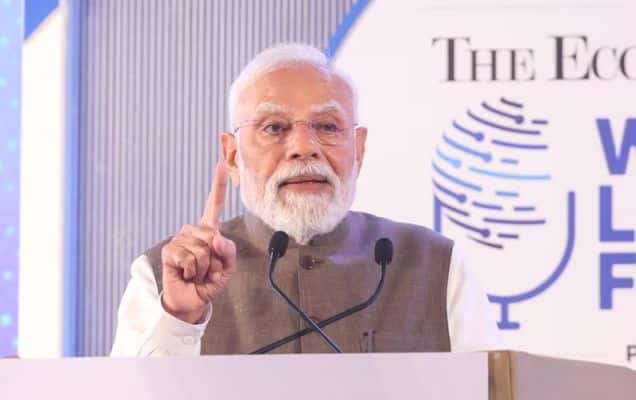
The Prime Minister, Shri Narendra Modi inaugurated the ‘Centre-State Science Conclave’ in Ahmedabad via video conferencing.
Addressing the gathering, the Prime Minister highlighted that the organisation of this conclave is a clear example of Sabka Prayas. The Prime Minister remarked “Science is like that energy in the development of 21st century India, which has the power to accelerate the development of every region and the development of every state. Today, when India is moving towards leading the fourth industrial revolution, the role of India's science and people related to this field is very important. In such a situation, the responsibility of people in administration and policy making increases significantly.”
The Prime Minister emphasized that Science is the basis of solutions, evolution and innovation. And, it is with this inspiration, that today's new India is moving forward with Jai Jawan, Jai Kisan, Jai Vigyan as well as Jai Anusandhan.
Commenting on the lessons that we can learn from history that will help both the centre and the states, the Prime Minister said if we remember the early decades of the last century, we find how the world was going through a period of devastation and tragedy. But even in that era, whether it was about the East or the West, scientists everywhere were engaged in their great discovery. In the West, scientists like Einstein, Fermi, Max Planck, Niels Bohr, and Tesla were dazzling the world with their experiments. In the same period, many scientists including CV Raman, Jagdish Chandra Bose, Satyendranath Bose, Meghnad Saha, and S Chandrashekhar were bringing their new discoveries to the fore. The Prime Minister underlined the difference between the East and West as we were not giving due recognition to the work of our scientists. The Prime Minister pointed out that when we celebrate the achievements of our scientists, science becomes part of our society, it becomes part of the culture. Shri Modi also requested everybody to celebrate the achievements of the scientists of our country. “Scientists”, the Prime Minister said, “are giving ample reasons to the country to celebrate them.” He lauded the role of Indian scientists in developing the Corona vaccine and contributing to the world's biggest vaccine drive.

The Prime Minister reiterated that the government is working with the thinking of Science-Based Development. “Since 2014, there has been a substantial increase in investment in the field of science and technology. Due to the efforts of the government, today India is ranked 46th in the Global Innovation Index, whereas in 2015, India was at number 81”, the Prime Minister added. He acknowledged the record number of patents being registered in the country. He also noted the climate of innovation and a vibrant startup ecosystem.
The Prime Minister pointed out that “inclination for science, technology and innovation is in the DNA of our young generation. We need to support this young generation with full strength.” The Prime Minister listed new sectors and missions in the field of research and innovation to support the innovative spirit of the youth. He gave examples of Space Mission, National Supercomputing Mission, semiconductor mission, Mission Hydrogen and drone technology. Similarly, NEP is promoting this by providing Science and technology education in the mother tongue.
The Prime Minister highlighted that in order to make India a global centre of research and innovation in this Amrit Kaal, we have to work on many fronts simultaneously. He stressed the need to take science and technology-related research to the local level. He asked states to promote research and innovation as per their local needs. The Prime Minister remarked that innovation can be encouraged by laying emphasis on the creation of more and more scientific institutions and simplification of processes by the state governments. He further added that the number of innovation labs should also be increased in the institutions of higher education in the states. He also asked every state to lay down modern policy regarding Science, innovation and technology. “As governments, we have to more and more cooperate and collaborate with our scientists, this will create an atmosphere of a scientific modernity”

The Prime Minister stressed that the states should take full advantage of the ability and expertise of many national-level scientific institutes, and national laboratories that are present. “We also have to take our science-related institutions out of the state of silos for optimum utilisation of scientific institutions and expertise”, the Prime Minister added. He asked for science promotion events at the grassroots level. He also advised the state Science Ministers to share good practices and aspects of their science curriculum.
In concluding the address, the Prime Minister expressed the belief that the ‘State-Centre Science Conclave’ will add a new dimension and resolve toward the progress of Science in the country. The Prime Minister also urged everyone to not let any opportunity slip in the field of science and technology. “The coming 25 years are the most important years for India as it will determine the new identity and strength of India to come”, the Prime Minister said. The Prime Minister also urged the participants to take the learnings from this conclave to their states and contribute toward nation-building.

Chief Minister of Gujarat, Shri Bhupendra Patel and Union Minister of State of Science and Technology, Dr Jitendra Singh were those present on the occasion.
Background
In line with the Prime Minister’s relentless efforts to facilitate innovation and entrepreneurship in the country, the first-of-its-kind Conclave will strengthen Centre-State coordination and collaboration mechanisms - in the spirit of cooperative federalism - to build a robust science, technology & innovation (STI) ecosystem across the country.
The two-day Conclave is being organised at Science City, Ahmedabad on 10-11 September 2022. It will include sessions on different thematic areas including STI Vision 2047; Future Growth Pathways and Vision for STI in States; Health - Digital Health Care for All; Doubling Private Sector investment in R&D by 2030; Agriculture - Technological interventions for improving farmers’ income; Water - Innovation for producing potable drinking water; Energy- Clean Energy for All including S&T role in Hydrogen mission; Deep Ocean Mission and its relevance for Coastal States/UTs as well as country’s future economy.
The Conclave witnessed the participation of Gujarat CM, Union MoS Science & Technology (S&T), S&T Ministers and Secretaries of States & Union Territories, industry leaders, entrepreneurs, NGOs, young scientists and students.
21वीं सदी के भारत के विकास में विज्ञान उस ऊर्जा की तरह है जिसमें हर क्षेत्र के विकास को, हर राज्य के विकास को गति देने का सामर्थ्य है।
— PMO India (@PMOIndia) September 10, 2022
आज जब भारत चौथी औद्योगिक क्रांति का नेतृत्व करने की तरफ बढ़ रहा है तो उसमें भारत की साइंस और इस क्षेत्र से जुड़े लोगों की भूमिका बहुत अहम है: PM
समाधान का, Solution का, Evolution का और Innovation का आधार विज्ञान ही है।
— PMO India (@PMOIndia) September 10, 2022
इसी प्रेरणा से आज का नया भारत, जय जवान, जय किसान, जय विज्ञान के साथ ही जय अनुसंधान का आह्वान करते हुए आगे बढ़ रहा है: PM @narendramodi
पश्चिम में Einstein, Fermi, मैक्स प्लांक, नील्स बोर, Tesla जैसे scientist अपने प्रयोगों से दुनिया को चौंका रहे थे।
— PMO India (@PMOIndia) September 10, 2022
उसी दौर में सी वी रमन, जगदीश चंद्र बोस, सत्येंद्रनाथ बोस, मेघनाद साहा, एस चंद्रशेखर समेत कई वैज्ञानिक अपनी नई-नई खोज सामने ला रहे थे: PM @narendramodi
अगर हम पिछली शताब्दी के शुरुआती दशकों को याद करें तो पाते हैं कि दुनिया में किस तरह तबाही और त्रासदी का दौर चल रहा था।
— PMO India (@PMOIndia) September 10, 2022
लेकिन उस दौर में भी बात चाहे East की हो या West की, हर जगह के scientist अपनी महान खोज में लगे हुए थे: PM @narendramodi
जब हम अपने वैज्ञानिकों की उपलब्धियों को celebrate करते हैं तो science हमारे समाज का हिस्सा बन जाती है, वो part of culture बन जाती है।
— PMO India (@PMOIndia) September 10, 2022
इसलिए आज सबसे पहला आग्रह मेरा यही है कि हम अपने देश के वैज्ञानिकों की उपलब्धियों को जमकर celebrate करें: PM @narendramodi
हमारी सरकार Science Based Development की सोच के साथ काम कर रही है।
— PMO India (@PMOIndia) September 10, 2022
2014 के बाद से साइंस और टेक्नोलॉजी के क्षेत्र में investment में काफी वृद्धि की गई है।
सरकार के प्रयासों से आज भारत Global Innovation Index में 46वें स्थान पर है, जबकि 2015 में भारत 81 नंबर पर था: PM
इस अमृतकाल में भारत को रिसर्च और इनोवेशन का ग्लोबल सेंटर बनाने के लिए हमें एक साथ अनेक मोर्चों पर काम करना है।
— PMO India (@PMOIndia) September 10, 2022
अपनी साइंस और टेक्नॉलॉजी से जुड़ी रिसर्च को हमें लोकल स्तर पर लेकर जाना है: PM @narendramodi
Innovation को प्रोत्साहित करने के लिए राज्य सरकारों को ज्यादा से ज्यादा वैज्ञानिक संस्थानों के निर्माण पर और प्रक्रियाओं को सरल करने पर बल देना चाहिए।
— PMO India (@PMOIndia) September 10, 2022
राज्यों में जो उच्च शिक्षा के संस्थान हैं, उनमें innovation labs की संख्या भी बढ़ाई जानी चाहिए: PM @narendramodi
राज्यों में, राष्ट्रीय स्तर के अनेक वैज्ञानिक संस्थान होते हैं, national laboratories भी होती हैं।
— PMO India (@PMOIndia) September 10, 2022
इनके सामर्थ्य का लाभ, इनकी expertise का पूरा लाभ भी राज्यों को उठाना चाहिए।
हमें अपने साइंस से जुड़े संस्थानों को Silos की स्थिति से भी बाहर निकालना होगा: PM @narendramodi