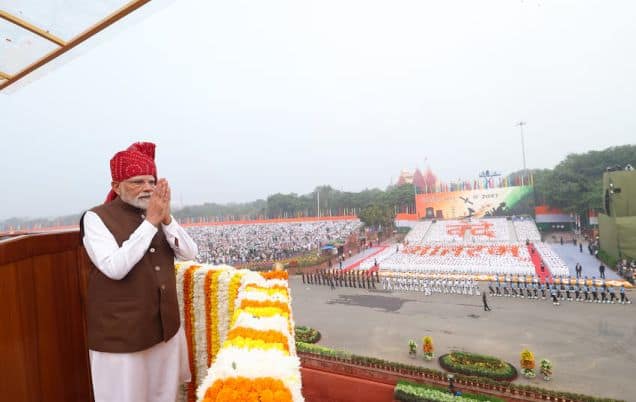
"Written by Mr. Sameer Kochhar, the book ModiNomics focuses on how Shri Narendra Modi has brought about a sea change through his unique brand of ModiNomics"
"I think it was decisiveness in terms of decision making that played a key role and this decisiveness was not merely political. The State’s Civil Services and the Bureaucracy also attuned themselves to this changed culture: Shri Arun Jaitley"
"Politicians are essentially known not by the number of years spent in the office but by the footprints they leave behind: Shri Jaitley"

Shri Arun Jaitley ji released the book ‘ModiNomics – Inclusive Economics, Inclusive Governance’, in New Delhi, today.

Written by Mr. Sameer Kochhar (Chairman of Skoch Group), the book focuses on how Shri Narendra Modi has brought about a sea change through his unique brand of ModiNomics. Mr. Sameer Kochhar has been interacting with Gujarat Government officials since 2003, and for much of the last decade, the annual Skoch Summits organised by Mr. Kochhar have featured case studies on Gujarat’s governance. Mr. Kochhar has also interacted with Shri Modi to know his mind on Gujarat and the nation first hand.

This book is an outcome of all the above and tells the Gujarat story in all its riveting details. It presents the vision behind Shri Modi’s thought process, his economics and governance vision, while also seeking to highlight the economic and development strategies adopted by Shri Modi.

Speaking on the occasion, Shri Jaitley said that though he had only glanced through the book, he was sure that the analysis put forth through data would make it ‘eminently readable and a great addition to the library’.

Putting forth his observations on the book, Jaitley ji spoke about the inspiring success story of Gujarat which had emerged as a favoured investment hub. He said that the Gujarat Chief Minister Shri Narendra Modi had faced criticism like no other leader, but instead of getting involved in the mud-slinging campaign, he chose to set his own agenda and move on. Citing the example of the successful Narmada, which Shri Modi relentlessly focused on achieving inspite of the severe opposition to it, Jaitley ji said that it was this dedicated and decisive approach of the Gujarat CM that had played an instrumental role in changing the face of the State. He spoke of how this project had triggered a subsequent growth in agriculture and also ensured availability of water to drought-rid regions. “The rural economy in Gujarat became stronger. Ports were developed, there was white revolution and all this created jobs,” said Shri Jaitley.

It was effectiveness of the leadership that got things to be implemented in Gujarat: Shri Arun Jaitley at the book release of ModiNomics

He further added how this approach had given the much-needed boost to the manufacturing segment. “The Manufacturing sector changed the face of Gujarat. Gujarat became known for that, and infrastructure too improved,” said Shri Jaitley.

Shri Arun Jaitley ji applauded the non-traditional thinking adopted in Gujarat, and said, “I think it was decisiveness in terms of decision making that played a key role and this decisiveness was not merely political. The State’s Civil Services and the Bureaucracy also attuned themselves to this changed culture.” This approach, he said, had also encouraged many investors as they found the environment to be more hospitable.

“It was effectiveness of the leadership that got things to be implemented,” said Shri Jaitley, while adding that the Nation needed not just a politician but a hardcore politician and a leader who could show the direction, implement decisions and be clear about the direction his country needs to move.

“I think eventually the model that grew is the model that India conceived of. One that ensured a high growth rate, investment, job creation, much larger economic activity and revenues,” said Shri Jaitley.

Shri Jaitley also spoke about the misdoings of the current government and said that scams like the 2G scam and Coal block only reflected the nepotism and misgovernance of the Central government. He also spoke of how corruption and subsequent mismanagement had had a spiral effect on the investment environment of India.

He spoke of the political credibility that eminent leaders like Shri Lal Bahadur Shastri had, and the kind of inspiring footprints they had left on the Indian economy. Strongly opposing the Hon’ble Finance Minister’s question challenging Shri Narendra Modi’s knowledge of economics, Shri Jaitley retorted by asking what according to the Finance Minister made a good leader of the government. “Politicians are essentially known not by the number of years spent in the office but by the footprints they leave behind,” said Shri Jaitley, while adding that, according to him, India could not afford a non-politician as a Prime Minister.

Other dignitaries to attend the occasion include Mr. Rana Kapoor, President, Assocham, Dr. Surjit Bhalla, Economist, Mr. Ashishkumar Chauhan, MD & CEO, BSE, and Ms. Sudha Pillai, Distinguished Fellow, Skoch Development Foundation and former Member Secretary, Planning Commission.

Explore More
आज सम्पूर्ण भारत, सम्पूर्ण विश्व राममय है: अयोध्या में ध्वजारोहण उत्सव में पीएम मोदी

लोकप्रिय भाषण

आज सम्पूर्ण भारत, सम्पूर्ण विश्व राममय है: अयोध्या में ध्वजारोहण उत्सव में पीएम मोदी
Tier-2 cities drive growth in India's tech hiring as GCC expansion spreads beyond metros

Media Coverage

Tier-2 cities drive growth in India's tech hiring as GCC expansion spreads beyond metros
NM on the go

Nm on the go

Always be the first to hear from the PM. Get the App Now!
...
List of Outcomes: Prime Minister of Japan’s visit to India for the 16th India-Japan Annual Summit
July 02, 2026
Sl. No.OutcomeDescription
1. India-Japan Joint Declaration on Economic Security Promotes project-based collaboration for enhancing joint resilience in key sectors including semiconductors, critical minerals, information and communication technology including AI, clean energy and pharmaceuticals. India-Japan Fact Sheet 2.0 captures growing India-Japan G2G and B2B engagement in this crucial area.
2. India-Japan Joint Statement on Cooperation in the Field of Artificial Intelligence Elevates the India-Japan relationship to a strategic research and development partnership in the AI domain. Building on the India-Japan AI Initiative, the Joint Statement provides a roadmap for greater cooperation across the entire AI technology stack in pursuit of the shared vision of safe, secure, trusted, inclusive, and human-centric AI.
3 Joint Statement on Energy Resilience (between MoPNG and METI, Japan) Strengthens cooperation in strategic stockpiling and reserve mechanisms for crude oil and petroleum products. Promotes collaboration in joint investments across the maritime energy transport value chain.
4. Celebrating the 75th Anniversary of India-Japan Diplomatic Relations Outlines a series of commemorative events to celebrate 2027, the 75th anniversary of establishment of diplomatic relations, as the India-Japan Year of Shared Horizons
5. Memorandum of Cooperation for India-Japan Cooperative Biogas for Growth (CBG) Initiative Promotes cooperation towards the goal of establishing 1,000 biogas and organic fertilizer plants all across India, leveraging the extensive network of dairy cooperatives.
6. Memorandum of Cooperation in the Field of Batteries Promotes cooperation in battery-related projects and expands business opportunities with an aim of building a trusted, resilient and sustainable battery supply chain.
7. Memorandum of Cooperation in the Field of Pharmaceuticals and Medical Devices Sector Strengthens pharma supply chains, including in Active Pharmaceutical Ingredients (APIs) and Key Starting Materials (KSMs), through promotion of bilateral investment and business linkages, technical collaboration and industry-academia collaboration.
8. Memorandum of Cooperation in the Field of Geology and Mineral Exploration Strengthens cooperation in upstream critical minerals exploration through exchange of technical expertise.
9. Memorandum of Cooperation between IndiaAI Mission and Ministry of Economy, Trade and Industry (METI), Japan Promotes institutional cooperation between IndiaAI Mission and Japan’s GENIAC initiative – through B2B matchmaking, webinars on AI policies and challenges and support for joint projects through access to computing resources
10. Memorandum of Cooperation on Next Generation Mobility Partnership (NGMP) Establishes a framework for operationalizing the Next Generation Mobility Partnership (NGMP) which was announced at the 15th Annual Summit in August 2025. The NGMP would accelerate private sector-led cooperation and investment in mobility sectors including rail, automotive and road infrastructure, aviation, shipbuilding and ports, logistics, and urban development, positioning India as a hub for “Make in India for the World” exports to third countries.
11. Memorandum of Understanding between India’s Centre for Cellular and Molecular Platforms (C-CAMP) and RIKEN, Japan Establishes a framework for academic, translational research and start-up oriented innovation in deep-tech and life sciences, covering healthcare, agriculture and environment.
12. Memorandum of Understanding between National Center for Biological Sciences-Tata Institute of Fundamental Research and RIKEN, Japan Creates a framework for cooperation in basic biological and neuroscience research between the two leading research institutions
13. Memorandum of Understanding between IIT Bombay, BharatGen Technology Foundation and National Institute of Informatics, Japan Furthers collaboration on large language models (LLMs), with a focus on developing LLMs for enhanced scientific reasoning, through joint research exchanges
14. Memorandum of Understanding between SarvamAI and Preferred Network on LLM Development Creates a framework for cooperation across the full AI technology stack, including foundation models.
15. Memorandum of Understanding Between National Internet Exchange of India (NIXI) and Japan Network Information Center (JPNIC) Promotes cooperation in National Internet Registry operations, IPv6 adoption, internet security improvements, capacity building, student/professional exchanges and exchange of views on internet governance at regional and global forums.
16. Exchange of Letters Between International Financial Services Centres Authority (IFSCA) and Financial Services Agency, Japan (JFSA) Establishes a framework for cooperation in development, regulation and supervision of financial services as well as information exchange on financial-market trends and best practices, particularly in FinTech and RegTech.