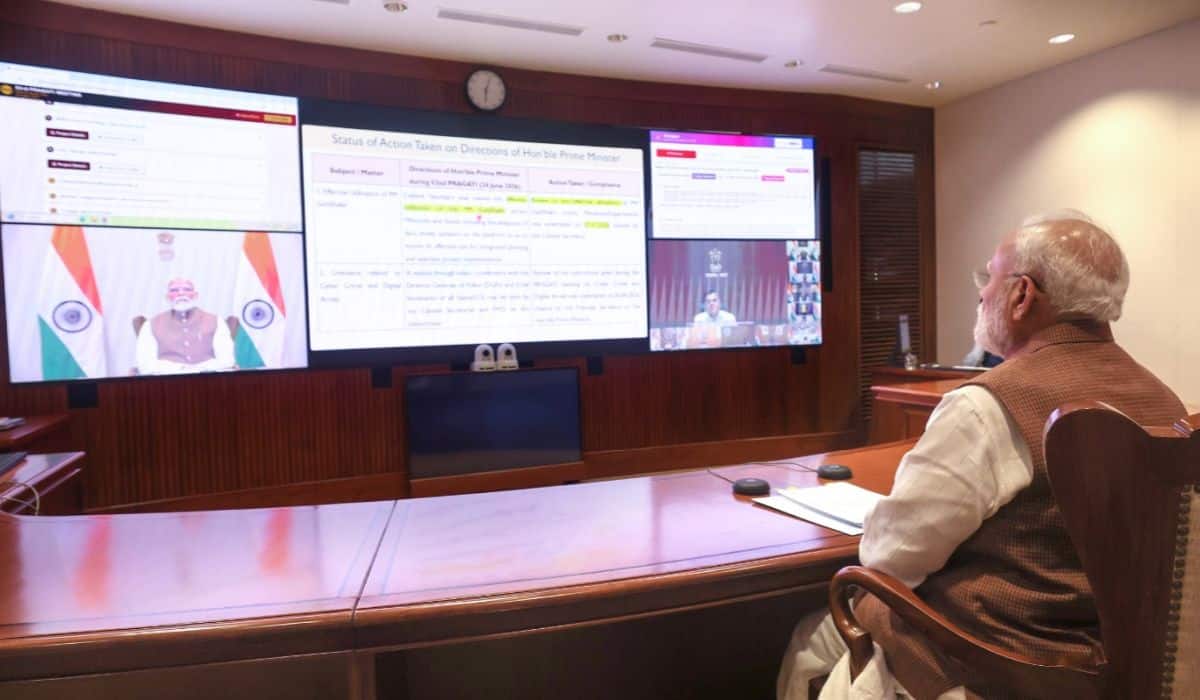
The Union Cabinet joins the Nation in celebrating the historic success of the Chandrayaan-3 Mission to the Moon. The Cabinet also appreciates the monumental achievement of our scientists. This is not just a victory for our space agency but is a bright symbol of India's progress and ascent on the global stage. The Cabinet welcomes that 23rd August would be celebrated as the “National Space Day”.
The Cabinet congratulates the Indian Space Research Organisation (ISRO) for its efforts. Thanks to our scientists, India is the first country to land near the Moon’s south pole. Landing on the moon, with predicted accuracy, in itself is a momentous achievement. Landing near the South Pole of the Moon, overcoming the arduous conditions, is a testament to the spirit of our scientists, who since centuries have sought to push the boundaries of human knowledge. The wealth of information being sent by ‘Pragyan’ rover from the Moon will advance knowledge and pave the way for ground-breaking discoveries and insights into the mysteries of the moon and beyond.
The Cabinet firmly believes that in an era defined by rapid technological advancements and the quest for innovation, India's scientists stand as shining beacons of knowledge, dedication and expertise. Their analytical prowess, combined with a fervent commitment to inquiry and exploration, has constantly propelled the nation into the forefront of global scientific achievements. Their relentless pursuit of excellence, unyielding curiosity, and indomitable spirit to overcome challenges have not only cemented their reputation on the international stage but have also inspired countless others to dream big and contribute to the vast tapestry of global knowledge.
The Cabinet is proud to see that a large number of women scientists have contributed to the success of Chandrayaan-3 and India’s space programme in general. This will motivate several aspiring women scientists in the years to come.
The Cabinet also congratulates Prime Minister Shri Narendra Modi for his visionary and exemplary leadership, and his unwavering commitment to India’s space programme for human welfare and scientific progress. His faith in the capabilities of our scientists and his constant encouragement have always fortified their spirit.
In his 22 long years as the head of a Government, first in the state of Gujarat and later as Prime Minister Shri Narendra Modi has an emotional attachment with all Chandrayaan Missions. He was serving as Chief Minister when the idea of such a mission was announced by former Prime Minister Shri Atal Bihari Vajpayee Ji. When Chandrayaan-1 was successfully launched in 2008, he went to ISRO and personally congratulated the scientists. In the case of Chandrayaan-2 in 2019, when India was just a hair breadth’s distance, in Space terms, from the moon’s surface, Prime Minister’s sagacious leadership and human touch lifted the scientists’ spirits, steeled their resolve and inspired them to pursue the mission with greater purpose.
Prime Minister Narendra Modi has always encouraged science and innovation. In the last 9 years, a series of reforms have been ushered which have made research and innovation easier. For the space sector, Prime Minister Modi ensured that the private sector and our StartUps got more opportunities in India. The establishment of IN-SPACe as an autonomous body under Department of Space, to create an eco-system of industry, academia and start-ups and to attract major share in the global space economy was launched in June 2020. It has become an instrument for enhancing India’s strides in the world of space. The emphasis on Hackathons has opened up many opportunities for young Indians.
The Cabinet welcomes the naming of two points on the moon as Tiranga Point (footprint of Chandrayaan-2) and ShivShakti Point (Chandrayaan-3’s landing spot). These names beautifully capture the essence of our past while embracing the spirit of modernity. These names are more than just titles. They establish a thread that intricately links our millennia-old heritage with our scientific ambitions.
The success of Chandrayaan-3 is one of the greatest testimonies to Prime Minister Shri Narendra Modi’s clarion call of “Jai Vigyan, Jai Anusandhan.” The space sector will now further open up to Indian home-grown start-ups and MSMEs and generate lakhs of job and give scope for new inventions. It will open up a world of possibilities for the youth of India.
By unequivocally stating that the knowledge that will come from the success of the Chandrayaan-3 mission will be used for the benefit and progress of humanity, especially the countries of the global south, Prime Minister Shri Narendra Modi has once more manifested the spirit of our timeless belief in Vasudhaiva Kutumbakam. The flame of progress in India will always seek to light up the lives of people elsewhere.
The Cabinet believes that India's advancements in the space sector are more than just monumental scientific achievements. They represent a vision of progress, self-reliance, and global leadership. This is also a symbol of rising New India. We urge our fellow citizens to leverage these strides to create more opportunities across industries, from satellite communication and meteorology to agriculture and disaster management. We should work to ensure that our innovations have direct applications on the ground, enhancing our infrastructure, boosting our digital economy, and providing critical data to various sectors.
In this era of science, technology and innovation, the Cabinet specially appeals to those associated with the world of education to inspire more youngsters towards science. The success of Chandrayaan-3 has given a monumental chance to ignite the spark of interest in these fields and also leverage the window of opportunities in our nation.
This Cabinet commends and appreciates every individual who has contributed to this landmark mission, acknowledging that Chandrayaan-3 is a glowing testament to what India can achieve with passion, perseverance and unwavering dedication. The Cabinet also expresses its confidence that the people of the country, their hearts brimming with joy and pride, shall rededicate themselves to build Bharat into a Developed Nation by 2047./