GoG gives assistance upto Rs.2 lakh to the poor patients suffering from critical illnesses

GKM has given the poor a new strength to battle against poverty, ailments and illiteracy

The Chief Minister Naerndra Modi addressed 1.15 lakh beneficiaries of 27 Garib Kalyan Melas (GKM) through video conferencing today. He said the present government of Gujarat has given the poor a new strength to battle against poverty, ailments and illiteracy.

Benefits worth Rs.224 crore were distributed today in 27 talukas by the ministers.

The Chief Minister appealed the poor to take vows for not remaining poor, ailing and illiterate.

“This government knows what it feels when the ailment strikes in the house of poor. And so, it has prepared a strategy to save the poor people from various diseases”, he said. The state government has spent thousands of crore of rupees in order to make available clean water in villages. This has helped the villagers in not becoming victims of epidemics. Gujarat has proved that providing clean water is an important way to save poor from being victims of various diseases, said the Chief Minister.

Mr. Modi said the budget for providing health services to poor has touched Rs.3000 crore. The state government has come up with Rs.200 crore ‘Chief Minister Amrutam’ scheme, under which the government gives assistance of up to rupees two lakh to the poor patients suffering from critical illnesses.

To facilitate the safer deliveries of pregnant women of poor families the state government has implemented Chiranjivi scheme. In past, 51 out of 100 women were able to go for delivery in hospital. Now, this number has increased to 93. Under Balsakha scheme the state government has launched a campaign to save infants of poor families. Due to which the infant mortality has declined from 60 per thousand to 44, he said.

The 108 emergency ambulance service gives speedy help to poor pregnant women for safe delivery. The service has also become instrumental in giving a new life to 29 lakh people who suffered the road accident, he said.

Mentioning various other pro-poor schemes the Chief Minister said the government provides nutrient food to the poor children, pregnant women and girls in order to save them from malnutrition. The State government has also started six new nursing colleges for tribal girls and the seats for nursing have been increased from 40 to 1240 in last decade. The government constructed lakhs of sanitation units for the women in villages. The health of school children is being examined. As many as 26,000 poor children have been given free of cost treatment in super specialty hospital. Around four lakh poor children have been given eye treatment and free of cost spectacles have been given to them.

If the poor have a healthy atmosphere in their houses, they will get strength for coming out of poverty, said the Chief Minister.

Explore More
Today, the entire country and entire world is filled with the spirit of Bhagwan Shri Ram: PM Modi at Dhwajarohan Utsav in Ayodhya

Popular Speeches

Today, the entire country and entire world is filled with the spirit of Bhagwan Shri Ram: PM Modi at Dhwajarohan Utsav in Ayodhya
Emerging cities see 42% growth in GCC jobs, outpacing metros: Report

Media Coverage

Emerging cities see 42% growth in GCC jobs, outpacing metros: Report
NM on the go

Nm on the go

Always be the first to hear from the PM. Get the App Now!
...
PM Modi chairs 51st PRAGATI Meeting
May 27, 2026
PM reviews seven critical infrastructure projects across the Railways, Power and Road sectors
Projects reviewed span across 9 States with cumulative investment of around ₹30,000 crore
PM also reviews Ken Betwa Link Project and Swachh Bharat Mission-Urban 2.0
PM says Ken-Betwa River Inter-linking Project should serve as a model for other States to resolve inter-State water issues amicably
PM asks States to expedite the completion of solid waste management-related infrastructure, including waste processing plants and GOBARdhan plants
PM calls for mission-mode rooftop solar coverage in urban areas
Acting upon the advice of PM, system of monthly review of social sector schemes at State level operationalised, starting with review of Swachh Bharat Mission

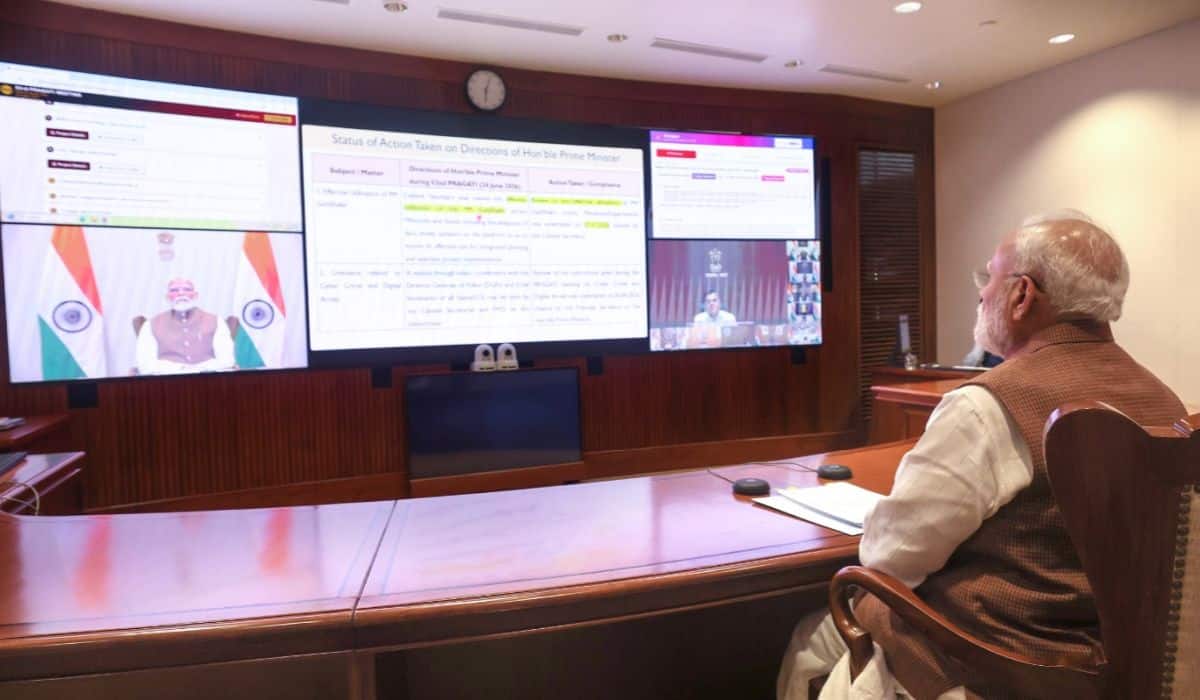
Prime Minister Shri Narendra Modi chaired the 51st meeting of PRAGATI, the ICT-enabled, multi-modal platform aimed at fostering Pro-Active Governance and Timely Implementation, by seamlessly integrating efforts of the Central and State governments, at Seva Teerth, earlier today.

During the meeting, the Prime Minister reviewed seven critical infrastructure projects across the Railways, Power and Road sectors covering nine States worth around ₹30,000 crore. These projects, pivotal to economic growth and public welfare, were reviewed with a focus on timelines, inter-agency coordination, and timely issue resolution. Prime Minister also reviewed Ken Betwa Link Project and Swachh Bharat Mission-Urban 2.0.

While reviewing power sector projects, Prime Minister emphasized the need to accelerate rooftop solar adoption across urban areas, with a special focus on cities, residential clusters and public institutions. He underlined that rooftop solar should be taken up in mission mode to reduce electricity costs, improve energy security and promote clean energy at the household and community level.

While reviewing road and port connectivity projects, it was emphasised that Vadhavan Port should be developed as a model of port-led, multi-modal development, where every major mode of transport is seamlessly integrated to create a future-ready logistics ecosystem. The project should not be seen merely as a port, but as a national gateway connected through coastal shipping, inland waterways, dedicated freight corridors, high-speed rail connectivity, highways and airport linkages.

Prime Minister emphasised the need for effective implementation of Swachh Bharat Mission 2.0 and underlined that the mission should move beyond infrastructure creation and ensure measurable outcomes through regular monitoring, citizen participation and convergence between various stakeholders. He asked States to expedite the completion of solid waste management-related infrastructure, including waste processing plants and GOBARdhan plants.

While reviewing Ken-Betwa River Inter-linking Project, Prime Minister observed that Ken-Betwa project should serve as a model for other States to resolve inter-State water issues through cooperation, timely clearances, technology-based monitoring and mission-mode execution. States were encouraged to identify similar opportunities where river-linking, water conservation, groundwater recharge and efficient irrigation can be taken up in an integrated manner to ensure long-term water security.

Prime Minister also underlined that the delay in the implementation of public projects leads not only to cost escalation but also deprives citizens of timely access to essential facilities and development benefits. He observed that every delay has a direct impact on people’s lives, regional growth and public resources. He stressed that Ministries, Departments and States must adopt a more proactive and time-bound approach to resolve pending issues, remove bottlenecks and ensure faster execution.

Prime Minister also emphasized that innovative use of canal networks should be explored, including installation of solar panels along canals and over canals for clean electricity generation. This would help optimize land use, reduce evaporation losses, generate renewable energy and create additional economic value from water infrastructure.

At the beginning of the meeting, the Cabinet Secretary informed that, in pursuance of the directions of the Prime Minister, a system of monthly review of social sector schemes at the State level has also been operationalised. This mechanism aims to ensure regular monitoring, faster resolution of implementation issues and greater accountability at the State and district levels. As part of this initiative, Swachh Bharat Mission has been taken up for review at the State level in the first instance.