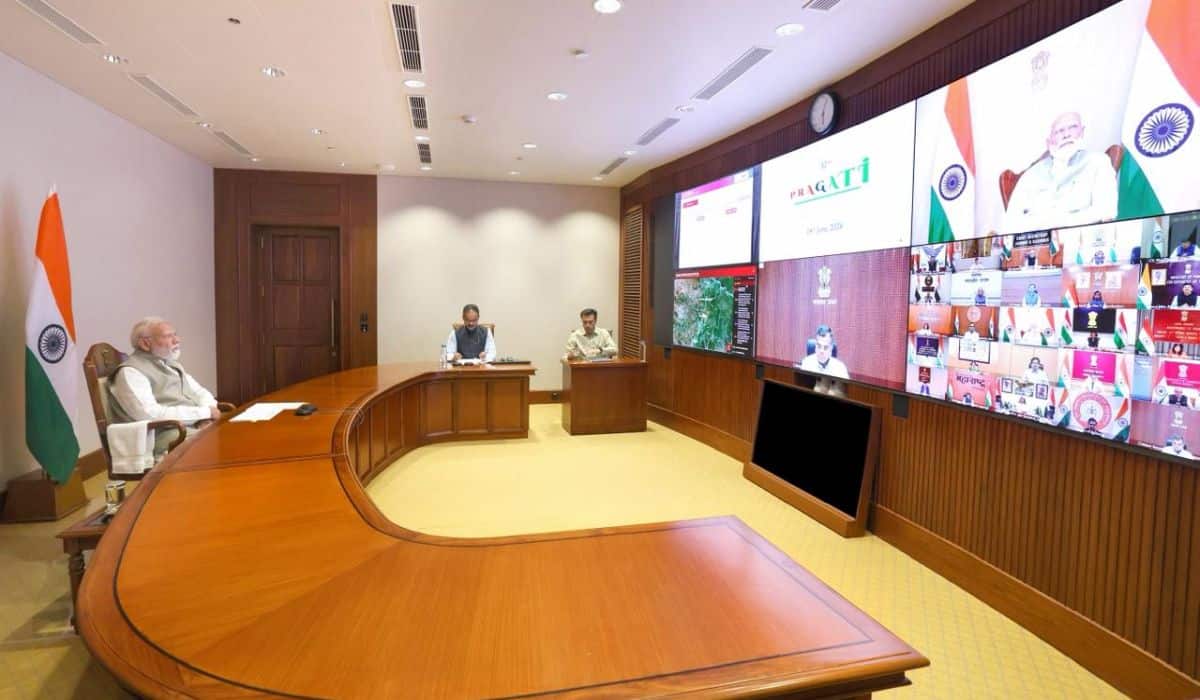
The Union Cabinet, chaired by Prime Minister Shri Narendra Modi, has approved the “Restructuring and extension of the lending period beyond 31.12.2024 of Prime Minister Street Vendor’s AtmaNirbhar Nidhi (PM SVANidhi) Scheme”. The lending period has now been extended until March 31, 2030. The total outlay for the scheme is ₹7,332 crore. The restructured scheme aims to benefit 1.15 crore beneficiaries including 50 lakh new beneficiaries.
Implementation of the scheme would be the joint responsibility of Ministry of Housing & Urban Affairs (MoHUA) and Department of Financial Services (DFS), with DFS being responsible for facilitating access to loan/ credit cards through banks/financial institution and their ground level functionaries.
The key features of the restructured scheme include enhanced loan amount across first & second tranche, provision of UPI-linked RuPay Credit Card for beneficiaries who have repaid the second loan, and digital cashback incentives for retail & wholesale transactions. The scheme’s coverage is being expanded beyond statutory towns to census towns, peri-urban areas etc. in graded manner.
The enhanced loan structure includes first tranche loans increased up to ₹15,000 (from ₹10,000) and second tranche loans increased up to ₹25,000 (from ₹20,000), while the third tranche remains unchanged at ₹50,000.
The introduction of UPI-linked RUPAY Credit Card would provide immediate access of credit to the street vendors in order to meet any emergent business and personal requirements.
Further, in order to give boost to digital adoption, the street vendors can avail cashback incentives upto ₹1,600 on making retail & wholesale transactions.
The scheme also focuses on building the capacity of the street vendors with a focus on entrepreneurship, financial literacy, digital skills, and marketing through convergence. Standard hygiene and food safety trainings would be conducted for street food vendors, in partnership with FSSAI.
In order to ensure holistic welfare & development of the street vendors and their families, the ‘SVANidhi se Samriddhi’ component will be further strengthened, through monthly Lok Kalyan Melas. The intent is to ensure that benefits under various GoI schemes reach the beneficiaries and their families in a saturation approach.
The Government had initially launched PM SVANidhi Scheme on 1st June 2020 to support street vendors who faced unprecedented hardships during the COVID-19 pandemic. However, since the inception of the scheme it has proved to be more than financial support for street vendors and has given them a sense of identity & formal recognition for their contribution to the economy.
The celebrated PM SVANidhi scheme has already achieved significant milestones. As of July 30, 2025, over 96 lakh loans amounting to ₹13,797 crore have been disbursed to more than 68 lakh street vendors. Nearly 47 lakh digitally active beneficiaries have conducted over 557 crore digital transactions worth ₹6.09 lakh crore, earning a total cashback of ₹241 crore. Under the ‘SVANidhi se Samriddhi’ initiative, 46 lakh beneficiaries across 3,564 Urban Local Bodies (ULBs) have been profiled, leading to over 1.38 crore scheme sanctions.
The scheme has received national recognition, winning the Prime Minister’s Award for Excellence in Public Administration (2023) for Innovation (Central Level) for its outstanding contribution to boosting the economy, promoting livelihoods, advancing financial inclusion, and driving digital empowerment and the Silver Award for Excellence in Government Process Re-engineering for Digital Transformation (2022).
The extension of the scheme envisages the holistic development of street vendors by offering a reliable source of finance to support business expansion and opportunities for sustainable growth. This will not only empower street vendors but will also foster inclusive economic growth, socio-economic upliftment of street vendors and their families enhancing their livelihoods, and ultimately transforming urban spaces into a vibrant, self-sustaining ecosystem.
देशभर के अपने रेहड़ी-पटरी वाले भाई-बहनों को आत्मनिर्भर बनाने के लिए हम प्रतिबद्ध हैं। इसी दिशा में आज पीएम स्वनिधि योजना को 31 मार्च, 2030 तक बढ़ाने को मंजूरी दी गई है। मुझे विश्वास है कि यह उनके जीवन में बहुत बड़ा बदलाव लाने में मददगार साबित होगा। https://t.co/6byxlSjOu0
— Narendra Modi (@narendramodi) August 27, 2025