India will soon wear a grand necklace of Industrial Smart Cities on the backbone of Golden Quadrilateral
Government greenlights 12 projects worth Rs. 28,602 crore to revolutionize India's industrial landscape
World-class greenfield industrial smart cities to be built ahead of demand with ‘plug-n-play' and 'walk-to-work' concepts
Robust, sustainable infrastructure to drive investments and spur balanced regional development
Aligning with the vision of Viksit Bharat, these projects will cement India's role in Global Value Chains with ready-to-allot land for investors

India will soon wear a grand necklace of Industrial Smart Cities as in a landmark decision today, the Cabinet Committee on Economic Affairs chaired by the Prime Minister Shri Narendra Modi has approved 12 new project proposals under the National Industrial Corridor Development Programme (NICDP) with an estimated investment of Rs. 28,602 crore. This move is set to transform the industrial landscape of the country creating a robust network of industrial nodes and cities that will significantly boost economic growth and global competitiveness.

Spanning across 10 states and strategically planned along 6 major corridors, these projects represent a significant leap forward in India's quest to enhance its manufacturing capabilities and economic growth. These industrial areas will be located in Khurpia in Uttrakhand, Rajpura-Patiala in Punjab, Dighi in, Maharashtra, Palakkad in Kerela, Agra and Prayagraj in UP, Gaya in Bihar, Zaheerabad in Telangana, Orvakal and Kopparthy in AP and Jodhpur-Pali in Rajasthan.

Key Highlights:

Strategic Investments: NICDP is designed to foster a vibrant industrial ecosystem by facilitating investments from both large anchor industries and Micro, Small, and Medium Enterprises (MSMEs). These industrial nodes will act as catalysts for achieving $2 trillion in exports by 2030, reflecting the government's vision of a self-reliant and globally competitive India.

Smart Cities and Modern Infrastructure: The new industrial cities will be developed as greenfield smart cities of global standards, built "ahead of demand" on the 'plug-n-play' and 'walk-to-work' concepts. This approach ensures that the cities are equipped with advanced infrastructure that supports sustainable and efficient industrial operations.

Area Approach on PM GatiShakti: Aligned with the PM GatiShakti National Master Plan, the projects will feature multi-modal connectivity infrastructure, ensuring seamless movement of people, goods, and services. The industrial cities are envisioned to be growth centers for transformation of whole region.

Vision for a 'Viksit Bharat':

The approval of these projects is a step forward in realizing the vision of ‘Viksit Bharat’ - a developed India. By positioning India as a strong player in the Global Value Chains (GVC), the NICDP will provide developed land parcels ready for immediate allotment, making it easier for domestic and international investors to set up manufacturing units in India. This aligns with the broader objective of creating an 'Atmanirbhar Bharat' or a self-reliant India, fostering economic growth through enhanced industrial output and employment.

Economic Impact and Employment Generation:

NICDP is expected to generate significant employment opportunities, with an estimated 1 million direct jobs and upto 3 million indirect jobs being created through planned industrialization. This will not only provide livelihood opportunities but also contribute to the socio-economic upliftment of the regions where these projects are being implemented.

Commitment to Sustainable Development:

The projects under the NICDP are designed with a focus on sustainability, incorporating ICT-enabled utilities and green technologies to minimize environmental impact. By providing quality, reliable, and sustainable infrastructure, the government aims to create industrial cities that are not just hubs of economic activity but also models of environmental stewardship.

The approval of 12 new industrial nodes under the NICDP marks a significant milestone in India's journey towards becoming a global manufacturing powerhouse. With a strategic focus on integrated development, sustainable infrastructure, and seamless connectivity, these projects are set to redefine India's industrial landscape and drive the nation's economic growth for years to come.

In addition to these new sanctions, the NICDP has already seen the completion of four projects, with another four currently under implementation. This continued progress highlights the government's commitment to transforming India's industrial sector and fostering a vibrant, sustainable, and inclusive economic environment.

Explore More
Today, the entire country and entire world is filled with the spirit of Bhagwan Shri Ram: PM Modi at Dhwajarohan Utsav in Ayodhya

Popular Speeches

Today, the entire country and entire world is filled with the spirit of Bhagwan Shri Ram: PM Modi at Dhwajarohan Utsav in Ayodhya
UPI — an eventful journey

Media Coverage

UPI — an eventful journey
NM on the go

Nm on the go

Always be the first to hear from the PM. Get the App Now!
...
PM chairs 53rd PRAGATI Meeting
August 25, 2026
PM reviews six key infrastructure projects across the Railway, Road and Power sectors
Projects reviewed span across 9 States with cumulative investment of more than ₹30,000 crore
PM says Infrastructure projects should be viewed as an integrated whole, rather than as individual sections or packages
PM calls for continuous reforms across all stages of project implementation and a proactive work culture across Ministries and States
PM says Speed must go hand-in-hand with quality
While reviewing AgriStack, PM emphasises the need to leverage the latest digital technologies including AI to derive greater value from agricultural data
On cyber fraud and ‘digital arrest’, PM stresses training, public awareness, cyber-safety education and coordinated action

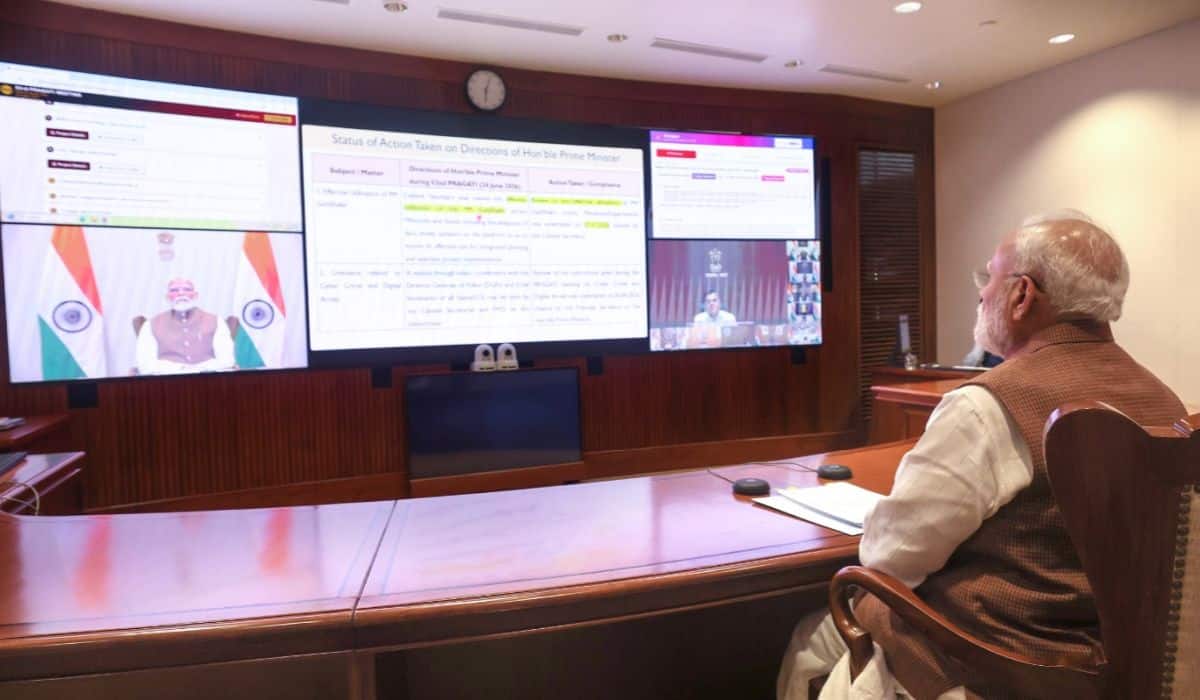
Prime Minister Shri Narendra Modi chaired the 53rd meeting of PRAGATI, the ICT-enabled, multi-modal platform for Pro-Active Governance and Timely Implementation, at Seva Teerth earlier today.

During the meeting, Prime Minister reviewed six key infrastructure projects across the Railway, Road and Power sectors, spanning nine States with a cumulative cost of more than ₹30,000 crore. The projects, significant for strengthening connectivity, supporting industrial and economic activity and improving public services, were reviewed with particular emphasis on adherence to timelines, inter-agency coordination, resolution of pending issues and expeditious completion.

Prime Minister emphasised that delays in infrastructure projects have consequences beyond cost escalation, as they also postpone the benefits intended for citizens, businesses and the economy. He said that infrastructure projects should be viewed and monitored as an integrated whole, rather than as isolated sections, stretches or packages. He noted that progress in individual packages should ultimately translate into timely completion and operationalisation of the entire project. Ministries and States were therefore asked to adopt an end-to-end approach, and address critical gaps that could delay the overall commissioning and delivery of benefits. He called for fostering a proactive work culture across Ministries and State Governments, with greater ownership at every level of project implementation.

Prime Minister stressed the need to explore common utility corridors for infrastructure services, wherever feasible, particularly while planning major transport and infrastructure projects. He called upon Ministries and States to examine such integrated approaches at the planning stage itself, keeping in view their technical and economic feasibility.

Prime Minister said that speed of execution must be accompanied by uncompromising quality. He called upon Ministries, States and implementing agencies to adopt modern technologies and strengthen quality assurance and supervision at every stage.

While reviewing AgriStack under the Digital Agriculture Mission, Prime Minister emphasised the need to leverage the latest digital technologies, including Artificial Intelligence, to derive greater value from agricultural data. He stressed that the data ecosystem should be effectively utilised across the agricultural value chain, from input planning to processing, enabling more informed interventions, better targeting and data-driven decision-making. He appreciated the efforts of the States and the Central Government in building the AgriStack ecosystem and called for further strengthening its use for delivering better outcomes for farmers.

During the review of cyber fraud cases, including incidents of digital arrest, Prime Minister said that prevention must be strengthened through a sustained focus on training, awareness and education. He stressed the need for continuous and targeted public-awareness campaigns, particularly for senior citizens, youth and other vulnerable sections, to familiarise them with common fraud techniques, warning signs and safe digital practices. He also called for regular capacity-building of personnel involved so that emerging modes of cyber fraud are identified and acted upon swiftly.