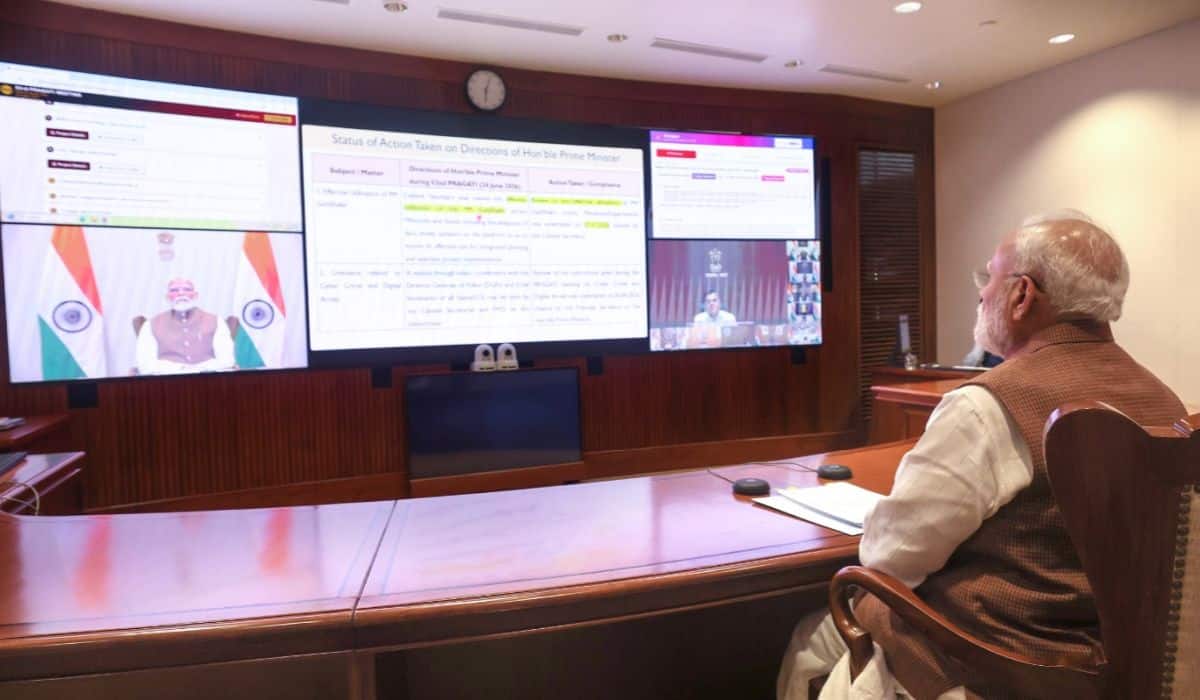
Heartiest congratulations to all of you on this grand event of 'Kalam No Carnival'. The tradition of book fair started by 'Nav Bharat Sahitya Mandir' every year in Ahmedabad is getting enriched with the passage of time. Through this initiative, the literature and knowledge of Gujarat is getting expanded, and the new young writers and novelists are also getting a platform.
I congratulate Navbharat Sahitya Mandir as well as all its members for this rich tradition. I also extend my best wishes to Mahendra Bhai and Ronak Bhai through the efforts of whom this book fair is benefiting the people of Gujarat.
Friends,
'Kalam No Carnival' is a huge collection of Hindi and English language books besides the books in Gujarati language. The motto of this event set by you i.e. 'Vanche Gujarat, Vanchanne Wadhave Gujarat', is also extremely relevant. When I was working amidst you all in Gujarat, Gujarat had also started the 'Vanche Gujarat' campaign. Today campaigns like 'Kalam No Carnival' are carrying forward the same resolve of Gujarat.
Friends,
Books and texts both are the basic elements of our 'Vidya Upasana'. There has been a very old tradition of libraries in Gujarat. Our Vadodara Maharaja Sayajirao ji had set up libraries at prominent places of his region. I was born in a village where there was a very good library in my village Vadnagar. Maharaja Bhagwat Singh Ji of Gondal had produced a prodigious dictionary like 'Bhagwat Gomandal'. When I was in Gujarat, some families would try to look for good names to name their children. Some people would ask me to suggest names. They used to look for books for the same. So once someone raised this topic and I asked them to go through 'Bhagwat Gomandal'. This is a book where you will find countless Gujarati words and a suitable name for your child too. And indeed there are several references and meanings. Such a rich tradition we have!
Similarly, the great poet Narmad had edited the 'Narm Kosh'. And this tradition continued till our Keka Shastri ji. Keka Shastri ji, who was with us for more than 100 years, also contributed a lot in this field. The history of Gujarat has been very rich in terms of books, authors and literary creations. I hope such book fairs reach the people in every corner of Gujarat and to every youngster so that they also get to know this history and can draw new inspiration.
Friends,
This year the book fair is being organized at a time when the country is celebrating the 'Azadi Ka Amrit Mahotsav'. One dimension of Amrit Mahotsav is all about the ways by which we revive the history of our freedom struggle. How do we pass this on to our future generations? We are committed to bringing back the glory of the forgotten chapters of the freedom struggle in front of the country and this will be possible with the efforts of all of you.
Events like 'Kalam No Carnival' can give impetus to this campaign. Special importance can be given to books related to the freedom struggle in the book fair. Such writers can be given a strong platform. I am sure this event will prove to be a positive medium in this direction.
Friends,
It has been said in our scriptures -
शास्त्र सुचिन्तित पुनि पुनि देखिअ।
That is, one should study the scriptures, texts and books again and again, only then they remain effective and useful. These words have become even more significant because today in this internet era, the people are taking the help of the internet whenever needed. Technology is undoubtedly an important source of information for us, but it is not a way to replace books or reading books. When information is in our mind, then the brain processes that information deeply and newer dimensions related to it come to our mind.
Now let me give you a small task. We all must have heard 'Vaishnav Jan To Tene Re Kahiye' composed by Narsinh Mehta. How many times would you have listened to it or sung it? Do one thing. Place it in a written form before you, sit with it and think about the things writen that are relevant in today's context. I can say with complete confidence that the 'Vaishnava Jan To' that you have heard thousands of times will start giving you hundreds of new meanings each time when you start thinking over it and try to understand it in today's context. This is the power! That is why, having the book with us, and the written pages in front of us, is a huge power for new innovations and research. It takes the debates deeper.
Therefore, with the changing times, our habit of reading books should be maintained. It is very crucial. Then whether the books are in physical form or in digital form, it doesn't really matter! I believe such events will play a major role in creating the necessary attraction for books among the youth and in understanding their significance.
Friends,
As I am talking to my people of Gujarat, I want to say another thing. When we think of building a new house, we hold a lot of discussions with the Architect about where we will have a dining room, a drawing room, a worship room and some even decide a place for keeping clothes but I request you to also decide a place to store books while building your homes. You can go to the book store and take your children too. Just make it a habit to have a corner of your house only for books. We generally do not do this.
You might be aware that I used to make repetitive requests in Gujarat, be it any programme or event. I used to say - "Gift a book instead of a bouquet". It is because the life-span of a bouquet is very less. So, I would ask people to bring books as it will also increase the sales of the books. It will financially help the publishers and writers. Sometimes we don't have a habit of buying books. However, buying a book is kind of a social service because we should naturally support the people dedicated to such work. Make a habit of buying books. The habit of keeping the book should be inculcated. I had seen many people in Gujarat distributing books to every household and requesting them to read and purchase the book and if they didn't find it worth buying, they could return it. We have seen many such people. I remember a gentleman who used to organize a book festival in Bhavnagar. Many people have been doing this type of work. But our system should be such that we have the reading habit in our family.
We have a saying, "Saraswati lupt hai, gupt hai". My logic is slightly different in the context of literature. And this logic pertains to the literary world. Saraswati is the goddess of knowledge. The saying 'Saraswati lupt hai, gupt hai' means that Saraswati keeps connecting the past, present and the future in a secret way through books. That's why we must understand the value of the book fairs. We should attend book fairs with the family. And when you look at the book and touch it by hand, you will feel that even such a topic has been touched upon and thought upon. That's why I expect all my brothers and sisters of Gujarat to read a lot and think a lot. And then engage in a lot of brainstorming. They should give a lot to the future generations. And our active participation in this fair will also be a kind of tribute to the eminent writers and authors of Gujarat. I wish you all the very best! Once again I extend my good wishes to all the readers, thereby ending my speech.
In the same spirit, wishing you all the very best once again.
Thank you!