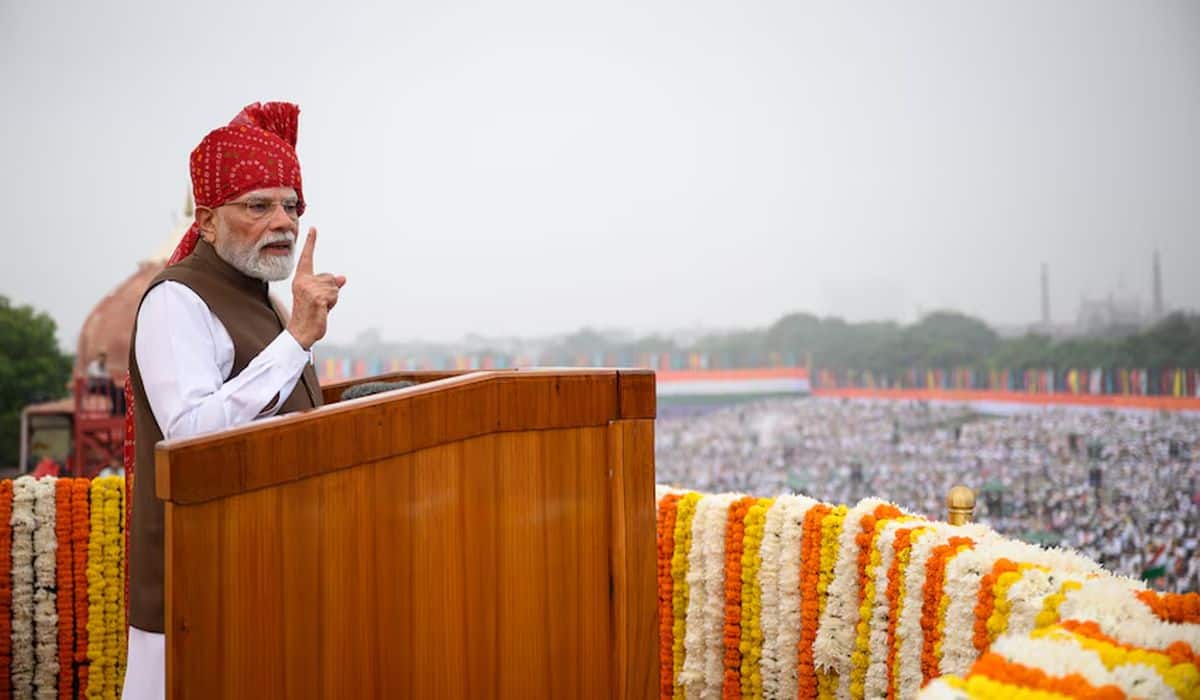
PM Modi flagged off five Vande Bharat Trains that will connect the six states of India including Madhya Pradesh, Goa, Karnataka, Jharkhand, Maharashtra and Bihar. After this, he addressed a public meeting on ‘Mera Booth Sabse Majboot’ in Bhopal. PM Modi acknowledged the role of the state of Madhya Pradesh in making the BJP the biggest political party in the world.

PM Modi also acknowledged the efforts of the Booth Karyakartas in bolstering the party over the past nine years. He said that it was the unflinching dedication of the Party Karyakartas and their dedication toward ‘Mother India’ that prompted him to meet them as soon as he arrived from his state visit to the US and Egypt.

Responding to the question on the reconciliation of the booth with the larger scheme of things, PM Modi said that the booth itself serves as a major center to identify the various persistent issues. These booths serve as a mechanism for feedback at the grassroots level. It is the importance of these booths that the Ujjwala Yojana could be implemented at such a large scale that has enabled the provision of clean cooking fuel to all.

The booths can serve as the catalyst for change and the Booth Karyakartas must take the initiative to be the pioneers of change. The booths can serve as nerve centers of education and information, where newspaper reading can be promoted collectively. Vehicle pooling to enable efficient transport of urea to villages is also something that can be facilitated at the Booth level, which can promote the resolution of various issues concerning agriculture.

Replying to the question on how Party Karyakartas can enable the development of villages, PM Modi said that for India to be a developed nation by 2047, its villages have to develop first. He said that the concerted efforts by Booth Karyakartas across the villages in India to enable cleanliness, nutritional security, harnessing solar energy, and dairy development of the villages by promoting essential values of village empowerment can lead to the development of villages, which in turn will lead to a developed India.
Speaking on the question posed on the wider dissemination of Government schemes and development works carried out by the Government, PM Modi acknowledged that information dissemination has been taking place at a good pace but it is important to keep focusing on further improvements in the dissemination of information as the aim is 100% coverage of all schemes for all people. For example, if an individual has received housing facilities under PM Awas Yojana, then our Booth Karyakartas have to ensure that they receive the benefits of the Mudra Yojana so that there is an attainment of universal coverage of all schemes.

On the issue of appeasement being the norm for social justice to transform people’s lives in the truest sense, PM Modi said that there are political forces that only survive on appeasement politics, but the BJP Government has always prioritized the empowerment of all. He said the politics of appeasement is also linked closely to corruption and there are political parties that thrive on this culture. The previous Governments had not prioritized the development of India, but the BJP has always kept the ‘Nation First.’
Over the nine years the BJP has only sought to provide developmental benefits to all, irrespective of their caste, creed, and religion among other distinctions. PM Modi highlighted how the BJP Government has uplifted the various downtrodden sections not only domestically but internationally, which showcases how the Government has always worked on furthering saturation and complete coverage and true social justice.
Addressing the question of ‘Vote-Bank Politics’, PM Modi stated that the social, economic and political mainstreaming of the Muslim community will only lead to their true development in this country.

Issues like Triple Talaq have only worked toward manifesting the exploitation of Muslim women, creating large scale social ramifications and disempowering them. It is this Government that has worked toward improving these concerns by banning ‘instant Triple Talaq.’ Various political forces who speak about empowering Muslims have supported Triple Talaq, when countries like Egypt, Bangladesh, and Qatar have banned it.
Various political parties benefit by isolating minorities from the fruits of development and use issues like the Uniform Civil Code issue to further enrage them. Hence, our Booth Karyakartas have a special role in communicating the intent of the Government to the people of the Muslim community, making them aware of their rights in the truest sense.
Answering the question on the opposition parties of conflicting ideologies forming an alliance, PM Modi stated there is a sense of unease among the various political parties, who earlier staunchly opposed each other and are now uniting. This sense of fear by the opposing alliance generates confidence in the fact that the BJP will again emerge victorious in 2024. For the same reason, it is important that the Booth Karyakartas ensure that they ask the people to vote for the BJP if they wish to see the continued development of their region and this country. It is important to convey to the people that voting for the opposing alliance is voting for corruption and scandals.
PM Modi said that if people wish to promote the betterment of dynasts, then they may vote for those political parties in the various states of India. He further added, “If you wish to support the flourishing of the sons and daughters of the various political parties, vote for them but if you wish to see the flourishing and development of your sons and daughters then vote for the BJP. It is the BJP that is the only party that is enabling the development of the masses creating opportunities and avenues for their future.”

Placing emphasis on how the various initiatives of the Government have enabled savings and reduction of costs for the common man in India, PM Modi said that it is important that Booth Karyakartas disseminate the various initiatives undertaken by the Government and to communicate the same effectively. PM Modi said that when the rates of inflation are extremely high in our neighboring countries, especially owing to the COVID Pandemic in India, it is significantly low. When Jan Aushadhi Kendras facilitates the availability of quality medicines at affordable prices, it is enabling saving and cost reduction for the people of India.
Similarly, when LED Bulbs are available at reduced prices compared to the previous governments, it showcases the intent of the Government to ease the living of the people in India. These are some of the instances that also with others have to be communicated effectively by the Booth Karyakartas with the people of India.

PM Modi while responding to the question posed with respect to the farmers of India said how the farmers were exploited under the previous regime. The Congress Party waived off farm loans worth but the benefit of those never reached the farmers who were in a dire need of it. Various farmers were deprived of formal sources of credit, and to make matters worse, many of them were forced to buy all agricultural inputs at an exorbitant price.
PM Modi said, “It is the BJP Government that has enabled the development of our farmers.” Further, he said, “Keeping in mind the adverse effects of climate change, it is the BJP Government that envisaged the promotion of ‘Shree Anna’ that has enabled sustainable agricultural practices in India benefitting all the farmers in the country also keeping in mind India’s nutritional imperative.”
In conclusion, PM Modi highlighted how India has transformed across sectors in the past nine years. He said that India is taking rapid strides in this Amritkaal, while also fulfilling the dreams of eminent personalities such as BR Ambedkar, RM Lohia of a modern and inclusive India. He also conveyed to the Karyakartas that to enable the BJP to win the 2024 elections, it is important that all unite and concentrate their efforts to ensure victory.
मुझे देश के 6 राज्यों को जोड़ने वाली 5 वंदे भारत ट्रेनों को हरी झंडी दिखाने का अवसर मिला है।
— narendramodi_in (@narendramodi_in) June 27, 2023
मैं मध्य प्रदेश, झारखंड, बिहार, कर्नाटक, गोवा और महाराष्ट्र की जनता को इस आधुनिक कनेक्टिविटी के लिए बधाई देता हूं: PM @narendramodi pic.twitter.com/vl0JXfSZtr
भाजपा के हर कार्यकर्ता के लिए देशहित सर्वोपरि है, दल से बड़ा देश है। pic.twitter.com/gRnFwHN8WX
— narendramodi_in (@narendramodi_in) June 27, 2023
2047 में भारत विकसित तभी होगा, जब गांव विकसित होगा। pic.twitter.com/Ksovwvadp2
— narendramodi_in (@narendramodi_in) June 27, 2023
हमारा लक्ष्य सैचुरेशन का है, शत-प्रतिशत कवरेज का है, हर सुविधा का लाभ देने का है। pic.twitter.com/lVWVxDAaWt
— narendramodi_in (@narendramodi_in) June 27, 2023
भाजपा की प्राथमिकता - दल से पहले देश। pic.twitter.com/qYYIEH8Q4Z
— narendramodi_in (@narendramodi_in) June 27, 2023
भाजपा ने ये तय किया है हमें तुष्टिकरण के रास्ते पर नहीं चलना है।
— narendramodi_in (@narendramodi_in) June 27, 2023
हम ये मानते हैं कि देश का भला संतुष्टिकरण में है। pic.twitter.com/JqEN2NWYO4
मुसलमान बेटियों पर तीन तलाक का फंदा लटकाकर, कुछ लोग उन पर हमेशा अत्याचार करने की खुली छूट चाहते हैं।
— narendramodi_in (@narendramodi_in) June 27, 2023
यही लोग तीन तलाक का समर्थन भी करते हैं। pic.twitter.com/YlHHmcQcjy
भारत के संविधान में नागरिकों के समान अधिकार की बात कही गई है। pic.twitter.com/GvgWkb6sSq
— narendramodi_in (@narendramodi_in) June 27, 2023
देश की जनता ने 2024 के चुनाव में भाजपा को वापस लाने का मन बना लिया है।
— narendramodi_in (@narendramodi_in) June 27, 2023
2024 में फिर एक बार भाजपा की प्रचंड विजय तय है, इसी वजह से तमाम विपक्षी दल बौखलाए हुए हैं। pic.twitter.com/7xWnutnUQu
विपक्षी दल गारंटी है - भ्रष्टाचार की।
— narendramodi_in (@narendramodi_in) June 27, 2023
ये गारंटी हैं - लाखों करोड़ रुपए के घोटालों की। pic.twitter.com/sxSvmQYStW
कोरोना के बावजूद, इतने समय से चले जा रहे युद्ध के बावजूद भारत में हमने महंगाई को बेकाबू नहीं होने दिया है। pic.twitter.com/VM0rpmmrQA
— narendramodi_in (@narendramodi_in) June 27, 2023
कांग्रेस की एक ही नीति थी...
— narendramodi_in (@narendramodi_in) June 27, 2023
पहले किसानों को संकट में पड़ने दो और फिर कर्जमाफी के नाम पर झूठ बोलकर वोट की फसल काटो। pic.twitter.com/p37eJyUcX8
भाजपा सरकार आज पीएम किसान सम्मान निधि से सीधा पैसा किसान के बैंक खाते में भेज रही है। pic.twitter.com/CVJ63GDFAW
— narendramodi_in (@narendramodi_in) June 27, 2023