PM addresses G20 Culture Ministers’ Meeting

Published By : Admin | August 26, 2023 | 09:47 IST
“Kashi is known to be a treasure chest of knowledge, duty and truth and it is indeed the cultural and spiritual capital of India”
“We in India are very proud of our eternal and diverse culture. We also attach great value to our intangible cultural heritage”
“‘Yuge Yugeen Bharat’ National Museum upon completion will stand as world's largest museum showcasing India's history and culture spanning over 5,000 years”
“Tangible heritage is not only of material value but it is also the history and identity of a nation”
“Heritage is a vital asset for economic growth and diversification, and it is echoed in India’s mantra of ‘Vikas Bhi Virasat Bhi’”
“India’s National Digital District Repository is helping rediscover the stories of freedom struggle”
“Working group reflects the importance of the four Cs - Culture, Creativity, Commerce and Collaboration”

The Prime Minister, Shri Narendra Modi addressed the G20 Culture Ministers’ Meeting held in Varanasi, Uttar Pradesh via video link today.

The Prime Minister welcomed the dignitaries to Varanasi, also known as Kashi, and expressed delight that the G20 Culture Ministers’ Meeting is taking place here as the city is his parliamentary constituency. Referring to Kashi as one of the oldest living cities, the Prime Minister mentioned the nearing town of Sarnath where Lord Buddha delivered his first sermon. “Kashi is known to be a treasure chest of knowledge, duty and truth and it is indeed the cultural and spiritual capital of India”, the Prime Minister remarked and suggested the guests witness the the Ganga Aarti program, pay a visit to Sarnath and try out the delicacies of Kashi.

Highlighting the inherent potential of culture to unite and enable us to understand diverse backgrounds and perspectives, the Prime Minister said that the work of the G20 Culture Ministers Group holds immense significance for entire humanity. “We in India are very proud of our eternal and diverse culture. We also attach great value to our intangible cultural heritage”, Shri Modi said as he underlined that India has been working hard to preserve and revitalize its heritage sites. He mentioned mapping the country’s cultural assets and artists at the national level as well as village level. He also mentioned building several centers to celebrate India’s culture and gave the example of the tribal museums located in different parts of the country which showcase the vibrant culture of India's tribal communities. Referring to the Prime Ministers’ Museum in New Delhi, the Prime Minister said that it is a one-of-a-kind effort to showcase India's democratic heritage. He also mentioned developing the ‘Yuge Yugeen Bharat’ National Museum, which upon completion will stand as the world's largest museum showcasing India's history and culture spanning over 5,000 years.

Speaking about the important issue of restitution of cultural property, the Prime Minister welcomed the efforts of the working group and said that tangible heritage is not only of material value but it is also the history and identity of a nation. Shri Modi remarked, “Everyone has the right to access and enjoy their cultural heritage.” Since 2014, the Prime Minister informed that India has brought back hundreds of such artifacts that showcase the glory of its ancient civilisation. He also commended the efforts towards living heritage as well as contributions to ‘Culture for LiFE’. After all, the Prime Minister said, cultural heritage is not just what is cast in stone, it is also the traditions, customs and festivals that are handed down the generations. The Prime Minister expressed confidence that the efforts of the working group will foster sustainable practices and lifestyles.

The Prime Minister underlined that heritage is a vital asset for economic growth and diversification, and it is echoed in India’s mantra of ‘Vikas Bhi Virasat Bhi’ which means development as well as heritage. “India takes pride in its 2,000-year-old craft heritage, with nearly 3,000 unique arts and crafts”, the Prime Minister said as he highlighted the ‘One District, One Product’ initiative which showcases the uniqueness of Indian crafts while fostering self-reliance at the same time. He emphasized that the efforts of G20 nations towards promoting cultural and creative industries hold profound significance as they will facilitate inclusive economic development and support creativity and innovation. In the coming month, the Prime Minister informed that India is going to roll out the PM Vishwakarma Yojana with an initial outlay of 1.8 billion dollars. He stated that it would create an ecosystem of support for traditional artisans and enable them to flourish in their crafts and contribute to the preservation of India's rich cultural heritage.

Noting that technology is an important ally in celebrating culture, the Prime Minister mentioned India’s National Digital District Repository which is helping rediscover the stories of freedom struggle. He emphasized India’s usage of technology to ensure better preservation of its cultural landmarks while also making places of cultural importance more tourist-friendly.

Concluding the address, the Prime Minister expressed delight that the G20 Culture Ministers’ working group has launched the ‘Culture Unites All’ campaign which encapsulates the spirit of Vasudhaiva Kutumbakam - One Earth, One Family, One Future. He also commended their pivotal role in shaping a G20 Action Plan with tangible outcomes. “Your work reflects the importance of the four Cs - Culture, Creativity, Commerce and Collaboration. It will enable us to harness the power of culture to build a compassionate, inclusive and peaceful future”, the Prime Minister concluded.

Click here to read full text speech

Explore More
শ্ৰী ৰাম জনমভূমি মন্দিৰৰ ধ্বজাৰোহণ উৎসৱত প্ৰধানমন্ত্ৰীৰ সম্বোধনৰ অসমীয়া অনুবাদ

Popular Speeches

শ্ৰী ৰাম জনমভূমি মন্দিৰৰ ধ্বজাৰোহণ উৎসৱত প্ৰধানমন্ত্ৰীৰ সম্বোধনৰ অসমীয়া অনুবাদ
UPI — an eventful journey

Media Coverage

UPI — an eventful journey
NM on the go

Nm on the go

Always be the first to hear from the PM. Get the App Now!
...
PM chairs 53rd PRAGATI Meeting
August 25, 2026
PM reviews six key infrastructure projects across the Railway, Road and Power sectors
Projects reviewed span across 9 States with cumulative investment of more than ₹30,000 crore
PM says Infrastructure projects should be viewed as an integrated whole, rather than as individual sections or packages
PM calls for continuous reforms across all stages of project implementation and a proactive work culture across Ministries and States
PM says Speed must go hand-in-hand with quality
While reviewing AgriStack, PM emphasises the need to leverage the latest digital technologies including AI to derive greater value from agricultural data
On cyber fraud and ‘digital arrest’, PM stresses training, public awareness, cyber-safety education and coordinated action

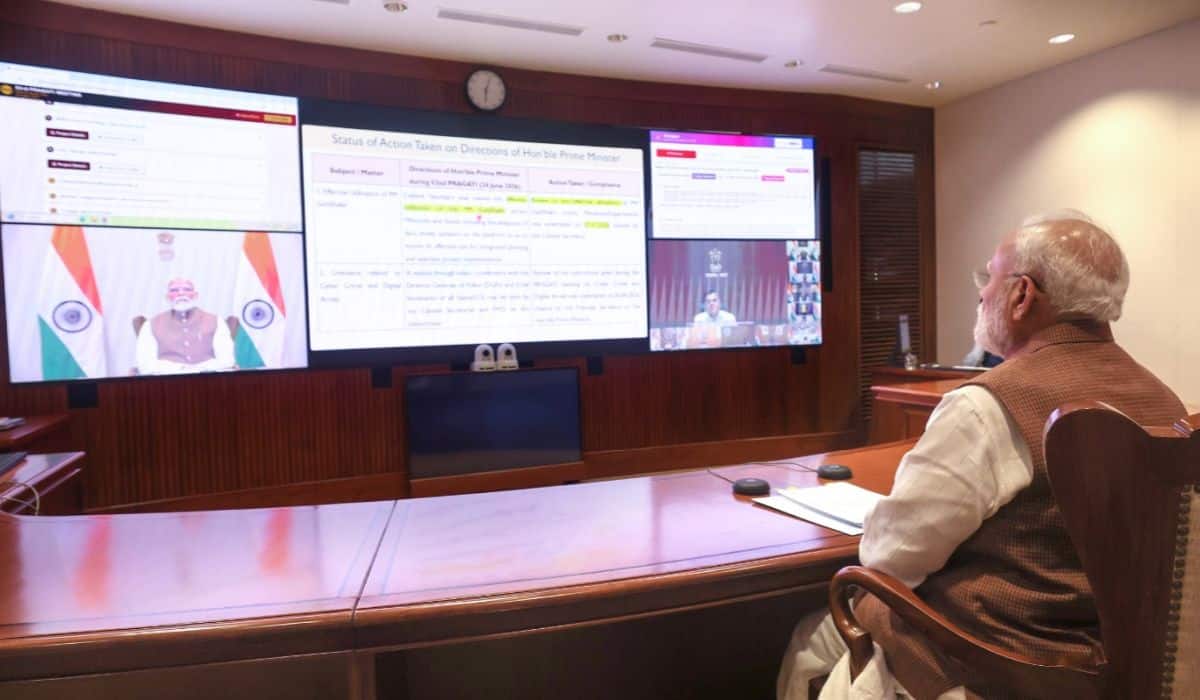
Prime Minister Shri Narendra Modi chaired the 53rd meeting of PRAGATI, the ICT-enabled, multi-modal platform for Pro-Active Governance and Timely Implementation, at Seva Teerth earlier today.

During the meeting, Prime Minister reviewed six key infrastructure projects across the Railway, Road and Power sectors, spanning nine States with a cumulative cost of more than ₹30,000 crore. The projects, significant for strengthening connectivity, supporting industrial and economic activity and improving public services, were reviewed with particular emphasis on adherence to timelines, inter-agency coordination, resolution of pending issues and expeditious completion.

Prime Minister emphasised that delays in infrastructure projects have consequences beyond cost escalation, as they also postpone the benefits intended for citizens, businesses and the economy. He said that infrastructure projects should be viewed and monitored as an integrated whole, rather than as isolated sections, stretches or packages. He noted that progress in individual packages should ultimately translate into timely completion and operationalisation of the entire project. Ministries and States were therefore asked to adopt an end-to-end approach, and address critical gaps that could delay the overall commissioning and delivery of benefits. He called for fostering a proactive work culture across Ministries and State Governments, with greater ownership at every level of project implementation.

Prime Minister stressed the need to explore common utility corridors for infrastructure services, wherever feasible, particularly while planning major transport and infrastructure projects. He called upon Ministries and States to examine such integrated approaches at the planning stage itself, keeping in view their technical and economic feasibility.

Prime Minister said that speed of execution must be accompanied by uncompromising quality. He called upon Ministries, States and implementing agencies to adopt modern technologies and strengthen quality assurance and supervision at every stage.

While reviewing AgriStack under the Digital Agriculture Mission, Prime Minister emphasised the need to leverage the latest digital technologies, including Artificial Intelligence, to derive greater value from agricultural data. He stressed that the data ecosystem should be effectively utilised across the agricultural value chain, from input planning to processing, enabling more informed interventions, better targeting and data-driven decision-making. He appreciated the efforts of the States and the Central Government in building the AgriStack ecosystem and called for further strengthening its use for delivering better outcomes for farmers.

During the review of cyber fraud cases, including incidents of digital arrest, Prime Minister said that prevention must be strengthened through a sustained focus on training, awareness and education. He stressed the need for continuous and targeted public-awareness campaigns, particularly for senior citizens, youth and other vulnerable sections, to familiarise them with common fraud techniques, warning signs and safe digital practices. He also called for regular capacity-building of personnel involved so that emerging modes of cyber fraud are identified and acted upon swiftly.