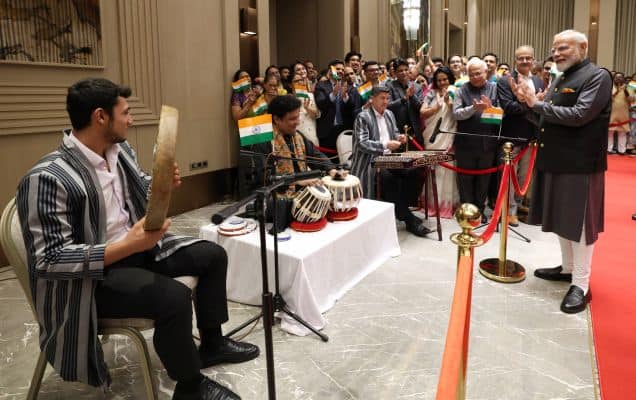
The Prime Minister, Shri Narendra Modi, today inaugurated the National Tribal Carnival in New Delhi. Speaking on the occasion after witnessing an enthralling carnival parade, he said this is the first time that tribal groups from across the country would be in Delhi at the time of the festive occasion of Diwali. He said the tribal carnival would showcase the capabilities of the tribal communities, in the national capital.

The Prime Minister said India is a land of great diversity. He said the carnival parade presented at the function today had offered just a small glimpse of this diversity.

The Prime Minister said the life of the tribal communities was marked by intense struggle. Yet, he added, the tribal communities had imbibed the ideals of community living, and of living cheerfully despite troubles.

Shri Narendra Modi said he was fortunate to have had the occasion for social work among the tribals in his youth. He recalled that it is difficult to hear a complaint escape their lips. In this respect, he added, the people living in urban areas can draw inspiration from them.

He said adivasis had the skills to make innovative products from local materials. These could be in great demand, and create great economic opportunity, if marketed well, he added. The Prime Minister gave several illustrations of innovations that had made a positive difference in the lives of the tribal communities. He recalled that it was former Prime Minister, Shri Atal Bihari Vajpayee, who had created a separate Ministry of Tribal Affairs in the Government of India.

The Prime Minister said change could not come for the tribal communities through a top down approach. He said it was necessary to make the tribal communities real stakeholders in the development process. In this context, he mentioned the Vanbandhu Kalyan Yojana.
The Prime Minister complimented the tribal communities for their role in the conservation of forests. The Prime Minister said most of our natural resources and forests were found in the same parts of the country, as tribal communities. He said while resources had to be harnessed, exploitation of tribals could not be allowed. The Prime Minister said the District Mineral Foundation, envisaged in the last Union Budget, would help channelize funds for the development of the tribal communities. He said this decision would unlock huge amounts of money for development of the mineral rich districts.

The Prime Minister said the Government was committed to using modern technology such as underground mining and coal gasification, which would minimize disturbance to tribal settlements. He also spoke of the Rurban Mission, which would focus on development of rural growth centres.

The capital is delighted to welcome people from tribal communities across India, that too during this festive season: PM @narendramodi
— PMO India (@PMOIndia) October 25, 2016
The capital is delighted to welcome people from tribal communities across India, that too during this festive season: PM @narendramodi
— PMO India (@PMOIndia) October 25, 2016
Our tribal communities have faced difficulties. They have also been blessed with the ability to overcome them & look ahead: PM @narendramodi
— PMO India (@PMOIndia) October 25, 2016
Have spent years working in tribal dominated areas and have interacted with them closely: PM @narendramodi
— PMO India (@PMOIndia) October 25, 2016
अभावों एवं काफ़ी परेशानियों के बावजूद जीवन जीने का ऐसा तरीका बनाया, हर पल ख़ुशी, कदम से कदम मिलाकर चलाकर चलना, ये उन्होंने सिखाया है: PM
— PMO India (@PMOIndia) October 25, 2016
भारत जैसे विशाल देश में विविधताओं को संजोये रखना एवं इन्हें भारत की एकता के रूप में प्रदर्शित करना ही देश के ताकत को बढ़ाता है : PM
— PMO India (@PMOIndia) October 25, 2016
India has a substantial tribal community population but it was under Atal Ji that a separate ministry for tribal communities was formed: PM
— PMO India (@PMOIndia) October 25, 2016
If there is someone who saved the forests it is our tribal communities. Saving forests is a part of tribal culture: PM @narendramodi
— PMO India (@PMOIndia) October 25, 2016
वनबंधु कल्याण योजना के तहत जनजातीय समुदायों की आवश्यकताओं को प्राथमिकता दी जा रही है और हम इस दिशा में काम कर रहे हैं: PM @narendramodi
— PMO India (@PMOIndia) October 25, 2016
वनों को हमारे जनजातीय समुदायों ने बचाया है : PM @narendramodi
— PMO India (@PMOIndia) October 25, 2016
जनजातीय समुदायों को उनका हक़ मिलना चाहिए, ये हमारी प्राथिमकता है। उनकी जमीं छीनने को किसी को अधिकार नहीं होना चाहिए : PM @narendramodi
— PMO India (@PMOIndia) October 25, 2016