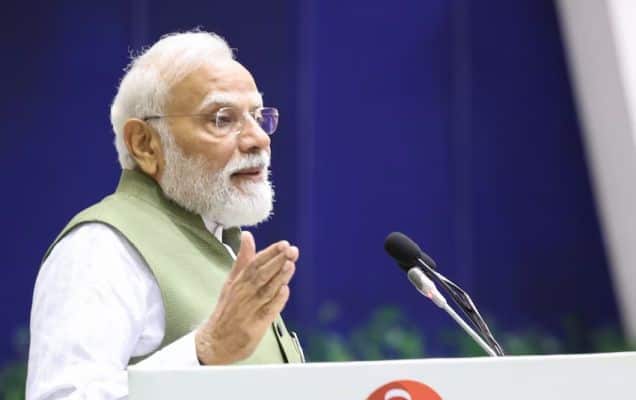
His Excellency President of the Republic of South Africa, Mr.Jacob Zuma,
Friends,
Thank you, Excellency, for your warm words of welcome and for your generous hospitality. Even though this is my first visit to this great country, my delegation and I already feel at home in this Rainbow Nation. For this, Excellency,we are deeply gratefulto you. For me personally, this visit is an opportunity to pay homage to two of the greatest human souls to have ever walked this Earth - Mahatma Gandhi and Nelson Mandela.
Friends,
Through centuries, India and South Africa have nurtured strong people to people ties.We stood together in our common fight against racial subjugation and colonialism.It was in South Africa that Gandhifound his true calling.He belongs as much to India as to South Africa.
Friends,
Our shared values, suffering and struggles provide a strong foundation to our strategic partnership. And,its success is visibleacross a range of sectors.In our discussions today, President Zuma and I reviewed the full spectrum of our engagement.We agreed that in the last two decades, our relationship has been a story of strong advances and concrete achievements. Two way trade has grownby over 300 percent in last ten years. Indian companies hold strong business interests in South Africa. About one fourth of our investments in Africa are in this country.

And, there is potential to expand our business and investment ties further, especially in the areas of:
- Minerals and mining;
- chemicals and pharmaceuticals;
- high-technology manufacturing; and
- information and communication technology.
I am convinced that Industry to industry ties can not only bring rich economic gains to our societies.They can give a new shape to our partnership, and drive it to new levels.And, in the process, also help both our nations to play a more robust regional and global role.Later today, the President and I will sit down with the business leadership of the two countries to identify synergies in our engagement.
Friends,
The nature of our developing economies demands that our engagement should also focus on improving our human capital. Our capacities and needs in the fields of vocational, technical and professional education complement each other, and can benefit both our people. India is also ready to share it's expertise and capacities for the development of small and medium business in South Africa. Beyond economic ties, and links of business, trade and investment, we can also partner in the field of defence and security. Both, at the level of industry and for our strategic and security needs. In India, this is one of the sectors witnessing a complete transformation. It offers exciting opportunities in defence trade. Our companies can also pool their capacities to jointly develop or manufacture defence equipments and platforms. And, not just to meet our defence needs, but also to respond to regional and global demand.

Friends,
President Zuma and I also agreed on the need to work more closely on international issues and emerging global challenges. I thanked the President for South Africa's support to India's membership of the Nuclear Suppliers Group. We know that we can count on the active support of our friends, like South Africa. Climate change, and its impact on the world, is our shared concern. We agreed that a large scale effort and focus on renewable energy is needed to address this challenge. It was with this in mind that India had led the efforts to form an International Solar Alliance at COP 21 in Paris. I believe that it can be the most effective platform for access to knowledge, technology and finance for promoting solar energy.I am thankful to President Zuma, for South Africa’s partnership in this Alliance, which already has the support of over 120 countries. Terrorism is another shared threat that puts at risk the safety and security of our people. It attacks the very foundations of our society. The President and I agreed that our two nations need to stay vigilant and cooperate actively to combat terrorism, both in our region and in the world.
Friends,
The waters of the Indian Ocean are our common sea frontiers. And, the Indian Ocean Rim Association has emerged as a key platform of engagement for the maritime neighbours connected by the Indian Ocean. I welcome South Africa’s chairmanship of the organization for 2017-19. India and South Africa are also working together to shape priorities of international agenda through IBSA [India, Brazil and South Africa] and BRICS. I look forward to welcoming President Zuma in Goa for the BRICS Summit later this year, in October.
Friends,
Let me say this in the end:
- From the Satyagraha of Gandhi to the forgiveness of Madiba;
- From ports of Gujarat to the shores of Durban;
- United by our shared values and common struggles;
- In the vast opportunities of our oceans and economies; and
- through the spirit of Vasudaiva Kutumbakum and Ubuntu.
Our relationship has been a story of resolve, determination, justice and the excellence of human endeavour.It is truly exceptional and unlike any other.
Thank you,
Thank you very much.
This visit is an opportunity to pay homage to two greatest human souls- Mahatma Gandhi & Nelson Mandela: PM @narendramodi @NelsonMandela
— PMO India (@PMOIndia) July 8, 2016
Stood together in our common fight against colonialism and racial subjugation: PM @narendramodi on India-SA ties @PresidencyZA @SAPresident
— PMO India (@PMOIndia) July 8, 2016
In last the two decades our ties are a story of strong advances and concrete achievements: PM @narendramodi at the joint press meet
— PMO India (@PMOIndia) July 8, 2016
The Prime Minister is talking about increasing economic and trade ties between India and South Africa. Watch. https://t.co/J4IwYA96cJ
— PMO India (@PMOIndia) July 8, 2016
PM: #IndiaSouthAfrica are partnering to shape int'l agenda thru IBSA & BRICS; I look fwd to welcoming @SAPresident for BRICS Summit in Goa
— Vikas Swarup (@MEAIndia) July 8, 2016
PM: Terrorism is a shared threat; @SAPresident & I agreed that we must be vigilant & cooperate to combat terrorism, regionally & globally
— Vikas Swarup (@MEAIndia) July 8, 2016
PM:Climate change is a shared concern & ISA can be effective platform for promoting solar energy; I thank @SAPresident for SAfrica’s partn'p
— Vikas Swarup (@MEAIndia) July 8, 2016
Thank President Zuma for South Africa's support to India's membership in the Nuclear Suppliers Group: PM @narendramodi @PresidencyZA
— PMO India (@PMOIndia) July 8, 2016
PM @narendramodi highlights the breadth of coop'n that can transform the economies & societies of #IndiaSouthAfrica pic.twitter.com/gsShx8ODBa
— Vikas Swarup (@MEAIndia) July 8, 2016