Narendra Modi & Technology

Published By : Admin | May 25, 2014 | 12:53 IST

Prime Minister Narendra Modi is a firm believer in the power of technology. An avid user of technology himself, Mr. Modi views technology as something that is easy, effective and economical, combining speed, simplicity and service. It makes work quicker, simplifies processes as well as systems and it is a brilliant way to serve the people. Mr. Modi is of the firm belief that technology is the best means to empower the less empowered and to make governance more transparent.

Since taking office in May 2014 the Prime Minister has sought to increase the usage of technology in the working of the Government. He launched the Digital India initiative, an all-encompassing programme, to invigorate the working of the government with latest technology and provide solutions to people’s problems through the power of technology. The Prime Minister has started a unique initiative PRAGATI a technology based multi-purpose and multi-nodal platform where projects are monitored and people’s problems are addressed. On the last Wednesday of every month, the Prime Minister himself sits down with top officials during the PRAGATI sessions and covers substantial ground in a wide range of sectors. This has made a very positive difference.

The Government of India is scaling up its technological usage to provide better health and education facilities to the people of India. Crores of Indian farmers have been receiving agriculture related information through SMS. The Cabinet cleared the Scheme of Promotion of National Agriculture Market through Agri-Tech Infrastructure Fund. Regulated markets across India will be integrated with common e-platform. Farmers & traders can thus get opportunities to purchase & sell agricultural commodities at optimal prices in a transparent manner.

In July 2014 the Prime Minister launched MyGov, a portal that uses the Internet to make the citizen a key part of governance and policy making. On MyGov various ministries and departments seek inputs on areas pertaining to their work. The Prime Minister has used MyGov time and again, be it for his monthly radio programme, ‘Mann Ki Baat’ or other occasions.

During his USA visit in September 2015 Shri Modi visited Silicon Valley, where he met several leading technology CEOs. He visited the Facebook HQ and joined a widely viewed Townhall Q&A session during which he answered questions on diverse range of issues. He also visited the Google office where he was shown the technological innovations being done there. At a Digital India dinner that was attended by the leading stalwarts of the technology world, he listed out the Government’s vision of a Digital India. The Tech CEOs, from Satya Nadella to Sundar Pichai lauded the efforts of the Government to create a digitally empowered society in India. During the visit Shri Modi met start-up entrepreneurs, who are using technology in a major way. Mr. Elon Musk also gave him a tour of Tesla Motors. Mr. Modi and Mr. Musk discussed how technology can aid development, particularly in rural areas and in agriculture.

The Prime Minister has held wide deliberations on technological cooperation whenever he travels overseas. During the India-Africa Summit, the Prime Minister listed ways through which India will help Africa in the field of technology.

On the personal side as well, those who know Mr. Modi will recall his love for technology. He is one of the most active world leaders on social media with a digital presence spanning across Facebook, Twitter, LinkedIn and Instagram. He has used social media to engage with people and seek inputs from them. He has used social media to make a positive difference, be it by asking people to share selfies with their daughters or by requesting people to share their glimpses of Incredible India.

Mr. Modi is also placing great emphasis on m-governance or mobile governance. He has his own Mobile App, the ‘Narendra Modi Mobile App’ that is available on Apple and Android phones. Through the App you can receive latest news, updates and connect with Mr. Modi.

Thus, Mr. Modi is working tirelessly and determinately to create an India where 1.25 billion Indians are connected with technology and engage in technology-driven innovation. He is working to connect India through digital highways and to make the netizen an empowered citizen.

Also See: Digital Dialogue with PM Modi

Disclaimer:

It is part of an endeavour to collect stories which narrate or recount people’s anecdotes/opinion/analysis on Prime Minister Shri Narendra Modi & his impact on lives of people.

Explore More
শ্ৰী ৰাম জনমভূমি মন্দিৰৰ ধ্বজাৰোহণ উৎসৱত প্ৰধানমন্ত্ৰীৰ সম্বোধনৰ অসমীয়া অনুবাদ

Popular Speeches

শ্ৰী ৰাম জনমভূমি মন্দিৰৰ ধ্বজাৰোহণ উৎসৱত প্ৰধানমন্ত্ৰীৰ সম্বোধনৰ অসমীয়া অনুবাদ
Jan Dhan accounts hold Rs 2.75 lakh crore in banks: Official

Media Coverage

Jan Dhan accounts hold Rs 2.75 lakh crore in banks: Official
NM on the go

Nm on the go

Always be the first to hear from the PM. Get the App Now!
...
ভাৰতীয় আখ্যানৰ পৰৱৰ্তী অধ্যায়টো গঢ়া
September 27, 2025

Praise has been showered on Prime Minister Narendra Modi’s charismatic presence and organisational leadership. Less understood and known is the professionalism which characterises his work — a relentless work ethic that has evolved over decades when he was the Chief Minister of Gujarat and later Prime Minister of India.

What sets him apart is not a talent for spectacle but a discipline that turns vision into durable systems. It is action anchored in duty, measured by difference on the ground.

A charter for shared work

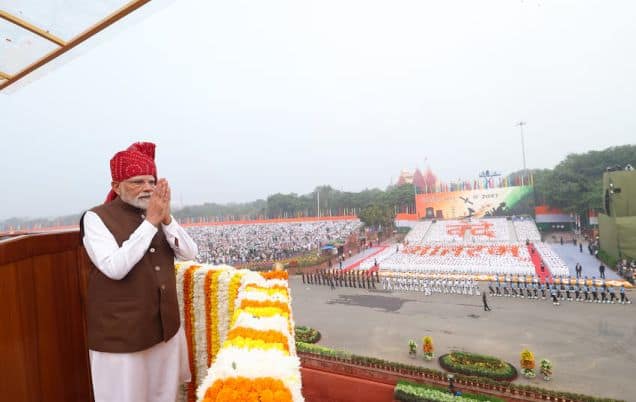
That ethic framed the Prime Minister’s Independence Day address from the Red Fort, this year. It was a charter for shared work: citizens, scientists, start-ups and States were invited to co-author Viksit Bharat. Ambitions in deep technology, clean growth and resilient supply chains were set out as practical programmes, with Jan Bhagidari, the partnership between a platform-building state and an enterprising people, as the method.

The recent simplification of the Goods and Services Tax (GST) structure reflects this method. By paring down slabs and ironing out friction points, the GST Council has lowered compliance costs for small firms and quickened pass-through to households. The Prime Minister’s focus was not on abstract revenue curves but on whether the average citizen or small trader would feel the change quickly. This instinct echoes the cooperative federalism that has guided the GST Council: States and the Centre debating rigorously, but all working within a system that adapts to conditions rather than remaining frozen. Policy is treated as a living instrument, tuned to the economy’s rhythm rather than a monument preserved for symmetry on paper.

I recently requested a 15- minute slot to meet the Prime Minister and was struck by the depth and range that he brought to the discussion — micro details and macro linkages that were held together in a single frame. It turned into a 45 minute meeting. Colleagues told me later that he had spent more than two hours preparing, reading through notes, data and counter-arguments. That level of homework is the working norm he sets for himself and expects of the system.

A focus on the citizen

Much of India’s recent progress rests on plumbing and systems which are designed to ensure dignity to our citizens. The triad of digital identity, universal bank accounts and real-time payments has turned inclusion into infrastructure. Benefits move directly to verified citizens, leakages shrink by design, small businesses enjoy predictable cash flow, and policy is tuned by data rather than anecdote. Antyodaya — the rise of the last citizen — becomes a standard, not a slogan and remains the litmus test of every scheme, programme and file that makes it to the Prime Minister’s Office.

I had the privilege to witness this once again, recently, at Numaligarh, Assam, during the launch of India’s first bamboo-based 2G ethanol plant. Standing with engineers, farmers and technical experts, the Prime Minister’s queries went straight to the hinge points: how will farmer payments be credited the same day? Can genetic engineering create bamboo that grows faster and increases the length of bamboo stem between nodes? Can critical enzymes be indigenised? Is every component of bamboo, stalk, leaf, residue, being put to economic use, from ethanol to furfural to green acetic acid?

The discussion was not limited to technology. It widened to logistics, the resilience of the supply chain, and the global carbon footprint. There was clarity of brief, precision in detail and insistence that the last person in the chain must be the first beneficiary.

The same clarity animates India’s economic statecraft. In energy, a diversified supplier basket and calm, firm purchasing have kept India’s interests secure in volatile times. On more than one occasion abroad, I carried a strikingly simple brief: secure supplies, maintain affordability, and keep Indian consumers at the centre. That clarity was respected, and negotiations moved forward more smoothly.

National security, too, has been approached without theatre. Operations that are conducted with resolve and restraint — clear aim, operational freedom to the forces, protection of innocents. The ethic is identical: do the hard work, let outcomes speak.

The work culture

Behind these choices lies a distinctive working style. Discussions are civil but unsparing; competing views are welcomed, drift is not. After hearing the room, he reduces a thick dossier to the essential alternatives, assigns responsibility and names the metric that will decide success. The best argument, not the loudest, prevails; preparation is rewarded; follow-up is relentless.

It is no accident that the Prime Minister’s birthday falls on Vishwakarma Jayanti, the day of the divine architect. The parallel is not literal but instructive: in public life, the most enduring monuments are institutions, platforms and standards. For the citizen, performance is a benefit that arrives on time and a price that stays fair. For the enterprise, it is policy clarity and a credible path to expand. For the state, it is systems that hold under stress and improve with use. That is the measure by which Narendra Modi should be seen, shaping the next chapter of the Indian story.

Hardeep S. Puri is Union Minister for Petroleum and Natural Gas, Government of India