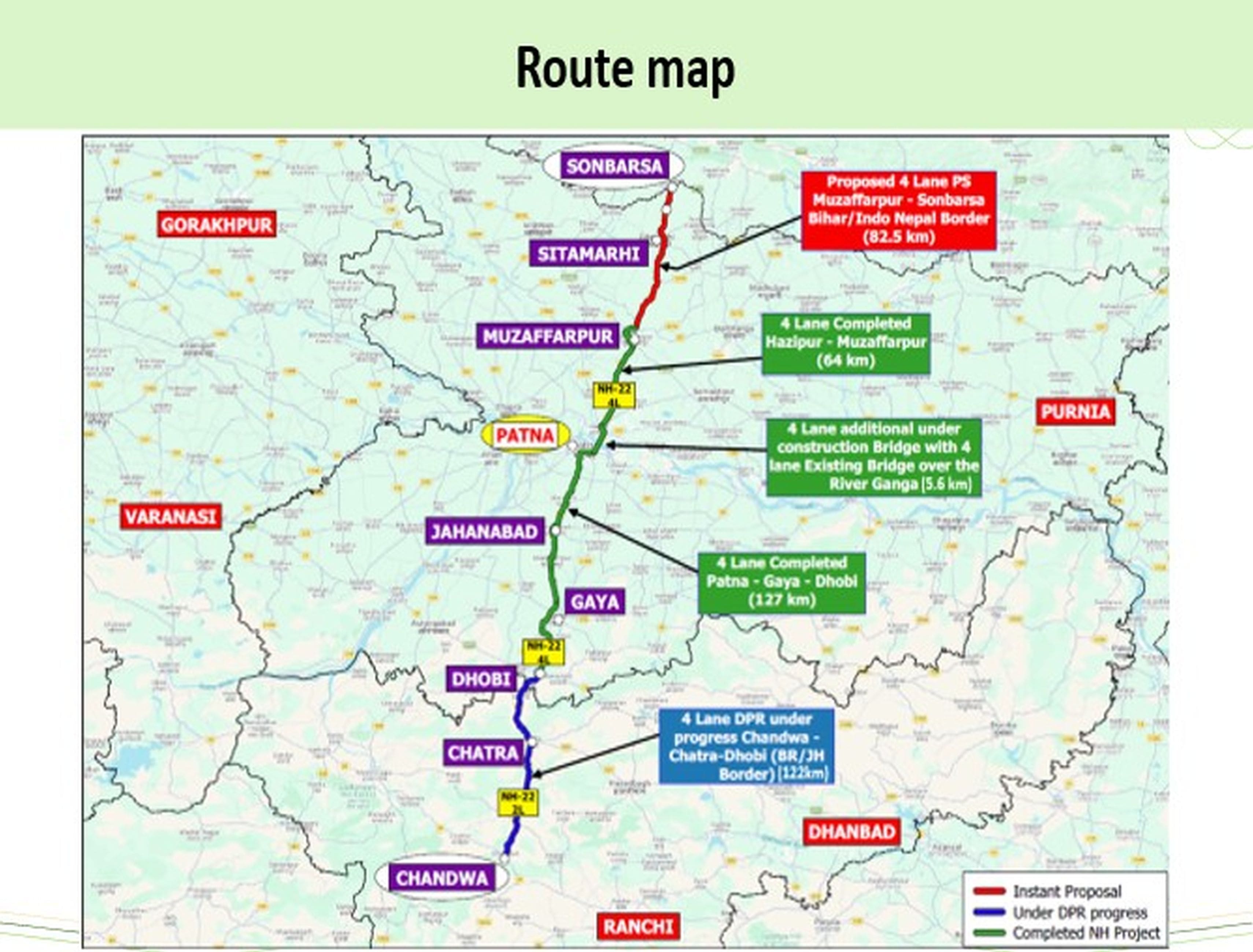
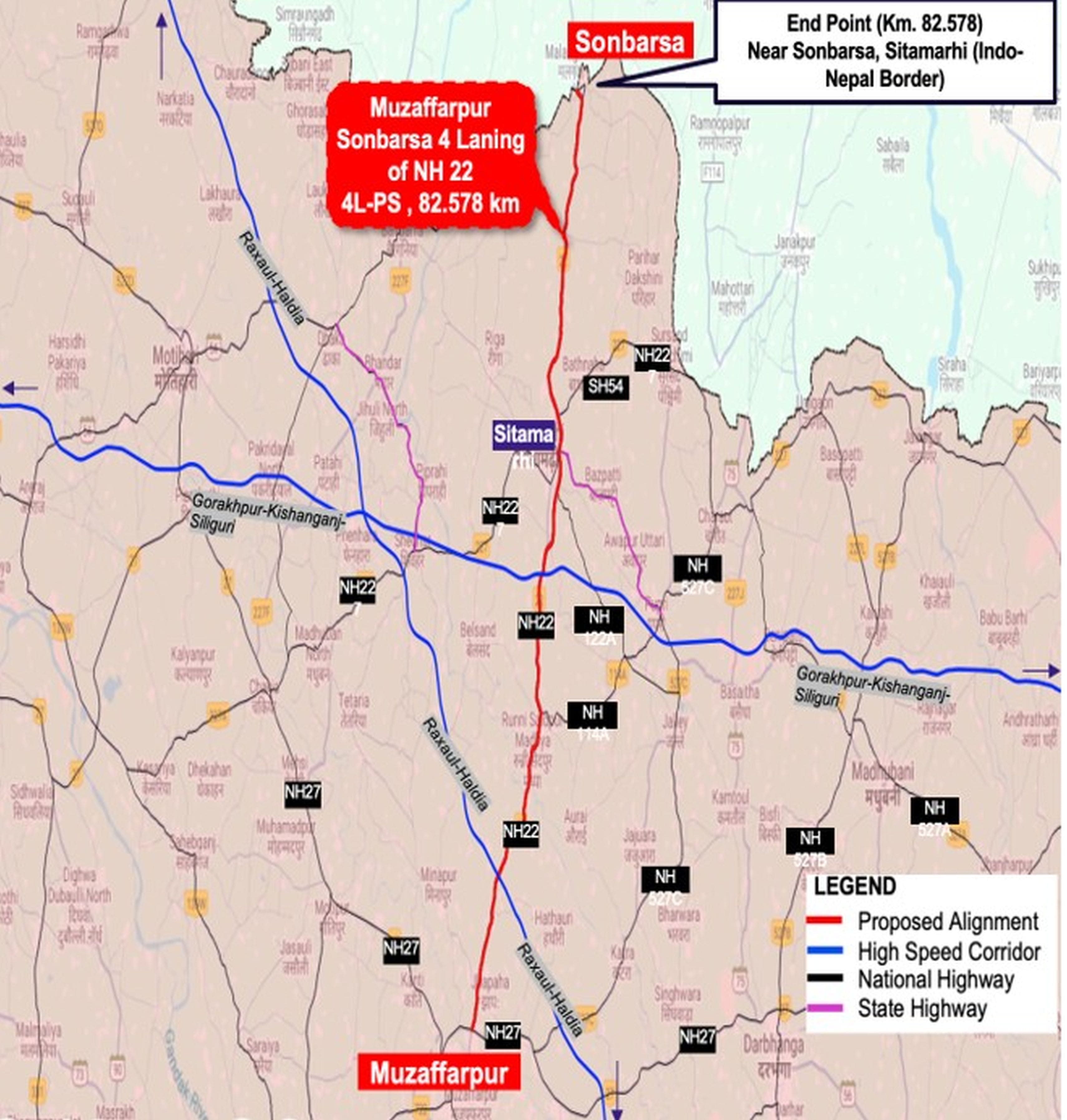
The Cabinet Committee on Economic Affairs, chaired by the Prime Minister Shri Narendra Modi, today has approved the Upgradation of the Muzaffarpur-Sitamarhi-Sonbarsa Section of NH-22 to four-Lane Standard in Bihar. The project will be developed on Hybrid Annuity Mode (HAM) at a total capital cost of Rs.3590.73 crore with a total length of 82.578 km.
The proposed project holds significant strategic and economic relevance due to its integration with Bihar’s expanding National Highway network. It acts as a key feeder corridor connecting the India–Nepal border at Sonbarsa with economic centers like Muzaffarpur at NH-27 (East–West Corridor). The project will significantly reduce congestion in densely populated areas of Muzaffarpur, Muksudpur, Runni Saidpur, Thumma, Dumra, Bhutahi, and Sonbarsa.
The project is expected to enable faster and safer movement of passengers and freight, improve travel efficiency and strengthen regional connectivity. It has been designed for a speed of 100 kmph with an average speed of 80 kmph, having no at-grade median openings, ensuring fast and safe travel.
Planned in accordance with the principles of the PM GatiShakti National Master Plan, the project will enhance multimodal integration by improving connectivity to key economic, social and logistics nodes, including industrial areas and major railway stations. Improved connectivity will facilitate efficient movement of goods and agricultural supply chains, support regional economic growth, and provide better access to important cultural and religious destinations such as the Buddhist Circuit and historic Janaki Punaura Dham Temple, Sitamarhi.
The Muzaffarpur–Sitamarhi–Sonbarsa stretch of NH-22 holds significant strategic and economic relevance, ensuring seamless linkage to the national freight grid. It is in synergy with existing corridors such as NH-31 and NH-122 enhances connectivity to industrial zones like Barauni and riverine logistics hubs along the Ganga It also enhances cross-border passenger and cargo movement via the nearby Land Port at Bhithamore.
In addition, the project has provision for seven Major Bridges (including a 340m long major bridge over the perennial Bagmati River), three Railway Over Bridges (ROBs), and two Flyovers (1170m & 270m) to maintain cross movement of the traffic and ensure safe, high-speed travel.
The project will increase average travel speeds, reduce travel time, and improve overall road safety, fuel efficiency, and vehicle operating costs, thereby enhancing regional mobility and socio-economic development.
The project provides seamless connectivity to key economic, social, and logistics nodes across Bihar. Additionally, the upgraded corridor will enhance connectivity to five PM Gati-Shakti Economic Nodes (four Industrial Estates and one Mega Food park), four Social Nodes (Baba Garibnath Temple, Mata Janki Temple, Punaura Dham, Muzaffarpur & Sitamarhi aspirational Districts), and two Logistic Nodes (Muzaffarpur & Sitamarhi Railway Stations), thereby facilitating faster movement of goods and passengers across the region.
बिहार के चौतरफा विकास के हमारे प्रयासों में कनेक्टिविटी का तेज विस्तार बहुत जरूरी है। इसी दिशा में आज हमारी सरकार ने NH-22 के मुजफ्फरपुर-सीतामढ़ी-सोनबरसा सेक्शन पर 4-लेन के निर्माण को मंजूरी दी है। पूरे राज्य के लिए लाइफलाइन साबित होने वाली इस परियोजना से प्रगति का एक नया अध्याय…
— Narendra Modi (@narendramodi) August 19, 2026