A tribute to Bhupen Da

Published By : Admin | September 8, 2025 | 08:30 IST

Today, 8th September, is a very special day for all those who are passionate about Indian culture and music. It is particularly more special for my sisters and brothers of Assam. After all, it is the birth anniversary of Dr. Bhupen Hazarika, one of the most extraordinary voices India has ever known. As you are all aware, this year marks the beginning of his birth centenary celebrations. It is an occasion to revisit his monumental contributions to Indian artistic expression and public consciousness.

What Bhupen Da gave us extends far beyond music. His works embodied emotions that transcended melody. More than just a voice, he was the heartbeat of the people. Generations have grown up listening to his songs, each word resonating with themes of kindness, social justice, unity and deep-rooted belonging.

From Assam emerged a voice that flowed like a timeless river, crossing borders and cultures, carrying with it the spirit of humanity. Bhupen Da travelled the globe, rubbed shoulders with the who’s who across all spectrums of society, but he remained deeply connected to his roots in Assam. The rich oral traditions, folk melodies and community storytelling practices of Assam deeply shaped his early childhood. These experiences formed the bedrock of his artistic vocabulary. He always carried the spirit of Assam’s indigenous identity and the ethos of its people.

Brilliance came to Bhupen Da at a very young age. At the age of just five, he sang at a public event and quickly caught the attention of none other than Lakshminath Bezbaruah, the pioneering figure of Assamese literature. By the time he was a teenager, he had recorded his first song. But music was only one part of his personality. Bhupen Da was as much an intellectual at heart...curious, articulate and driven by an insatiable desire to understand the world. Cultural legends like Jyoti Prasad Agarwala and Bishnu Prasad Rabha left a deep impression on his mind and also deepened his spirit of enquiry. It was also this desire to learn that made him excel at Cotton College, Banaras Hindu University and took him to the United States, where he interacted with leading academics, thinkers and musicians of those times. He met Paul Robeson, the legendary artist and civil rights leader. Robeson’s song “Ol’ Man River” became the inspiration for Bhupen Da’s iconic composition ‘Bistirno Parore.’ The much-admired former American First Lady, Eleanor Roosevelt, awarded him a Gold Medal for his performances of Indian folk music.

Bhupen Da had the option of remaining in the US, but he returned to India and immersed himself in music. From radio to theatre, films to educational documentaries, he was well-versed in each of these media. Wherever he went, he emphasised supporting young talent. His works combined lyrical flair and also gave social messages, touching upon justice for the poor, rural development, strength of common citizens, to name a few. Through his music, he gave voice to the aspirations of boatmen, tea garden workers, women, farmers, etc. In addition to being nostalgic, Bhupen Da’s works also became a powerful lens to view modernity. A lot of people, especially from the socially backward classes like him, derived strength and hope from his music.

The spirit of ‘Ek Bharat, Shreshtha Bharat’ found powerful expression in Bhupen Hazarika’s life journey. His works transcended linguistic and regional boundaries to unite people across the country. He composed for films in Assamese, Bengali and Hindi. He made Assam visible and audible to the rest of India. It is no exaggeration to say that he helped shape the cultural identity of modern Assam, both for those within the state and for the Assamese diaspora across the globe.

Bhupen Da, although not really a political person, did remain connected to the world of public service as well. In 1967, he was elected as an independent MLA from Nauboicha constituency in Assam, demonstrating how deeply his public persona was rooted in the people’s trust. Though he never became a career politician, his passion for serving others was highly impactful.

The people and Government of India have recognised his enormous contributions over the years. He was conferred with several awards, including the Padma Shri, Padma Bhushan, Padma Vibhushan, Dadasaheb Phalke Award and more. In 2019, it was an honour for me personally and for the NDA government that the Bharat Ratna was conferred upon him during our tenure. People from across the world, especially those from Assam and the Northeast, expressed joy that this honour was conferred upon him. This honour celebrated the principles that Bhupen Da held dear to his heart- that music, when grounded in truth, can transcend all barriers. That a song can carry the weight of a people’s dreams and move hearts across the world.

I remember the time Bhupen Da passed away in 2011. I had seen on television how lakhs of people attended his funeral. Every eye was moist that time. Even in death, like in his illustrious life, he brought people together. It was thus fitting that he was cremated at the Jalukbari hillock overlooking the Brahmaputra, the very river that had been the lifeline of his music, metaphors and memories. It is gladdening that the Assam Government has supported the work of the Bhupen Hazarika Cultural Trust, which is working to popularise his life journey among youngsters.

Bhupen Hazarika’s life teaches us the power of empathy, of listening to people and of staying rooted. His songs continue to be sung by young and old alike. His music teaches us to be compassionate and courageous. It asks us to remember our rivers, our labourers, our tea workers, our Nari Shakti and our Yuva Shakti. It encourages us to believe in unity in diversity.

Bharat is blessed to have Bhupen Hazarika. As we celebrate the beginning of his centenary year, let us reiterate our commitment to spreading his message far and wide. May it also inspire us to keep working to support music, art and culture, to encourage young talent and make India a nurturing ground for creativity and artistic excellence.

It is only fitting that one of India’s most significant infrastructure projects, the bridge connecting Dhola and Sadiya, bears the name of Bhupen Hazarika. Just as his songs connected hearts across regions, this bridge connects lands and people.

Explore More
Today, the entire country and entire world is filled with the spirit of Bhagwan Shri Ram: PM Modi at Dhwajarohan Utsav in Ayodhya

Popular Speeches

Today, the entire country and entire world is filled with the spirit of Bhagwan Shri Ram: PM Modi at Dhwajarohan Utsav in Ayodhya
PM Modi calls for resolutions by people to save foreign exchange to overcome impact of war

Media Coverage

PM Modi calls for resolutions by people to save foreign exchange to overcome impact of war
NM on the go

Nm on the go

Always be the first to hear from the PM. Get the App Now!
...
Somnath and Bharat’s unconquerable spirit!
May 08, 2026

At the start of 2026, I had gone to Somnath for the Somnath Swabhiman Parv, marking a thousand years since the first attack on the Somnath Temple. Now, I will be back in Somnath on 11th May to mark 75 years since the inauguration of the restored Temple by the then President of India, Dr. Rajendra Prasad. In less than half a year, it is a privilege to be attending two important milestones relating to Somnath and its journey from ruin to renewal or what we describe as from Vidhvans to Srijan.

Somnath gives us a civilisational message. The vast sea before it evokes timelessness. The waves tell us…that no matter how fierce the storms are or how turbulent the tides are, one can always rise again with dignity and strength. The waves return to the shore, as though reminding every generation that the spirit of the people can never be subdued for long.

Our ancient scriptures say: प्रभासं च परिक्रम्य पृथिवीक्रमसंभवम्. It means, a Pradakshina of the divine Prabhasa (Somnath) is equal to a Pradakshina of the whole earth itself! While people have come here to pray, they have also experienced the remarkable continuity of a civilisation whose flame could never be extinguished. Empires rose and fell, tides changed, history moved through conquest and upheaval, yet Somnath continued to endure in our consciousness.

It is time to remember the countless greats who stood firm in the face of tyranny. There were Lakulisha and Soma Sarman, who transformed Prabhasa into a great centre of philosophy. Chakravarti Maharaja Dharasena IV of Vallabhi built the Second Temple there centuries ago. Bhima Deva, Jayapala and Anandapala will always be remembered for defending civilisational honour against invasions. It is said that Raja Bhoja too helped with the reconstruction. Karna Deva and Siddharaja Jayasimha played a vital role in restoring Gujarat’s political and cultural strength. Bhava Brihaspati, Kumarapala Solanki and the Pashupata Acharyas rebuilt and sustained the shrine as a great centre of worship and learning. Vishaladeva Vaghela and Tripurantaka protected its intellectual and spiritual traditions. Mahipaladeva and Ra Khangar were instrumental in reviving worship after destruction. Punyashlok Ahilyabai Holkar, whose 300th birth centenary is being marked, ensured the continuity of devotion in the most difficult of times. There were the Gaekwads of Baroda, who safeguarded the rights of pilgrims. And of course, our soil is blessed to have nurtured brave personalities like Veer Hamirji Gohil and Veer Vegdaji Bhil, whose sacrifice and courage have become a part of Somnath’s living memory.

In the 1940s, when the spirit of freedom swept across India and the foundations of a new republic were being laid under the leadership of towering figures like Sardar Patel, one thing continued to trouble him deeply…the condition of Somnath. On 13th November 1947, during Diwali time, he stood next to the dilapidated ruins of the temple with sea-water in his hands and said, “On this auspicious day of the (Gujarati) New Year, we have decided that Somnath should be reconstructed. You, people of Saurashtra, should do your best. This is a holy task in which all should participate.” On one clarion call of Sardar Patel, it was not only the people of Gujarat but also the people of the whole of India that responded enthusiastically.

Unfortunately, fate did not allow Sardar Patel to witness the fulfilment of the dream he had so passionately championed. Before the restored Somnath Temple could open its doors to devotees, he had departed from this world. Yet, his impact continued to be felt over the sacred shores of Prabhas Patan. His vision was championed by Shri KM Munshi, ably supported by the Jamsaheb of Nawanagar. In 1951, when the Temple was complete, it was decided to call the President of India, Dr. Rajendra Prasad, for the ceremony. Overcoming strong objections from the then Prime Minister Pandit Nehru, Dr. Prasad graced the ceremony, thus making it even more special and historic.

My mind also goes back to October 2001, when I had just taken over as Chief Minister. On 31st October 2001, the Jayanti of Sardar Patel, the Gujarat Government had the honour of organising a programme to mark 50 years since the Somnath Temple opened its doors. It also coincided with the 125th birth anniversary celebrations of Sardar Patel. The then Prime Minister Shri Atal Bihari Vajpayee and the then Home Minister Shri LK Advani attended the programme.

During his speech on 11th May 1951, Dr. Rajendra Prasad said that the Somnath Temple proclaims to the world that anything with unparalleled faith and love cannot be destroyed. He expressed hope that this Temple will live in the hearts of people. He also said that the restoration of the Temple was a fulfilment of Sardar Patel’s dream, but taking that spirit forward, it is important that we restore prosperity to the lives of people. These are important and inspiring messages he gave.

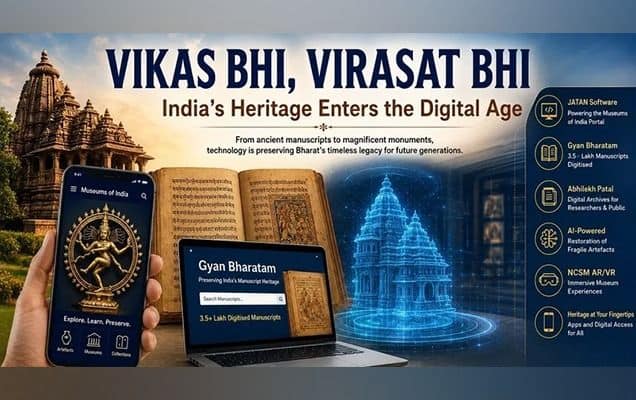
This is the path we have been walking for over a decade. I consider it my good fortune that, inspired by the principle of ‘Vikas Bhi, Virasat Bhi’, from Somnath to Kashi, Kamakhya to Kedarnath, Ayodhya to Ujjain, Trimbakeshwar to Srisailam, our team has had the opportunity to equip our spiritual centres with the latest facilities while at the same time preserving their traditional character. This, along with efforts to improve connectivity, ensures more people can visit them. It boosts the local economy, secures livelihoods and deepens the spirit of ‘Ek Bharat, Shreshtha Bharat.’

The struggles and sacrifices of those who laid down their lives to protect Somnath and those who rebuilt it time and again will never be forgotten. Countless individuals from different corners of India contributed to restoring its glory. They saw every part of Bharat as sacred, bound together by a sense of oneness that transcended geography. In a world often marked by divisions, this spirit of unity is more relevant than ever. Somnath will continue to stand tall in all its glory because the sense of unity and shared civilisational consciousness lives on in the hearts of every Indian. As a tribute to this, remembering the extraordinary courage of a thousand years, there will be special Pujas at Somnath for the next thousand days. It is gladdening to see several people donating for these Pujas as well.

I urge my fellow Indians to travel to Somnath in this special time. When you stand on the shores of Somnath, let its ancient echoes speak to you. You will not only be overwhelmed by devotion but will also feel the strong pulse of a civilisational spirit that refuses to fade, that is unbroken and unyielding. You will experience Bharat’s unconquerable spirit and understand why, despite every effort, our culture remained undefeated and you will have the opportunity to behold the vision of eternal triumph. It will surely be unforgettable.

Jai Somnath.

(Narendra Modi is the Prime Minister of India and is also the Chairman of the Shree Somnath Trust)