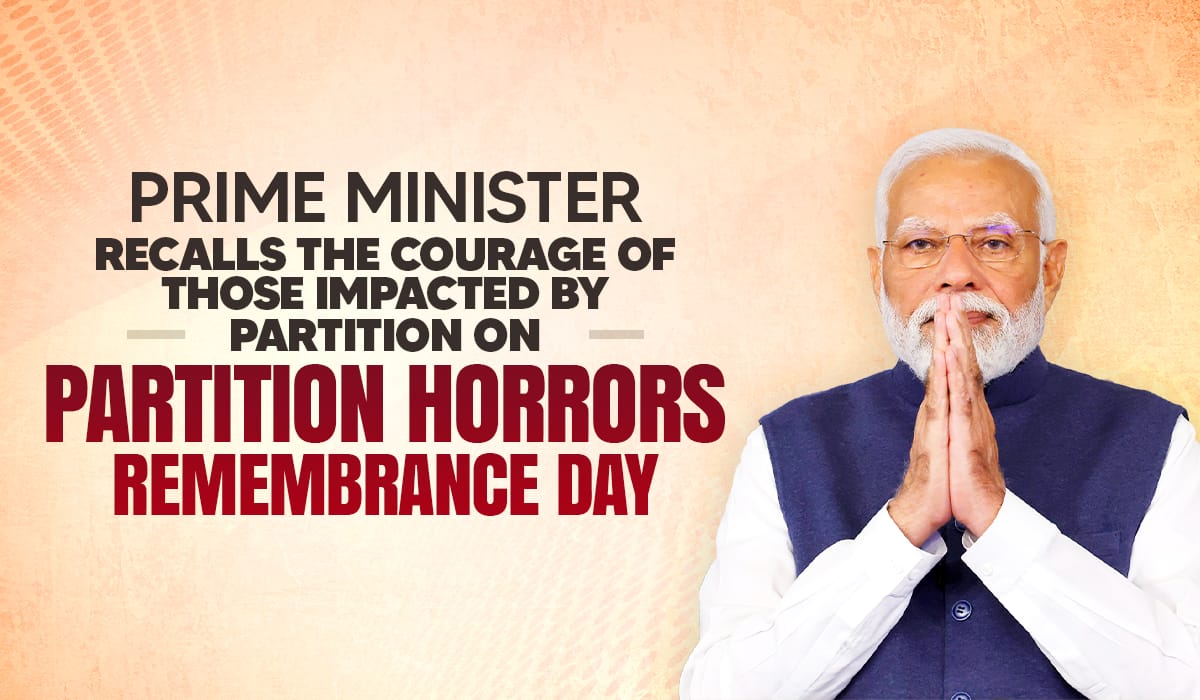
Prime Minister Shri Narendra Modi today stated that as we mark Partition Horrors Remembrance Day, we recall the courage of all those who were impacted by Partition. He noted that it was a moment in history that tore apart several lives, where families were uprooted, loved ones were lost, and immense suffering was endured.
The Prime Minister highlighted that at the same time, overcoming this, people rebuilt their lives from nothing, turned adversity into achievement, and contributed immensely to our nation’s progress. He observed that their life journeys remind us of the strength of the human spirit. Shri Modi expressed hope that this day may deepen our resolve to preserve harmony and brotherhood in our nation and collectively work towards building a Viksit Bharat.
The Prime Minister offered his heartfelt tributes to all those countrymen who, emerging from that horrific period, made invaluable contributions to the progress of the country. He stated that through their courage and capability, they showed how resolutions are accomplished even in adverse circumstances. Shri Modi called upon everyone to further strengthen the national spirit of goodwill and solidarity.
Sharing a Subhashitam, the Prime Minister emphasized that it is through hard work, enterprise, and dedicated effort that diverse arts, science, technological skills, craftsmanship, and innovations flourish, paving the way for success. He added that therefore, one should not remain dependent on fate; rather, one should move steadily towards one's goals with courage, diligence, and persistent effort, for it is human endeavor that shapes destiny.
In a series of posts on X, the Prime Minister wrote:
"Today we mark #PartitionHorrorsRemembranceDay. We recall the courage of all those who were impacted by Partition. It was a moment in history that tore apart several lives…families were uprooted, loved ones were lost and immense suffering was endured.
At the same time, overcoming this, people rebuilt their lives from nothing, turned adversity into achievement and contributed immensely to our nation’s progress. Their life journeys remind us of the strength of the human spirit.
May this day deepen our resolve to preserve harmony and brotherhood in our nation and collectively work towards building a Viksit Bharat."
"विभाजन विभीषिका स्मृति दिवस पर उन सभी देशवासियों का हृदय से नमन, जिन्होंने उस वीभत्स दौर से निकलकर देश की प्रगति में अमूल्य योगदान दिया। उन्होंने अपने साहस और सामर्थ्य से दिखाया कि कैसे विपरीत परिस्थितियों में भी संकल्पों को सिद्ध किया जाता है। आइए, सद्भावना और एकजुटता की राष्ट्रीय भावना को और सशक्त करें।
उद्यमस्य प्रसादेन दृश्यन्ते विविधाः कलाः।
कातरा एव जल्पन्ति यद् भाव्यं तद् भविष्यति॥”
It is through hard work, enterprise and dedicated effort that diverse arts, science, technological skills, craftsmanship and innovations flourish, paving the way for success. Therefore, one should not remain dependent on fate; rather, one should move steadily towards one's goals with courage, diligence and persistent effort, for it is human endeavor that shapes destiny.