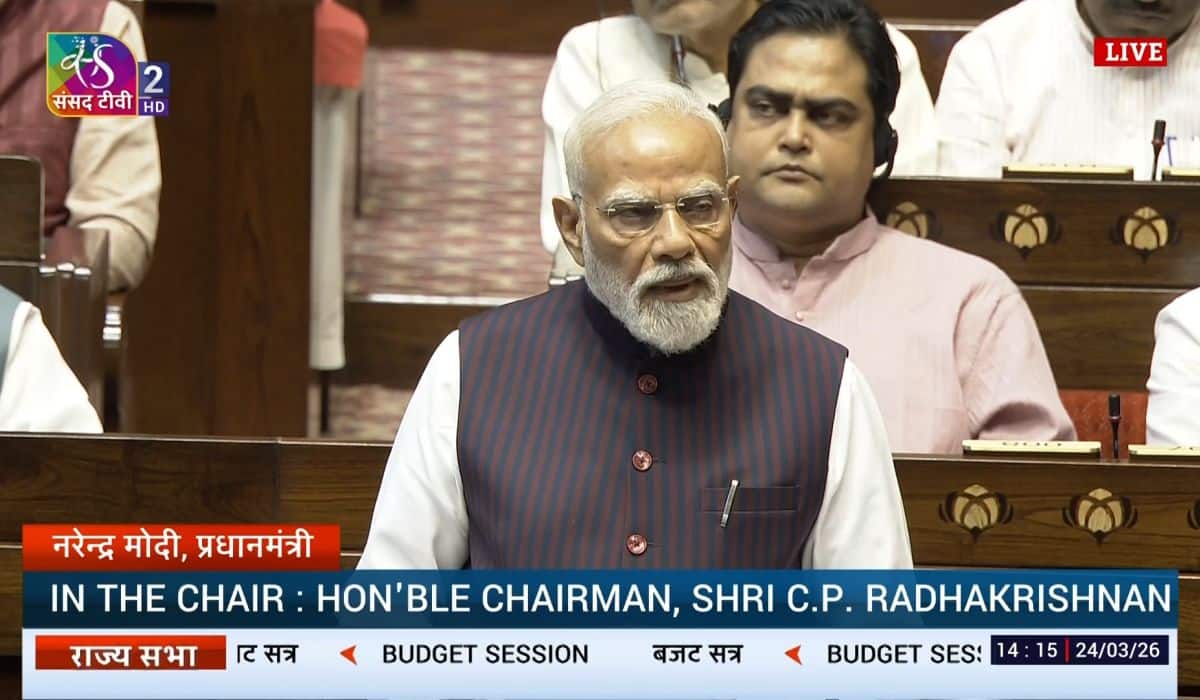
PM Modi delivers key note address at the Economic Times Global Summit
True reforms are those which result in transformation in the lives of citizens: PM
We should create new opportunities for citizens to progress and also give them a choice of opportunities: PM
I am confident that despite the challenges, we can successfully go forward in a way to benefit the common people: PM
Entrepreneurship is one of India's traditional strengths, it was sad to see it neglected in the last few years but we have changed that: PM
I believe in the politics of empowerment. I believe in empowering the people to improve their own lives: PM
We have taken India to the top of global league tables of foreign investment and growth in less than 2 years: PM
When the power of the people is with us, hard challenges become huge opportunities: PM
I believe in the politics of empowerment. I believe in empowering the people to improve their own lives: PM

Shri Vineet Jain Distinguished Guests Ladies and Gentlemen

I am very happy to be here today. The global economy is going through a period of uncertainty. At a time like this I am glad that so many participants not only from India, but also from abroad have taken the time to come here. I am sure all of us in India will benefit from the experience of other countries. I will take this opportunity to present to you some of my thoughts on the progress of the Indian economy and on the business environment.

Some of you may recall what I have said before - that true reforms are those which result in transformation in the lives of citizens. As I have said before, my goal is “reform to transform”. Let me start with the basics. What should be the basic guiding principles of economic policy in any country, particularly for the developing countries? 


Firstly, we have to improve the use of our natural and human resources, to increase the value addition we can get from them. This means increasing the efficiency in allocation of resources. It means greater managerial efficiency. It means removing unnecessary controls and distortions.

Secondly, we should create new opportunities for citizens to progress and also give them a choice of opportunities. Opportunity is like oxygen to the aspirational citizen and we are keen that this is never in short supply. In simple terms, it means Sabka Saath, Sabka Vikas.

Thirdly, we have to increase the quality of life of the common citizen and even more so, the quality of life of the poor. Quality of life may have an economic aspect, but it is not economics alone. If a government is progressive, and runs an honest and efficient administration, the biggest beneficiaries are the poor. I know from my experience, that poor governance hurts the poor more than it hurts others. Therefore, improved governance is as important as economic reform.

We live in a globally connected world. Actions of one country affect another. Such actions are not only based on trade and investment but also in matters of pollution and environment. A poet had said that no man is an island. Today it can be said that no country can live alone. It is often said that all politics is local. To me, all economics is global. Indeed the distinction between domestic affairs and foreign affairs is increasingly losing relevance. For a country in the modern day, it is not sufficient that its economic policies should only address its domestic priorities. To me, India’s policies must be such that they make a positive contribution to the rest of the world.

Many of you are aware of the contribution India can make to the global economy at a time of economic stagnation in many parts. For the last four quarters, India has been the fastest growing large economy in the world. In 2014-15, India contributed 7.4% of global GDP in purchasing power terms. But it contributed 12.5% of global growth. Thus its contribution to growth is 68% higher than its share of the global economy. FDI in India has increased by 39% in the last 18 months, at a time when global FDI has fallen.

But a country’s contribution goes beyond economics. Protecting our planet from climate change is one of the most important tasks for this generation. If one country reduces its environmental footprint, it creates benefits for all others. It is for this reason that in the COP 21 Summit, India made far reaching commitments towards the larger welfare of the planet. In history, every country that has grown has increased its per capita emissions footprint. We are committed to re-writing that history. We are committed to reducing the emission intensity of our GDP by 33% by 2030 even while growing at a fast pace. For a country which is already at a very low base of per capita emission, this is a very ambitious target. We have committed that by 2030, 40% of our electric power capacity will be from non-fossil fuel. We have also committed to building an additional carbon sink of over 2.5 billion tonnes of carbon dioxide equivalent. This will be done by creating additional forest cover by 2030. This commitment is from a country with a very low per capita land availability. We have taken the lead in launching an international solar alliance, involving 121 countries falling between the Tropic of Cancer and the Tropic of Capricorn. This initiative will help many developing countries, from Africa to South America, to take advantage of developments in renewable energy around the world.

Let me now return to the three policy objectives I mentioned. I will start with the performance of Indian economy. Economists talk about GDP growth, inflation, investment, and the fiscal deficit as key economic parameters. Since this Government took office, growth has increased and inflation has decreased. Foreign investment has increased and the fiscal deficit has decreased. And despite a slow-down in global trade, the balance of payments deficit has also decreased.

Yet, such broad statistics give only a partial picture of what we are attempting, and what we are achieving. It is often said “the devil is in the detail”. But I believe that God is in the proper execution of many so-called details. It is these so-called details which, when done well, add up to a big picture.

You may be interested to know that • India’s highest ever urea fertiliser production was achieved in 2015.

• India’s highest ever production of ethanol as blended fuel, benefiting sugar cane farmers, was in 2015.

• The highest number of new cooking gas connections to the rural poor was achieved in 2015.

• India’s highest ever output of coal was achieved in 2015.

• India’s highest ever generation of electricity was achieved in 2015

• India’s highest ever quantity of cargo handled by major ports was in 2015.

• India’s fastest average turnaround time in ports was in 2015. • India’s highest ever increase in railway capital expenditure was achieved in 2015.

• India’s highest ever number of new highway kilometres awarded was in 2015.

• India’s highest ever production of motor vehicles was achieved in 2015

• India’s highest ever software exports were achieved in 2015.

• India’s highest ever rank in World Bank Doing Business indicators, was achieved in 2015.

• India’s highest ever foreign exchange reserves were achieved in 2015.

When I give these figures, it is important to remember that in the preceding years, many of these indicators were moving in the opposite direction. Not only have many indicators improved, but they have improved by large margins. For example, in 2013-14, the total number of National Highway kilometres awarded was about 3500. This more than doubled in the first year of this Government to nearly 8000 kilometres, an all-time high. This year we are planning to award 10,000 kilometres.

Let me give you more examples of quantum leaps. The Shipping Corporation of India which made a loss of Rs. 275 crores in 2013-14 made a profit of Rs. 201 crores in 2014-15. This is a turnaround of Rs. 475 crores in one single year.

In 2013-14, India accounted for just 0.1% of global demand for energy efficient LED lighting. In 2015-16, it is 12%. Indian LED bulbs are now the cheapest and most competitive in the world, costing less than a dollar versus a global average of 3 dollars. In 2013-14, India commissioned 947 megawatts of solar power plants. In 2015-16, this will rise to over 2500 megawatts. It is expected to reach 12,000 megawatts in 2016-17. India’s share of the global solar energy market will rise from 2.5% in 2014 to 18% in 2016. India’s contribution here is not merely in increasing the share of clean energy. Its other contribution is that the huge increase in scale has enabled producers to cut prices benefitting the whole world. In 2013-14, 16,800 kilometres of transmission lines were added. In 2014-15 this rose to over 22,000, an increase of 32%. In the power sector as a whole, the cost of power has declined by over 30%.

Let me turn to the second aspect — improving opportunities. I believe in the politics of empowerment. I believe in empowering the people to improve their own lives. We undertook the world’s largest and most successful financial inclusion programme. It has brought over two hundred million unbanked people into the banking system. In the early days of this programme, sceptics felt that these accounts would have no balances. You will be surprised to know that today these accounts have a balance exceeding Rs. thirty thousand crores or over four billion dollars. We have also issued a record number of debit cards to them. India is now one of the few countries where the market share of an indigenous credit card brand exceeds 33%.

We have introduced a new and comprehensive program of crop insurance. This empowers farmers to give their best, with the State providing cover against risks beyond the farmer’s control.

We have introduced soil health cards to empower our farmers. The card will tell every farmer the exact character of his soil. This will enable him to increase crop yield, reduce over-use of chemical inputs and fertilizer and restore soil health.

Entrepreneurship is one of India's traditional strengths. It was sad to see it neglected in the last few years. “Business” and “profits” had become bad words. We have changed that. We need to value enterprise and hard work, not wealth. Our programs ranging from MUDRA to Start Up India and Stand-Up India provide opportunity to the hard working and to the enterprising. In so doing, we have placed special emphasis on Scheduled Castes, Scheduled Tribes, Other Backward Classes and women. We are empowering them to become masters of their own destinies.

Creating opportunities for cities and towns to grow is very crucial. Urban areas are an engine of growth. A key initiative for urban transformation is the Smart City Mission. The Mission has several ‘firsts’. It is the first time that certain areas in cities will be comprehensively developed in a systematic and qualitative way. These areas will act as ‘light houses’ which will eventually influence the rest of the city. It is the first time that there has been such extensive citizen consultation. Nearly 2.5 million people participated through contests, discussions, polls, blogs and talks on the MyGov platform. This is a major break from the top-down approach to urban planning. It is the first time that allocation of funds in a government scheme is done not by decisions of Ministers or officers but on the basis of competition. This is a good example of competitive and cooperative federalism.

As I mentioned earlier, the role of a Government does not end with the economy alone. There are many non-economic dimensions which are vital for ensuring the welfare of the citizens. Good governance is crucial. We have taken numerous steps which have transformative potential. We have ended the era of high level corruption. This is a fact acknowledged by Indians and foreigners, and by critics and supporters of this Government. This is not an easy achievement. We have ended political interference and crony capitalism in nationalized banks. We have for the first time appointed several heads of public sector banks from the private sector. Transparent auctions have cleaned up the natural resources sector which was riddled with scandals.

Many experts have commented on the need to reduce subsidies. The new universal access to banking through the Jan Dhan Yojana, has enabled plugging of huge leakages in subsidies. In developing countries, fuel subsidies are generally very difficult to tackle. We have successfully decontrolled cooking gas prices. We are now operating the world’s largest direct benefit transfer scheme for cooking gas. Subsidies are transferred to the bank account of households. Through electronic verification, multiple and bogus connections are eliminated. This enables genuine beneficiaries to get what they deserve while eliminating those who are not eligible. This has substantially reduced the subsidy.

Another subsidized fuel is kerosene, used by the poor for cooking and lighting, and distributed by state governments. There is clear evidence that a large quantity of subsidized kerosene is misused and diverted. We have begun a pilot in thirty three districts where kerosene will be sold at market prices. The difference between market price and the subsidized price will be transferred directly to bank accounts of those who are poor. The poor will be properly identified through bank accounts and biometric identification through Aadhaar. This will eliminate duplicate, non-eligible and bogus consumers. This elimination will reduce the total subsidy. We have decided that 75% of the savings from this will be passed on to the states. Thereby, we have encouraged state governments to implement this in all districts.

The experience of Chandigarh, shows that this is possible. In April 2014, there were 68,000 beneficiaries of subsidized kerosene in Chandigarh. A campaign was launched to issue gas connections to all eligible families. 10,500 new gas connections were issued. Kerosene quotas were stopped for 42,000 families who already had gas connections. By 31st March, 2016, Chandigarh will be declared kerosene-free. Believe it or not, till date, the saving achieved in kerosene consumption through this initiative is 73%!

Two days ago at a meeting with Chief Secretaries of the States, I was reviewing implementation of various pension schemes. I was pleasantly surprised to see that there had been noteworthy reduction in leakage, simply by eliminating those who were double counted and who were ineligible. In some states, a reduction of 12% in subsidies has been achieved without any harm to the poor.

Another major subsidy is on fertilizer. A substantial quantity of subsidized urea is diverted illegally to use in the production of chemicals. We have introduced a simple but effective technical solution: neem-coating of urea. The organic neem coating makes the fertilizer unsuitable for diversion. We have now achieved 100% neem coating in both domestic and imported urea. A significant side benefit has also happened. The collection of neem leaves for urea has become a new income earning opportunity for rural women.

I know that several of you are economists. Economists generally believe that human beings are rational. They believe people will not give up a benefit for which they are entitled. Last year, I gave a call to citizens. I asked them to give up their cooking gas subsidies, if they felt they were not poor enough to get it. We also made a promise. Every connection given up, would be used to give a new gas connection to a poor family. Poor women in rural India use firewood or biomass and suffer greatly because of smoke. This scheme is entirely voluntary. You may be surprised to learn that nearly 6.5 million people in India have responded to my call. It warms my heart, to see that so many of them have come forward, with no compulsion to benefit the poor and give up their subsidies. Already, over 5 million new connections have been given to the poor. It is a sign of the public spirit and the self-respect which prevails among Indians and shows the potential of citizen action. Another example where citizens have responded is in the case of Khadi. In October 2014, I had appealed to all Indians to buy at least one Khadi garment. In response, Khadi sales have increased substantially.

We have taken a creative approach to tackling the problem of loss making power distribution companies. Under the UDAY programme, short term debt relief is given by state governments taking over bank loans. But this is accompanied by strong long term conditions to hold both the distribution companies and the states. This will create the conditions for rolling out 24x7 power supply.

Our country suffers from an excess of old and unnecessary laws which obstruct people and businesses. We began the exercise of identifying unnecessary laws and repealing them. 1,827 Central laws have been identified for repeal. Out of these, 125 have already been repealed. Bills for repealing another 758 have been passed by the Lok Sabha and are awaiting the approval of the Upper House.

I have given just a few examples of the potential of improved governance. The benefits of improved governance and reduced corruption are lasting and profound. If our policies are studied closely, you will find that many are popular, but none are populist. Every one of the changes we have made is in the direction of good governance and rationality.

I have been referring to cooking gas, fertilizer and kerosene subsidies. I must confess that I am surprised by the way words are used by experts on this matter. When a benefit is given to farmers or to the poor, experts and government officers normally call it a subsidy. However, I find that if a benefit is given to industry or commerce, it is usually called an “incentive” or a “subvention”. We must ask ourselves whether this difference in language also reflects a difference in our attitude? Why is it that subsidies going to the well-off are portrayed in a positive manner? Let me give you an example. The total revenue loss from incentives to corporate tax payers was over Rs. 62,000 crores. Dividends and long term capital gains on shares traded in stock exchanges are totally exempt from income tax even though it is not the poor who earn them. Since it is exempt, it is not even counted in the Rs. 62,000 crores. Double Taxation avoidance treaties have in some cases resulted in double non-taxation. This also is not counted in the Rs. 62,000 crores. Yet these are rarely referred to by those who seek reduction of subsidies. Perhaps these are seen as incentives for investment. I wonder whether, if the fertiliser subsidy is re-named as “incentive for agricultural production”, some experts will view it differently.

I am not arguing that all subsidies are good. My point is that there cannot be any ideological position on such matters. We have to be pragmatic. We have to eliminate bad subsidies, whether or not they are called subsidies. But some subsidies may be necessary to protect the poor and the needy and give them a fair chance to succeed. Hence my aim is not to eliminate subsidies but to rationalize and target them.

In 19 months, much has been achieved. Much more is expected of us. And there are challenges ahead. Yet, I am now confident • that we can successfully go forward, • that we can successfully go faster, • and that we can do so in a way that will benefit the common people.

When the people of a nation make up their minds to go forward and when the power of the people is with us, hard challenges become huge opportunities. This confidence of mine is not formed in a vacuum, but founded on my experience over the last 19 months.

We inherited a struggling economy, just recovering from a currency crisis. In less than two years, we have taken India to the top of global league tables of foreign investment and growth. Friends, we have a long way to go but I feel ours is a journey well begun. Like all long journeys, there may be obstacles on the way, but I am confident we will reach our destination. We have created a platform for a new future and for a new India:

An India where every child is born safely and maternal and infant mortality are below world averages,

An India where no person is houseless,

An India where every town and every village, every school and every train, every street and every house, are clean and sanitary,

An India where every citizen has access to good health care,

An India where every village has 24x7 electricity,

An India where every city is vibrant and livable,

An India where girls are educated and empowered,

An India where every boy and every girl is skilled and ready for productive employment,

An India where agriculture, industry and services provide well-paying jobs to all who need them,

An India where farmers know the nature of their soil, have the best inputs and reach global levels of productivity,

An India where enterprises, large and small, have access to capital and credit,

An India where start-ups and other businesses provide innovative solutions,

An India which is at the forefront of a global digital economy,

An India which leads the world in clean energy,

An India where every citizen has basic social security and a pension in old age,

An India where citizens trust Government and are trusted by Government.

And above all, a transformed India where all citizens have the opportunity to reach their full potential.

Thank you.

Explore More
Today, the entire country and entire world is filled with the spirit of Bhagwan Shri Ram: PM Modi at Dhwajarohan Utsav in Ayodhya

Popular Speeches

Today, the entire country and entire world is filled with the spirit of Bhagwan Shri Ram: PM Modi at Dhwajarohan Utsav in Ayodhya
Interim framework shows India got best US trade deal compared to others

Media Coverage

Interim framework shows India got best US trade deal compared to others
NM on the go

Nm on the go

Always be the first to hear from the PM. Get the App Now!
...
Marks, skills, balance, dreams... PM Modi keeps it real with students at Pariksha Pe Charcha!
February 06, 2026
Listen to everyone’s advice, but change your pattern only when you want to: PM
PM advises teachers to inform students in advance to create curiosity and improve understanding
Goals should be within reach but not easily achievable - Aim and Act: PM
Plough the mind, then connect the mind, and then place the subjects of study, this will help you succeed: PM
Balancing studies, skills, rest and hobbies is the key to growth: PM
Books impart knowledge, but only practice makes you professionally skilled: PM
Don’t waste time dwelling on the past, think of living what lies ahead: PM
Education is not only for exams but for life, exams are meant to examine oneself: PM
Aspire, not to be, but to do: PM
The Present is God’s greatest ‘Present’ - Live here and now: PM
The more involved you are in a moment, the longer you remember it: PM
Collaborative learning helps everyone improve: PM
Revise and become wise: PM
Strengthen your foundation in school, competitive exams will follow in time: PM
PM advises parents to allow children to blossom according to their capacity, ability, and interest
Turn your hobbies into practical products and share them for free, Feedback fuels new ideas and success: PM
Discover Yourself, Experience all that life offers: PM
Exams are like Festivals, celebrate them: PM
Real confidence comes from inner truth, Be true to who you are: PM
Comfort zones don’t shape life - your way of living does: PM
Not having a dream is a crime - have a dream always: PM
Be your own anchor, celebrate your strengths: PM
Dream big, fear less - read biographies: PM
Maintaining Cleanliness is the foremost priority and our duty: PM
Technology is a great teacher, embrace it, AI increases our capabilities: PM
Harness AI wisely, boost your wisdom: PM

Prime Minister: Alright, let’s begin. Tell me!

Student: I am Saanvi Acharya, from your own state, Gujarat. My first question is this: Parents worry about us, teachers support us. But the main issue arises when teachers suggest one study pattern, parents insist on another, and among students there is yet another trend. At that time, we get confused about which pattern is correct.

Prime Minister: See, this is how it is in life also. Even after becoming Prime Minister, some people tell me to do things one way, others say do it another way. Look at your own home during meals-everyone has a different eating pattern. One starts with vegetables.

Student: Yes, sir!

Prime Minister: Another begins with dal.

Student: Yes, sir!

Prime Minister: Someone else mixes roti, sabzi, and dal all together. Each one has a different pattern, isn’t it?

Student: Yes, sir!

Prime Minister: And what about you? Do you copy theirs?

Student: No, sir!

Prime Minister: You eat in your own pattern, and that’s when you enjoy it, right?

Student: Yes, sir!

Prime Minister: Similarly, some people feel they study best at night. Others prefer waking up at 4 a.m. Everyone has their own pattern.

Student: Yes, sir!

Prime Minister: But some people are dishonest. At night they tell their mother, “From tomorrow I’ll start studying in the morning.” But when the mother wakes them up, they say, “No, not now,” and keep postponing.

Student: Yes, sir!

Prime Minister: The first thing is: trust your own pattern. But also listen carefully to suggestions, try to understand them. If you feel that adding something to your pattern will help, then add it-not because someone said so, but because your own experience tells you so. For example, when I started Pariksha Pe Charcha, I had one pattern. Gradually, I kept improving it.

Student: Yes, sir!

Prime Minister: I kept changing it. This time I even did it in different states. So I changed my pattern too, but I never abandoned the original one.

Student: Yes, sir!

Student: His nature was very good. He was very friendly. He mingled with all of us children easily. The Prime Minister told us that we should listen to everyone’s pattern, take some good qualities from each, but focus on our own pattern. We should adopt the best qualities and gradually improve our own way.

Student: Narmade, sir!

Prime Minister: Narmade Har!

Student: Sir, my name is Ayush Tiwari. My question is: Often we cannot match the speed of the school or teacher. In trying to cover what we missed, we also lose track of the next chapters and fall behind. How should we manage this situation?

Prime Minister: So you have a complaint against your teacher?

Student: No, sir!

Prime Minister: But cleverly, you have conveyed your complaint against the teacher. So I will answer on behalf of the teacher.

Student: Yes, sir!

Prime Minister: A teacher should try to keep the speed just one step ahead of the student-not too much. The goal should be within reach, but not easily grasped.

Student: Yes, sir!

Student: Sir, in Exam Warrior it is written, Mantra 26: “Goal should be within reach but not easily achievable.”

Prime Minister: Wow! You all remember everything?

Student: Yes, sir!

Prime Minister: See, if the teacher goes fifty steps ahead, the student will say, “This is too far, I can’t do it.” Just like a farmer ploughs the field, a teacher must plough the student’s mind. How? Suppose in the third week of January, the teacher plans to teach a history lesson. On January 1, they should announce: “In the first week, I’ll teach this lesson; in the second week, this one; in the third week, this one.” Then you know what’s coming in the next three weeks. The teacher can say, “Start reading it before I teach. Come prepared, ask questions.”

Student: Yes, sir!

Prime Minister: If you need to, search on Google and come prepared.

Student: Yes, sir!

Prime Minister: And when the lesson is actually taught, what will happen?

Student: Sir, we will feel curiosity.

Student: Sir, we will be curious. We will understand better because we already studied it.

Student: Our focus will also improve.

Prime Minister: Mansi!

Student: Sir, if a chapter seems very interesting, we will want to know more, which will help us revise it better.

Prime Minister: Tell me, isn’t this a simple method?

Student: Yes, sir!

Prime Minister: Then will you face a problem with the teacher’s speed?

Student: No, sir!

Prime Minister: Will you feel left behind?

Student: No, sir!

Prime Minister: Why? Because you went one step ahead of the teacher.

Student: Yes, sir!

Prime Minister: Plough the mind, then connect the mind, and then place the subjects of study. You will always find students successful this way.

Student: Not everyone gets the opportunity to sit face-to-face with the Honourable Prime Minister, ask questions, and share their thoughts. He told us that instead of being two steps behind the teacher, we should be two steps ahead. Then we can never fall behind.

Student: Namaste, Sir!

Prime Minister: Yes, Namaste!

Student: I am Shreya Pradhan from Sikkim. Sir, I have composed a song myself. It is written in three languages.

Prime Minister: Oh, wonderful!

Student: In Hindi, Nepali, and Bengali. It is a patriotic song.

Prime Minister: Yes, please sing it!

Student: The title I have given is Hamāra Bhārat Bhūmi (Our Land of India).

Prime Minister: So you enjoy writing poetry?

Student: Yes, Sir! Mostly I write poems about nature.

Prime Minister: Ah, about nature!

Student: A few times I have also written about humanity. Yes, Sir!

Prime Minister: Alright, let’s hear it!

Student: Our India is the land of sages. Our India is the land of sages. Unity in diversity, a peaceful environment. Unity in diversity, a peaceful environment. Beloved of gods and goddesses, humanity is our true abode.

Prime Minister: Excellent! Very beautiful! You spoke of the unity of the nation. One India, Best India. Mansi, you must also have a song?

Student: Yes, Sir!

Prime Minister: Which one will you sing? Tell me.

Student: Sir, I want to sing a song.

Prime Minister: Yes, go ahead!

Student: Sir, this song was written by my mother, and it is dedicated to students.

Prime Minister: Oh, very nice. Please sing!

Student: Keep moving forward, keep moving forward. Keep doing, keep achieving. The whole world will follow you, keep fighting against difficulties. The whole world will follow you, keep fighting against difficulties. Keep moving forward, keep advancing.

Prime Minister: Wah! Splendid! Please convey my congratulations to your mother.

Student: Thank you, Sir!

Prime Minister: Your mother has written something truly inspiring!

Student: Sir, I also have a YouTube channel, a Facebook page, and Instagram.

Prime Minister: Oh, really!

Student: Yes, Sir! My Facebook page has one and a half lakh followers.

Prime Minister: One and a half lakh!

Student: I enjoyed this very much, and for me it is a great honor and pride that I met you.

Prime Minister: Come, everyone, please sit down! Today I welcomed you with what in Assam is called a gamocha. It is very special, my most cherished possession. Its weaving is beautiful. Moreover, it is a symbol of women’s empowerment in Assam and the Northeast. It is made at home, and truly shows how the women’s strength and power work there. It fills the heart with respect and admiration. So I felt I should present the children today with Assam’s gamocha.

Students: Thank you, Sir! Thank you, Sir!

Student: My name is Sabavat Venkatesh.

Prime Minister: Yes, Venkatesh Garu, tell me!

Student: Sir, I am very interested in technology and robotics. Nowadays, many people say skills are more important, while others say marks are more important. Thinking about this creates fear in us. So please tell us, Sir, are skills more important or marks?

Prime Minister: This question of what is more important-this or that, eating or sleeping, studying or playing-has one common answer: balance. Everything must be in balance. If you lean too much to one side, will you fall or not?

Student: Yes, Sir!

Prime Minister: And if you maintain proper balance, will you ever fall?

Student: No, Sir!

Prime Minister: So that is the simple truth. Now, about skills: there are two kinds. One is life skills. The other is professional skills. If someone asks me which is more important, I will say both. Tell me, without study, without observation, without knowledge, can any skill be acquired?

Student: No, Sir!

Prime Minister: So the beginning of skill is always knowledge.

Student: Yes, Sir!

Prime Minister: Therefore, knowledge is not less important. Suppose you have studied very well, but one day your parents go out. You are hungry, the kitchen is full of food, but you don’t know what to do, which container has what, how to cook. Why? Because you never paid attention. That is why life skills are essential for everyday living. Knowing your routine, your sleep schedule, exercising according to your age, learning new exercises, speaking confidently when meeting people, knowing how to buy a ticket at the railway station-these are life skills you must absorb.

Now, professional skills: suppose you want to be a doctor. Your medical skills must be constantly updated. It is not enough to say, “I was number one in university, so I can operate.” No. If you want to be a heart specialist, books can help you, but they cannot make you one. You become a heart specialist only when you actually work with patients, at every stage, and develop your skill. Similarly, if you want to be a lawyer, you may know all the constitutional provisions, punishments, and bail rules. But to become a practicing lawyer, you must work as a junior under another lawyer.

Student: Yes, Sir!

Prime Minister: Professional skills must be learned. You must progress through them. Life skills cannot be compromised-100% they must be achieved. Professional skills must be continuously updated in whichever profession you choose. Earlier, heart patients had less technology; today, new technology exists. Even if you are 40 years old, you must learn the new technology. So education and skill are like twin siblings. They are not separate. But skill is indispensable in life.

Student: I belong to a very poor family. My family feels proud that their son got this opportunity. They were very excited to know I would speak with you. For us, it was a great chance to talk to you.

Student: Jai Hind, Sir! My name is Imota K Shyam. I am from Sainik School, Imphal, Manipur. Sir, you have been a great inspiration to me since childhood, and my birthday also falls on the same day as yours.

Prime Minister: Oh! Just recently a leader called me on my birthday, September 17. He said, “You have turned 75.” I replied, “No, 25 are still left.” I do not count what has passed; I count what remains. That is why I say to you: do not waste time counting what is gone. Think about how to live what is left. Now tell me!

Student: Sir, my question is: When we prepare for board exams or school exams, we look at past years’ questions and decide which topics are more important. We think some topics will not be focused on by the examiner, so we skip them. Is this the right approach?

Prime Minister: Sometimes you must have seen newspaper headlines saying, “This year’s paper was very tough.”

Student: Yes, Sir!

Prime Minister: Students suffered a lot. Why does this happen? Was the syllabus outside the exam?

Student: No, Sir!

Prime Minister: But it feels tough because you focused only on the three or four questions repeated over ten years.

Student: Yes, Sir!

Prime Minister: Earlier there were “sure suggestions,” then “important questions,” then “ten years’ papers will give you the pattern.”

Student: Yes, Sir!

Prime Minister: This problem existed even when I was a student. Some teachers spread this habit. They think, “If my school scores well, my class scores well, I will only teach what gets marks.”

Student: Yes, Sir!

Prime Minister: Good teachers, however, teach the entire syllabus for holistic development. They make students work on the whole syllabus, and explain its usefulness in life. Look at a sportsman: if he wants to be a bowler, will he only strengthen his shoulder muscles? Will that make him a good bowler?

Student: No, Sir!

Prime Minister: What else must he do?

Student: He must exercise, do yoga.

Prime Minister: Yes, exercise, strengthen the whole body, strengthen the mind.

Student: Yes, Sir!

Prime Minister: He must also adjust his diet accordingly.

Student: Yes, Sir!

Prime Minister: He must sleep properly too. He only throws the ball, but he prepares his whole body, doesn’t he?

Student: Yes, Sir!

Prime Minister: If one part of the body is weak-say the shoulder is strong, speed is good, but the leg doesn’t work properly-will he be able to bowl?

Student: No, Sir!

Prime Minister: Just as a player must care for the whole body to master his game, so too education is not just for exams. Education is the medium to build life. Exams are not the ultimate goal; they are a way to examine ourselves. The ultimate goal cannot be exam marks. The ultimate goal must be the complete development of life. Therefore, do not limit yourself to ten questions or past papers. That does not mean you should ignore them-you should do them too, but give them only 10%

Student: Yes, Sir!

Student: Sir, I want to ask you this question: In the subjects where I need to work harder, I feel pressure because instead of focusing on them, I also have to perform well in the pre-boards. How can I maintain balance in my studies?

Prime Minister: This is a concern for everyone. In the first quarter, we did well in some subjects. In the second quarter, in others. Then we start wondering-what should I do now, this or that? We must always keep the student within us alert and alive. Education should not be a compulsion. Education should not be a burden. It requires total involvement-complete involvement. Without that, half-hearted education will never make life successful. This obsession with marks, marks, marks-it is a kind of illness. Tell me, do you remember the names of the top ten scorers in last year’s board exams? Very difficult to recall, isn’t it? Even if you saw their photos in the newspaper, read their names, and there was applause, within a month you would forget. Even their own schoolmates may not remember how many marks they got.

Student: No, Sir!

Prime Minister: That shows how little importance these things really have.

Student: They are remembered only for a short time.

Prime Minister: Exactly, only for a short while.

Student: Yes, Sir! Yes, Sir!

Prime Minister: Nothing more than that. Therefore, instead of tying our minds to numbers and marks, we should ask ourselves: where is my life heading? And we must keep testing ourselves-not just in the classroom or examination hall, but constantly.

Student: Sir, my question is: When we study, many distracting thoughts come to mind, so we cannot focus. We read, but then forget quickly. How can we keep ourselves calm at that time?

Prime Minister: For example, today you have come here. If someone asks you about this program 25 years from now, will you forget it or remember it?

Student: We will remember, Sir. This is very memorable.

Student: Sir, this is a very special moment, meeting you.

Prime Minister: It is not just because it is “special.” It is because you are fully involved. From the moment you left home, your mind was filled with thoughts-Delhi, PM, visiting the PM’s residence. Even yesterday you must have spoken about it at home: “Tomorrow morning I have to go.” This means you were completely involved, right?

Student: Yes, Sir!

Prime Minister: That is why even after 20 or 25 years, you will remember everything about today.

Student: Yes, Sir!

Prime Minister: Another way to remember is to share with friends. In your class, make friends with one or two students who are less bright, and tell them, “I will teach you.” Also, approach students who are smarter than you and say, “Sit with me for 5–10 minutes. I am thinking this way, is it correct? Please correct me.” Then you gain double benefits.

Student: Yes, Sir!

Student: When we take their opinion, we get more thoughts about what else can be added.

Prime Minister: And does that help?

Student: Yes, Sir!

Prime Minister: New ideas come.

Student: Yes, Sir!

Prime Minister: And your mind opens up completely.

Student: When I asked him my question directly and he gave me a satisfactory answer, it felt like we were living our dream. Because not everyone gets this chance-it is not in everyone’s destiny. So I feel very fortunate.

Student: Sat Sri Akal, Sir!

Prime Minister: Sat Sri Akal!

Student: My name is Ekam Kaur. I am from Punjab. My question is: Students in Class 12 prepare for both board exams and competitive exams at the same time. Is this right? Because the exam patterns are very different, and both exams come around the same time.

Prime Minister: Your concern is valid. It is like playing cricket while at the same time having to play a football match. Then you wonder-should I prepare for cricket or football?

Student: Yes, Sir!

Prime Minister: My advice is that your first priority must be the Class 12 board exams. But if, as a student, you have absorbed the syllabus connected to your age and class, then competitive exams will not require separate effort.

Student: Yes, Sir!

Prime Minister: They will be a by-product. Some parents think these things must be achieved earlier than necessary.

Student: Yes, Sir!

Prime Minister: I would tell parents: let children blossom according to their capacity, ability, and interest.

Student: Sir, I have another question.

Prime Minister: Yes.

Student: I am very interested in gaming. But society tells me to leave gaming and focus only on studies. Yet I feel my future could be in gaming. How will I know whether I am on the right path or the wrong one?

Prime Minister: Parents’ nature is such that at first they scold: “Don’t do it, don’t do it.”

Student: Yes, Sir!

Student: Yes, Sir!

Prime Minister: But still you quietly continue. And suppose you win a medal-what will they do then?

Student: They will be happy!

Prime Minister: They will go around the whole neighborhood saying, “Look, my son achieved this, my son achieved that.” Your success becomes their honor.

Student: Yes, Sir!

Prime Minister: Then they join you wholeheartedly.

Student: Yes, Sir!

Prime Minister: India has so many stories and fables. Have you ever thought of creating a game based on the Panchatantra? You could become a game creator. Just like Mansi has her own page, you too can create a social media profile and design one or two games yourself. Launch them, and when your family sees that 10,000 or 20,000 people are playing your game, they will start giving you ideas: “Make a game on the story of Hanuman ji,” or “Create a game on Abhimanyu-how will he escape the chakravyuh?” You will get new ideas. So your interest in gaming is a good thing. Never hesitate. But remember, gaming should not just be for passing time. Data is cheap in India, technology is not too expensive, so keep working at it. But gaming should not become gambling. I have already passed a law that games involving betting money are destructive.

Student: Yes, Sir!

Prime Minister: That must not be allowed. But gaming is a skill, and it requires speed-lots of speed.

Student: Yes, Sir!

Prime Minister: Your alertness in gaming can also help in your personal development. But aim to master high-quality games and build your expertise. Will you do that?

Student: Yes, Sir!

Student: Visiting the PM’s residence was very exciting for me. He spoke to us in a friendly way, listened carefully to our questions, and gave us excellent answers.

Student: Namaste, Sir!

Prime Minister: Namaste!

Student: Sir, earlier I used to feel stress and anxiety about exams. But after reading your book, I overcame my fear. For this, we all wrote quotes. I used to be scared of exams but now it is my friend - Maitri in Gujarati.

Student: Earlier, I used to feel nervous seeing how others studied, comparing myself to them. But after reading Exam Warrior, I realized my technique is unique, and it works best for me. Sir, I used to be scared of dissection, but now I have no fear.

Student: Sir, I wrote: I used to be scared of time management but now it is my friend. Since childhood, I have struggled with time management. Everyone-family, school, friends would tell me, “Do things quickly, you are talented, you have ideas, but you don’t finish on time.” That was my biggest problem. But I learned from Exam Warrior. Now I wake up early every morning.

Prime Minister: Let me share a simple method. Before sleeping at night, write in your diary the tasks you must do tomorrow. The next day, check them off. If you wrote five tasks but completed only three, mark the two that remain. Then ask yourself why they were left undone. Maybe you spent too much time on the phone with friends, or wasted 30 minutes on a TV serial. You will realize where you can save time. Often we don’t even know how we waste time. If you learn time management and productive use of time, you will never feel pressure or fatigue. For example, I have so many responsibilities, but I don’t feel stressed because I developed the habit of using time wisely long ago.

Student: I used to think maths was a ghost, but now I am the ghost. As a child, I was terrified of maths, as if it were a ghost. But now I have come so close to it that I cannot live without maths.

Prime Minister: Oh! That’s a big change. Have you seen Vedic Mathematics?

Student: No.

Prime Minister: Online classes in Vedic Mathematics are available. It feels like magic tricks. If you take interest, you will enjoy it greatly. You can even show your friends maths games of that kind, and your interest will grow further.

Student: Sir, I used to be scared of exams but now it is my friend. When the exam date sheet came, I used to panic. But the first mantra of Exam Warrior says we should treat exams as a festival, with enthusiasm and joy. Reading that gave me a lot of motivation.

Prime Minister: Sometimes the problems you face come from within the family. The lessons that helped you can also help them. At least ask your elders at home to read Pariksha Pe Charcha. Discuss it with them.

Student: Yes, Sir!

Prime Minister: And if there is a mantra you like, underline it and tell them, “Look, the PM said this-read it.”

Student: Sir, my mother read all the mantras and she was very happy.

Prime Minister: See, your strength has increased.

Student: I used to be scared of low marks but now it is my friend. Earlier, I thought marks were everything. When my marks were low, I felt it was the end of everything. But after reading your book, I understood that exams are just preparation for life. You gave us the example of Dr. APJ Abdul Kalam.

Prime Minister: Yes, you remember?

Student: He faced failure, but if he had not tried again, we would never have had the “Missile Man of India.” That taught me that exam marks mean nothing. If we keep trying, we can do better.

Prime Minister: Now that your tension is gone, do you feel like learning something new?

Student: Yes, Sir!

Prime Minister: Singing, playing an instrument, painting-do such thoughts come?

Student: Yes, Sir!

Prime Minister: And are you doing it when you get time?

Student: Yes, Sir! I have started writing poems.

Prime Minister: Writing poems-very good!

Student: I used to be scared of presentations but now it’s my friend. Watching you, Sir, I saw how confident you are. Reading your book gave me persistence: when I fail, I won’t quit, I will prepare again. Now I feel confident that I can give presentations.

Prime Minister: So now you have courage.

Student: Yes, Sir!

Prime Minister: Imagine poor women selling goods on the roadside. If a quarrel breaks out, those women, who never spoke on TV before, give excellent interviews. How? Because they speak from direct experience. No pretence, no lies-just truth. That confidence comes from truth. Your confidence also comes from the truth: “I am doing this, I have done this, I am saying what is right.”

Student: I used to fear that during exams I would panic, especially in literature papers. They seemed so lengthy, and I would get nervous. But after reading the book, I realized: Now I can. I will not panic. I will practice writing more and more, so I can write faster and improve my handwriting.

Prime Minister: Now you have full confidence. Later, you won’t even notice mistakes.

Student: Absolutely not! Because now I know my problem. Earlier I panicked just seeing the paper, but not anymore.

Prime Minister: You have understood correctly. We are not weak. We make mistakes only in haste.

Student: Yes, Sir.

Prime Minister: Some techniques help. For example, when you get the paper, sit quietly for 30 seconds. Take a deep breath-fill your chest completely, then slowly release it. Your mind will calm down. Then look at the paper again-you will see it differently, more clearly. If you don’t know something, mistakes may happen. But if you do know, mistakes will not happen.

Student: Namaskar, Sir! Jai Guru Shankar!

Prime Minister: Namaskar!

Student: My name is Nidumal Barman. Sir, my question is: In small homes, with noise and household chores, studying becomes difficult. And if parents don’t support our dreams seriously, what should we do?

Prime Minister: Let me tell you. I once saw a video on social media that touched my heart. A father was driving a bullock cart carrying goods to earn his livelihood. His child was sitting on top of the load, reading a book. He wasn’t worried about comfort.

Student: Yes, Sir.

Prime Minister: Some people say they can’t sleep because the room isn’t right. Even if you put them in a five-star hotel, they still won’t sleep. So the idea that comfort brings ability is wrong. Who are the children who score highest in board exams? Those from small villages. Earlier, only children from big schools and wealthy families scored high. Not anymore. Now children from small families, without comfort, succeed. Recently, I met girls from the blind cricket team who had just won. Listening to them brought tears to my eyes. They had no homes, they were blind, yet they learned to play and achieved victory despite disability. So where you are born, where you live-none of that matters. Life is not built by comfort zones. Do not live under that illusion. Life is built by the way you live it.

Student: Seeing the Honourable Prime Minister, I couldn’t believe he was really there. As the leader of India, I thought he would be very serious. But when he spoke with us, he felt approachable. The advice he gave made me feel, “Yes, I can do this.” Now I will follow his advice and try to apply it in my life.

Student: Vanakkam, Sir!

Prime Minister: Vanakkam!

Student: Sir, my name is Nikhil. I come from the Land of Temples, Tamil Nadu. Sir, sometimes during exam time, guests come to our home and they ask about our preparation. Some things we want to forget, we try to put them out of our mind, but they ask about those very things and remind us again. Sir, even our parents cannot do much about it. So I want to ask you, Sir, how can we handle such situations?

Prime Minister: Let me tell you a clever trick. When someone comes and asks, you say: “Uncle, you are a very successful person. I have heard about you. Please tell me, how did you study in your childhood? Did you ever get angry? Did your teachers ever scold you? How did you manage?” Before they ask you, you ask them. You will see-the whole table will turn.

Student: Yes, Sir.

Prime Minister: When he came, I was totally surprised. Someone I had only seen on TV, I was now seeing in real life. And he gave such a creative answer, I had not expected it. He said: “Turn the table around. Ask them how they did it, how they crossed the stages of life.”

Student: Juley, Sir! My name is Padma. I am from Ladakh. My question is: Should children of our age dream big? And where should we begin to fulfill those dreams?

Prime Minister: Not dreaming is a crime. You must dream. But just humming about dreams will never work. Life must be centered on action. Wherever I am, I must succeed there, only then can I move forward. If I want to climb a tree to pluck mangoes, just staring at the mangoes will not help. For example, if you want to be an astronaut and go to the moon, then you should start reading about astronauts-who they were, their biographies, what space really is. Gradually, you must build interest. If there is a program on TV, watch it carefully. That will give nourishment, fertilizer for your idea, and it will grow. Telling others will not help. Sometimes if you tell, they will mock you: “Oh, he wants to be an astronaut!” So do not make your dreams public. But write them down.

Student: I was very nervous because this was my first experience of Pariksha Pe Charcha. But the moment the Prime Minister came before me, my nervousness turned into excitement.

Student: Sir, I have a question. For the big dreams we see, what is one small daily habit we should adopt to move closer to them?

Prime Minister: I believe we should read biographies of great people. Sometimes we only see them after they have become great. But they too were once small. Today you met the Prime Minister, but once the Prime Minister was also a child. When you read biographies, you realize: “Yes, he became great, but he started here.” Then you can relate: “I am like that too. I do the same things.” That builds confidence. You think: “Yes, I can start here. This was the first step. He did this as the second step. He did this as the third step.” In this way, you can strengthen your own path forward.

Student: Listening to his advice, I felt that I should look at my ideal, study their background, see what challenges they faced, what difficulties they overcame. By knowing that, I can take one small step and work on it. When I complete the first step, then I can move to the second.

Student: Sir, I want to recite a poem for you.

Prime Minister: A poem? Please recite.

Student: You are the hope of us all. You are the pride of India. You are the boatman of Bharat. You are the servant of humanity. I have come from far away, bringing some questions with me. We have received the gift of Pariksha Pe Charcha, and we have got this opportunity. You are the shadow of compassion, the companion of the deprived. You put the nation first, you say “Victory to Mother India.” So I too say this, I express my thoughts. You are a man of discipline and a yogi. You are the Modi of India’s dreams. With this, I conclude my words and once again bow to you.

Prime Minister: Wah! Wah! You compose excellent poetry.

Student: When he met me, when I was reciting my poem and speaking with him, as he came closer, I felt I would faint, that I would collapse right there.

Prime Minister: It is good that you all wrote your thoughts.

Student: Thank you, Sir!

Prime Minister: Come!

Prime Minister: Now, let me ask you some questions. You have asked me many questions. When I speak of Viksit Bharat (Developed India), which year do I mention?

Student: 2047.

Prime Minister: 2047.

Student: Yes, Sir!

Prime Minister: Why do I say that?

Student: Because it is the centenary goal-100 years of independence.

Prime Minister: Yes, when India completes 100 years of independence, how old will you be?

Student: 39.

Student: 40.

Prime Minister: At 39–40–35–45, that age will be so important for you. So many opportunities will be before you. For whom am I working so hard?

Student: For us!

Prime Minister: And should we all work for it too?

Student: Yes, Sir!

Prime Minister: Look, Mahatma Gandhi returned from Africa in 1915 and led the freedom movement. From 1915 to 1947, they kept striving for freedom, didn’t they?

Student: Yes, Sir!

Prime Minister: And did freedom come?

Student: Yes, Sir!

Prime Minister: Bhagat Singh climbed the gallows.

Student: Yes, Sir!

Prime Minister: At a young age, he sacrificed himself, but he sowed the dream of freedom, didn’t he?

Student: Yes, Sir!

Prime Minister: He inspired every youth to live for freedom, didn’t he?

Student: Yes, Sir!

Prime Minister: If 25–30 years before independence, those dreams were seen, and sacrifices made, did freedom come or not?

Student: Yes, Sir!

Prime Minister: If such a great freedom could be achieved, then can we not, through our collective efforts, achieve a developed India?

Student: Yes, Sir!

Prime Minister: Do you believe it?

Student: Yes, Sir!

Prime Minister: Therefore, never forget this dream. You must also write it down at home: “For Viksit Bharat, I must do this.” Now tell me, what five things will you do for Viksit Bharat?

Student: Sir, we will develop our skills.

Student: Sir, we will believe in ourselves and move forward.

Prime Minister: Believe in yourselves.

Student: We will use more indigenous products.

Prime Minister: And how will you do that? First, you must prepare your mind.

Student: Yes, Sir!

Prime Minister: Using indigenous products comes later.

Student: Yes, Sir!

Prime Minister: We live with a colonial mindset. In school, if a friend wears a foreign jacket and says, “This is from such-and-such country,” how do we react? “Wow, wow!” Isn’t that true?

Student: Yes, Sir!

Prime Minister: So here is one task for you.

Student: Yes, Sir!

Prime Minister: From morning brushing your teeth to the next morning brushing your teeth, make a list of all the things you use. You will be surprised-your comb may be foreign, your shoes may be foreign. Write it down. Then decide: this month, replace ten items with Indian ones. Next month, replace another ten. Within a year, all foreign items will be gone, and Indian products will be in your home. We must resolve: whatever happens, in my body, my family, my life, I will first check-Is it Indian? If yes, I will use it. Will you do this?

Student: Yes, Sir!

Prime Minister: If we ourselves do not take pride in our country’s products, will the world ever do it?

Student: No, Sir!

Prime Minister: For example, when we are late, what do we say? We say, “This is Indian time.” Don’t we say that?

Student: Yes, Sir!

Prime Minister: That means we were late, we started the program late, but whom did we blame?

Student: India.

Prime Minister: India. The second thing is fulfilling our duties. First, change your way of living. Begin with cleanliness. We must not litter. When we see pictures of other countries, they look clean.

Student: Yes, Sir!

Prime Minister: Why are they clean? Because of cleaners, or because people don’t litter?

Student: Because people don’t litter!

Prime Minister: Exactly. If we want to build a developed India, we must decide: we will not litter. We will never compromise on cleanliness-at home, outside, in the neighborhood, everywhere. If someone throws garbage, don’t fight with them. Pick it up yourself. They will see it and feel ashamed.

Student: Yes, Sir!

Student: They will think, “He picked up my trash.”

Prime Minister: That is why we must fulfill our duties as citizens. Staying healthy is also a duty.

Student: Yes, Sir!

Prime Minister: If we follow our duties even to this extent, no power in the world can stop India from becoming a developed nation. And when you are 35–40 years old, you will enjoy the fruits of it the most.

Student: Yes, Sir!

Prime Minister: Now tell me, if you are the one to enjoy the fruits, should you not do the work?

Student: Yes, Sir!

Prime Minister: Should you not do it as much as possible?

Student: Yes, Sir!

Prime Minister: Good. Now let me ask you a question. You belong to a generation with an open sky, a vast canvas. What do you think are the things we can do today?

Student: Sir, nowadays everything is about AI. Many things are happening in AI.

Prime Minister: See, you are fortunate. You have opportunities in technology that my generation did not. But we must develop the wisdom to use it correctly. AI should enhance your strength. How should AI be used? One way is to ask AI: “Give me the main points of this biography.” AI will give you ten points, and you will feel you have gained knowledge. You will boast to your friends. But did you really benefit? No. But if you ask AI: “I am this age, I am interested in these subjects. Suggest ten good biographies I should read.” Then AI will find them for you. You go to the market, buy the books, and read them. Then AI has truly helped you.

Student: Yes, Sir!

Prime Minister: Your development has happened.

Student: Yes, Sir!

Prime Minister: You have benefited.

Student: Yes, Sir!

Student: My favorite part was when he spoke about AI. He said AI is helpful, but it cannot directly take us to our goal. We must use it wisely. I also use it-for example, to build apps related to technology. I liked that he said AI should be used in ways that are truly useful for everyone.

Student: Sir, I want to play the flute for you. I am learning Carnatic classical music on the flute, and today I will play a Sanskrit composition.

Prime Minister: Yes, please play!

Prime Minister: Wah! Very good. Thank you all very much!

Student: Sir, I have made a sketch for you. May I show it to you, please?

Prime Minister: Oh! Where is it?

Student: Sir, I made this for you.

Prime Minister: What have you made, child?

Student: Sir, I made a handmade bouquet.

Prime Minister: Very nice!

Student: This is traditional from the mountains of Uttarakhand. On Basant Panchami, we wake up early, pluck flowers, and place them at people’s homes.

Student: Famous from Tripura!

Prime Minister: Tripura Sundari!

Student: It was made from a coconut shell.

Student: And Sir, this is tea from…

Prime Minister: Wah! Tea for the tea-lover!

Student: Sir, it’s organic tea.

Prime Minister: Organic tea! You write very good poetry. Keep writing continuously!

Student: Yes, Sir!

Prime Minister: And here is Assam’s gamocha. Well done! Thank you all very much, and best wishes!

Students: Thank you, Sir! Bye, Sir! Bye!

Prime Minister: Thank you, everyone!

Students: Thank you, Sir!

Prime Minister: Many students have sent me suggestions that Pariksha Pe Charcha should also be held in different parts of the country. In this special episode, you will see exactly that. Even within families, if one sibling has a good quality, we should try to learn from it. Aspiring to become great is not wrong. But don’t compare yourself with someone who has already become great. Education is needed in life, in society. But play is also essential in life. So if any of you want to share something, to speak your mind, I am here to listen. Who will begin?