“India will prosper when our tribal communities prosper; the welfare of tribal communities is our foremost priority”
- PM Narendra Modi
India's tribal communities, once marginalised and underrepresented, are at the forefront of the government's multifaceted efforts for national development. Prime Minister Narendra Modi has reiterated that the prosperity of the nation is intrinsically tied to the well-being of its tribal population. This article delves into the comprehensive initiatives undertaken by the government to uplift tribal youth across education, economic empowerment, and skill development. From enhancing educational opportunities to fostering economic independence, concerted government efforts aim to not only address immediate needs but also to create sustainable, long-term impact.
Empowering Through Education
From primary school through graduation and post-graduation, a myriad of opportunities is being extended to tribal youth, enabling them to showcase their capabilities in society and actively contribute to the realization of a developed India. The budget for pre and post-matric scholarships has more than doubled, reaching Rs. 2,500 crore in 2023-24 against Rs. 978 crore in 2013-14. An average of 30 lakh students benefit from these programs. Moreover, the National Education Policy (2020) enables tribal youth to learn in their choice of language.
The government has allowed tribal children to receive residential education in more than 400 Eklavya Model Residential Schools (EMRS). 38,000 teachers and support personnel are set to be hired for the EMRS, benefiting 3.5 lakh tribal students. In Madhya Pradesh alone, around 24,000 students are studying in such schools. Notably, the number of female students (60,815) in EMRS exceeds that of male students (59,255). Moreover, a total of 38,000 teachers and support staff are being recruited for the Ekalavya Model Residential Schools.
Several fellowship and scholarship initiatives have been introduced to offer financial support to students belonging to the Scheduled Tribes (ST) across various educational levels, including pre-matric, post-matric, and higher education, and for studies abroad. Noteworthy is the fact that in the past nine years, a cumulative total of 3.15 crore tribal students have been beneficiaries of scholarships and fellowships, amounting to a sum exceeding Rs. 17,087 Crore (from April 2014 until September 2023).
More and more tribal students are opting for higher education. About 6,000 students have secured admissions in IITs, AIIMS, and IIMs under the Central Sector Scheme under the government. Moreover, to further give impetus to access to education among the tribal youth, two Central Tribal Universities in the country, namely Indira Gandhi National Tribal University, Amarkantak, Madhya Pradesh, and Central Tribal University of Andhra Pradesh, Vizianagram, Andhra Pradesh, wherein 523 tribal students are studying. The government also funds 27 Tribal Research Institutes. Thus, the government's focus on higher education for tribal students is evident.
Economic Impetus and Budget Allocations
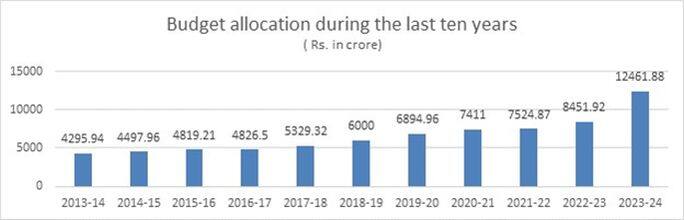
PM Modi has emphasised that for the government, the tribal society is not just a government statistic. It is a matter of empathy and emotional concern. This belief shows in reflected in a substantial budget increase, with the Ministry of Tribal Affairs receiving over Rs. 12,461.88 crore, marking a commendable 70% rise.
The total allocation for the Ministry of Tribal Affairs stands at Rs. 12,461.88 crore, marking a substantial rise of over 70% compared to the Revised Estimate (RE) of Rs. 7,301.00 crore from the preceding year. In the last 10 years, the rising budget allocation for the Ministry of Tribal Affairs is shown in this graph:
Moreover, in the Union Budget for the fiscal year 2023-24, over Rs. 1 lakh crore has been earmarked as funds for the Scheduled Tribe Component.
As of February 2023, the nationwide presence of 37 Aadi Mahotsavs has resulted in significant benefits for over 7,700 tribal artisans who actively participated, generating impressive sales surpassing Rs. 38.00 crore. The overall impact extends beyond these events, with a substantial Rs. 239.11 crores generated from the sales of tribal products through diverse offline and online platforms, including those associated with Aadi Mahotsavs. A total of 141 TRIFED outlets have also been established to promote and sell tribal products. The Tribes India e-commerce portal has formed partnerships with major platforms such as Amazon and Flipkart to enhance the online visibility and accessibility of these tribal products.
The Pradhan Mantri Aadi Adarsh Gram Yojana (PMAAGY) aims to enhance basic infrastructure in 36,428 villages with a 50% tribal population and 500 Scheduled Tribes (STs). This initiative includes villages in Aspirational Districts recognised by NITI Aayog. Among the total Aspirational Districts, 86 Districts overlap, encompassing 10,509 villages under the PMAAGY.
To ensure lucrative livelihoods for tribal families, a budgetary provision of Rs. 288 crore has been designated for implementation through TRIFED. This will involve establishing Self Help Groups and producer enterprises. Under the Pradhan Mantri Jan Jatiya Vikas Mission, emphasis will be placed on creating 3,958 Van Dhan Vikas Kendras, operating cooperatively and benefitting 1,83,412 tribal persons. Key focus areas include organic farming, medicinal plants, millets, and food processing, all to be undertaken by these tribal self-help groups. Additionally, there will be a concentration on skill development, craft training, and providing appropriate credit and marketing facilities.
2.56 lakh beneficiaries since 2019-20 under the schemes of the National Scheduled Tribes Finance and Development Corporation like the term loan scheme, Adivasi Mahila Sashaktikaran Yojana, Micro Credit scheme, Adivasi Shiksha Rrinn Yojana etc. for undertaking various economic activities also financially empower tribal communities. The Indian government has implemented several schemes to empower Scheduled Tribes (ST) women and entrepreneurs. The Adivasi Mahila Sashaktikaran Yojana (AMSY) offers highly concessional loans of up to 90% for projects costing up to ₹2.00 lakh, specifically benefiting ST women with a low-interest rate of 4% per annum. The Micro Credit Scheme for Self-Help Groups provides loans up to ₹50,000 per member and a maximum of ₹5 lakh per Self Help Group. A Venture Capital Fund for Scheduled Tribes’ (VCF-ST), has also been set up which is aimed at promoting Entrepreneurship among the STs.
Additionally, ST Entrepreneurs can benefit from the Margin Money Support Scheme under Stand-Up India, receiving financial assistance equivalent to 15% of the total project cost. The National SC/ST Hub fosters a supportive ecosystem for SC/ST entrepreneurs, while grants totalling Rs.1472 crore are allocated to States with ST populations for development. Furthermore, through the PM MUDRA Yojana and PM Street Vendor's AatmaNirbhar Nidhi funds have been disbursed in substantial amounts, including Rs 40,000 crores disbursed to Chhattisgarh youth. 22% of the disbursement within the PM SVANidhi scheme has gone to Scheduled Castes and Scheduled Tribes, exceeding Rs 9,100 crore. These measures underscore the government's commitment to fostering economic development and empowerment among tribal communities.
Skilling Tribal Youth
The government has been actively involved in skill development through various programs, contributing significantly to the training of tribal candidates. Some of these initiatives include the Pradhan Mantri Kaushal Vikas Yojana, through which 6,56,263 tribal candidates have been trained since 2015, and the Jan Shikshan Sansthan Scheme, under which 2,04,552 tribal youth have been trained since 2018.
Moreover, under the National Apprenticeship Promotion Scheme, 76,448 people have been trained since 2018, and 7,50,211 people have been trained under the Craftsman Training Scheme conducted through Industrial Training Institutes (ITIs). These statistics underscore the government's commitment to skill development, providing valuable opportunities for tribal individuals to enhance their capabilities and contribute to the workforce.
Lastly, the government initiated the Going Online as Leaders (GOAL) Program on May 15, 2020, to digitally empower and enhance the digital skills of 5,000 youth from tribal communities over five years. This project strives to enlist the support of 2500 accomplished individuals across various industries, including policymakers, influencers, educators, artists, entrepreneurs, and social workers, renowned for their accomplishments. The primary goal is to have these mentors personally guide and mentor tribal youth throughout India.
In conclusion, the comprehensive initiatives undertaken by the government for tribal youth reflect a commitment to inclusive growth and empowerment. From educational advancements to economic initiatives and skill development programs, the approach goes beyond policies and budgets, embodying a genuine concern for the well-being of tribal communities. As these efforts continue to unfold, they pave the way for a more equitable and prosperous India, where the potential of every tribal youth is recognized and nurtured.