Pays tributes to Shri Atal Bihari Vajpayee due to whose strong will, the state of Jharkhand came into existence
 “In this Amrit Kaal of independence, the country has decided that the country will give a more meaningful and more grand identity to the tribal traditions of India and its valor stories”
 “This museum will become a living venue of our tribal culture full of diversity, depicting the contribution of tribal heroes and heroines in the freedom struggle.”
 “Bhagwan Birsa lived for the society, sacrificed his life for his culture and his country. Therefore, he is still present in our faith, in our spirit as our God.”

Friends,

On this important occasion, the nation’s first Tribal Freedom Fighters Museum is being dedicated to the countrymen. Fighting for India's identity and independence, Bhagwan Birsa Munda spent his last days in this jail in Ranchi. The land, which had an imprint of Bhagwan Birsa and which is witness to his penance and sacrifice, is a kind of pilgrimage for all of us. Some time back I had called for the establishment of Adivasi (tribal) museums across the country to cherish the history of tribal society and their contribution to the freedom struggle. The central and all the state governments are working together for this purpose. I am happy that the first tribal museum in Jharkhand, which is rich in tribal culture, has come into existence today. I congratulate the tribal society of the country, every citizen of India for the Bhagwan Birsa Munda Memorial Udyan cum Freedom Fighter Museum. This museum will become a living venue of our tribal culture full of diversity, depicting the contribution of tribal heroes and heroines in the freedom struggle. There are statues of many tribal heroes, including Sidhu-Kanhu, Poto Ho, Telanga Kharia, Gaya Munda, Jatra Tana Bhagat and Diva-Kisun in this museum and their life stories have also been explained in detail.

Friends,

Apart from this, work is going on at a rapid pace on nine more such museums in different states of the country. Very soon, we will see the museums in Rajpipla in Gujarat, Lambasingi in Andhra Pradesh, Raipur in Chhattisgarh, Kozhikode in Kerala, Chhindwara in Madhya Pradesh, Hyderabad in Telangana, Tamenglong in Manipur, Kelsih in Mizoram and Ponda in Goa. These museums will not only make the new generation of the country aware of the pride of tribal history, but will also give a new impetus to tourism in these areas. These museums will also preserve and promote songs, music, art-skills, handicrafts and crafts passed down from generation to generation.

Friends,

Bhagwan Birsa Munda and many of our tribal fighters had sacrificed their lives for the freedom of the country. But what was the meaning of independence and Swaraj to them? The innate goal of the freedom struggle was that the sovereignty of India and the power to make decisions for India should rest with the people of India. At the same time, the fight for 'Dharti Aaba' was also against the ideology that wanted to erase the identity of India's tribal society. Bhagwan Birsa Munda knew that attacking diversity in the name of modernity, tampering with ancient identity and nature was not the way for the welfare of the society. He was in favor of modern education, he advocated for changes and he also showed courage to speak against the evils and shortcomings of his own society. He campaigned against illiteracy, drug addiction, discrimination and created awareness among the youths of the society. It was the impact of these moral values ​​and positive thinking that gave a new energy to the tribal society. The same foreigners, who considered our tribal society, Munda brothers and sisters, as backward and weak, were brought to their knees by Bhagwan Birsa Munda and Munda society. This fight was for the root-forest-land, the identity of the tribal society and the independence of India. And it was so powerful because Bhagwan Birsa had taught the society to fight against the external enemies as well as the weaknesses within. Therefore, I think Janjatiya Gaurav Diwas is also an occasion to remember this great sacrifice of empowering the society and an opportunity to remember it again and again.

Friends,

The 'Ulgulan' (revolution) of Bhagwan Birsa Munda was not limited to victory and defeat. It was not an ordinary battle of history. ‘Ulgulan’ was an inspiring event for hundreds of years to come. Bhagwan Birsa gave life for the society, culture and the country. Therefore, he exists as God in our faith and spirit even today. When we see the tribal society becoming a participant in the development of the country and leading India on environment, we see the face of Bhagwan Birsa Munda and feel his blessings. Therefore, the tribal society should preserve the customs and culture of their society. This is what our India is doing today for the entire world!

Friends,

Bhagwan Birsa is not an individual but a tradition for all of us. He is the embodiment of the philosophy of life that has been a part of the soul of India for centuries. We don't just call him ‘Dharti Aaba’. Around the time when Father of the Nation Mahatma Gandhi was becoming the voice of humanity against apartheid in South Africa, Birsa Munda had already written a chapter of the battle against servitude in India. ‘Dharti Aaba’ did not live for very long. But he wrote a complete history for the country in a short span of life and gave direction to the generations of India. In the ongoing Amrit Mahotsav of Independence, the country is reviving countless such pages of history, which were forgotten in the past decades. The freedom of this country involves the sacrifices of so many fighters, who did not get the recognition that was due to them. If we look at that period of our freedom struggle, there was hardly any period when there was no tribal revolution in different parts of the country! Be it the Munda movement under the leadership of Bhagwan Birsa, or the Santhal struggle and the Khasi struggle, the Ahom struggle in the Northeast or the Kol war in the Chota Nagpur region and the Bhil struggle, the tribal sons and daughters of India challenged the British rule in every period.

Friends,

If we look at the history of Jharkhand and the entire tribal region, Baba Tilka Manjhi had launched a vigorous front against the British. The Sidho-Kanhu and Chand-Bhairav brothers ​​had blown the trumpet of the Santhal war from Bhognadih. There were so many fighters like Telanga Kharia, Sheikh Bhikhari and Ganpat Rai, heroes and leading ladies like Tikait Umrao Singh, Vishwanath Shahdeo, Nilambar-Pitamber, Narayan Singh, Jatra Oraon, Jadonang, Rani Gaidinliu and Rajmohini Devi who made supreme sacrifices to carry forward the freedom struggle. The contribution of these great souls cannot be forgotten. Their glorious past and sagas will give energy for a new India. Therefore, the nation has appealed to its youth and historians to rewrite the history of independence involving these personalities. The youth have been urged to come forward. A writing campaign is being run regarding this in this virtuous period of freedom.

I would also request the youth of Jharkhand, especially the tribal youth, who not only read the history of this land, but have seen, heard and lived it to take the responsibility of this resolve of the country. You can research or write a book on the history related to the freedom struggle. You can also discover new innovative ways to take tribal art and culture to the masses. Now it is our responsibility to give new consciousness to our ancient heritage and history.

Friends,

Bhagwan Birsa Munda had dreamed of existence, identity and self-reliance for the tribal society. Today the country is also moving forward with this resolve. We have to remember that no matter how big a tree is, it can stand tall only when it is deeply rooted. Therefore, AatmaNirbhar Bharat is also a resolve to connect with its roots and strengthen its roots. This resolution will be fulfilled with the efforts of all of us. I have full faith our country will definitely fulfill its resolutions and will also give direction to the entire world with the blessings of Bhagwan Birsa. I once again wish the nation for the Janjatiya Gaurav Diwas. I would urge the students of the country to visit Ranchi and see this exhibition showcasing the great culture of the tribal community. Try to learn something there. There is a lot here for every child of India to move forward with determination in life. I once again thank you all very much.


Explore More
శ్రీరామ జన్మభూమి ఆలయ ధ్వజారోహణ ఉత్సవం సందర్భంగా ప్రధానమంత్రి ప్రసంగం

ప్రముఖ ప్రసంగాలు

శ్రీరామ జన్మభూమి ఆలయ ధ్వజారోహణ ఉత్సవం సందర్భంగా ప్రధానమంత్రి ప్రసంగం
India's electronics production rises 6-fold, exports jump 8-fold since 2014: Ashwini Vaishnaw

Media Coverage

India's electronics production rises 6-fold, exports jump 8-fold since 2014: Ashwini Vaishnaw
NM on the go

Nm on the go

Always be the first to hear from the PM. Get the App Now!
...
PM chairs Fifth National Conference of Chief Secretaries in Delhi
December 28, 2025
Viksit Bharat is synonymous with quality and excellence in governance, delivery and manufacturing: PM
PM says India has boarded the ‘Reform Express’, powered by the strength of its youth
PM highlights that India's demographic advantage can significantly accelerate the journey towards Viksit Bharat
‘Made in India’ must become a symbol of global excellence and competitiveness: PM
PM emphasises the need to strengthen Aatmanirbharta and strengthen our commitment to 'Zero Effect, Zero Defect’
PM suggests identifying 100 products for domestic manufacturing to reduce import dependence and strengthen economic resilience
PM urges every State must to give top priority to soon to be launched National Manufacturing Mission
PM calls upon states to encourage manufacturing, boost ‘Ease of Doing Business’ and make India a Global Services Giant
PM emphasises on shifting to high value agriculture to make India the food basket of the world
PM directs States to prepare roadmap for creating a global level tourism destination

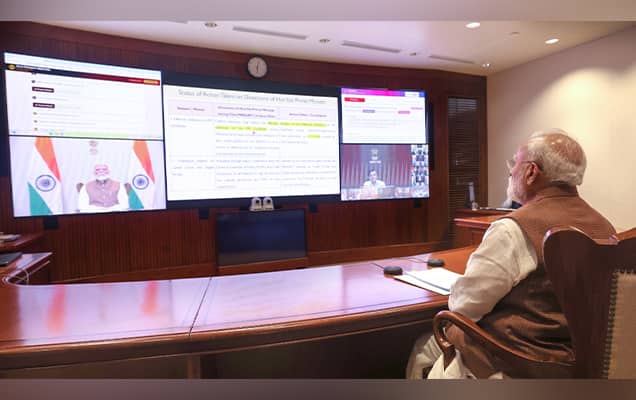
Prime Minister Narendra Modi addressed the 5th National Conference of Chief Secretaries in Delhi, earlier today. The three-day Conference was held in Pusa, Delhi from 26 to 28 December, 2025.

Prime Minister observed that this conference marks another decisive step in strengthening the spirit of cooperative federalism and deepening Centre-State partnership to achieve the vision of Viksit Bharat.

Prime Minister emphasised that Human Capital comprising knowledge, skills, health and capabilities is the fundamental driver of economic growth and social progress and must be developed through a coordinated Whole-of-Government approach.

The Conference included discussions around the overarching theme of ‘Human Capital for Viksit Bharat’. Highlighting India's demographic advantage, the Prime Minister stated that nearly 70 percent of the population is in the working-age group, creating a unique historical opportunity which, when combined with economic progress, can significantly accelerate India's journey towards Viksit Bharat.

Prime Minister said that India has boarded the “Reform Express”, driven primarily by the strength of its young population, and empowering this demographic remains the government’s key priority. Prime Minister noted that the Conference is being held at a time when the country is witnessing next-generation reforms and moving steadily towards becoming a major global economic power.

He further observed that Viksit Bharat is synonymous with quality and excellence and urged all stakeholders to move beyond average outcomes. Emphasising quality in governance, service delivery and manufacturing, the Prime Minister stated that the label "Made in India' must become a symbol of excellence and global competitiveness.

Prime Minister emphasised the need to strengthen Aatmanirbharta, stating that India must pursue self-reliance with zero defect in products and minimal environmental impact, making the label 'Made in India' synonymous with quality and strengthen our commitment to 'Zero Effect, Zero Defect.’ He urged the Centre and States to jointly identify 100 products for domestic manufacturing to reduce import dependence and strengthen economic resilience in line with the vision of Viksit Bharat.

Prime Minister emphasised the need to map skill demand at the State and global levels to better design skill development strategies. In higher education too, he suggested that there is a need for academia and industry to work together to create high quality talent.

For livelihoods of youth, Prime Minister observed that tourism can play a huge role. He highlighted that India has a rich heritage and history with a potential to be among the top global tourist destinations. He urged the States to prepare a roadmap for creating at least one global level tourist destination and nourishing an entire tourist ecosystem.

PM Modi said that it is important to align the Indian national sports calendar with the global sports calendar. India is working to host the 2036 Olympics. India needs to prepare infrastructure and sports ecosystem at par with global standards. He observed that young kids should be identified, nurtured and trained to compete at that time. He urged the States that the next 10 years must be invested in them, only then will India get desired results in such sports events. Organising and promoting sports events and tournaments at local and district level and keeping data of players will create a vibrant sports environment.

PM Modi said that soon India would be launching the National Manufacturing Mission (NMM). Every State must give this top priority and create infrastructure to attract global companies. He further said that it included Ease of Doing Business, especially with respect to land, utilities and social infrastructure. He also called upon states to encourage manufacturing, boost ‘Ease of Doing Business’ and strengthen the services sector. In the services sector, PM Modi said that there should be greater emphasis on other areas like Healthcare, education, transport, tourism, professional services, AI, etc. to make India a Global Services Giant.

Prime Minister also emphasized that as India aspires to be the food basket of the world, we need to shift to high value agriculture, dairy, fisheries, with a focus on exports. He pointed out that the PM Dhan Dhanya Scheme has identified 100 districts with lower productivity. Similarly, in learning outcomes States must identify the lowest 100 districts and must work on addressing the issues around the low indicators.

PM also urged the States to use Gyan Bharatam Mission for digitization of manuscripts. He said that States may start a Abhiyan to digitize such manuscripts available in States. Once these manuscripts are digitized, Al can be used for synthesizing the wisdom and knowledge available.

Prime Minister noted that the Conference reflects India’s tradition of collective thinking and constructive policy dialogue, and that the Chief Secretaries Conference, institutionalised by the Government of India, has become an effective platform for collective deliberation.

Prime Minister emphasised that States should work in tandem with the discussions and decisions emerging from both the Chief Secretaries and the DGPs Conferences to strengthen governance and implementation.

Prime Minister suggested that similar conferences could be replicated at the departmental level to promote a national perspective among officers and improve governance outcomes in pursuit of Viksit Bharat.

Prime Minister also said that all States and UTs must prepare capacity building plan along with the Capacity Building Commission. He said that use of Al in governance and awareness on cyber security is need of the hour. States and Centre have to put emphasis on cyber security for the security of every citizen.

Prime Minister said that the technology can provide secure and stable solutions through our entire life cycle. There is a need to utilise technology to bring about quality in governance.

In the conclusion, Prime Minister said that every State must create 10-year actionable plans based on the discussions of this Conference with 1, 2, 5 and 10 year target timelines wherein technology can be utilised for regular monitoring.

The three-day Conference emphasised on special themes which included Early Childhood Education; Schooling; Skilling; Higher Education; and Sports and Extracurricular Activities recognising their role in building a resilient, inclusive and future-ready workforce.

Discussion during the Conference

The discussions during the Conference reflected the spirit of Team India, where the Centre and States came together with a shared commitment to transform ideas into action. The deliberations emphasised the importance of ensuring time-bound implementation of agreed outcomes so that the vision of Viksit Bharat translates into tangible improvements in citizens’ lives. The sessions provided a comprehensive assessment of the current situation, key challenges and possible solutions across priority areas related to human capital development.

The Conference also facilitated focused deliberations over meals on Heritage & Manuscript Preservation and Digitisation; and Ayush for All with emphasis on integrating knowledge in primary healthcare delivery.

The deliberations also emphasised the importance of effective delivery, citizen-centric governance and outcome-oriented implementation to ensure that development initiatives translate into measurable on-ground impact. The discussions highlighted the need to strengthen institutional capacity, improve inter-departmental coordination and adopt data-driven monitoring frameworks to enhance service delivery. Focus was placed on simplifying processes, leveraging technology and ensuring last-mile reach so that benefits of development reach every citizen in a timely, transparent and inclusive manner, in alignment with the vision of Viksit Bharat.

The Conference featured a series of special sessions that enabled focused deliberations on cross-cutting and emerging priorities. These sessions examined policy pathways and best practices on Deregulation in States, Technology in Governance: Opportunities, Risks & Mitigation; AgriStack for Smart Supply Chain & Market Linkages; One State, One World Class Tourist Destination; Aatmanirbhar Bharat & Swadeshi; and Plans for a post-Left Wing Extremism future. The discussions highlighted the importance of cooperative federalism, replication of successful State-level initiatives and time-bound implementation to translate deliberations into measurable outcomes.

The Conference was attended by Chief Secretaries, senior officials of all States/Union Territories, domain experts and senior officers in the centre.