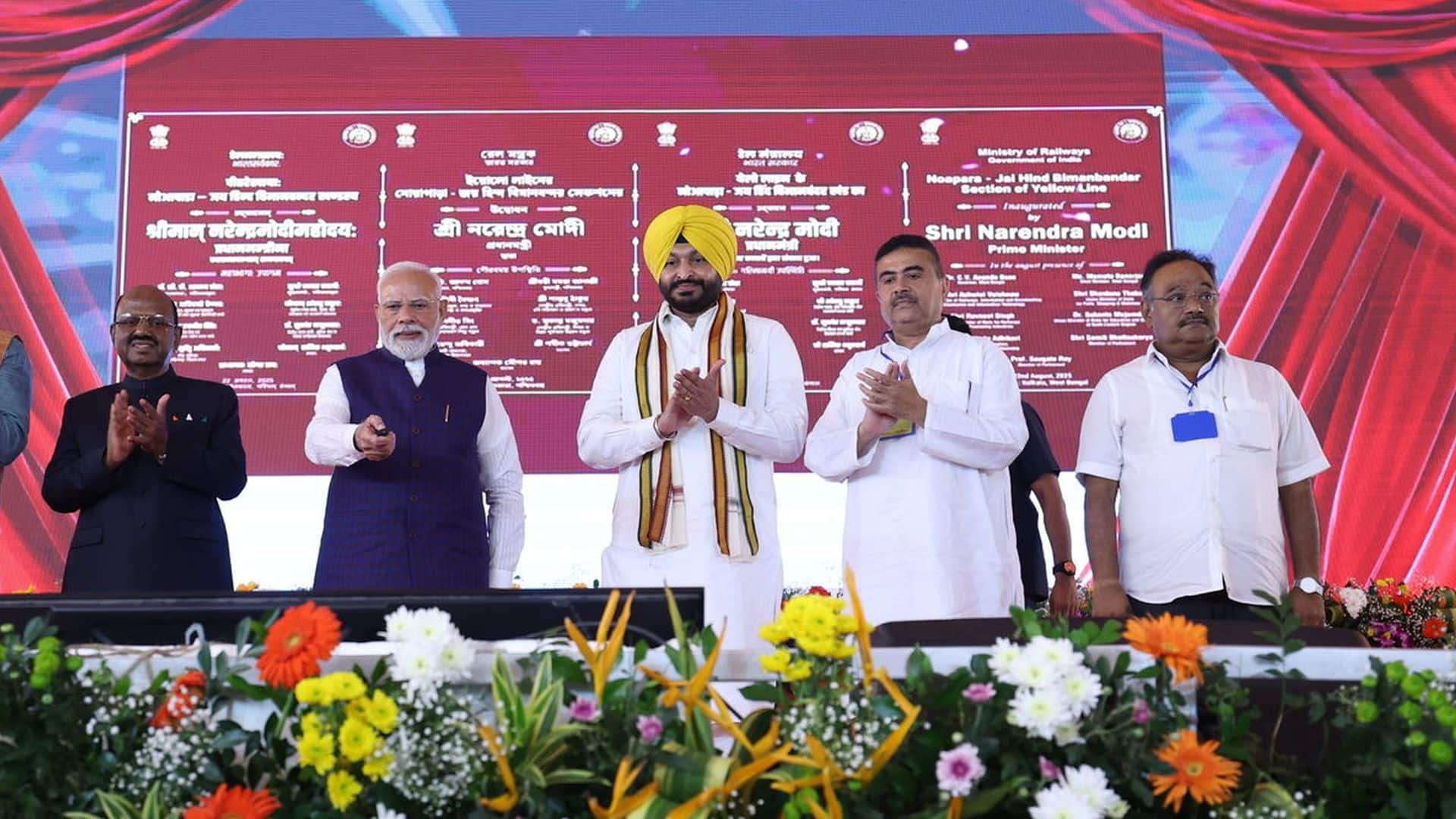


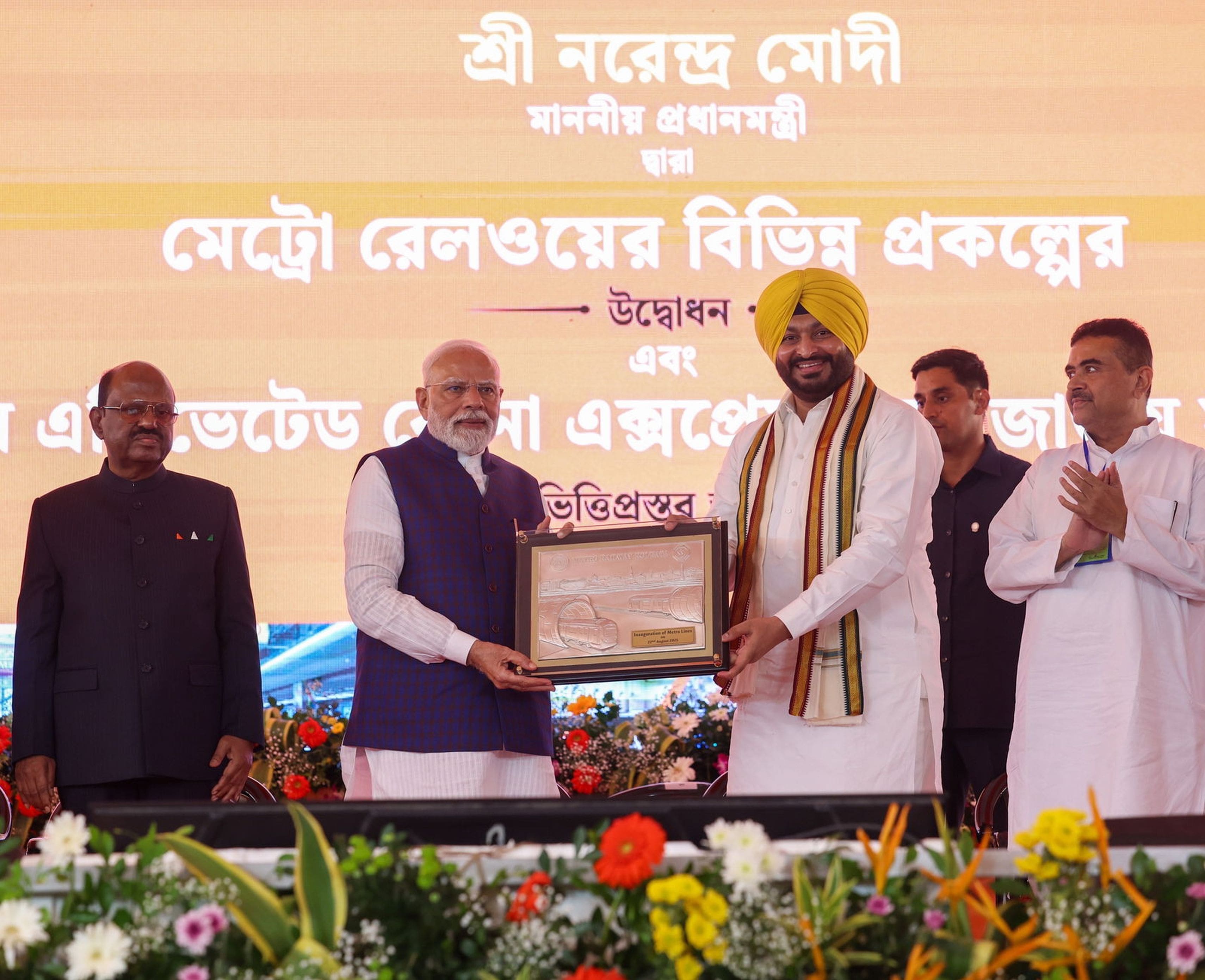
The Prime Minister Shri Narendra Modi laid the foundation stone and inaugurated multiple development projects worth over Rs 5,200 crore in Kolkata at West Bengal today. Addressing the gathering, the Prime Minister stated that he once again had the opportunity to accelerate the development of West Bengal. Sharing his experience of the Kolkata Metro journey from Noapara to Jai Hind Airport, Shri Modi said that during this visit, he interacted with many colleagues and noted that everyone expressed happiness over the modernization of Kolkata’s public transport system. The Prime Minister also laid the foundation stone for the six-lane elevated Kona Expressway. He extended heartfelt congratulations to the people of Kolkata and all citizens of West Bengal for these multi-thousand crore rupee projects.
“Cities like Kolkata are a rich embodiment of both India’s history and its future, as India moves towards becoming the world’s third-largest economy, cities such as Dum Dum and Kolkata will play a pivotal role”, said Shri Modi. He stated that the message of today’s programme goes beyond the inauguration of the metro and the foundation stone of the highway. The Prime Minister noted that this event is a testament to how modern India is transforming its urban landscape. He emphasized that efforts are underway across Indian cities to promote green mobility, while the number of electric charging points and electric buses is being increased. He further added that under the ‘Waste to Wealth’ initiative, cities are now generating electricity from urban waste. Highlighting that metro services are expanding and metro networks are being extended, Shri Modi expressed pride in the fact that India now has the world’s third-largest metro network. He pointed out that before 2014, the country had only 250 kilometres of metro routes, while today, the metro network in India has expanded to over 1,000 kilometres. He stated that Kolkata too has witnessed continuous expansion of its metro system. The Prime Minister informed that approximately 14 kilometres of new lines are being added to Kolkata’s metro rail network, while seven new stations are being integrated into the Kolkata Metro. He affirmed that all these developments will enhance the Ease of Living and Ease of Travel for the people of Kolkata.
“21st-century India requires a 21st-century transport system. Therefore, today across the country, modern transport facilities—from railways to roads, metros to airports—are being developed and interconnected”, emphasised Shri Modi. He highlighted that the government’s effort is not only to connect one city to another, but also to ensure seamless transport access near people’s homes. He remarked that a glimpse of this vision can be seen in Kolkata’s multi-modal connectivity. The Prime Minister noted that two of the country’s busiest railway stations—Howrah and Sealdah—are now connected via metro. He pointed out that travel time between these stations, which earlier took around one and a half hours, will now take only a few minutes by metro. He added that the Howrah Station subway is also ensuring multi-modal connectivity. Noting that earlier, passengers had to take long detours to catch trains from Eastern Railway or South Eastern Railway, Shri Modi said with the construction of this subway, interchange time will be significantly reduced. The Prime Minister announced that Kolkata Airport is now connected to the metro network, which will make it easier for people from distant parts of the city to reach the airport.

Affirming that the Government of India is making every possible effort for the development of West Bengal, Shri Modi underlined that West Bengal is now among the states where 100% railway electrification has been achieved. He acknowledged the long-standing demand for a MEMU train between Purulia and Howrah, and confirmed that the Government of India has fulfilled this public demand. The Prime Minister informed that nine Vande Bharat trains are currently operating on various routes in West Bengal with two additional Amrit Bharat trains also running for the people of the state.
Stating that over the past 11 years, the Government of India has completed several major highway projects in the region, the Prime Minister noted that work is ongoing on many other infrastructure projects. He highlighted that once the six-lane Kona Expressway is completed, it will significantly improve port connectivity. He concluded by adding that this enhanced connectivity will strengthen the foundation for a better future for Kolkata and West Bengal.
The Governor of West Bengal, Dr. C.V. Ananda Bose, Union Ministers Shri Shantanu Thakur, Shri Ravneet Singh Bittu, Dr. Sukanta Majumdar were present among other dignitaries at the event.

Background
In line with his commitment to world class infrastructure and developed urban connectivity, Prime Minister inaugurated metro railway projects in Kolkata. A 13.61 km long newly constructed metro network will be inaugurated and metro services will be launched on these routes. He visited the Jessore Road Metro Station, where he will flag off the Noapara–Jai Hind Bimanbandar metro service from Jessore Road. In addition, through video conferencing, he will also flag off the Sealdah–Esplanade metro service and the Beleghata–Hemanta Mukhopadhyay metro service. He also undertook a metro ride from Jessore Road Metro Station to Jai Hind Bimanbandar and back.
At the public function, Prime Minister inaugurated these metro sections and a newly constructed subway at Howrah Metro Station. The Noapara–Jai Hind Bimanbandar metro service will significantly improve the access to the airport. The Sealdah–Esplanade metro will reduce the travel time between the two points from nearly 40 minutes to only 11 minutes. The Beleghata–Hemanta Mukhopadhyay metro section will play a crucial role in enhancing connectivity with the IT hub. These metro routes will connect some of Kolkata’s busiest areas, bring a notable reduction in travel time, and strengthen multimodal connectivity, benefiting lakhs of daily commuters.
In a major boost to road infrastructure in the region, Prime Minister also laid the foundation stone of 7.2 km long six-lane elevated Kona Expressway worth over Rs 1,200 crore. It will enhance connectivity between Howrah, surrounding rural areas, and Kolkata, saving hours of travel time and giving significant boost to trade, commerce, and tourism in the region.
పూర్తి ప్రసంగం చదవడానికి ఇక్కడ క్లిక్ చేయండి
कोलकाता जैसे हमारे शहर...भारत के इतिहास और हमारे भविष्य, दोनों की समृद्ध पहचान हैं।
— PMO India (@PMOIndia) August 22, 2025
आज जब भारत, दुनिया की तीसरी सबसे बड़ी इकॉनॉमी बनने की तरफ आगे बढ़ रहा है... तब दमदम, कोलकाता...इन शहरों की भूमिका बहुत बड़ी है: PM @narendramodi
21वीं सदी के भारत को... 21वी सदी के ट्रांसपोर्ट सिस्टम की जरूरत है।
— PMO India (@PMOIndia) August 22, 2025
इसलिए आज देश में रेल से रोड तक, मेट्रो से एयरपोर्ट तक... हम मॉडर्न ट्रांसपोर्ट फैसिलिटीज डेवलप भी कर रहे हैं और उन्हें आपस में कनेक्ट भी कर रहे हैं: PM @narendramodi