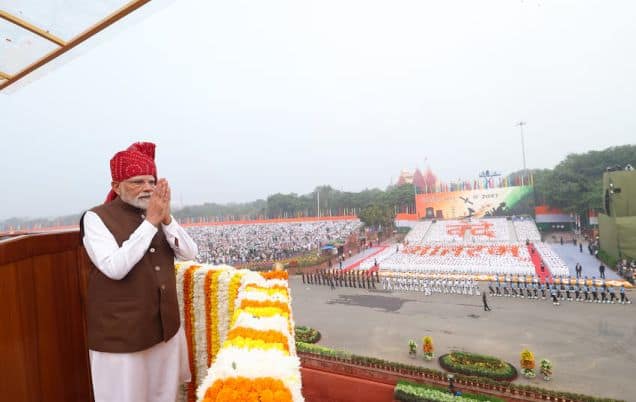
Prime Minister Narendra Modi gently declined the idea of including a chapter on him in school textbooks - being considered by certain states - by stating that the school curriculum should, instead, include lessons on the many stalwarts who have contributed to making the India of today.

Justifying his realistic stand, the Prime Minister said that he firmly believed that the life story of living individuals should not be included as a part of the school curriculum.

The humble self that he is, Shri Modi urged the authorities to include other stalwarts so that the young minds could read about these great people and emulate them.

Shri Narendra Modi tweeted:

Explore More
శ్రీరామ జన్మభూమి ఆలయ ధ్వజారోహణ ఉత్సవం సందర్భంగా ప్రధానమంత్రి ప్రసంగం

ప్రముఖ ప్రసంగాలు

శ్రీరామ జన్మభూమి ఆలయ ధ్వజారోహణ ఉత్సవం సందర్భంగా ప్రధానమంత్రి ప్రసంగం
Tier-2 cities drive growth in India's tech hiring as GCC expansion spreads beyond metros

Media Coverage

Tier-2 cities drive growth in India's tech hiring as GCC expansion spreads beyond metros
NM on the go

Nm on the go

Always be the first to hear from the PM. Get the App Now!
...
India-Japan Joint Statement on cooperation in the field of Artificial Intelligence (AI)
July 02, 2026

The Prime Minister of the Republic of India and the Prime Minister of Japan acknowledged that Artificial Intelligence (AI) is an era-defining general-purpose technology that is transforming economies, societies, science and technology, industry and business, governance, and security. They recognized that the choices made today in the design, development, deployment and governance of AI will have long-term implications for innovation, social welfare, economic security, and the international order. Based on this understanding, they concurred in advancing cooperation to mutually enhance the resilience and competitiveness of both countries in the field of AI and to bring about innovation and growth in both countries, in order to build a safe, secure, trustworthy, inclusive, human-centric, sustainable, accountable, and innovation-oriented AI ecosystem.

The two leaders recognized the need to adapt to structural changes in the international order. They concurred in cooperating to build resilient and growth-oriented economic ecosystems in alignment with India’s MAHASAGAR and Japan’s updated “Free and Open Indo-Pacific (FOIP)”. To this end, they committed to strengthen AI cooperation between India and Japan, with like-minded countries and partners, to support resilient and inclusive AI development in the Indo-Pacific and the Global South.

The two leaders affirmed that, for the sustainable development of AI, it is crucial to promote innovation through the use and application of AI technologies, appropriately mitigate associated risks, and ensure resilient, diversified, and trustworthy AI supply chains. In this regard, they welcomed the deliberations and outcomes of the New Delhi AI Impact Summit.

The two leaders acknowledged the progress under the "Japan-India AI Cooperation Initiative (JAI)" and especially welcomed the discussions at the first India and Japan AI Strategic Dialogue held in April 2026. They concurred in continuing regular India and Japan AI Strategic Dialogues, involving relevant stakeholders as appropriate, to deepen common understanding of AI opportunities and challenges and translate their shared vision into practical outcomes in the following priority areas:

I. International AI Governance, Safety, and Cybersecurity

The two leaders reaffirmed the importance of promoting an international governance framework that is centered on safe, secure, trustworthy, robust, and inclusive AI that supports responsible innovation, while respecting national laws, priorities, and contexts. They emphasized that AI governance should be risk-balanced, participatory, informed, proportionate, interoperable, and adaptive. In this regard, they reaffirmed the significance of the Hiroshima AI Process (HAIP), including its international guiding principles and codes of conduct for advanced AI systems. They also highlighted the principles in the Guidance Note on AI Governance prepared during the India AI Impact Summit by the Safe & Trusted AI Working Group, which was co-chaired by Japan. They decided to strengthen coordination between the two countries in international fora, including the G20, the Organization for Economic Cooperation and Development (OECD), Global Partnership on AI(GPAI), and the United Nations, and welcomed the first UN Global Dialogue on AI governance in this regard. They reaffirmed their commitment to deepen cooperation within the Hiroshima AI Process Friends Group and Partners Community, including through greater participation of the Global South and the private sector, and promote the implementation of the Hiroshima AI Process Friends Group Action Plan 2026.

The two leaders emphasized the need to strengthen cooperation on the safe design, development, deployment, and use of AI throughout its full lifecycle, including on AI model evaluation, capability assessment, guidelines, tools, and benchmarks. They encouraged relevant institutions to explore cooperation through Trusted AI Commons, announced during the India AI Impact Summit as a collaborative platform consolidating technical resources, tools, benchmarks and best practices.

The two leaders recognized that highly capable frontier AI models possess advanced cyber capabilities, which can strengthen defenders while also creating risks of misuse. Reaffirming that cyberspace is a Global Public Good, they underlined that arrangements for the evaluation, controlled release and trusted access of such systems should be risk-based and attentive to the legitimate cyber-defense needs of responsible partners. They decided to strengthen cooperation on AI-enabled cybersecurity and the security of AI systems, with particular attention to critical infrastructure.

The two leaders emphasized the importance of protecting the safety of children as AI is developed and deployed, and concurred that responsible design, governance, and risk-based safeguards are essential to ensuring that AI serves as a means of learning and growth for children rather than a source of harm.

II. Infrastructure Development, Model Development, and Human Resources Exchange and Co-creation of Solutions

The two leaders reaffirmed the importance of building safe, secure and trustworthy AI ecosystem, including in the Indo-Pacific, supported by resilient, diversified, and trustworthy supply chains of AI technology stack. In this regard, they decided to elevate India and Japan as strategic research and development partners in the field of AI. They decided to strengthen cooperation on secure digital infrastructure for AI, including data centers, GPU and other compute resources, and semiconductors, and to jointly assess potential opportunities and vulnerabilities across the AI technology stack from an economic-security perspective. In this regard, they also emphasized advancing the FOIP Digital Corridor Initiative to strengthen digital connectivity and resilient AI supply chains.

The two leaders decided to cooperate on resilient, innovative and efficient AI, taking note of the Voluntary Guiding Principles on Resilient, Innovative, and Efficient AI as discussed at the India AI Impact Summit, the Playbook on Advancing Resilient AI Infrastructure, including through work on efficient models, optimized inference, energy-efficient compute and green, secure data infrastructure.

The two leaders concurred in enhancing cooperation between government, industry, and academia on multilingual, open-source, domain specific, and vertical AI models, including models for native languages and public interest applications. In this context, the two leaders welcomed the signing of several significant memorandums aimed at fostering deeper collaboration in the field of Artificial Intelligence. These include a Memorandum of Understanding (MOU) between the Indian Institute of Technology Bombay, the BharatGen Technology Foundation, and the National Institute of Informatics (NII/ROIS) for the joint research and development of large language models (LLMs); a MOU between Sarvam and Preferred Networks to cooperate across the full AI technology stack; and a Memorandum of Cooperation (MOC) between India AI and METI (Ministry of Economy, Trade and Industry) to support AI development companies from both countries.

The two leaders recognized the importance of AI-enabled scientific discovery and advanced research, and encouraged relevant institutions to cooperate in this regard, including under the Network of AI for Science (AI4S) Institutions established during the India AI Impact Summit.

The two leaders reaffirmed the strategic importance of deepening research cooperation, including promoting joint research projects and fostering the exchange of researchers. In this context, the two leaders committed to further strengthen the industrial competitiveness of both countries by engaging in human resource exchanges through industry-academia collaboration, from semiconductors to applications across the entire AI stack. Recognizing India's strong AI human capital as a foundation for closer cooperation, they welcomed the growing engagement of Japanese companies with India's leading higher education institutions and technology talent. Both sides concurred to undertake measures to encourage Japanese companies to expand AI-related R&D, innovation and industry partnerships in India, while supporting the professional development and mobility of Indian talent to Japan through joint research, internships, employment opportunities, and other pathways, to foster stronger linkages between Japanese companies and India's AI talent ecosystem. In this context, they reaffirmed the goal, set out at the India - Japan Foreign Ministers’ Strategic Dialogue in January 2026, of inviting 500 highly skilled AI professionals from India to Japan by 2030 and promoting joint research.

The two leaders also recognized that human capital is central to the responsible development, deployment and governance of AI. In this regard, they highlighted the utility of the Voluntary Guiding Principles for Skilling and Reskilling in the Age of AI formulated during the India AI Impact Summit.

The two leaders reaffirmed the importance of co-creating AI solutions to address the strategic, economic, and societal priorities of both countries, and concurred in accelerating ongoing projects through public-private partnership. They called upon corporations, startups, research institutions, investors and public agencies of both countries to identify concrete problem statements and co-develop scalable AI solutions. In this regard, they encouraged relevant stakeholders to draw upon the Global AI Impact Commons to support the adoption, replication and scale-up of successful AI use cases.

III. AI for All

The two leaders welcomed the vision of 'AI for All' advocated by the 'New Delhi Declaration' adopted at the India AI Impact Summit and reaffirmed their shared commitment to aim for AI to benefit all humanity, for inclusive and sustainable development, and to improve public services delivery.

The two leaders decided to work together, with like-minded countries and other partners, to support AI capacity building, technical assistance, knowledge sharing and use-case replication respecting national laws, priorities, and contexts. The two leaders concurred that strengthening cooperation with partners from third countries and multi-stakeholder communities is key to co-creating a safe, secure, inclusive, sustainable, resilient, and trustworthy AI ecosystem.

Prime Minister Narendra Modi welcomed and supported Takaichi Sanae, Prime Minister of Japan, in her announcement that Japan will host the AI Summit at the earliest opportunity.