PM Modi's Development Politics Sweeps the Nation

Published By : Admin | December 3, 2023 | 23:00 IST

The saying goes, "a leader is one who knows the way, goes the way, and shows the way." Today, as 638 seats underwent the test of democracy, the BJP emerged victorious in over 70% of them. This resounding victory reflects the trust that people have in the vision, work, and leadership of Prime Minister Narendra Modi. Modi ki Guarantee has indeed prevailed.

Modi ki Guarantee, underscored by PM’s model of Seva and Sushasan, is imbued with the vision of Aatmanirbhar and Viksit Bharat.

It is clear beyond doubt that when a true leader speaks, people believe. The outcome of this vote is a direct result of the strong connection that the Prime Minister has with his janta janardan, the care he exhibits for their upliftment, and the genuine concern he has for his country’s growth. People have reposed their faith in PM Modi’s guarantee which is about performance and delivery. This has happened because people have seen this guarantee as a living reality across the length and breadth of India.

Electricity has reached 100% of villages. Over 13 crore tap water connections have been delivered, covering 70% of families in rural India as against a mere 17% about a decade ago. The country is 100% Open Defecation Free (ODF). Over 4 crore houses have been sanctioned for construction. The underprivileged are entitled to receive free medical treatment up to Rs. 5 lakhs every year. And almost 100% of villages today have LPG connections.

From electricity, water, housing to healthcare and environment, Prime Minister Narendra Modi’s guarantee is backed by a long and authentic track record of good governance. This governance model has lent character and trust to the idea of public service unlike in the past when people were instead at the receiving end of corrupt and divisive politics; when the common man remained isolated from the political elite, and policies were formulated in silos. Today, PM Modi has ensured that the citizen remains at the heart of policy and decision-making. Rightly so, after nine years of the Modi government, traditional politics has been revolutionized, making way for a development politics, which has reached the homes of crores of Indians.

PM Modi’s development model is reaching even the areas that have hitherto remained on the periphery of welfarism. Be it the tribal areas or pockets affected by left-wing extremism, people are embracing development as the basis of politics, steering away from divisive approaches. Tribals today have erased governments that deprived them of opportunities for over seven decades. Due credit goes to the PM Modi’s policies and programs that have elevated the public experience, moving away from the fault-lines of casteism, regionalism and religionism and embracing inclusive development.  


Only four castes – women, youth, farmer and poor

“For me, there are only four castes in the country. Empowering our women, empowering our youth, supporting our farmers, and uplifting our poor families—strengthening these four castes is the key to empowering the nation,” exclaimed PM Modi in his address to the nation from the BJP Headquarters today.

PM Modi has garnered the support of the poor through initiatives like PM Garib Kalyan Anna Yojana which guarantees free rations to 80 crore Indians, a program extended for the next five years. With this and such efforts in tow, the Modi government has lifted 13.5 crore people out of poverty. The farmers, on the other hand, are extensively supported through multifarious schemes including PM KISAN that benefits over 11.8 crore farmers today.

The Nari Shakti or the ladli behnas as they are called in Madhya Pradesh, has undoubtedly thrown their weight behind PM Modi as they break barriers across social, political, and economic spectrums, opting for a double-engine government. The Modi government has gone beyond providing basic amenities like electricity, water, gas, toilets, and bank accounts to women – amenities that particularly empower them. It has also solidified their confidence through the historic Nari Shakti Vandan Adhiniyam, ensuring their involvement in policy-making and granting them a share in shaping the nation's agenda.

The Prime Minister’s commendable efforts in creating world-class infrastructure, revitalising entrepreneurial energy, and elevating India’s global standing have energised the aspirations of the country’s youth. The election results have made it clear that the youth of the country solely desire development.

As a matter of fact, the election results have given out a clear message that the women, the poor, the youth, the OBCs, the dalits, and the STs have embraced the PM’s vision of Sabka Saath, Sabka Vikas, Sabka Vishwas, Sabka Prayas. The mandate for the BJP underscores a growing zero tolerance for corruption, favoritism, and dynastic politics. These elections serve as a testament to the maturity of Indian voters who have chosen stability and signaled to the world the robustness of Indian democracy.


The ‘momentum’ of India’s progress to continue

The world is also witnessing that India is creating newer records each day in terms of record-breaking GST collections and unprecedented agricultural production. The confidence in Indian share market is at utmost, and the nation is setting new records in exports. The adoption of UPI transactions has reached unprecedented levels, showcasing the increasing digitalization of financial transactions. Festive seasons are witnessing record-breaking consumer purchases, and the sale of vehicles is at an all-time high. Moreover, there is a surge in production and generation across sectors such as cement, coal, steel, and electricity. International companies are expressing eagerness to establish manufacturing operations in India.

Moreover, the modernization of railways, expanding civil aviation business, credit growth, revolutionary digital infrastructure, and other developments stand out as key elements in the narrative of India's economic growth. These factors are collectively contributing to positioning India as the fastest-growing major economy and the most attractive investment destination globally.

And now the double-engine governments, working in tandem, are set to grease the wheels of the Indian economy to reach its full potential.


The juggernaut that Bharat has hopped onto is riding on the back of the decisive leadership and peerless vision of Prime Minister Narendra Modi. Even at the age of 73, the PM makes it a point to personally campaign across the country just like his Viksit Bharat Sankalp Yatra traversing India, taking saturation of his government’s unique initiatives to 100%. The mantra of the PM is to take governance to the doorstep of each Indian. And taking that resolve further, he urges each one of us to become a Viksit Bharat Ambassador. PM’s enthusiasm for India’s growth is incomparable, and in a similar vein, he wishes to create a generation of Indians who are determined to create a Viksit Bharat by 2047.

Modi’s Guarantee Wali Gadi is ceaseless. It transcends all ‘isms’, and focuses on building a New India that is characterized by inclusive development for all.

Explore More
శ్రీరామ జన్మభూమి ఆలయ ధ్వజారోహణ ఉత్సవం సందర్భంగా ప్రధానమంత్రి ప్రసంగం

ప్రముఖ ప్రసంగాలు

శ్రీరామ జన్మభూమి ఆలయ ధ్వజారోహణ ఉత్సవం సందర్భంగా ప్రధానమంత్రి ప్రసంగం
Modi’s West Asia tour marks India’s quiet reordering of regional security partnerships

Media Coverage

Modi’s West Asia tour marks India’s quiet reordering of regional security partnerships
NM on the go

Nm on the go

Always be the first to hear from the PM. Get the App Now!
...
PM chairs 50th meeting of PRAGATI
December 31, 2025
In last decade, PRAGATI led ecosystem has helped accelerate projects worth more than ₹85 lakh crore: PM
PM’s Mantra for the Next Phase of PRAGATI: Reform to Simplify, Perform to Deliver, Transform to Impact
PM says PRAGATI is essential to sustain reform momentum and ensure delivery
PM says Long-Pending Projects have been Completed in National Interest
PRAGATI exemplifies Cooperative Federalism and breaks Silo-Based Functioning: PM
PM encourages States to institutionalise PRAGATI-like mechanisms especially for the social sector at the level of Chief Secretary
In the 50th meeting, PM reviews five critical infrastructure projects spanning five states with a cumulative cost of more than ₹40,000 crore
Efforts must be made for making PM SHRI schools benchmark for other schools of state governments: PM

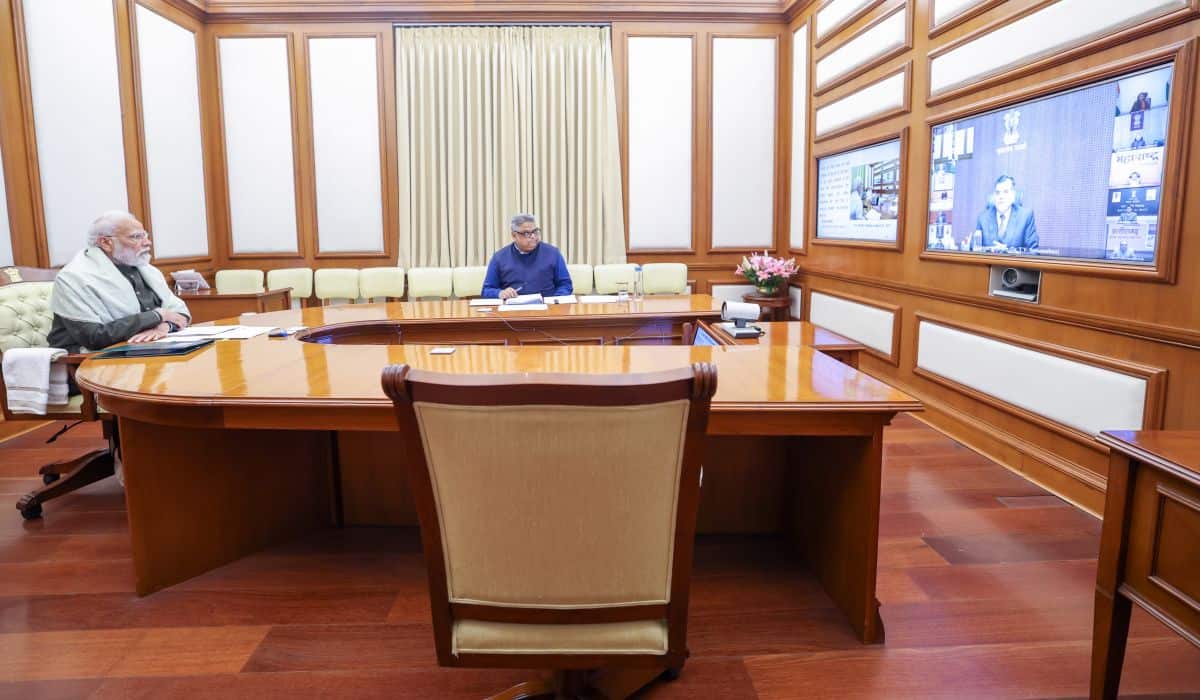
Prime Minister Shri Narendra Modi chaired the 50th meeting of PRAGATI - the ICT-enabled multi-modal platform for Pro-Active Governance and Timely Implementation - earlier today, marking a significant milestone in a decade-long journey of cooperative, outcome-driven governance under the leadership of Prime Minister Shri Narendra Modi. The milestone underscores how technology-enabled leadership, real-time monitoring and sustained Centre-State collaboration have translated national priorities into measurable outcomes on the ground.

Review undertaken in 50th PRAGATI

During the meeting, Prime Minister reviewed five critical infrastructure projects across sectors, including Road, Railways, Power, Water Resources, and Coal. These projects span 5 States, with a cumulative cost of more than ₹40,000 crore.

During a review of PM SHRI scheme, Prime Minister emphasized that the PM SHRI scheme must become a national benchmark for holistic and future ready school education and said that implementation should be outcome oriented rather than infrastructure centric. He asked all the Chief Secretaries to closely monitor the PM SHRI scheme. He further emphasized that efforts must be made for making PM SHRI schools benchmark for other schools of state government. He also suggested that Senior officers of the government should undertake field visits to evaluate the performance of PM SHRI schools.

On this special occasion, Prime Minister Shri Narendra Modi described the milestone as a symbol of the deep transformation India has witnessed in the culture of governance over the last decade. Prime Minister underlined that when decisions are timely, coordination is effective, and accountability is fixed, the speed of government functioning naturally increases and its impact becomes visible directly in citizens’ lives.

Genesis of PRAGATI

Recalling the origin of the approach, the Prime Minister said that as Chief Minister of Gujarat he had launched the technology-enabled SWAGAT platform (State Wide Attention on Grievances by Application of Technology) to understand and resolve public grievances with discipline, transparency, and time-bound action.

Building on that experience, after assuming office at the Centre, he expanded the same spirit nationally through PRAGATI bringing large projects, major programmes and grievance redressal onto one integrated platform for review, resolution, and follow-up.

Scale and Impact

Prime Minister noted that over the years the PRAGATI led ecosystem has helped accelerate projects worth more than 85 lakh crore rupees and supported the on-ground implementation of major welfare programmes at scale.

Since 2014, 377 projects have been reviewed under PRAGATI, and across these projects, 2,958 out of 3,162 identified issues - i.e. around 94 percent - have been resolved, significantly reducing delays, cost overruns and coordination failures.

Prime Minister said that as India moves at a faster pace, the relevance of PRAGATI has grown further. He noted that PRAGATI is essential to sustain reform momentum and ensure delivery.

Unlocking Long-Pending Projects

Prime Minister said that since 2014, the government has worked to institutionalise delivery and accountability creating a system where work is pursued with consistent follow-up and completed within timelines and budgets. He said projects that were started earlier but left incomplete or forgotten have been revived and completed in national interest.

Several projects that had remained stalled for decades were completed or decisively unlocked after being taken up under the PRAGATI platform. These include the Bogibeel rail-cum-road bridge in Assam, first conceived in 1997; the Jammu-Udhampur-Srinagar-Baramulla rail link, where work began in 1995; the Navi Mumbai International Airport, conceptualised in 1997; the modernisation and expansion of the Bhilai Steel Plant, approved in 2007; and the Gadarwara and LARA Super Thermal Power Projects, sanctioned in 2008 and 2009 respectively. These outcomes demonstrate the impact of sustained high-level monitoring and inter-governmental coordination.

From silos to Team India

Prime Minister pointed out that projects do not fail due to lack of intent alone—many fail due to lack of coordination and silo-based functioning. He said PRAGATI has helped address this by bringing all stakeholders onto one platform, aligned to one shared outcome.

He described PRAGATI as an effective model of cooperative federalism, where the Centre and States work as one team, and ministries and departments look beyond silos to solve problems. Prime Minister said that since its inception, around 500 Secretaries of Government of India and Chief Secretaries of States have participated in PRAGATI meetings. He thanked them for their participation, commitment, and ground-level understanding, which has helped PRAGATI evolve from a review forum into a genuine problem-solving platform.

Prime Minister said that the government has ensured adequate resources for national priorities, with sustained investments across sectors. He called upon every Ministry and State to strengthen the entire chain from planning to execution, minimise delays from tendering to ground delivery.

Reform, Perform, Transform

On the occasion, the Prime Minister shared clear expectations for the next phase, outlining his vision of Reform, Perform and Transform saying “Reform to simplify, Perform to deliver, Transform to impact.”

He said Reform must mean moving from process to solutions, simplifying procedures and making systems more friendly for Ease of Living and Ease of Doing Business.

He said Perform must mean to focus equally on time, cost, and quality. He added that outcome-driven governance has strengthened through PRAGATI and must now go deeper.

He further said that Transform must be measured by what citizens actually feel about timely services, faster grievance resolution, and improved ease of living.

PRAGATI and the journey to Viksit Bharat @ 2047

Prime Minister said Viksit Bharat @ 2047 is both a national resolve and a time-bound target, and PRAGATI is a powerful accelerator to achieve it. He encouraged States to institutionalise similar PRAGATI-like mechanisms especially for the social sector at the level of Chief Secretary.

To take PRAGATI to the next level, Prime Minister emphasised the use of technology in each and every phase of the project life cycle.

Prime Minister concluded by stating that PRAGATI@50 is not merely a milestone it is a commitment. PRAGATI must be strengthened further in the years ahead to ensure faster execution, higher quality, and measurable outcomes for citizens.

Presentation by Cabinet Secretary

On the occasion of the 50th PRAGATI milestone, the Cabinet Secretary made a brief presentation highlighting PRAGATI’s key achievements and outlining how it has reshaped India’s monitoring and coordination ecosystem, strengthening inter-ministerial and Centre-State follow-through, and reinforcing a culture of time-bound closure, which resulted in faster implementation of projects, improved last-mile delivery of Schemes and Programmes and quality resolution of public grievances.