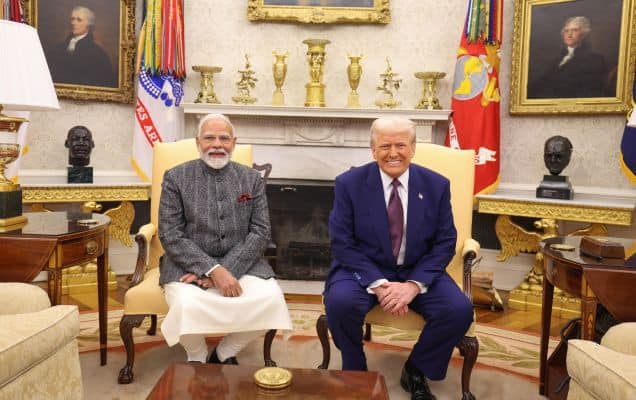
1. At the invitation of His Excellency Mr. Enrique Peña Nieto, President of the United Mexican States, His Excellency Mr. Narendra Modi, Prime Minister of India paid a working visit to Mexico on 8th June 2016, with the objective to continue the dialogue held by the two leaders on the margins of the 70thregular session of the United Nations General Assembly on 28th September 2015.
2. The leaders recognized the opportunities to define the path of the India-Mexico Privileged Partnership for the 21st Century that allows the growth of bilateral relations in economic field, in science and technology and in the most important issues of the global agenda reflecting a broad convergence of long-term political, economic and strategic goals.
3. President Enrique Peña Nieto elaborated on the structural reforms undertaken in Mexico to promote economic growth and development. On his part, Prime Minister Mr. Narendra Modi highlighted the initiatives undertaken by his Government for the economic growth and the improvement of standard of living of the people.
In this context, both leaders:
Political Dialogue
4. Instructed the Foreign Ministers of both countries to develop the roadmap of the Privileged Partnership suitable for the 21stCentury, in the framework of the Seventh Mexico-India Joint Commission Meeting to be held in Mexico in 2016.
5. Look forward to the results of the Sixth Meeting of the Joint Committee on Science and Technology, and the Fourth Meeting of the High Level Group on Trade, Investment and Cooperation, which will be held in Mexico during the second half of 2016.
6. The two countries will update the bases of cooperation according to a convergent and comprehensive plan, will evaluate the progress made in diverse fields and will set new objectives and themes to strengthen the agenda of bilateral relations.
7. Had a detailed exchange of views on the regional issues of mutual interest, including the political and economic developments in Latin America, the CELAC and the Pacific Alliance, as well as the current situation in the Asia-Pacific region.
Economic Partnership
8. Underscored the increasing importance of diversifying the economic exchanges to promote trade and investment to a level corresponding to their true potential.
9. Stressed the necessity of developing a greater connectivity between the two countries and encouraging cooperation in the infrastructure sector, among small and medium enterprises, in pharmaceutical products, in energy, in the automobile sector, in Information and Communication Technology, in agriculture, in food processing and in other related sectors.
10. Noted with satisfaction the growing interest for investment of the Indian companies in the energy sector - attracted by the structural reforms carried out in Mexico, as well as the opportunities for Mexican companies in the Indian market.
11. Agreed that cooperation is key to promote the investment and the use of solar energy. The two sides agreed to explore ways and means to boost the objectives of the International Solar Alliance.
12. Stressed the importance of promoting increased exchanges between the peoples of the two countries for better understanding and strengthening of bilateral links in the areas of culture, education and tourism.
Bilateral Cooperation
13. Exchanged points of views and welcomed the opportunities offered by the convergence between the National Digital Strategy of Mexico and the Digital India Initiative, which share common objectives.
14. Welcomed collaboration in space science, earth observation, climate and environmental studies, and the efficient use of space-related resources available in India as well as in Mexico for remote sensing, advance warning for disaster prevention and launch of satellites between the Mexican Space Agency (AEM) and the Indian Space Research Organization (ISRO).
15. Considering that both countries have huge diaspora communities abroad, the Leaders agreed on exchanging views, information and share best practices with respect to the participation of networks, organizations and individuals in their diasporas in the development of communities of their origin and their residence, as well as for the welfare and protection of their respective nationals in foreign countries.
Dialogue on Global Affairs
16. Pledged to continue promoting the shared goals of nuclear disarmament and non-proliferation as solutions with multilateral perspective, as well as to continue promoting cooperation on international security issues.
17. Reiterated their strong condemnation of terrorism in all its forms and manifestations.
18. Reaffirmed the importance to have an effectivemultilateral system, with the United Nations at its core, and agreed on the importance of continuing supporting the progress in the process of comprehensive reforms of the United Nations Security Council.
19. Noted productive and substantive cooperation in the context of their participation in G-20.
20. Welcomed with satisfaction the successful conclusion of the Climate Change Conference held in Paris in December 2015 and applauded the signing by both countries of the Paris Agreement on April 22, 2016. They committed to ratify the Paris Agreement as soon as possible, as well as to develop new and renewable sources of energy to meet the developmental challenges of their respective countries.
21. President Enrique Peña Nieto cordially invited the Indian Prime Minister to visit Mexico again on a State visit in the near future. Similarly, Prime Minister Modi invited President Peña Nieto to pay a State visit to India. They agreed that suitable dates would be worked out through diplomatic channels.