Sabka Saath, SabkaVikas : Collective Efforts Inclusive Growth

Published By : Admin | May 9, 2014 | 16:00 IST

Government has only one religion - India first!

Government has one holy book - the Constitution.

The Government must be immersed in only one Bhakti- Bharat Bhakti!

The Government’s only strength is Jan Shakti!

Government’s only ritual is the well being of the 125 crore Indians!

The only code of conduct of the Government should be ‘Sabka Saath, Sabka Vikas!

- Narendra Modi

Never before in the history of Independent India has a political leader given such a resounding and mature message of unity with inclusion.

Narendra Modi has come a long way from how the political discourse has been conducted in India. Politicians in India have very often used & thrived on vote banks by playing emotions of one against the other. While some leaders pit one religion against the other, others pit one caste against each other. Some political parties have also tried to ignite the people’s sentiments against industrial development &encash it during the polls.

In such times, Narendra Modi’s thoughts strike a refreshing contrast & provide a much needed alternate perspective on what Unity really means. Narendra Modi has proven to be an apostle of unity and inclusivity having demonstrated how his words could be put into action in Gujarat.

His actions while in office, his policies and his speeches have all reverberated with his message of unity and inclusivity. The most important thing that he has done is to break the myth that growth of a caste, community, religion, village, city or sector has to be at the cost of another. He has shown that development, upliftment and progress need not be a case of one against the other, but it can include everyone.

One of the landmark events happened when Narendra Modi went to Patna to address the Hunkar Rally in October 2013. Bombs were going off in the historic Gandhi Maidan just as he was about to speak. Any other leader would have either panicked or would have incited the crowd against the terror plot. No prepared speech would have been useful at that time. At such a time, Narendra Modi spoke from his heartand delivered a powerful message of peace & unity to both Hindus and Muslims that went to the crux of the principal challenge before our nation. He announced that Hindus and Muslims should together fight poverty instead of fighting among themselves. This is the only way forward for the nation.

gov16

At the heart of Narendra Modi’s success lies his Panchamrut philosophy that drives it. This philosophy has a vision for the all-round development at the core of it. Panchamrut is the integration of five different streams which drives growth. This confluence of the panchshakti (five vital powers) of Knowledge, Water, Energy, Security and Human Resources, the five fundamental powers required to achieve holistic and sustainable growth have resulted in unprecedented growth and improvement in the quality of life in the state during his tenure as the Chief Minister of Gujarat.It is the amalgamation of mantra of ‘SabkaSaath, Sabka Vikas’ and Panchamrut philosophy that forms the corner stone of Narendra Modi’s model of governance.

gov17

Narendra Modi’s model of development has been unique in the sense that it has not created inequalities or conflicts between contrasting requirements. While his model embraced urbanisation as an opportunity rather than a threat, it made provisions to modernise & improve lives in urban areas. Similarly, while Gujarat has focused on industrial development & investments, agriculture & farmers have been given special attention too. While private entrepreneurs big & small have thrived in the business friendly atmosphere, the Public sector companies have achieved a miraculous turn around too. Gujarat’s GDP growth increased significantly under Narendra Modi along with significant improvement in the social indicators. Technology has been given importance and at the same time people great attention has been given to skill development.

sabka-namo-in1

Similarly people from all castes, communities & religions including minorities, & underprivileged sections of the society have progressed, prospered in Gujarat under Narendra Modi.

This model is unique & worth emulating as it focuses on removing fault-lines of discrimination & prejudice. Once everyone is placed on an equal footing & given equal opportunities, it can only result in the creation of a truly equal & healthy society.

Explore More
Today, the entire country and entire world is filled with the spirit of Bhagwan Shri Ram: PM Modi at Dhwajarohan Utsav in Ayodhya

Popular Speeches

Today, the entire country and entire world is filled with the spirit of Bhagwan Shri Ram: PM Modi at Dhwajarohan Utsav in Ayodhya
From CM To PM: The 25-Year Bond Between Narendra Modi And Vladimir Putin

Media Coverage

From CM To PM: The 25-Year Bond Between Narendra Modi And Vladimir Putin
NM on the go

Nm on the go

Always be the first to hear from the PM. Get the App Now!
...
6 Years of Jal Jeevan Mission: Transforming Lives, One Tap at a Time
August 14, 2025
Jal Jeevan Mission has become a major development parameter to provide water to every household.” - PM Narendra Modi

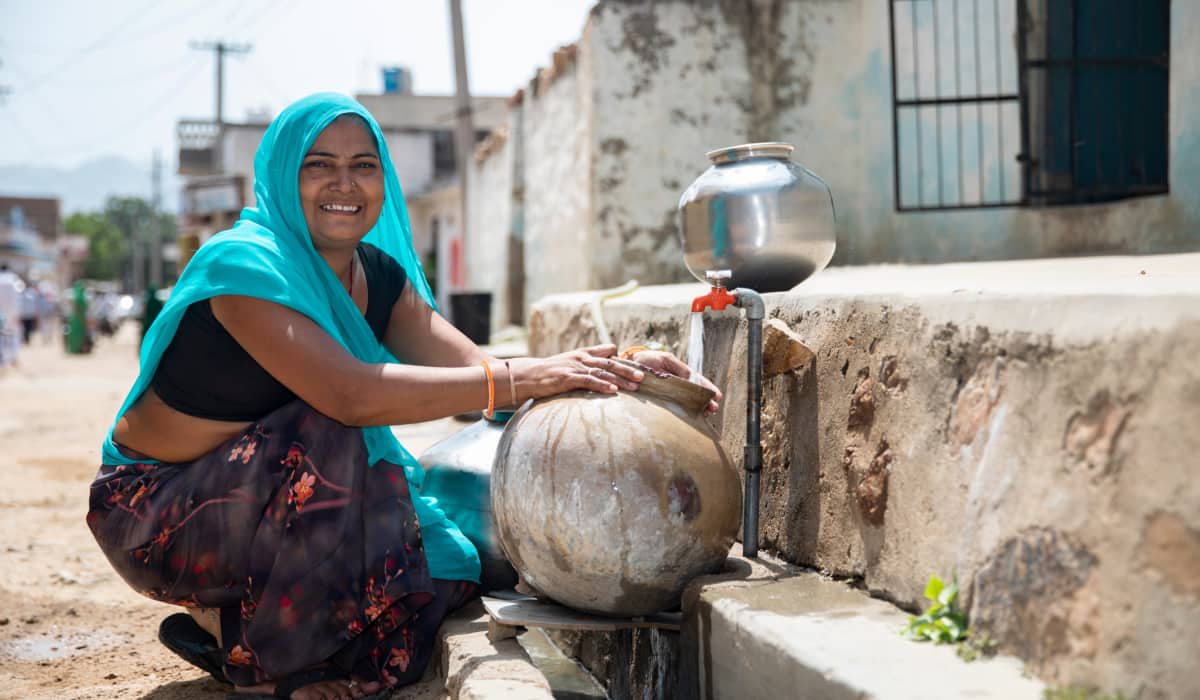
For generations, the sight of women carrying pots of water on their heads was an everyday scene in rural India. It was more than a chore, it was a necessity that was an integral part of their everyday life. The water was brought back, often just one or two pots which had to be stretched for drinking, cooking, cleaning, and washing. It was a routine that left little time for rest, education, or income-generating work, and the burden fell most heavily on women.

Before 2014 water scarcity, one of India’s most pressing problems, was met with little urgency or vision. Access to safe drinking water was fragmented, villages relied on distant sources, and nationwide household tap connections were seen as unrealistic.

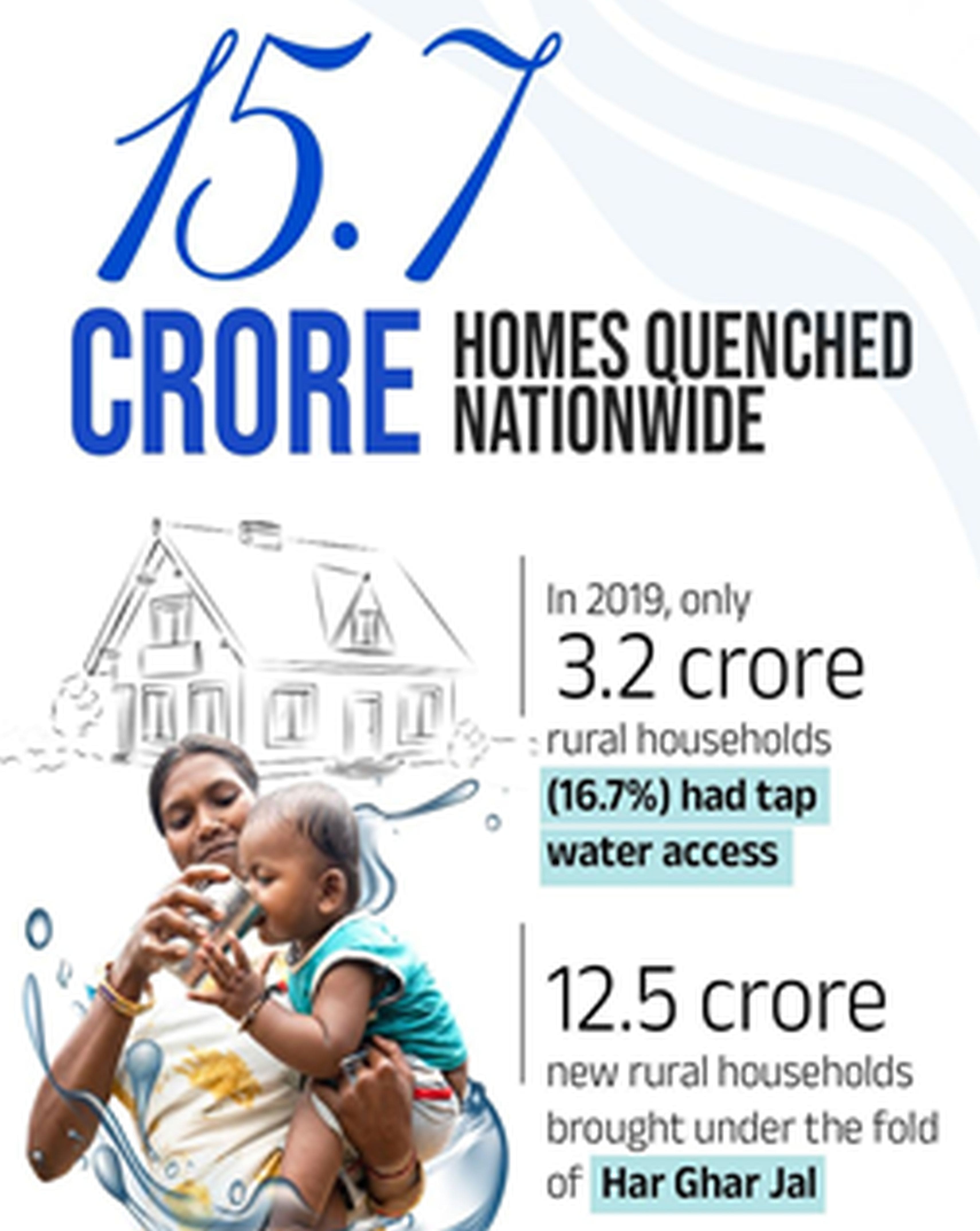
This reality began to shift in 2019, when the Government of India launched the Jal Jeevan Mission (JJM). A centrally sponsored initiative which aims at providing a Functional Household Tap Connection (FHTC) to every rural household. At that time, only 3.2 crore rural households, a modest 16.7% of the total, had tap water. The rest still depended on community sources, often far from home.

As of July 2025, the progress under the Har Ghar Jal program has been exceptional, with 12.5 crore additional rural households connected, bringing the total to over 15.7 crore. The program has achieved 100% tap water coverage in 200 districts and over 2.6 lakh villages, with 8 states and 3 union territories now fully covered. For millions, this means not just access to water at home, but saved time, improved health, and restored dignity. Nearly 80% of tap water coverage has been achieved in 112 aspirational districts, a significant rise from less than 8%. Additionally, 59 lakh households in LWE districts have gained tap water connections, ensuring development reaches every corner. Acknowledging both the significant progress and the road ahead, the Union Budget 2025–26 announced the program’s extension until 2028 with an increased budget.

The Jal Jeevan Mission, launched nationally in 2019, traces its origins to Gujarat, where Narendra Modi, as Chief Minister, tackled water scarcity in the arid state through the Sujalam Sufalam initiative. This effort formed a blueprint for a mission that would one day aim to provide tap water to every rural household in India.

Though drinking water is a State subject, the Government of India has taken on the role of a committed partner, providing technical and financial support while empowering States to plan and implement local solutions. To keep the Mission on track, a strong monitoring system links Aadhaar for targeting, geo-tags assets, conducts third-party inspections, and uses IoT devices to track village water flow.

The Jal Jeevan Mission’s objectives are as much about people as they are about pipes. By prioritizing underserved and water-stressed areas, ensuring that schools, Anganwadi centres, and health facilities have running water, and encouraging local communities to take ownership through contributions or shramdaan, the Mission aims to make safe water everyone’s responsibility..

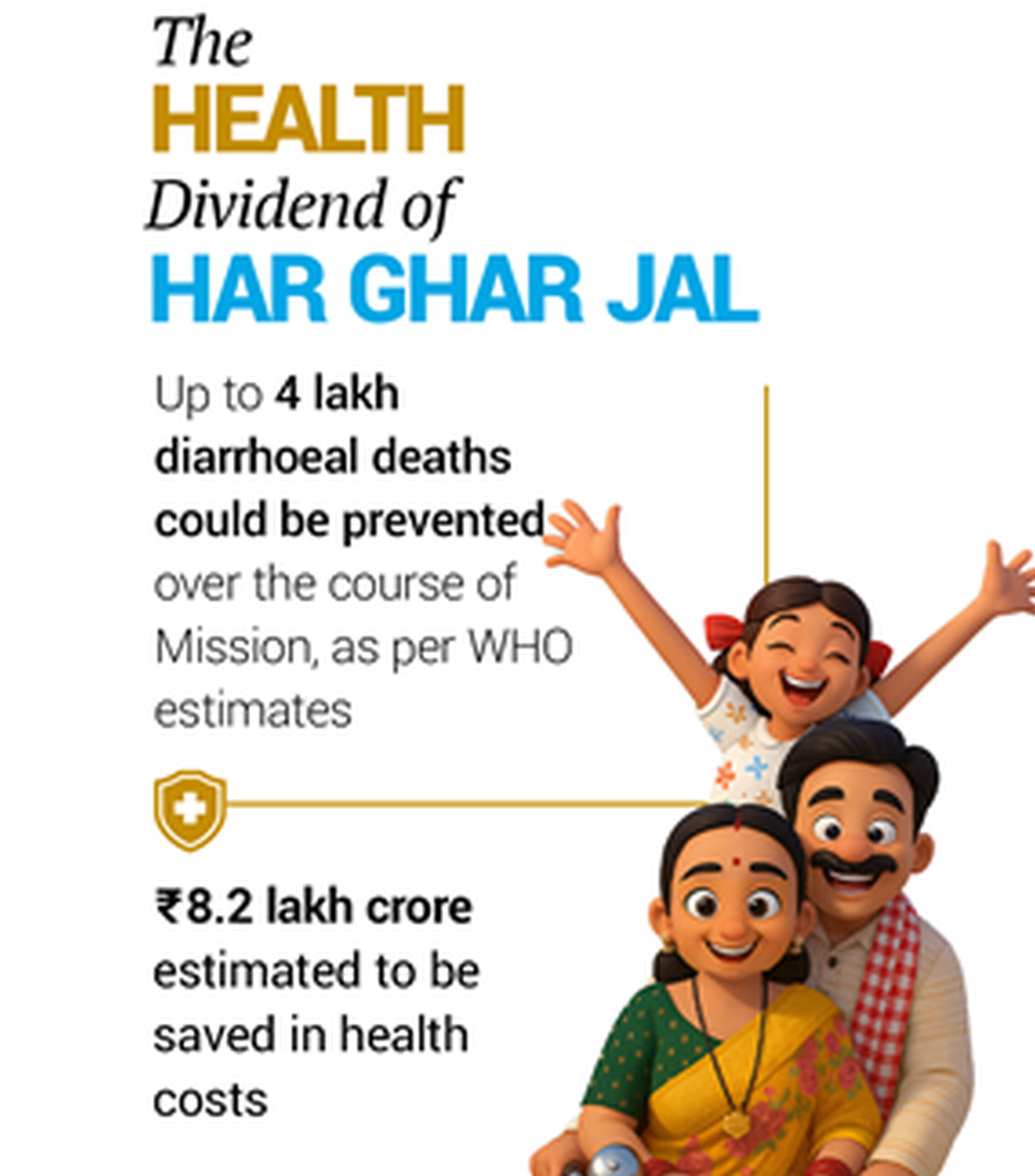
The impact reaches far beyond convenience. The World Health Organization estimates that achieving JJM’s targets could save over 5.5 crore hours each day, time that can now be spent on education, work, or family. 9 crore women no longer need to fetch water from outside. WHO also projects that safe water for all could prevent nearly 4 lakh deaths from diarrhoeal disease and save Rs. 8.2 lakh crores in health costs. Additionally, according to IIM Bangalore and the International Labour Organization, JJM has generated nearly 3 crore person-years of employment during its build-out, with nearly 25 lakh women are trained to use Field testing Kits.

From the quiet relief of a mother filling a glass of clean water in her kitchen, to the confidence of a school where children can drink without worry, the Jal Jeevan Mission is changing what it means to live in rural India.