Red Carpet, Not Red Tape

Published By : Admin | May 10, 2014 | 15:49 IST

The country can progress only if we end red-tapism. No red tape, only red carpet, is my policy towards investors. - Narendra Modi

According to a lot of analysts, the decade 2004-14 under the UPA Government has been marked by a slowdown in investments, stalled projects and jobless growth. This period has also seen rampant crony capitalism due to the lack of a policy driven approach. In a way, this red-tapism arising from arbitrary decision-making has been the root cause of several problems plaguing India during the UPA rule.

Bureaucratic deadlocks, an inefficient decision-making process and a quagmire of approvals required to set up a business or industry of any kind led to a decrease in the confidence of the investor.

In such an atmosphere, the emergence of Narendra Modi’s business-friendly approach has proved to be a big boost to the economy. Narendra Modi’s vision of engaging private players for public welfare is ground breaking. Narendra Modi explored new horizons and welcomed investors while eliminating the scope for corruption as well as unnecessary deadlocks. The episode with Tata Nano has made its place in history books, where Narendra Modi in an unprecented move invited the Tata Group, which was struggling to set up their operations in West Bengal, to shift their plant to Gujarat with just one SMS. After which he made sure all permissions and approvals were granted in record time.

Even though the results of Narendra Modi’s policies were most visible towards the end of 2010, efforts to bring in investment and the formulation of sound policies started immediately after he took over as Gujarat Chief Minister back in 2001. After the deadly earthquake and the 2002 riots, Narendra Modi made extra efforts to convince private players to be a partner in the state’s development journey.

vibrant-namo-in1

His government organized the Vibrant Gujarat Investment Summits, which were later emulated by different states in different forms. The Vibrant Gujarat Global Investors Summit was started in 2003 in a modest manner to promote Gujarat as a good investment destination. It was conceived as a biennial event to bring together investors, industrialists, technology providers, professionals and experts from across the state, the country and the world. State to country partnerships emerged at the summit and the event successfully showcased Gujarat as the Growth Engine of India.

The Business Summit also became a platform for other Indian states to get introduced to investor countries looking to expand. Eventually, the event expanded from a business event to a major knowledge-sharing event. Needless to say, such initiatives have made Gujarat the hottest destination in the country and brought in big-ticket investments, which has improved employment prospects for the youth while boosting production. Narendra Modi cut down on red tape for approving private investments as well as for public sector companies. When he took over in Gujarat, the public sector companies were in sorry state, but in a decade there has been a turnaround and some companies are even making a profit.

gov13

Narendra Modi also invited private support for initiatives in public private partnerships, such as the award-winning BRTS, ports or even in the power sector.

brts-namo-in1

Thus what Narendra Modi has done is to break away from the stereotypical Indian attitude towards industries, which viewing them with suspicion or indulging them in creating monopolies and practicing cronyism. He managed to harness the power of private capital to forge a partnership with the public sector and the people for the ultimate benefit of the Citizens.

Explore More
Today, the entire country and entire world is filled with the spirit of Bhagwan Shri Ram: PM Modi at Dhwajarohan Utsav in Ayodhya

Popular Speeches

Today, the entire country and entire world is filled with the spirit of Bhagwan Shri Ram: PM Modi at Dhwajarohan Utsav in Ayodhya
Jan Dhan accounts hold Rs 2.75 lakh crore in banks: Official

Media Coverage

Jan Dhan accounts hold Rs 2.75 lakh crore in banks: Official
NM on the go

Nm on the go

Always be the first to hear from the PM. Get the App Now!
...
6 Years of Jal Jeevan Mission: Transforming Lives, One Tap at a Time
August 14, 2025
Jal Jeevan Mission has become a major development parameter to provide water to every household.” - PM Narendra Modi

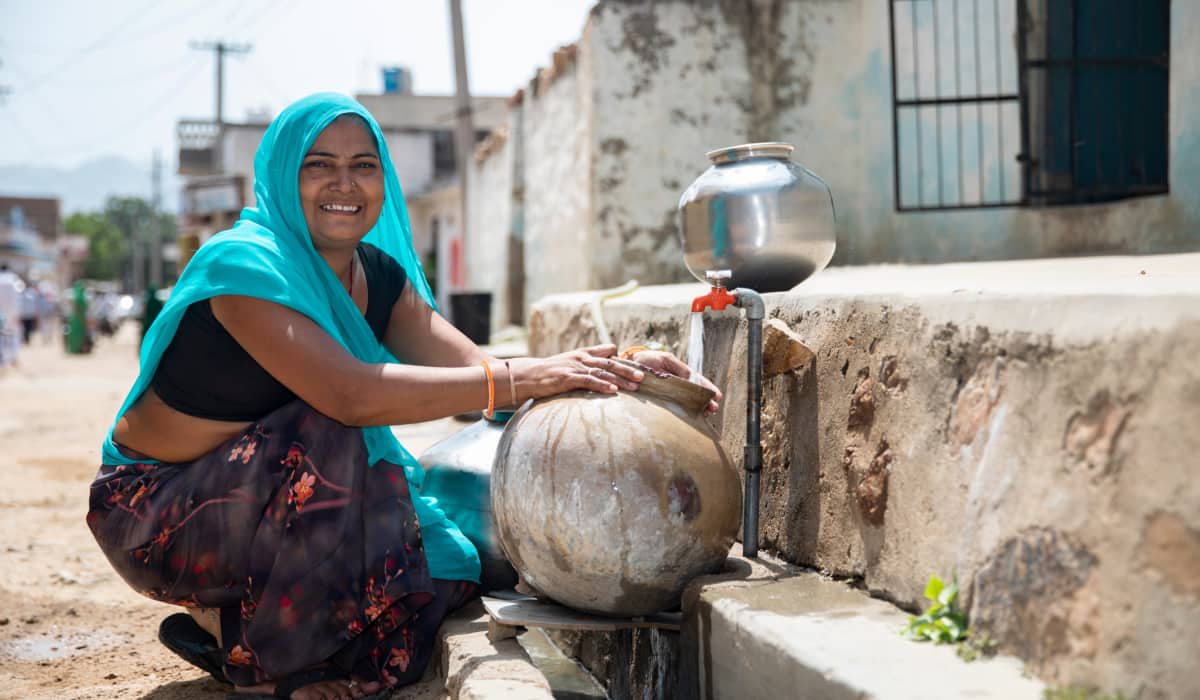
For generations, the sight of women carrying pots of water on their heads was an everyday scene in rural India. It was more than a chore, it was a necessity that was an integral part of their everyday life. The water was brought back, often just one or two pots which had to be stretched for drinking, cooking, cleaning, and washing. It was a routine that left little time for rest, education, or income-generating work, and the burden fell most heavily on women.

Before 2014 water scarcity, one of India’s most pressing problems, was met with little urgency or vision. Access to safe drinking water was fragmented, villages relied on distant sources, and nationwide household tap connections were seen as unrealistic.

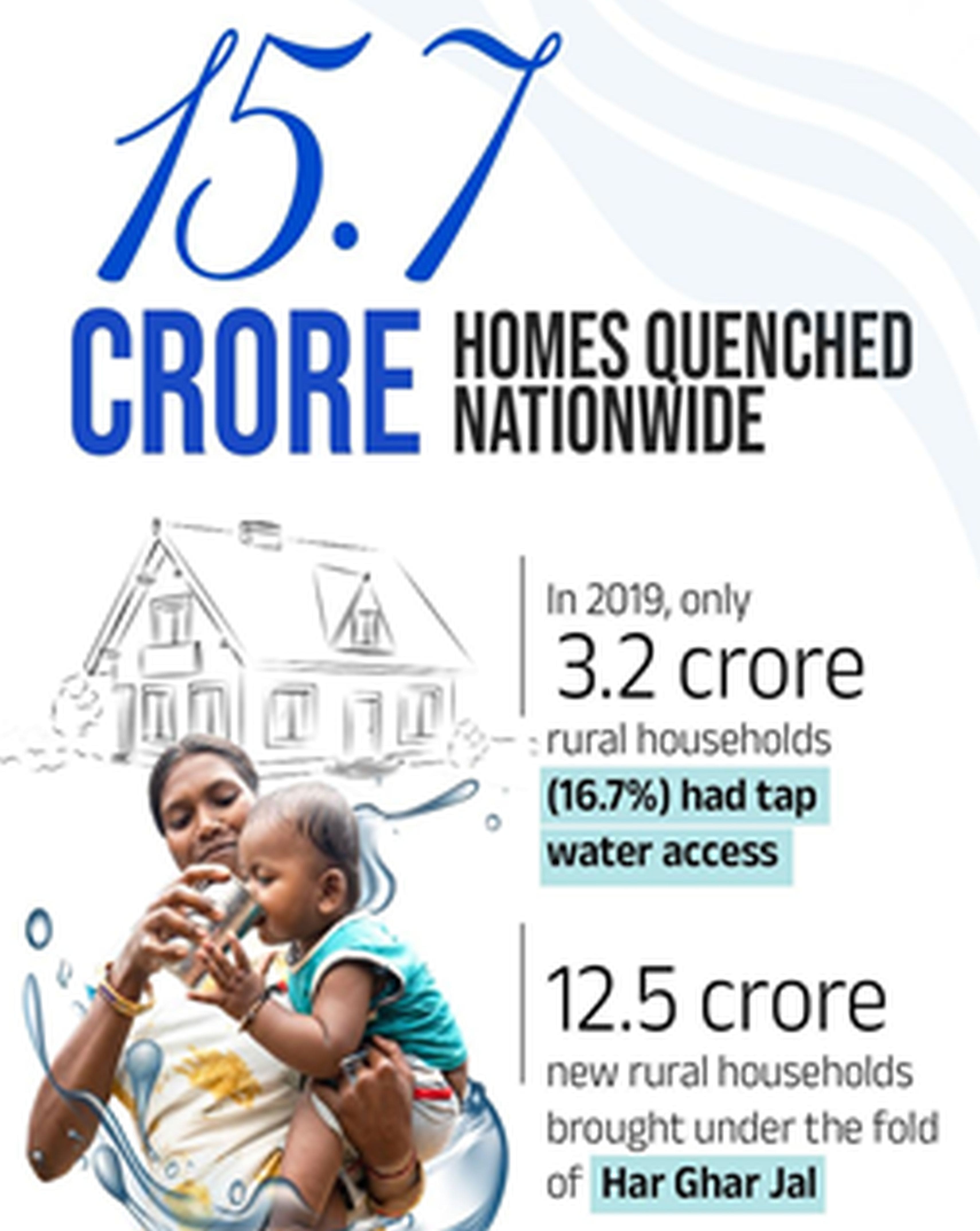
This reality began to shift in 2019, when the Government of India launched the Jal Jeevan Mission (JJM). A centrally sponsored initiative which aims at providing a Functional Household Tap Connection (FHTC) to every rural household. At that time, only 3.2 crore rural households, a modest 16.7% of the total, had tap water. The rest still depended on community sources, often far from home.

As of July 2025, the progress under the Har Ghar Jal program has been exceptional, with 12.5 crore additional rural households connected, bringing the total to over 15.7 crore. The program has achieved 100% tap water coverage in 200 districts and over 2.6 lakh villages, with 8 states and 3 union territories now fully covered. For millions, this means not just access to water at home, but saved time, improved health, and restored dignity. Nearly 80% of tap water coverage has been achieved in 112 aspirational districts, a significant rise from less than 8%. Additionally, 59 lakh households in LWE districts have gained tap water connections, ensuring development reaches every corner. Acknowledging both the significant progress and the road ahead, the Union Budget 2025–26 announced the program’s extension until 2028 with an increased budget.

The Jal Jeevan Mission, launched nationally in 2019, traces its origins to Gujarat, where Narendra Modi, as Chief Minister, tackled water scarcity in the arid state through the Sujalam Sufalam initiative. This effort formed a blueprint for a mission that would one day aim to provide tap water to every rural household in India.

Though drinking water is a State subject, the Government of India has taken on the role of a committed partner, providing technical and financial support while empowering States to plan and implement local solutions. To keep the Mission on track, a strong monitoring system links Aadhaar for targeting, geo-tags assets, conducts third-party inspections, and uses IoT devices to track village water flow.

The Jal Jeevan Mission’s objectives are as much about people as they are about pipes. By prioritizing underserved and water-stressed areas, ensuring that schools, Anganwadi centres, and health facilities have running water, and encouraging local communities to take ownership through contributions or shramdaan, the Mission aims to make safe water everyone’s responsibility..

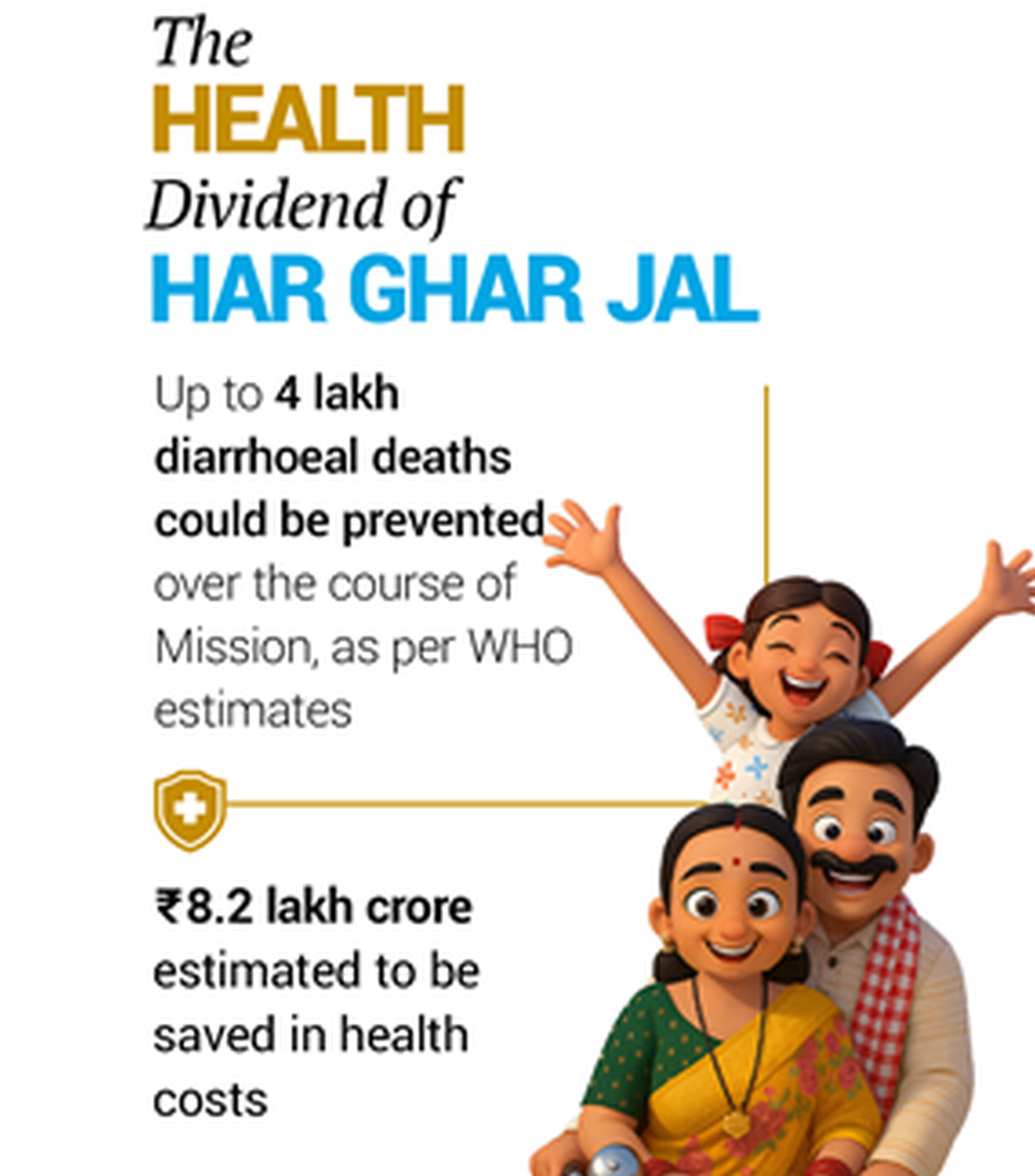
The impact reaches far beyond convenience. The World Health Organization estimates that achieving JJM’s targets could save over 5.5 crore hours each day, time that can now be spent on education, work, or family. 9 crore women no longer need to fetch water from outside. WHO also projects that safe water for all could prevent nearly 4 lakh deaths from diarrhoeal disease and save Rs. 8.2 lakh crores in health costs. Additionally, according to IIM Bangalore and the International Labour Organization, JJM has generated nearly 3 crore person-years of employment during its build-out, with nearly 25 lakh women are trained to use Field testing Kits.

From the quiet relief of a mother filling a glass of clean water in her kitchen, to the confidence of a school where children can drink without worry, the Jal Jeevan Mission is changing what it means to live in rural India.