“Meditating together gives effective results. This feeling of solidarity and power of unity is a major basis of Viksit Bharat”
“A perfect example of ‘One Life, One Mission’, Acharya Goenka had only one mission – Vipassana”
“Vipassana is the path of self-transformation through self-observation”
“Vipassana has become even more important in today’s challenging times when the youth has become victims of stress due to work life balance, lifestyle and other problems.”
“Bharat needs to take the lead in making Vipassana more acceptable”

The Prime Minister, Shri Narendra Modi addressed the concluding ceremony of the year-long celebrations of S N Goenka’s 100th birth anniversary via video message today.

Recalling the beginning of the birth centenary celebrations of the Vipassanā meditation teacher, Acharya Shri S N Goenka a year ago, the Prime Minister underlined that the nation celebrated ‘Amrit Mahotsav’ and also remembering the ideals of Kalyan Mitra Goenka at the same time. He reaffirmed that when these celebrations are coming to an end today, the country is moving rapidly towards fulfilling the resolutions of a Viksit Bharat. Quoting Lord Buddha’s mantra which was often used by Guruji, Prime Minister Modi explained the meaning and said “Meditating together gives effective results. This feeling of solidarity and power of unity is a major basis of Viksit Bharat.” He extended his warm wishes to all for propagating the same mantra throughout the year.

The Prime Minister recalled his connections with Shri Goenka and said that they met multiple times in Gujarat after the first meeting at the World Religion Conference at the United Nations. Shri Modi called himself fortunate for seeing him during his final stages and having the privilege of knowing and understanding the Acharya closely. The Prime Minister spoke highly about Shri Goenka absorbing Vipassana deeply along with his calm and serious personality which created an atmosphere of virtuousness wherever he went. “A perfect example of ‘One Life, One Mission’, Shri Goenka had only one mission – Vipassana! He imparted the knowledge of Vipassana to everyone”, the Prime Minister said as he hailed the huge contribution to humanity and the world.

The Prime Minister pointed out that even though Vipassana is a wonderful gift of the ancient Indian way of life to the whole world, this heritage was lost for a long period in the country and the art of teaching and learning Vipassana seemed to have come to an end. However, the Prime Minister informed that after 14 years of penance in Myanmar, Shri Goenka acquired the knowledge and returned to the homeland with Bharat’s ancient glory of Vipassana. Highlighting the importance of Vipassana, the Prime Minister said, “It is the path of self-transformation through self-observation.” While it held great relevance when it was introduced thousands of years ago, the Prime Minister reaffirmed the belief that it has become even more relevant in today's life as it has the power to resolve the current challenges of the world. He said that because of Guruji's efforts, more than 80 countries of the world have understood the importance of meditation and adopted it. “Acharya Shri Goenka once again gave a global identity to Vipassana. Today India is giving new expansion to that resolution with full strength”, the Prime Minister said as he recalled the support of more than 190 countries to India’s proposal of celebrating International Yoga Day in the United Nations, thereby making it a part of life globally by getting.

Even though it was India’s ancestors who researched the processes of Vipassana yoga, the Prime Minister pointed out the irony where the next generations forgot its importance. “Vipassana, Meditation, Dharana, are often considered only as matters of renunciation and people but its role was forgotten”, he added and praised eminent personalities like Acharya Shri SN Goenka for their leadership. Quoting Guru ji the Prime Minister remarked, “A healthy life is a big responsibility of all of us towards ourselves”. Highlighting the benefits of Vipassana, he said that practicing Vipassana has become even more important in today’s challenging times when the youth have become victims of stress due to work life balance, prevailing lifestyle and other issues. He emphasized it is a solution not just for them but also for the members of micro and nuclear families where elderly parents remain under a lot of stress. He also urged everyone to connect elderly people with such initiatives.

The Prime Minister further applauded Acharya Goenka’s efforts to make everyone’s life peaceful, happy and harmonious through his campaigns. He also wanted the future generations to avail the benefits of these campaigns and that is why he expanded his knowledge. He did not stop there but also created skilled teachers. The Prime Minister once again explained about Vipassana, saying that it is a journey into the soul and a way to dive deep within yourself. However, it is not just a genre but a science. He said as we are familiar with the results of this science, we now need to present its evidence to the world according to the standards of modern science. “While a lot is already being done all over the world in this direction, Bharat needs to take the lead in making it more acceptable using new research for bringing greater welfare to the world”, he added.

Concluding his address, the Prime Minister called this year of the birth centenary celebrations of Acharya SN Goenka an inspiring time for all and expressed confidence that his efforts be carried forward for human service.

Click here to read full text speech

Explore More
Today, the entire country and entire world is filled with the spirit of Bhagwan Shri Ram: PM Modi at Dhwajarohan Utsav in Ayodhya

Popular Speeches

Today, the entire country and entire world is filled with the spirit of Bhagwan Shri Ram: PM Modi at Dhwajarohan Utsav in Ayodhya
Emerging cities see 42% growth in GCC jobs, outpacing metros: Report

Media Coverage

Emerging cities see 42% growth in GCC jobs, outpacing metros: Report
NM on the go

Nm on the go

Always be the first to hear from the PM. Get the App Now!
...
PM Modi chairs 51st PRAGATI Meeting
May 27, 2026
PM reviews seven critical infrastructure projects across the Railways, Power and Road sectors
Projects reviewed span across 9 States with cumulative investment of around ₹30,000 crore
PM also reviews Ken Betwa Link Project and Swachh Bharat Mission-Urban 2.0
PM says Ken-Betwa River Inter-linking Project should serve as a model for other States to resolve inter-State water issues amicably
PM asks States to expedite the completion of solid waste management-related infrastructure, including waste processing plants and GOBARdhan plants
PM calls for mission-mode rooftop solar coverage in urban areas
Acting upon the advice of PM, system of monthly review of social sector schemes at State level operationalised, starting with review of Swachh Bharat Mission

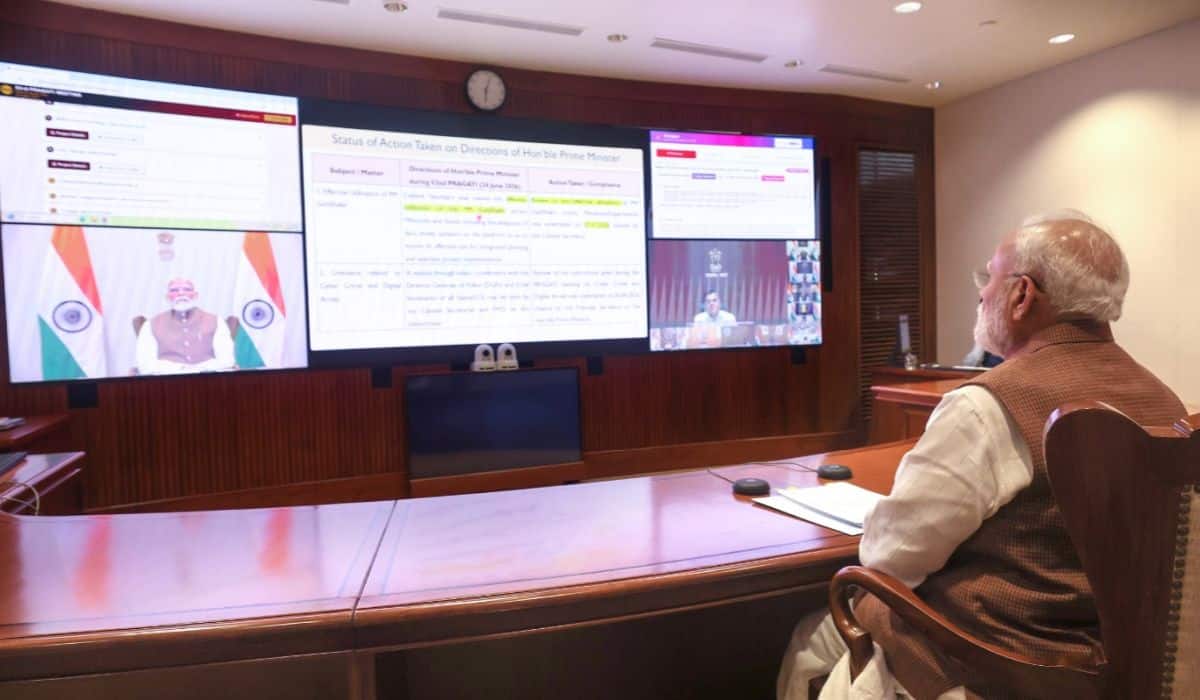
Prime Minister Shri Narendra Modi chaired the 51st meeting of PRAGATI, the ICT-enabled, multi-modal platform aimed at fostering Pro-Active Governance and Timely Implementation, by seamlessly integrating efforts of the Central and State governments, at Seva Teerth, earlier today.

During the meeting, the Prime Minister reviewed seven critical infrastructure projects across the Railways, Power and Road sectors covering nine States worth around ₹30,000 crore. These projects, pivotal to economic growth and public welfare, were reviewed with a focus on timelines, inter-agency coordination, and timely issue resolution. Prime Minister also reviewed Ken Betwa Link Project and Swachh Bharat Mission-Urban 2.0.

While reviewing power sector projects, Prime Minister emphasized the need to accelerate rooftop solar adoption across urban areas, with a special focus on cities, residential clusters and public institutions. He underlined that rooftop solar should be taken up in mission mode to reduce electricity costs, improve energy security and promote clean energy at the household and community level.

While reviewing road and port connectivity projects, it was emphasised that Vadhavan Port should be developed as a model of port-led, multi-modal development, where every major mode of transport is seamlessly integrated to create a future-ready logistics ecosystem. The project should not be seen merely as a port, but as a national gateway connected through coastal shipping, inland waterways, dedicated freight corridors, high-speed rail connectivity, highways and airport linkages.

Prime Minister emphasised the need for effective implementation of Swachh Bharat Mission 2.0 and underlined that the mission should move beyond infrastructure creation and ensure measurable outcomes through regular monitoring, citizen participation and convergence between various stakeholders. He asked States to expedite the completion of solid waste management-related infrastructure, including waste processing plants and GOBARdhan plants.

While reviewing Ken-Betwa River Inter-linking Project, Prime Minister observed that Ken-Betwa project should serve as a model for other States to resolve inter-State water issues through cooperation, timely clearances, technology-based monitoring and mission-mode execution. States were encouraged to identify similar opportunities where river-linking, water conservation, groundwater recharge and efficient irrigation can be taken up in an integrated manner to ensure long-term water security.

Prime Minister also underlined that the delay in the implementation of public projects leads not only to cost escalation but also deprives citizens of timely access to essential facilities and development benefits. He observed that every delay has a direct impact on people’s lives, regional growth and public resources. He stressed that Ministries, Departments and States must adopt a more proactive and time-bound approach to resolve pending issues, remove bottlenecks and ensure faster execution.

Prime Minister also emphasized that innovative use of canal networks should be explored, including installation of solar panels along canals and over canals for clean electricity generation. This would help optimize land use, reduce evaporation losses, generate renewable energy and create additional economic value from water infrastructure.

At the beginning of the meeting, the Cabinet Secretary informed that, in pursuance of the directions of the Prime Minister, a system of monthly review of social sector schemes at the State level has also been operationalised. This mechanism aims to ensure regular monitoring, faster resolution of implementation issues and greater accountability at the State and district levels. As part of this initiative, Swachh Bharat Mission has been taken up for review at the State level in the first instance.