Prime Minister meets Prime Minister of the United Kingdom

Published By : Admin | July 24, 2025 | 15:59 IST

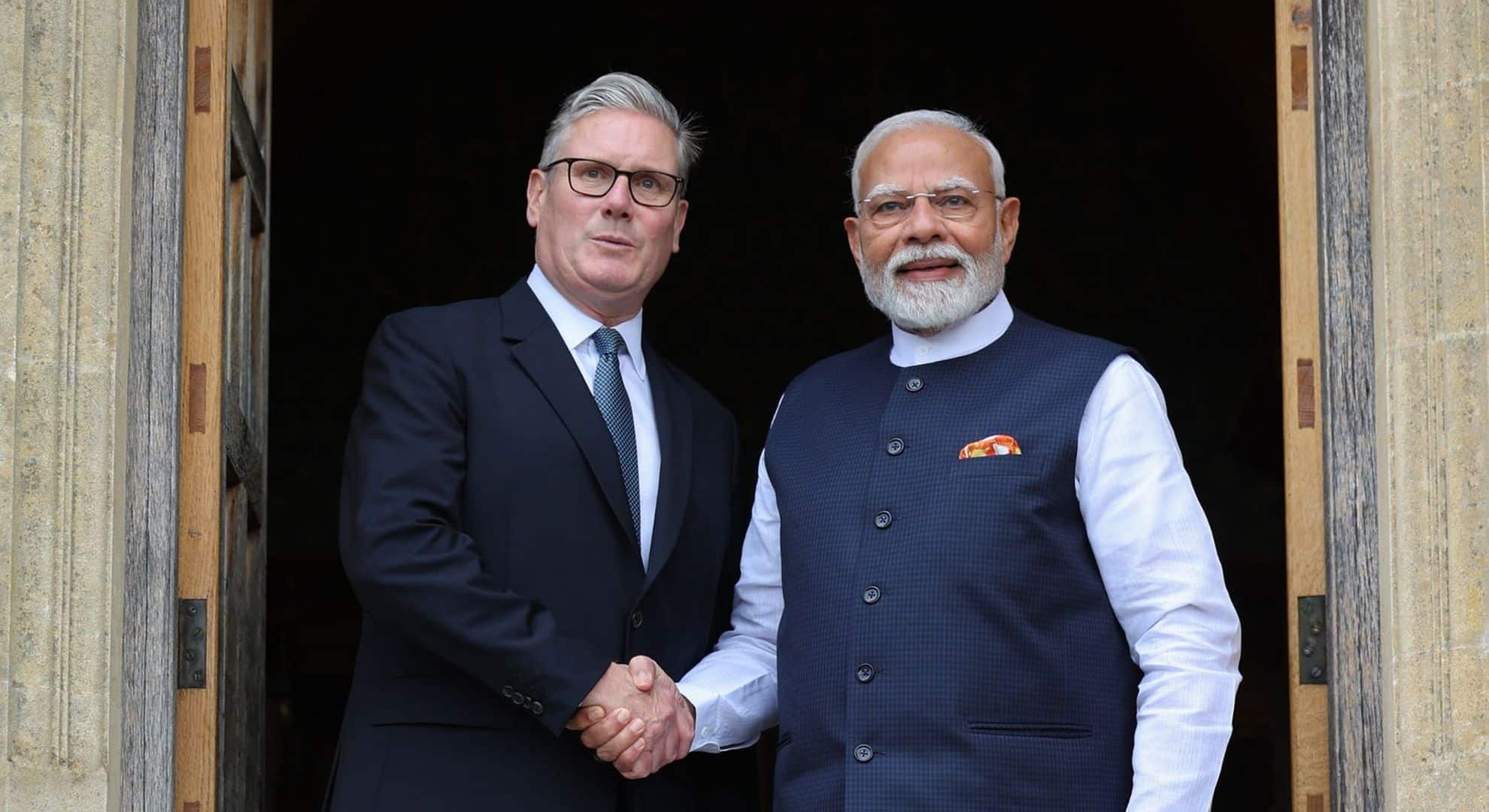
During his official visit to the United Kingdom from 23-24 July 2025, Prime Minister Shri Narendra Modi met today with the Prime Minister of the United Kingdom, Rt. Hon. Sir Keir Starmer. On arrival at the UK Prime Minister’s country residence at Chequers in Buckinghamshire, he was warmly received by Prime Minister Starmer. The two leaders held a one-on-one meeting as well as delegation level talks.

The two Prime Ministers welcomed the signing of the historic India-UK Comprehensive Economic and Trade Agreement (CETA) which will raise the Comprehensive Strategic Partnership to a new level, while significantly enhancing bilateral trade, investment, economic collaborations and job creation in both economies. The two sides have also agreed to negotiate a Double Contribution Convention, which will come into effect along with the CETA and will facilitate professionals and service industry in both countries by promoting competitiveness and reducing the cost of doing business for commercial entities. Noting the growing collaboration in the fields of capital markets and financial services, Prime Minister Modi underlined that the two sides could work to promote greater interaction between GIFT City in Gujarat, India’s first international financial services centre, and UK’s vibrant financial ecosystem.

The two leaders reviewed the entire gamut of the bilateral relationship and adopted the India-UK Vision 2035. The Vision 2035 document will infuse greater ambition and renewed momentum in the Comprehensive Strategic Partnership by steering the relationship for the next ten years in key areas of economy and growth, technology, innovation, research and education, defence and security, climate action, health and people-to-people ties.

The two leaders also welcomed the finalization of a Defence Industrial Roadmap to promote collaboration in co-design, co-development and co-production of defence products to meet the growing demand in both countries as well as for the world market. Welcoming the regular engagement of armed forces of the two countries, they expressed satisfaction at the deepening defence and security partnership.

The two leaders expressed satisfaction at the growing collaboration in new and emerging technologies and called for accelerated implementation of the Technology and Security Initiative (TSI), which focuses on telecom, critical minerals, AI, biotechnology and health technology, semiconductors, advanced materials and quantum. The TSI completed one year today.

The two Prime Ministers also welcomed the growing partnership between India and the UK in the education sector, with six UK universities working to open campuses in India under the New Education Policy (NEP). Southampton University which opened its campus in Gurugram on 16 June 2025, is the first foreign university to open its campus in India under the NEP.

Both sides acknowledged the valuable contribution of the Indian diaspora in the UK in the areas of academia, arts, literature, medicine, science, sports, business and politics. They agreed that this living bridge is a key pillar of the growth and development of India-UK relations.

Prime Minister Modi thanked Prime Minister Starmer for his strong support and solidarity extended to the people of India in the wake of the Pahalgam terror attack. The two leaders committed to strengthen the global fight against terrorism. While noting that extremism and radicalisation pose threat to both societies, they agreed to further enhance bilateral cooperation to deal with the menace. Prime Minister Modi also sought UK’s cooperation to bring to justice economic offenders and fugitives.

The two leaders also exchanged views on global and regional issues of mutual interest, including on the developments in the Indo-Pacific, West Asia and the Russia-Ukraine conflict.

Prime Minister thanked Prime Minister Starmer for his warm hospitality and invited him to visit India at the earliest convenience.

The following documents were signed/adopted by the two sides during the visit:

● Comprehensive Economic and Trade Agreement

● India-UK Vision 2035 [Link]

● Defence Industrial Roadmap

● Statement on Technology and Security Initiative 

● MoU between Central Bureau of Investigation, India and National Crime Agency of UK


Click here to read full text speech

Explore More
Today, the entire country and entire world is filled with the spirit of Bhagwan Shri Ram: PM Modi at Dhwajarohan Utsav in Ayodhya

Popular Speeches

Today, the entire country and entire world is filled with the spirit of Bhagwan Shri Ram: PM Modi at Dhwajarohan Utsav in Ayodhya
UPI — an eventful journey

Media Coverage

UPI — an eventful journey
NM on the go

Nm on the go

Always be the first to hear from the PM. Get the App Now!
...
PM chairs 53rd PRAGATI Meeting
August 25, 2026
PM reviews six key infrastructure projects across the Railway, Road and Power sectors
Projects reviewed span across 9 States with cumulative investment of more than ₹30,000 crore
PM says Infrastructure projects should be viewed as an integrated whole, rather than as individual sections or packages
PM calls for continuous reforms across all stages of project implementation and a proactive work culture across Ministries and States
PM says Speed must go hand-in-hand with quality
While reviewing AgriStack, PM emphasises the need to leverage the latest digital technologies including AI to derive greater value from agricultural data
On cyber fraud and ‘digital arrest’, PM stresses training, public awareness, cyber-safety education and coordinated action

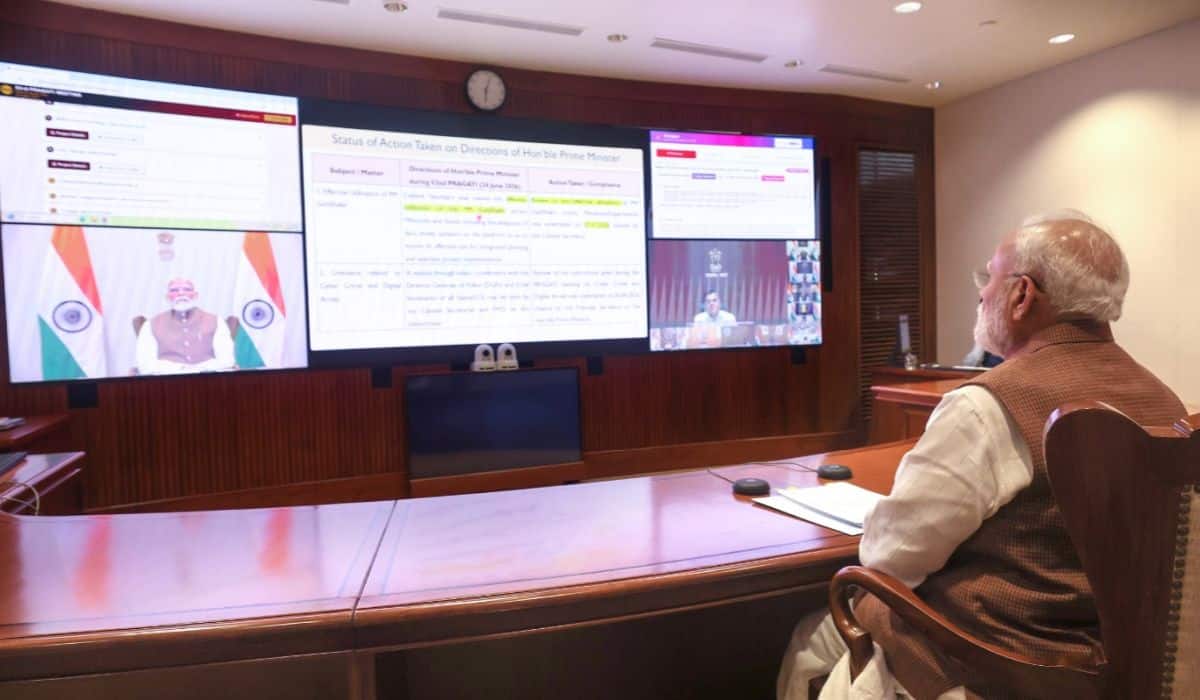
Prime Minister Shri Narendra Modi chaired the 53rd meeting of PRAGATI, the ICT-enabled, multi-modal platform for Pro-Active Governance and Timely Implementation, at Seva Teerth earlier today.

During the meeting, Prime Minister reviewed six key infrastructure projects across the Railway, Road and Power sectors, spanning nine States with a cumulative cost of more than ₹30,000 crore. The projects, significant for strengthening connectivity, supporting industrial and economic activity and improving public services, were reviewed with particular emphasis on adherence to timelines, inter-agency coordination, resolution of pending issues and expeditious completion.

Prime Minister emphasised that delays in infrastructure projects have consequences beyond cost escalation, as they also postpone the benefits intended for citizens, businesses and the economy. He said that infrastructure projects should be viewed and monitored as an integrated whole, rather than as isolated sections, stretches or packages. He noted that progress in individual packages should ultimately translate into timely completion and operationalisation of the entire project. Ministries and States were therefore asked to adopt an end-to-end approach, and address critical gaps that could delay the overall commissioning and delivery of benefits. He called for fostering a proactive work culture across Ministries and State Governments, with greater ownership at every level of project implementation.

Prime Minister stressed the need to explore common utility corridors for infrastructure services, wherever feasible, particularly while planning major transport and infrastructure projects. He called upon Ministries and States to examine such integrated approaches at the planning stage itself, keeping in view their technical and economic feasibility.

Prime Minister said that speed of execution must be accompanied by uncompromising quality. He called upon Ministries, States and implementing agencies to adopt modern technologies and strengthen quality assurance and supervision at every stage.

While reviewing AgriStack under the Digital Agriculture Mission, Prime Minister emphasised the need to leverage the latest digital technologies, including Artificial Intelligence, to derive greater value from agricultural data. He stressed that the data ecosystem should be effectively utilised across the agricultural value chain, from input planning to processing, enabling more informed interventions, better targeting and data-driven decision-making. He appreciated the efforts of the States and the Central Government in building the AgriStack ecosystem and called for further strengthening its use for delivering better outcomes for farmers.

During the review of cyber fraud cases, including incidents of digital arrest, Prime Minister said that prevention must be strengthened through a sustained focus on training, awareness and education. He stressed the need for continuous and targeted public-awareness campaigns, particularly for senior citizens, youth and other vulnerable sections, to familiarise them with common fraud techniques, warning signs and safe digital practices. He also called for regular capacity-building of personnel involved so that emerging modes of cyber fraud are identified and acted upon swiftly.