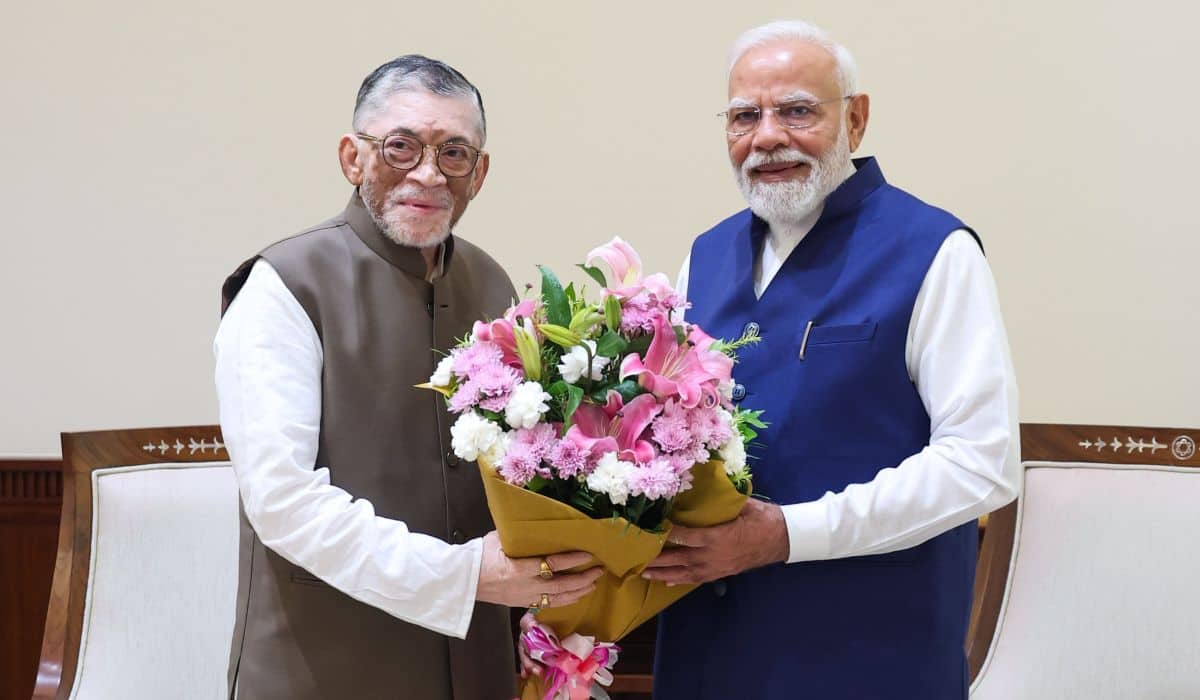
Prime Minister Narendra Modi addressed public meetings in Araria and Munger, Bihar, where he emphasized the importance of the ongoing elections and highlighted the achievements of the NDA government.
PM Modi began by expressing gratitude for the affection and blessings he has received from the people of Araria and Supaul. He assured the audience that he would work even harder to repay this debt and make even bigger decisions for the country in the third term. He reiterated the slogan 'Phir Ek Baar, Modi Sarkar,' signifying the nation's support for the BJP.

The Prime Minister urged all voters, especially the youth, to participate in the second phase of voting, describing it as the festival of democracy. Despite the heat, he emphasized the importance of fulfilling one's duty towards democracy by casting votes.
PM Modi underscored the significance of Bihar in India's economic and social development, praising the determination, intellect, and hard work of its people. He highlighted Bihar's role in India's historical prosperity and its importance in the country's journey towards becoming the third economic superpower in the world.
Critiquing the alliance between RJD and Congress, PM Modi accused them of disregarding the country's constitution and democracy. He criticized their past governance, alleging that they had snatched people's rights and manipulated the electoral process. He said, “The alliance between RJD and Congress doesn't care about the country's constitution or democracy. These are the people who, for decades, snatched the rights of the people under the guise of ballot paper. The people of Bihar witnessed how ballots were looted during the RJD-Congress regime, and the poor were not allowed to vote.”
“Now, when the poor, the honest voters of the country, have got the power of EVM, these people cannot tolerate it. Every leader of the INDI alliance has sinned creating doubt in the minds of the people regarding EVM,” he added.

The Prime Minister lauded the Supreme Court's recent decision upholding the integrity of the electoral process and urged leaders of the opposition alliance to apologize to the nation. “Today, when the whole world praises India's democracy and its electoral process, these people raise questions about EVM with malintent. They have continuously undermined democracy. But today, the Supreme Court has delivered a resounding slap to them. Every leader of the INDI alliance should apologize to the people of the country,” said the Prime Minister.
Differentiating between the two streams of Indian politics, PM Modi contrasted the BJP-led NDA's agenda of empowering the people with the Congress-RJD alliance's aim of keeping people dependent. He accused Congress and RJD of depriving Bihar of development during their rule and highlighted the progress made under Nitish Kumar's leadership.
PM Modi praised Nitish Kumar for pulling Bihar out of the "jungle raj" and highlighted the NDA government's efforts to reach every beneficiary through various schemes. He cited the direct transfer of over 50 thousand crore rupees to the bank accounts of Bihar's people through DBT and the provision of ‘pucca houses’ under the PM Kisan Samman Nidhi scheme.
The Prime Minister outlined the NDA government's priorities, including making the lives of women easier through schemes such as providing water through taps, toilets, and free electricity connections. He warned against Congress and RJD's attempts to snatch people's rights, particularly their conspiracy to implement religion-based reservations.
PM Modi criticized Congress and RJD for their appeasement politics and highlighted instances of discrimination against Hindus for the benefit of their vote bank. He said, “Parties like Congress and RJD have sunk so deep into the quagmire of appeasement that even the Constitution doesn't hold any meaning for them.”

He urged the media to raise awareness about this issue and criticized the INDI alliance government for its divisive policies. “Today, another old video of Manmohan Singh has surfaced where he is again saying that Muslims have the first right to the country's resources. I urge the media to make people aware of this video and discuss it. The country should also know what mentality the Indian coalition government has been running the country for 10 years.”
Under Nitish Kumar's leadership, PM Modi affirmed that every caste, community, and religion was being developed, by the Constitution. He accused Congress and RJD of going against the basic principles of the Constitution for their selfish interests.
PM Modi emphasized the rights of the poor, Dalits, backward classes, and tribals over the country's resources, refuting Congress and RJD's claims. He warned against Congress's plan to impose a 55% tax on inherited property and urged voters to support the NDA to prevent such policies.
During his second public gathering in Munger, Bihar, PM Modi began his address by praising the heritage and pride of Munger, highlighting its historical significance in India's prosperity. The Prime Minister spoke about the modernization of Indian railways and the government's commitment to making India self-reliant in various sectors, including agriculture and textiles. “Today the fight in Bihar is between the ‘Santushtikaran model’ of the NDA versus the 'Tushtikaran model' of the INDI alliance.”

Regarding the upcoming elections, PM Modi criticized the Congress for its proposed policies, such as income and property surveys and inheritance tax, which he deemed detrimental to the people. He said, “Congress says that they will survey the homes and land of farmers and impose an inheritance tax on you. That is, you will not be able to give your entire property to your children, half of it will be taken by Congress. The rest will be distributed as inheritance tax in their vote bank.”
“Congress wants to impose heavy taxes even on the salary of youth, on their earnings, on the earnings of small businesses,” he added.

Speaking about the alliance between RJD and Congress’s thinking, PM Modi said, “Today when I proudly proclaim in front of the whole world that India is the mother of democracy, these RJD-Congress-Left people make fun of it. This mockery is not just of Modi but of the democratic history of Bihar. In the past 10 years, we have established our heritage, and our legacy on the global stage. These people surrounded by the mentality of servitude cannot change this new India even if they want to.”

PM Modi concluded by announcing initiatives to promote yoga and Ayurveda globally and reaffirming his mission to make India the world's hub for agricultural produce. He urged the people of Bihar to vote for the NDA candidates in the upcoming elections, emphasizing the importance of their support for India's development and heritage.
Click here to read full text speech of Araria
Click here to read full text speech of Munger
इंडी गठबंधन के हर नेता ने EVM को लेकर जनता के मन में संदेह पैदा करने का पाप किया है।
— narendramodi_in (@narendramodi_in) April 26, 2024
आज सुप्रीम कोर्ट ने इनको गहरा झटका दिया है। कोर्ट ने साफ कह दिया है कि बैलेट पेपर वाला पुराना दौर वापस लौटकर नहीं आएगा। pic.twitter.com/sl3EM5PKkF
आज देश में राजनीति की दो मुख्य धाराएं बन गई हैं।
— narendramodi_in (@narendramodi_in) April 26, 2024
एक धारा BJP और NDA की है, जिसका मकसद है देश के लोगों को सशक्त करना, हर लाभार्थी के दरवाजे तक खुद जाकर उसे लाभ पहुंचाना।
इसके विपरीत एक और धारा है- कांग्रेस और आरजेडी की।
इंडी गठबंधन वालों का मकसद है, देश के लोगों से छीनना,… pic.twitter.com/F2fp51v7if
बहनों-बेटियों के जीवन को आसान बनाना, NDA की प्राथमिकता है। pic.twitter.com/ge57nqlNJV
— narendramodi_in (@narendramodi_in) April 26, 2024
कांग्रेस, पूरे देश में धर्म आधारित आरक्षण के लिए जोर लगा रही है। pic.twitter.com/eP2ssCPIMz
— narendramodi_in (@narendramodi_in) April 26, 2024
तुष्टिकरण के दलदल में कांग्रेस-आरजेडी जैसी पार्टियां इतना धंस गई हैं कि उनके लिए संविधान भी मायने नहीं रखता। pic.twitter.com/J0beXpwhFv
— narendramodi_in (@narendramodi_in) April 26, 2024
इस समय दुनिया भी जानती है कि ये समय भारत का है।
— narendramodi_in (@narendramodi_in) April 26, 2024
दुनिया को भी लगता है कि जितनी मज़बूत सरकार भारत बनाएगा, उतनी ही मज़बूती दुनिया को भी मिलेगी। pic.twitter.com/DNkMmpHYIi
आज बिहार में लड़ाई NDA के 'संतुष्टिकरण मॉडल' और इंडी गठबंधन के 'तुष्टिकरण मॉडल' के बीच है। pic.twitter.com/4Fwm1CYpU2
— narendramodi_in (@narendramodi_in) April 26, 2024
भ्रष्टाचार करके लोगों को तबाह करने वाली कांग्रेस की गलत नज़र अब आपकी इस संपत्ति पर भी पड़ गई है: PM @narendramodi pic.twitter.com/m009qvVQpr
— narendramodi_in (@narendramodi_in) April 26, 2024
जबतक मोदी है, तबतक ये SC/ST/OBC का हक छीनकर धर्म के आधार पर नहीं बांट पाएंगे।
— narendramodi_in (@narendramodi_in) April 26, 2024
ये मोदी की गारंटी है: PM @narendramodi pic.twitter.com/P1JIw5XYAI
दिल्ली में G-20 सम्मेलन के दौरान हमने नालंदा विश्वविद्यालय के गौरवमयी इतिहास को दुनिया के सामने रखा।
— narendramodi_in (@narendramodi_in) April 26, 2024
NDA, भारत को 21वीं सदी के वैश्विक ज्ञान का केंद्र बनाने के लिए समर्पित है: PM @narendramodi pic.twitter.com/hd2KFmQOEJ