PM to visit Jhansi in Uttar Pradesh on 15 February 2019

Published By : Admin | February 14, 2019 | 18:42 IST

The Prime Minister, Shri Narendra Modi, will visit Jhansi on 15 February 2019. The Prime Minister will inaugurate or lay foundation stone of various development projects in Jhansi.

PM will lay the Foundation Stone of Defence Corridor in Jhansi, Uttar Pradesh. To make India self-reliant in defence production Government of India had taken the decision to establish two defence corridors in the country, one at Tamil Nadu and the other in Uttar Pradesh. Jhansi is one of the six nodal points of the UP defence corridor. The Prime Minister during the UP Investors Meet held on February 2018, had announced the setting up of one such corridor in the Bundelkhand Region of UP.

PM will inaugurate the electrification of 297 km long section of Jhansi- Khairar section. Electrification will lead to faster trains, reduced carbon emissions and sustainable environment.

He will also dedicate to Nation the West- North Inter-Region Power Transmission Strengthening Project to ensure uninterrupted power supply to Western Uttar Pradesh.

PM will inaugurate Pahari Dam Modernization Project. Pahari Dam is a water storage dam situated on Dhasan river in Jhansi district.

Keeping in line with the Government’s vision of providing drinking water to all, PM will lay the Foundation Stone of Piped Water Scheme for the rural areas of Bundelkhand Region. The project is significant as it will ensure water supply to the drought prone Bundelkhand region. Foundation Stone of Jhansi City Drinking Water Scheme Phase-II under AMRUT will also be laid by the PM.

PM will lay the Foundation Stone of Coach Refurbishing Workshop in Jhansi. The facility will create employment opportunities to the Bundelkhand region.

PM will lay the foundation stone of doubling of 425 km long Jhansi-Manikpur and Bhimsen-Khairar railway lines. It will not only provide easy movement of trains but also help in the overall development of Bundelkhand region.

The Prime Minister, Shri Narendra Modi, earlier visited Vrindavan and Varanasi in Uttar Pradesh to serve the three billionth meal to underprivileged children from schools and for the Pravasi Bharatiya Diwas respectively.

Explore More
Today, the entire country and entire world is filled with the spirit of Bhagwan Shri Ram: PM Modi at Dhwajarohan Utsav in Ayodhya

Popular Speeches

Today, the entire country and entire world is filled with the spirit of Bhagwan Shri Ram: PM Modi at Dhwajarohan Utsav in Ayodhya
Regional languages take precedence in Lok Sabha addresses

Media Coverage

Regional languages take precedence in Lok Sabha addresses
NM on the go

Nm on the go

Always be the first to hear from the PM. Get the App Now!
...
Cabinet approves three new corridors as part of Delhi Metro’s Phase V (A) Project
December 24, 2025

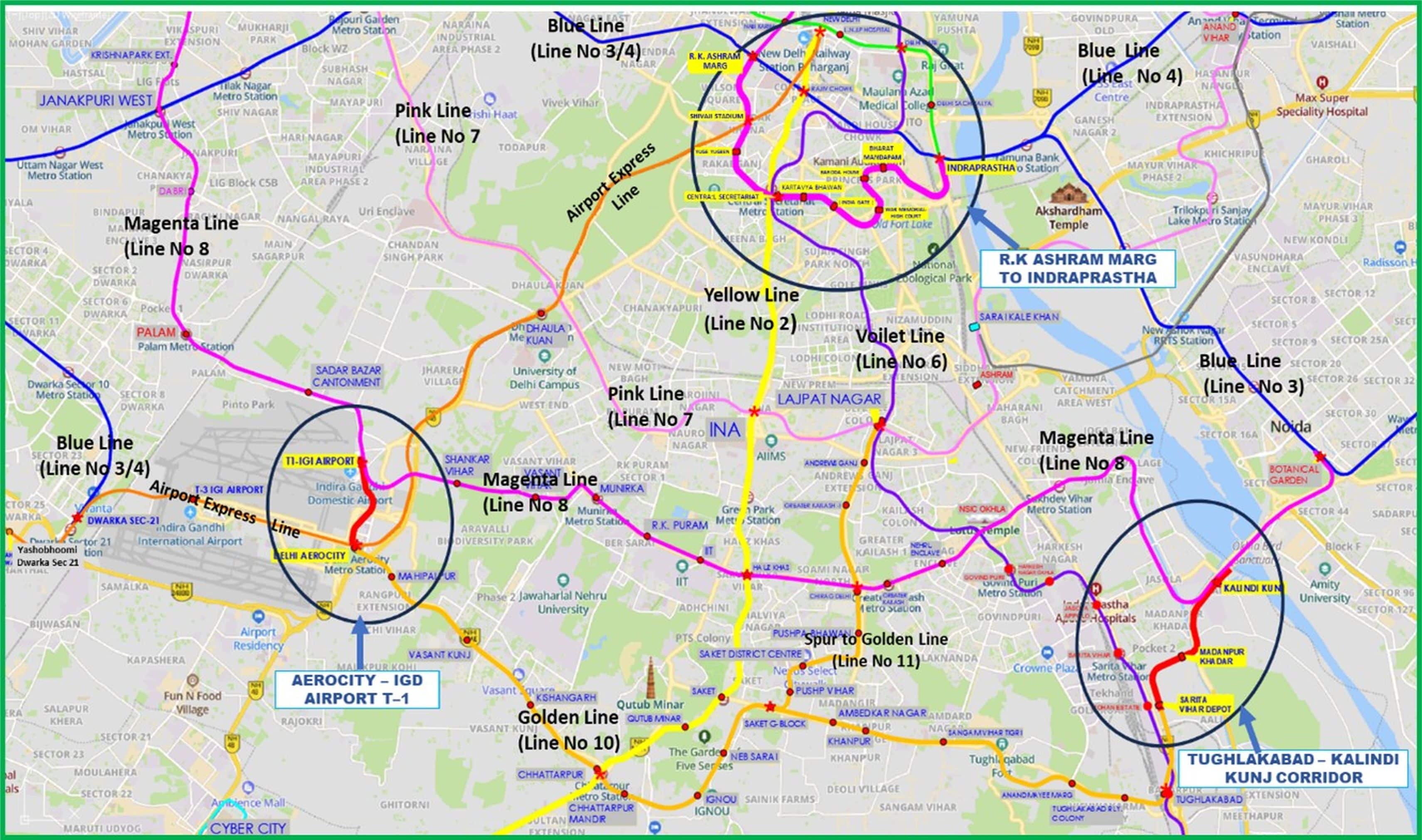
The Union Cabinet chaired by the Prime Minister, Shri Narendra Modi has approved three new corridors - 1. R.K Ashram Marg to Indraprastha (9.913 Kms), 2. Aerocity to IGD Airport T-1 (2.263 kms) 3. Tughlakabad to Kalindi Kunj (3.9 kms) as part of Delhi Metro’s Phase – V(A) project consisting of 16.076 kms which will further enhance connectivity within the national capital. Total project cost of Delhi Metro’s Phase – V(A) project is Rs.12014.91 crore, which will be sourced from Government of India, Government of Delhi, and international funding agencies.

The Central Vista corridor will provide connectivity to all the Kartavya Bhawans thereby providing door step connectivity to the office goers and visitors in this area. With this connectivity around 60,000 office goers and 2 lakh visitors will get benefitted on daily basis. These corridors will further reduce pollution and usage of fossil fuels enhancing ease of living.

Details:

The RK Ashram Marg – Indraprastha section will be an extension of the Botanical Garden-R.K. Ashram Marg corridor. It will provide Metro connectivity to the Central Vista area, which is currently under redevelopment. The Aerocity – IGD Airport Terminal 1 and Tughlakabad – Kalindi Kunj sections will be an extension of the Aerocity-Tughlakabad corridor and will boost connectivity of the airport with the southern parts of the national capital in areas such as Tughlakabad, Saket, Kalindi Kunj etc. These extensions will comprise of 13 stations. Out of these 10 stations will be underground and 03 stations will be elevated.

After completion, the corridor-1 namely R.K Ashram Marg to Indraprastha (9.913 Kms), will improve the connectivity of West, North and old Delhi with Central Delhi and the other two corridors namely Aerocity to IGD Airport T-1 (2.263 kms) and Tughlakabad to Kalindi Kunj (3.9 kms) corridors will connect south Delhi with the domestic Airport Terminal-1 via Saket, Chattarpur etc which will tremendously boost connectivity within National Capital.

These metro extensions of the Phase – V (A) project will expand the reach of Delhi Metro network in Central Delhi and Domestic Airport thereby further boosting the economy. These extensions of the Magenta Line and Golden Line will reduce congestion on the roads; thus, will help in reducing the pollution caused by motor vehicles.

The stations, which shall come up on the RK Ashram Marg - Indraprastha section are: R.K Ashram Marg, Shivaji Stadium, Central Secretariat, Kartavya Bhawan, India Gate, War Memorial - High Court, Baroda House, Bharat Mandapam, and Indraprastha.

The stations on the Tughlakabad – Kalindi Kunj section will be Sarita Vihar Depot, Madanpur Khadar, and Kalindi Kunj, while the Aerocity station will be connected further with the IGD T-1 station.

Construction of Phase-IV consisting of 111 km and 83 stations are underway, and as of today, about 80.43% of civil construction of Phase-IV (3 Priority) corridors has been completed. The Phase-IV (3 Priority) corridors are likely to be completed in stages by December 2026.

Today, the Delhi Metro caters to an average of 65 lakh passenger journeys per day. The maximum passenger journey recorded so far is 81.87 lakh on August 08, 2025. Delhi Metro has become the lifeline of the city by setting the epitome of excellence in the core parameters of MRTS, i.e. punctuality, reliability, and safety.

A total of 12 metro lines of about 395 km with 289 stations are being operated by DMRC in Delhi and NCR at present. Today, Delhi Metro has the largest Metro network in India and is also one of the largest Metros in the world.