PM Modi's Decadal Deliveries & Development Commitment in Telangana

Published By : Admin | February 24, 2024 | 15:36 IST

"The connectivity that the Government of India is increasing in Telangana today, is benefitting the industries of Telangana as well as tourism here. There are many heritage centres and religious places in Telangana. It is now becoming more convenient to visit these places. That is, be it farmers or labourers, students or professionals, everyone is getting benefitted out of it." - Prime Minister Narendra Modi.


Telangana has benefited from various central agriculture, irrigation, and rural development schemes. Many infrastructure projects have been launched in the state to enable Telangana's aspirations, enabling better connectivity. PM Narendra Modi has laid the foundation stones and inaugurated multiple transformative projects that span various sectors, including road, rail, petroleum, natural gas, and higher education, promising a brighter future for the state. One significant one is the Rs 13,500 crore project in Mahbubnagar. In the state, the Modi government constructed 2,500 km of new National Highways in the last decade. Regional Connectivity has been enhanced. One notable initiative, Pradhan Mantri Gram Sadak Yojana (PMGSY), which focuses on rural road development, has seen great results in Telangana, as it witnesses the construction and improvement of roads, enhancing connectivity in rural areas.


PM Modi has strengthened the hands of Annadatas in Telangana through fertilizer subsidy transfer worth Rs 33,000 crore, set up a state-of-the-art modern fertilizer plant in Ramagundam with a budget of Rs.6,338 crore, procurement Rs 1.24 crore worth of rice on MSP and Rs 9,028 crore transferred to 39.50 lakh farmers under various welfare schemes. Over 99 FPOs and 18 lakh farmers enrolled in the e-NAM portal are assured of improved market access and better prices. 1888 Amrit Sarovar was constructed across districts across the state.


The Modi government has ensured that people experiencing poverty get a bank account, gas connection, toilet, and homes through the timely release of funds. Telangana has a 100 per cent tap water connection in every household under the Jal Jeeva Mission. Over 3.5 lakh candidates are trained under PM Kaushal Vikash Yojana as of July 2023.


Telangana railway stations are undergoing a significant makeover through investment of Rs 894 crore, upgraded with modern amenities. The reconstruction of 21 stations began with the laying of the foundation by PM Modi. The 37-kilometer Jaklair–Krishna New Railway Line segment, constructed at an expense above Rs 500 crore, adds regions of the underdeveloped Narayanpet district to the Railway map for the first time. The route of Secunderabad-Visakhapatnam Vande Bharat Express boasts an occupancy rate of 134% and 143% to-forth, connecting the shared culture of Telangana & Andhra. To provide low-cost power to the state and boost its economic development, the most modern NTPC plant in the country, with the expectation of an installed capacity of 4000 MW, was inaugurated by PM in Peddapalli district.


Nagpur-Vijayawada Economic Corridor, gifted by the PM to the state, is a revolutionary infrastructure project to improve trade and transportation throughout Telangana, Andhra Pradesh, and Maharashtra. With eight Special Economic Zones, five Mega Food Parks, four fishing and seafood clusters, three pharma and medical clusters, and one textiles cluster, this corridor is expected to boost trade, tourism, and industry. It offers young people in Hanamkonda, Mahabubabad, Warangal, and Khammam additional chances and job opportunities. Hassan-Cherlapalli LPG Pipeline Project and the Multiproduct Petroleum Pipeline between Krishnapatnam and Hyderabad have already generated thousands of direct and indirect jobs in Telangana and a safe, faster, efficient and environmentally friendly mode of petroleum products in the region.

A whopping amount of Rs 1,365 crore for the prestigious AIIMS located in Bibinagar was approved. Rs 2,200 crore for constructing ESI hospitals and medical colleges and upgrading existing dispensaries. Additionally, Prime Minister Modi inaugurated several buildings at the Hyderabad Central University, which now holds the status of 'Institution of Eminence' with special funding from the Central Government. PM announced the establishment of the Central Tribal University in Mulugu district, named after the revered tribal goddesses Sammakka-Sarakka, with an investment of approximately Rs 900 crore.


"The state of Telangana may be a new one. But the contribution of Telangana and its people in the history of India has always been great." These words from Prime Minister Narendra Modi are his assurance to the people that his government will ensure holistic and inclusive growth in the state.

Explore More
Today, the entire country and entire world is filled with the spirit of Bhagwan Shri Ram: PM Modi at Dhwajarohan Utsav in Ayodhya

Popular Speeches

Today, the entire country and entire world is filled with the spirit of Bhagwan Shri Ram: PM Modi at Dhwajarohan Utsav in Ayodhya
India's electronics exports cross $47 billion in 2025 on iPhone push

Media Coverage

India's electronics exports cross $47 billion in 2025 on iPhone push
NM on the go

Nm on the go

Always be the first to hear from the PM. Get the App Now!
...
6 Years of Jal Jeevan Mission: Transforming Lives, One Tap at a Time
August 14, 2025
Jal Jeevan Mission has become a major development parameter to provide water to every household.” - PM Narendra Modi

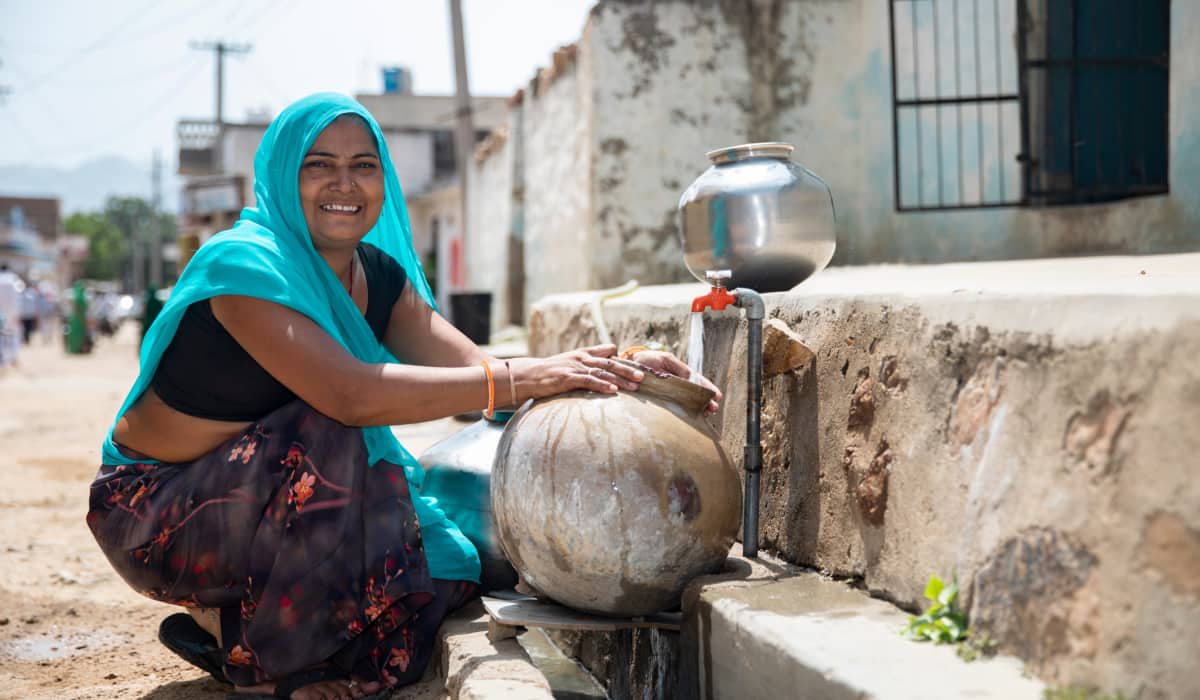
For generations, the sight of women carrying pots of water on their heads was an everyday scene in rural India. It was more than a chore, it was a necessity that was an integral part of their everyday life. The water was brought back, often just one or two pots which had to be stretched for drinking, cooking, cleaning, and washing. It was a routine that left little time for rest, education, or income-generating work, and the burden fell most heavily on women.

Before 2014 water scarcity, one of India’s most pressing problems, was met with little urgency or vision. Access to safe drinking water was fragmented, villages relied on distant sources, and nationwide household tap connections were seen as unrealistic.

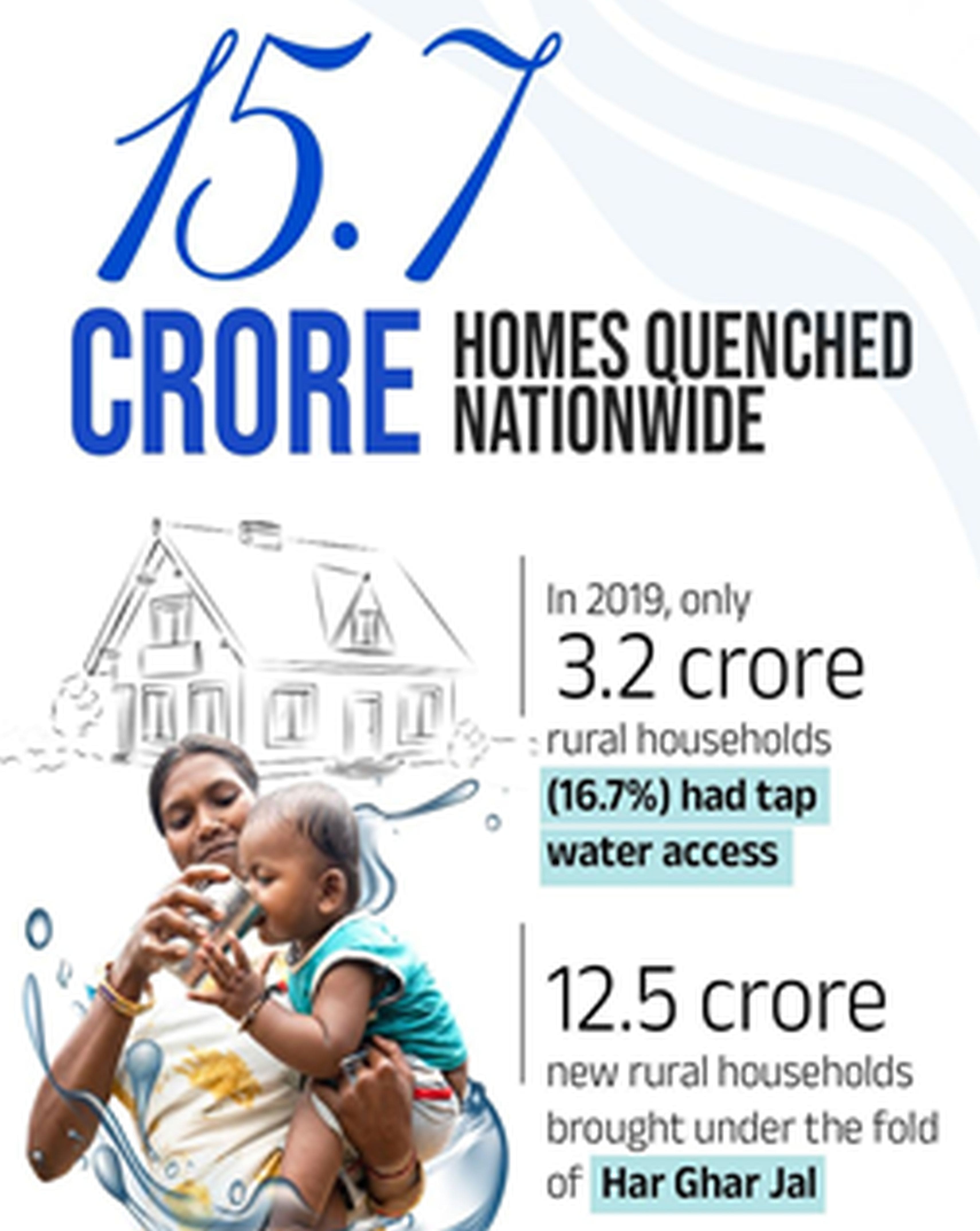
This reality began to shift in 2019, when the Government of India launched the Jal Jeevan Mission (JJM). A centrally sponsored initiative which aims at providing a Functional Household Tap Connection (FHTC) to every rural household. At that time, only 3.2 crore rural households, a modest 16.7% of the total, had tap water. The rest still depended on community sources, often far from home.

As of July 2025, the progress under the Har Ghar Jal program has been exceptional, with 12.5 crore additional rural households connected, bringing the total to over 15.7 crore. The program has achieved 100% tap water coverage in 200 districts and over 2.6 lakh villages, with 8 states and 3 union territories now fully covered. For millions, this means not just access to water at home, but saved time, improved health, and restored dignity. Nearly 80% of tap water coverage has been achieved in 112 aspirational districts, a significant rise from less than 8%. Additionally, 59 lakh households in LWE districts have gained tap water connections, ensuring development reaches every corner. Acknowledging both the significant progress and the road ahead, the Union Budget 2025–26 announced the program’s extension until 2028 with an increased budget.

The Jal Jeevan Mission, launched nationally in 2019, traces its origins to Gujarat, where Narendra Modi, as Chief Minister, tackled water scarcity in the arid state through the Sujalam Sufalam initiative. This effort formed a blueprint for a mission that would one day aim to provide tap water to every rural household in India.

Though drinking water is a State subject, the Government of India has taken on the role of a committed partner, providing technical and financial support while empowering States to plan and implement local solutions. To keep the Mission on track, a strong monitoring system links Aadhaar for targeting, geo-tags assets, conducts third-party inspections, and uses IoT devices to track village water flow.

The Jal Jeevan Mission’s objectives are as much about people as they are about pipes. By prioritizing underserved and water-stressed areas, ensuring that schools, Anganwadi centres, and health facilities have running water, and encouraging local communities to take ownership through contributions or shramdaan, the Mission aims to make safe water everyone’s responsibility..

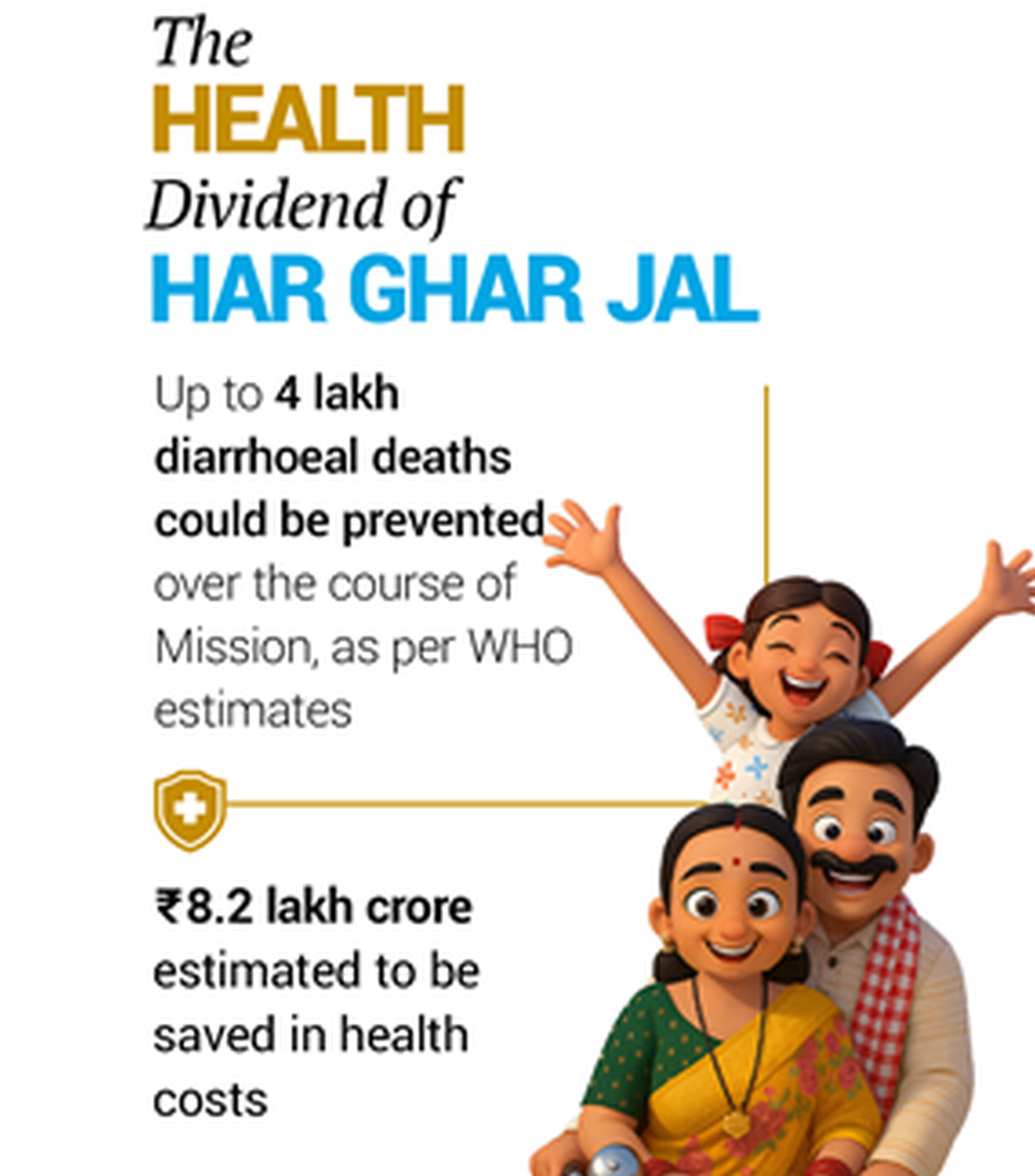
The impact reaches far beyond convenience. The World Health Organization estimates that achieving JJM’s targets could save over 5.5 crore hours each day, time that can now be spent on education, work, or family. 9 crore women no longer need to fetch water from outside. WHO also projects that safe water for all could prevent nearly 4 lakh deaths from diarrhoeal disease and save Rs. 8.2 lakh crores in health costs. Additionally, according to IIM Bangalore and the International Labour Organization, JJM has generated nearly 3 crore person-years of employment during its build-out, with nearly 25 lakh women are trained to use Field testing Kits.

From the quiet relief of a mother filling a glass of clean water in her kitchen, to the confidence of a school where children can drink without worry, the Jal Jeevan Mission is changing what it means to live in rural India.