Published By : Admin |
August 19, 2014 | 19:14 IST
Share
"PM terms corruption a disease worse than cancer
""Mera Kya, Mujhe Kya" attitude must end. PM hints at harsh measures to curb corruption"
"PM: Network of roads is essential to take development to every nook and corner, just as a network of veins is essential to take blood to all parts of the body"
The Prime Minister, Shri Narendra Modi today described corruption as a disease worse than cancer, and said he was determined to remove corruption from the nation, with the support of the people.
The Prime Minister was addressing a large gathering at Kaithal, Haryana, after laying the Foundation Stone for the four-laning of "Kaithal-Narwana-Hisar-Rajasthan Border" Highway. "Should corruption be removed from society," Shri Narendra Modi asked the assembled people. "Will you support me, if I take harsh steps to remove it," he asked? Amid applause, he declared that he would rid the country of corruption, with the support of the people. He said the "Mera Kya, Mujhe Kya" attitude had taken the country on the path of destruction, and it had to be ended immediately. The nation is not willing to bear these ills much longer, he added.
Highlighting the importance of infrastructure in the development of nations, the Prime Minister said Haryana provided a good example of this. The stretch of land on both sides of National Highway-1 (which runs through Haryana) has developed well, but beyond that, one can see lack of development in the state. He said a network of roads was essential for development, in the same way as a network of veins in the body provides blood to every part of it. The Prime Minister outlined his Government`s vision of modern infrastructure development, which included world class roads, optical fibre networks, power, gas and water grids.
Referring to the four laning project of the Kaithal-Rajasthan border stretch, the foundation for which was laid today, the Prime Minister said this road would connect Haryana and Rajasthan, and spur trade and transportation links between the two states, benefiting the nation as well.
The Prime Minister said youth needed employment opportunities, and development was essential for generating employment. He said the large gathering at the function venue is proof that the people are interested and keen for development. They want to join the whole world on the path of development, he added.
The Prime Minister described himself as the Pradhan Sewak of the nation and said Haryana has a special right on him. He said his Government was committed to early completion of all central sector projects pending in the state.
Saluting the farmers of Haryana for filling the granaries of India, the Prime Minister called for adoption of modern agricultural practices and technologies, which not only help in filling granaries, but also ensure that the farmer gets well-remunerated. (Ann ka bhandar bhi bhare, aur Kisan ki jeb bhi bhare). Referring to the Pradhan Mantri Gram Sadak Yojana, launched by former Prime Minister Shri Atal Bihari Vajpayee, the Prime Minister said his Government would ensure irrigation for the farmers through the Pradhan Mantri Krishi Sinchai Yojana.
The Governor of Haryana Prof. Kaptan Singh Solanki, the Chief Minister of Haryana Shri Bhupinder Singh Hooda, the Union Minister for Road Transport and Highways Shri Nitin Gadkari, the Union MoS for Road Transport and Highways Shri Krishan Pal, and the Union MoS for Defence Rao Inderjit Singh were also present on the occasion.
Fulfilling public aspirations is the core objective of this budget and the resolution of this government: PM Modi
March 09, 2026
Share
India is working today on a vision of preventive and holistic health: PM
In recent years, the country’s health infrastructure has strengthened, with medical colleges opening in hundreds of districts and health services reaching every village through Ayushman Bharat and Arogya Mandirs: PM
Our Yoga and Ayurveda are becoming popular across the entire world: PM
We must accelerate linking our education system with the real-world economy and increase our focus on AI, automation, digital economy and design-driven manufacturing: PM
India is moving towards an innovation-driven economy: PM
As we prepare for futuristic technologies today; it is crucial that no daughter is held back due to a lack of opportunities: PM
In recent years, sports have been seen as a key pillar of national development; initiatives like Khelo India have energised the sports ecosystem and sports infrastructure is being strengthened nationwide: PM
Friends,
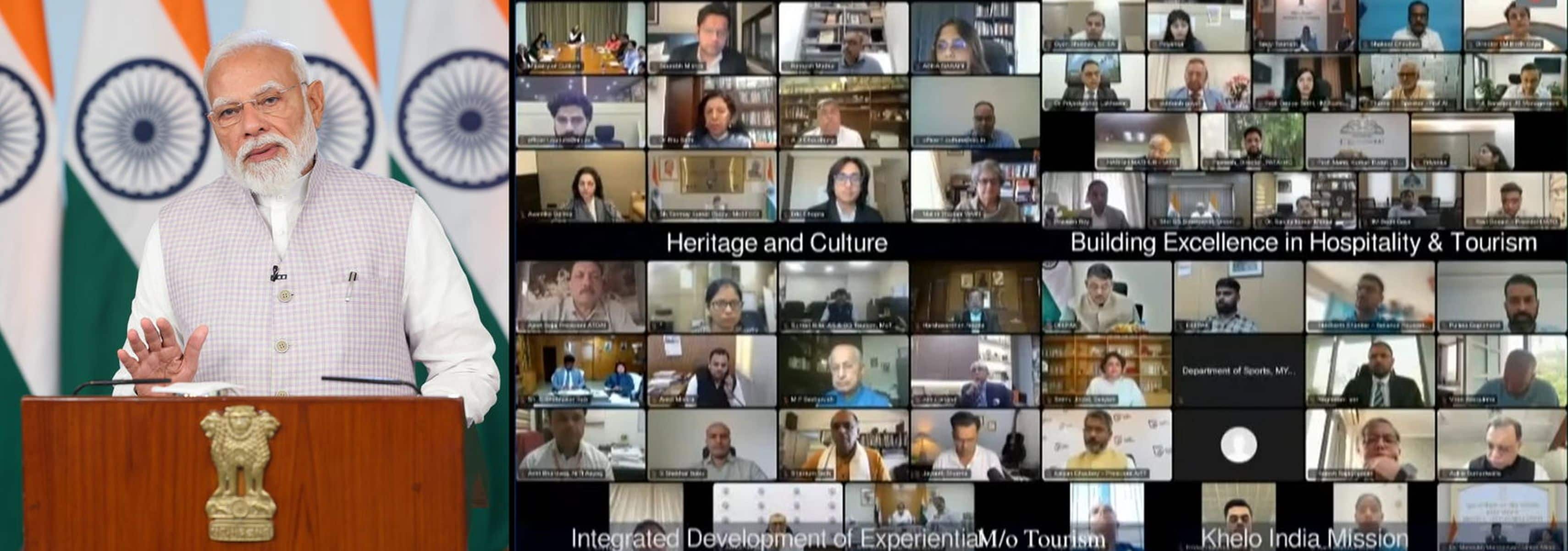
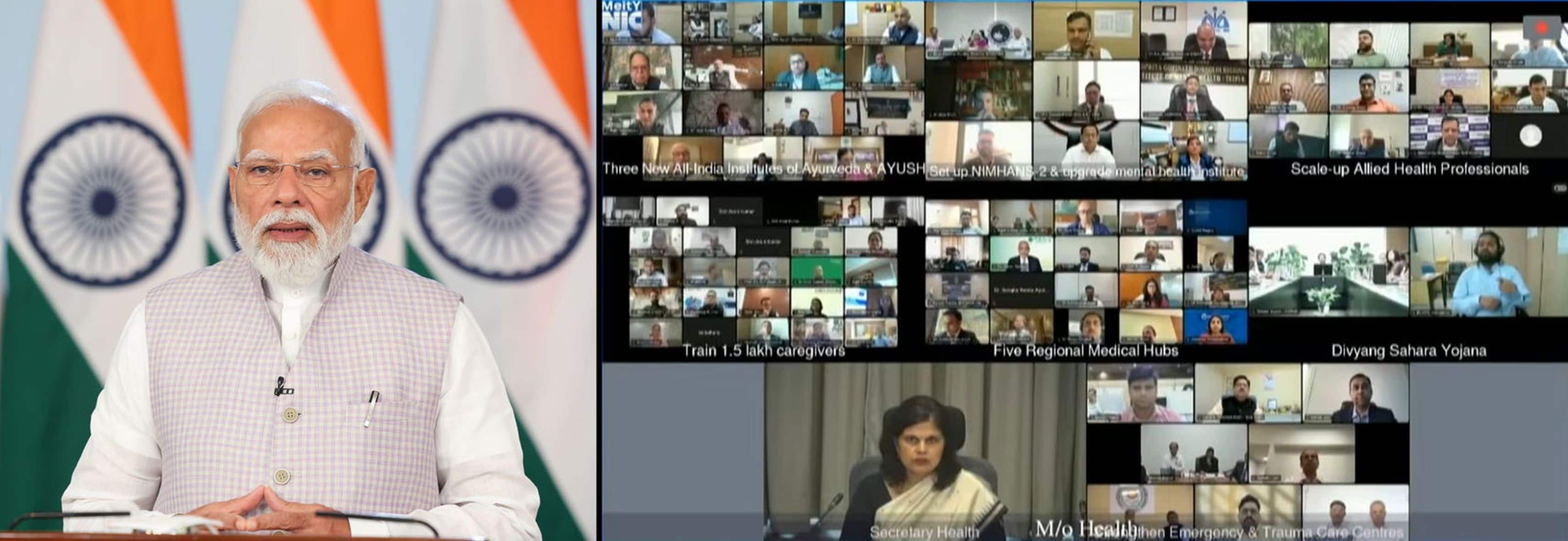
In this series of post-budget webinars, today marks the fourth and most significant one. Fulfilling aspirations of people is not merely a subject of discussion-it is the core objective of this budget and the firm resolve of this government. Education, Skill, Health, Tourism, Sports, and Culture are fundamental sectors that serve as the major means of fulfilling these aspirations. Therefore, in this webinar, we are deliberating on these crucial dimensions. For the implementation of budget announcements, the thoughts and suggestions of all experts, policymakers, scholars, entrepreneurs, and my young companions present here are extremely important. I warmly welcome and greet you all in this fourth session of the budget webinar.
Friends,
India today is working on a vast vision for preventive and holistic health. In recent years, the country’s health infrastructure has been strengthened, with hundreds of new medical colleges opening across districts. Through the Ayushman Bharat scheme and wellness centers, healthcare services have expanded to villages nationwide. Our yoga and Ayurveda are gaining popularity across the world. You will certainly discuss various aspects of this, but I would like to highlight one important subject-the care economy. In the coming decade, the number of senior citizens in the country will rise rapidly. Moreover, even today, many countries across the world face a huge demand for caregivers. Therefore, in the health sector, new skill-based employment opportunities are emerging for millions of youth. I urge the health sector experts present in this webinar to suggest new training models and partnerships so that the training ecosystem in the country can be further strengthened.
Friends,
Closely related to this is the subject of telemedicine. Today, a large number of people in remote areas are benefiting from it, and trust in it is steadily growing. However, I believe there is still a great need to increase awareness and ease of access in this area.
Friends,
Over the past decade, a major transformation has taken place in the mindset of the country. Today, beyond the boundaries of villages, towns, and cities, every young Indian wants to do something new, driven by the spirit to achieve. This new mindset of the new generation is the nation’s greatest strength, its most valuable capital for a bright future. To capitalize on this, we must continuously modernize and upgrade our education system. The new education policy has laid the necessary foundation for this. Now, it is essential that our curriculum remains updated according to market needs! We must accelerate the process of linking our education system with the real-world economy. We need to place greater focus on subjects like AI and automation, digital economy, and design-driven manufacturing.
Friends,
The country is consistently working to connect education with employment and enterprise. New models like university townships reflect this approach. Today, India is promoting the A.V.G.C. sector-Animation, Visual Effects, Gaming, and Comics. India is moving towards an innovation-driven economy. Many academicians and academic institutions are connected to this webinar today. I urge you to deliberate on developing your campuses as centers of industry collaboration and research-driven learning. This will provide students with real-world exposure and strengthen the skill ecosystem.
Friends,
A very important subject is STEM-Science, Technology, Engineering, and Mathematics. It is a matter of great pride that the number of daughters showing interest in STEM subjects is steadily increasing in our country. As we prepare for futuristic technologies, it is crucial that no daughter is held back due to lack of opportunities. In this webinar, you must discuss this direction. We need to place greater emphasis on increasing women’s participation. We must build a research ecosystem where young researchers have full opportunities to experiment and work on new ideas.
Friends,
Youth power becomes national power only when it is healthy, disciplined, and full of self-confidence. That is why, in recent years, sports have been seen as an important stream of national development. Initiatives like Khelo India have infused new energy into the sports ecosystem of the country. Sports infrastructure is being strengthened across the nation. In this webinar, you must deliberate on some key questions: How can talent be identified more accurately even from small towns and villages? How can structured financial support for thousands of athletes be improved? And thirdly, how can our sports bodies be made more professional? In the coming years, the Commonwealth Games will be held in India, and the country is striving to host the Olympics. In such a scenario, we must identify young athletes at an early age and nurture them, only then will India be able to raise its flag high in international competitions.
Friends,
Tourism and culture play a major role in creating new employment opportunities. When tourism grows in a place, the branding of that location or city also increases. This accelerates the overall development of that city. India has no shortage of historical sites. But for a long time, tourism remained confined to a few select destinations. Now, we are focusing on developing tourist destinations across every corner of the country.
Friends,
In this webinar, you must discuss a holistic approach to strengthening India’s tourism ecosystem. Your suggestions on trained guides, hospitality skills, digital connectivity, community participation, cleanliness, tourism, and related subjects will be very important.
Friends,
When institutions, industry, and academia work together, the pace of transformation accelerates. I am confident that this series of post-budget webinars will provide concrete direction for the future. Such efforts will further strengthen the foundation of a developed India. And friends, it is a very pleasant experience that due to the tradition of webinars, after the budget and especially during implementation, I have been told that this year, lakhs of people connected to these subjects-experts, beneficiaries, and those involved in the system-have actively participated in the webinars. Our officials have informed me that excellent and practical suggestions are coming in. This means not only solutions to problems but also new energy and new momentum to move forward with confidence. I say this is a very delightful experience of the webinars. All those who participated in these webinars are worthy of appreciation and gratitude. Once again, I extend my best wishes and heartfelt thanks to all of you.