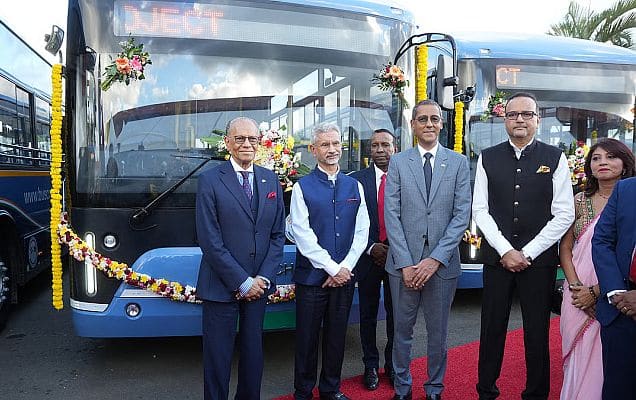
"The numbers of growing economy and the growing income are bound to infuse new confidence in the mobility sector"
- Prime Minister Narendra Modi, Bharat Mobility Global Expo 2024, Delhi
Today, countries and governments are increasingly aware of the dire need to protect the environment to tackle climate change. Green mobility has become a crucial component of policies and initiatives adopted by countries across the globe. India is dedicated to upholding internationally acknowledged environmental standards and aims to achieve approximately fifty per cent of its installed electric power capacity from non-fossil fuel sources by 2030. This gradual transition involves shifting from conventional energy sources that require fossil fuels to renewable alternatives.
Under the leadership of Prime Minister Modi, India has also made a concerted effort to encourage sustainable modes of transportation and hastened the adoption of electric vehicles (EVs). The policy objective of the Modi government's multipronged initiatives for electric vehicles is to promote economic expansion and technological innovation along with cutting carbon emissions.
As envisioned by PM Modi, India's future mobility is based on a vision of seven C's. This vision is a Common, Connected, Convenient, Congestion-free, Charged, Clean, and Cutting-edge mobility for Indian citizens. To achieve such a vision for mobility, the government has been continuously focusing on adopting sustainable modes of transportation.
Under the leadership of PM Modi, the government introduced the National Electric Mobility Mission Plan (NEMMP) 2020 to realize the goal of green mobility. This plan sets out the goals and time frame for the nation to manufacture and adopt electric vehicles with incredible speed. This plan aims to improve the country's fuel security, offer affordable, eco-friendly transportation, and help the Indian car sector become a global leader in manufacturing.
The Ministry of Heavy Industries (MHI)introduced the FAME India Scheme in 2015 under NEMMP 2020 to encourage using electric and hybrid vehicles (xEVs). Phase 1 of the scheme ended on March 31, 2019, when Rs. 895 crore was allocated to realize its objectives. Approximately 2.8 lakh xEVs received incentives totalling roughly Rs. 359 crores during this time. In addition, 425 hybrid and electric buses were introduced in different cities, supported by government subsidies to the tune of Rs. 280 crore.
Launched on April 1, 2019, Phase II of the project has five-year budgetary support of Rs. 10,000 crore and aims to give incentives for 7090 e-Buses, 5 lahks e-3 Wheelers, 55,000 e-4 Wheeler Passenger Cars and 10 lakh e-2 Wheelers. Phase II envisages subsidies for electric car producers totalling Rs. 5356 crores with a target of selling 1,196,203 electric vehicles by December 15, 2023.
Building a solid infrastructure network for charging is essential to advancing electric mobility. The government led by PM Modi has taken several steps to promote the growth of charging stations nationwide to achieve this objective. It involves funding the installation of charging stations for public and commercial organizations, promoting innovative charging techniques like battery swapping, and factoring the charging infrastructure requirement into urban planning and development plans. A capital subsidy of Rs. 800 crore has been set aside for the construction of 7,432 public charging stations for electric vehicles to increase the pace of this infrastructure development, Additionally, 148 EV charging stations have been approved under the FAME scheme, thus augmenting the country's infrastructure for electric vehicles.
Another critical component of the government's green mobility guidelines is incentivizing and providing subsidies to encourage the uptake of EVs. The government has introduced a Production Linked Incentive (PLI) scheme for the automotive industry. It introduced a PLI Scheme for the automotive sector in 2021 and allocated Rs. 25,938 crore. This programme is intended to encourage domestic auto production and includes electric vehicles under its purview.
In May 2021, the Cabinet approved the PLI Scheme on 'National Programme on Advanced Chemistry Cell (ACC) Battery Storage' for achieving a manufacturing capacity of Fifty (50) GigaWatt hours (GWh) of ACC with an outlay of Rs.18,100 Crore. Furthermore, the government has reduced the GST on electric vehicles (EVs) from 12% to 5%, and similarly, the GST on chargers and charging stations for EVs has been reduced from 18% to 5%.
The government has also sponsored R&D projects to promote innovation and domestic manufacturing capabilities in the EV industry. The initiative involves providing funds to academic institutions, working with industry partners to develop cutting-edge technology, and using programmes like the Production Linked Incentive (PLI) scheme to incentivize domestic EV component production. The Automotive Research Association of India (ARAI), IIT Madras, IIT Kanpur, Non-Ferrous Material Technology Development Centre (NFTDC), Aligarh Muslim University (AMU), and other organizations/institutions have been awarded projects worth approximately Rs. 158 Crore for technology development, including the establishment of testing infrastructure, the creation of a "Centre of Excellence" for Advanced Research in Electrified Transportation, Battery Engineering, etc.
The Modi government's roadmap for green mobility demonstrates its dedication to advancing environmentally responsible transportation options and reducing harmful environmental impacts. With this vision, India is positioned to promote eco-friendly mobility and create a more sustainable future by employing financial incentives, infrastructural development, and R&D.