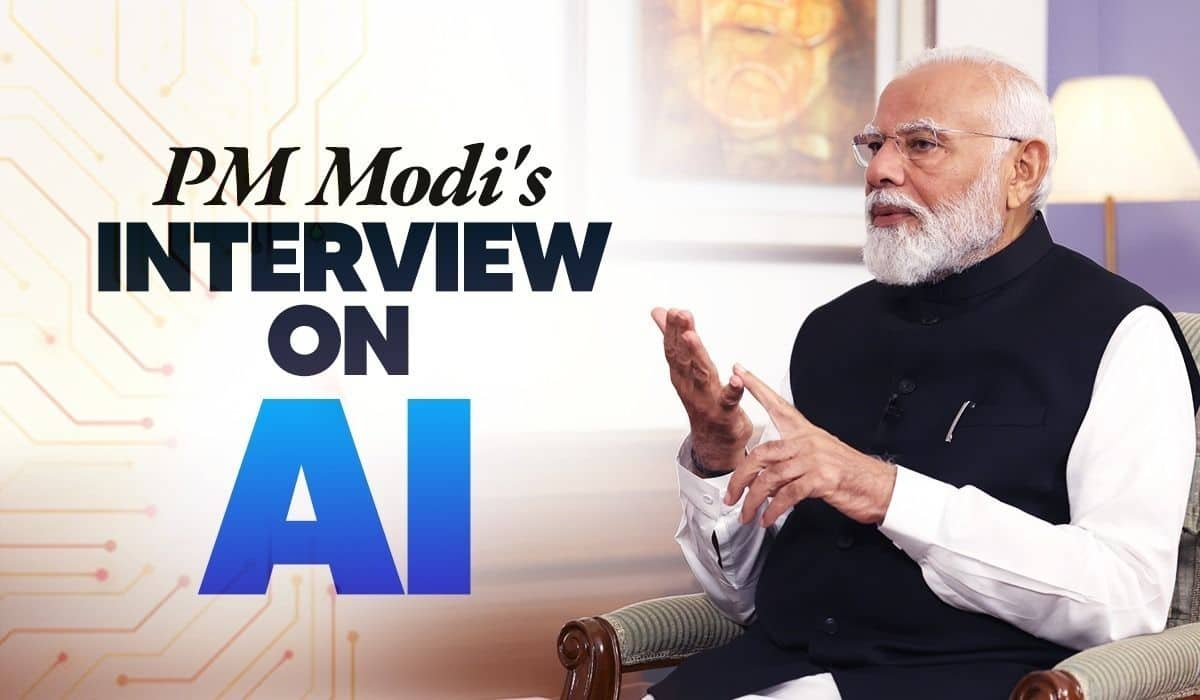
"We have been able to move away from a feeling of cynicism and pessimism to a feeling of hope and optimism. This is the single biggest achievement of our campaign so far," said NDA’s Prime Ministerial candidate Shri Narendra Modi, during his recent interview to IANS.
Excerpts from the interview with IANS: Q: With less than a fortnight to go for D-Day, how is the feeling? Is it one of anticipation or anxiety?
A: There is no anxiety; but yes, there is a sense of anticipation. Change is in the air. And I think the results are going to be as unprecedented as this election has been in every way. I think finally the BJP and NDA may end up doing better than the best predictions among all opinion polls. The best thing is that the entire country is interested in the results. It is a welcome change from the feeling of disinterest if not contempt for Indian politics and Indian elections.
Q: India -- and possibly the world -- is widely expecting a change of guard in New Delhi and the anointing of Narendra Modi, a complete outsider to Delhi's power corridors, as the prime minister of a country of 1.2 billion people. Did you ever expect or dream that you will reach this stage in national politics? Or was it always your secret ambition to lead this country?
A: I never dream about becoming something. I always dream about doing something. I have always believed in doing every job entrusted to me by the party or the nation to the best of my ability. I always believe that I should give my best to every job that I do.
Q: All PMs-in-waiting worldwide have prepared a shadow cabinet. Do you have one, if not on paper, at least in your mind?
A: I think it is premature to talk about cabinet formation. However, I think that having led successful governments, both at the centre and several states, the BJP and its NDA partners have got several leaders with abundant experience, talent and commitment.
The Leader of Opposition in the Lok Sabha Sushma Swaraj and the Leader of Opposition in the Rajya Sabha Arun Jaitley have played a very important role in bringing important issues to the notice of the people. I think a lot of credit goes to both of them and other senior members of the party. They have all demonstrated that the BJP has got enough understanding of important national affairs as also the experience required to work in government.
Q: Do you have a plan for the first 100 days of a Modi government? Which areas would you want to prioritise in your early days?
A: I do not believe in shortcut politics and running the government to cater to the requirements of people who believe less in substance and more in sensationalism. However, we are going to work 24x7 round the year and we are going to work very hard to fulfil our promises and to realise the hopes and expectations of our people. We will be committed that we don't lose any time and get on to the job as early as possible. It will be our priority to restore confidence in the government, bring back credibility in the system and take effective steps to bridge the trust deficit that exists today.
Q: There is huge expectation from a Modi government. People expect you to tame inflation, accelerate growth, create jobs, improve infrastructure, build better roads, fix Pakistan and China, root out corruption and the list goes on. Are you not daunted by these expectations and that people might be disappointed if the government is unable to quickly fulfil these expectations?
A: Yes, I agree that for the first time we are having an election based on the positive idea of development and good governance and this is happening despite the efforts of the opposition to divert the attention of the nation and take the debate back to the issues of divisive vote bank politics. Due to this positive conversation with the citizens, we have been able to generate hopes and expectations. We have been able to move away from a feeling of cynicism and pessimism to a feeling of hope and optimism. This is the single biggest achievement of our campaign so far.
Yes, I agree that at times the expectations may be large, but India is no longer a poor country. The minimum our people can aspire to is having a good standard of living and an opportunity to build their own lives and careers. They have a right to dream and they have a right to get the enabling environment to fulfil their dreams. They have a right to elect a government which delivers. We will give a government which will work hard, work day and night to fulfil these expectations. We are confident that we will succeed in our endeavours. It will be a government that will not hesitate in taking decisions. Our government will be a truly representative, transparent and sensitive government.
Q: How many seats do you think the BJP win in the Lok Sabha? How many seats will the party get in Tamil Nadu, Kerala, West Bengal and Andhra Pradesh where it is weak?
A: It has become a very difficult election to predict because, with each passing day, the support for the BJP and its allies seems to be increasing. The momentum is building even more as we move from one phase to another. A few things are very clear from the voting that has taken place till now: it appears that the present government has already been voted out of power. It is also clear that a strong foundation has been laid for a BJP-led NDA government. The last two phases will decide how big or clear the majority is. I am also getting a feeling that the BJP and its allies are likely to end up getting more number of seats than the ones predicted even by the most favourable opinion polls.
The party's performance in states like Tamil Nadu, Kerala, West Bengal and Andhra Pradesh, where it has traditionally not been very strong, is going to be the real surprise in these elections. We expect to do very well in these states.
Q: How has the campaign been so far? Do you think the discourse has hit a new low in terms of charges or counter-charges and is likely to get even more abusive in the closing weeks?
A: For us the campaign has gone very smoothly. So far the support we have got has kept motivation sustained among the party rank and file. The party workers at the ground are very energised.
Yes, I agree that the opposition parties staring at defeat have indulged in abusive language which has reduced the discourse of the campaign by several notches. I wish they had shown more maturity.
Q: A lot of people fear that the extremist elements in the Sangh Parivar, like Pramod Muthalik, Praveen Togadia, might rule the roost once the BJP comes to power and this is the part of the Hindu right that many among the middle class and young are finding it difficult to accept. Comment.
A: These are not genuine fears, but exaggerated analysis by vested interest groups. Those who have seen my government function in the last one decade in Gujarat would agree that we believe in the rule of law and the majesty of the judicial process. I firmly believe that this country has to be run as per the constitutional framework and the statutory provisions. Our motto is clear: "Be you ever so high, the law is always above you."
Q: There is apprehension among Muslims about BJP which has been further fanned by recent comments by some of BJP/VHP leaders. You had asked them to "refrain" from making such comments. Do you really think BJP would be able to gain the confidence of minorities, particularly Muslims?
A: I would only request all the people of this country to judge me and my party by the work we have done. I would appeal that nobody should judge us by the allegations levelled against us by our political opponents.
I will only add that we are committed to provide a government where nobody needs to be apprehensive or fearful. We are committed to go the extra mile to ensure that not only are we fair and just, but that we are also perceived to be fair and just.
Q: Many people think that riots will break out once Modi comes to power. How will you allay their concerns and fears in this regard?
A: As I have already said these are the kind of fears expressed by the fear-mongers whose only hope is to create insecurity in the minds of people and somehow get their votes. They do not realise that today's India no longer responds to such fear-mongering.
Q: Despite the BJP's efforts to reach out to Muslims, why has the party not given ticket in a sizeable number to members from the community that comprises 15 percent of India's population?
A: During elections ticket distribution is done by the Central Election Committee of the party after taking into account all aspects. However, it would be wrong to say that the BJP has not given representation to the minority community.
Besides, I don't think it is a correct yardstick to define a party's stand on such matters. You cannot forget that it was the NDA government which had proposed the name of A.P.J. Abdul Kalam for the post of president even as the UPA had opposed his candidature.
Q: Will the BJP come clean on the huge amount of money spent on these elections and the sources of the funding to quell talk that Adani and Ambani are funding your campaign?
A: Sometime back, a senior leader of the Congress party had levelled this frivolous allegation. Immediately thereafter I had dared the Congress to inquire into this allegation. I had gone to the extent of saying that Congress can choose any agency under the control of the central government. However, I have heard little on this issue after that. It is clear that the Congress' bluff has been called.
Q: There have been charges that BJP's campaign is centred around a single personality and the promotion of a personality cult. You hardly hear from veteran leaders like Advani, Sushma Swaraj, etc. Have they been sidelined because they opposed your leadership?
A: The decision-making system in the BJP is of collective leadership. At times it is difficult for most of our political opponents from political parties which have a family rule or are dominated by an individual to appreciate the concept of collective decision-making.
In any case, I think if the credit or the blame for the election being dominated by a single personality has to be given to anyone, it has to be my political opponents. You would have seen how I have been targeted in the last 12 years by my political opponents. I think it is their single-minded focus on somehow attacking Modi and stopping him which has brought a lot of support from the people of India to me.
Q: Coming to policies, how will you step up manufacturing that has been steadily on the decline? Are you ready to adopt any changes in the land acquisition policy?
A: In the last 10 years, our economy has seen a sharp decline in its growth rate. And whatever little growth we are having can also be called jobless growth. This is because the UPA government has never given adequate emphasis on the manufacturing sector. We are very clear that we have to revive growth in the manufacturing sector. That is the only way to generate adequate employment for our youth.
To step up growth in manufacturing, we have to revive investor sentiment. We have to clear projects in a fast-track mode. If there are environment related concerns, they need to be suitably addressed, but all decisions must be taken in a time-frame. We cannot permit the present state of policy paralysis and indecisiveness to continue for long. Our procedures have to be made more transparent and swift. We have to move towards a single-window clearance system. We have to also ensure that in all such decisions, the state governments are taken together so that lack of coordination between central and state governments does not lead to undue delays in clearing project investments. As far as the land acquisition policy is concerned, we are very clear that the first priority has to be to protect the interest of the farmers whose land is being acquired. They have to be adequately compensated as per the market rates. As far as possible we should go through the private purchase route rather than compulsory acquisition. Even where compulsory acquisition is resorted to, the compensation should be decided in consent between the farmer and the acquiring authority.
I believe that there is a win-win situation possible here. The farmers should get adequate compensation and should also benefit from the development that comes. However, all this need not come at the cost of delaying projects.
Q: What would be the focus of international policy, something the world is waiting for? It is said that, because of the US' past attitudes to you, Indian foreign policy in your government would be less pro-West and more oriented towards China, Japan, Korea, Israel and other emerging powers. Comment.
A: I have made it clear several times in the past that relations between two nations should not and cannot be influenced by incidents related to individuals.
Similarly, relations between India and another nation cannot be predicated with our relations with other countries. We have a right to conduct our foreign policy affairs guided by the supremacy of national interest. We will continue to do so.
Q: Your critics slam you as a dictator, compare you to Hitler and say you tend to be a know-all leader. How do you respond?
A: I am essentially a team man. Those who have worked with me know fully well that I work by achieving maximum consensus among all stakeholders. Even when it is difficult to achieve unanimity on all issues, I always try to have maximum consultation with all stakeholders.
By no stretch of imagination I can claim myself to be a know-all leader. On the contrary, I believe that professionals and domain experts have a role to play in governance. It is better to be guided by expert advice wherever it is available.
Q: Why did you contest from two places? Is it because you were unsure of a Varanasi victory?
A: It is not the first time that a person is contesting from two places. Our law provides for the same. I would not have contested from Varanasi if I had been unsure of a victory. I have been certain from day one that I will receive huge support from the people of Varanasi. The kind of response I got in Varanasi on 24th April will satisfy even the sceptics.
Q: Will Robert Vadra go to jail if his wrongdoing is proved in his land deals in Haryana? A: As I have already said publicly, I am not going to waste my time in launching a witch-hunt against my political opponents or other individuals. I cannot afford to make the same mistake which the Congress party has made in the last 10 years.
However, it goes without saying that our country is governed by the rule of law and be you ever so high, the law is always above you. Even if there is a case against me, it has to and it should reach to its logical conclusion as per the due process.
Q: You address so many rallies in a day, plus the responsibilities of your state. What keeps you fit and going?
A: Yes, in the last one month it has been a very hectic and gruelling schedule. However, when I see the kind of support the people are giving to the BJP this time, it keeps me motivated to work hard. Also, when I see the kind of hopes and expectations we have been able to generate in the people after a long time, I feel a sense of responsibility to keep working hard.
Q: What kind of books do you read? Who have been your favourite authors? Do you listen to music?
A: Of late, I hardly get time to read anything. I certainly like to listen to music, but again for the past several months, my schedule has not permitted me to relax in any manner.
Q: You have been criticising the UPA's handling of the economy but have not spelt out how will you fix the problems of inflation, slow growth and lack of job opportunities that has frustrated the youth, including 150 million first-time voters? How will a Modi government's economic policy be different from that of the UPA's? Will the difference be on ideology or approach?
A: Our focus is going to be on reviving the economy and growth. For this we need to revive investor sentiment and start taking decisions to clear the various pending investment proposals. Our focus is going to be clearly on infrastructure and the manufacturing sector. It will not only encourage investment, but will also produce the required employment opportunities.
Our approach is going to be drastically different from the UPA's approach. The UPA government's approach was a legislation-based approach wherein they would just try to wish away problems by legislating against them. It was wishful thinking at best and lazy governance at worst. You cannot solve serious problems of poverty and unemployment by just coming out with pieces of legislation without backing it up with a concrete action plan to implement the provisions. Our focus is going to be on time-bound implementation of various initiatives.
Q: Can you please clarify once and for all your approach to FDI? The Swadesh Jagran Manch, which is part of the Sangh Parivar, has come out against blanket approvals to FDI.
A: I have categorically stated that apart from FDI in retail for which we have expressed certain reservations, our party is in favour of FDI in all sectors wherever such investment leads to growth, employment opportunities and sharing of new technology. I would reiterate our party's commitment to encouraging FDI in various sectors to boost economic growth and to create employment opportunities for our youth.
Q: Your party opposes FDI in retail but Gujaratis in the US are all for it and have been lobbying for opening up the retail industry to international chains, saying it makes the supply chain more efficient and provides lots of jobs to young people. There is talk that you will moderate your stand on this once you come to power.
A: Our opposition to FDI in retail has been consistent. We have stated our position on this issue very clearly in our manifesto.
Q: What will your priorities be in infrastructure development, which India sorely lacks? How do you plan to give a fillip to manufacturing that has been stagnating? Are you in favour SEZs? Will your government continue the policy of the UPA government in building industrial corridors, like the one between Delhi-Mumbai and Chennai-Bangalore?
A: To begin with, infrastructure development has to focus on highways, railways, port, power, etc. We will revive the National Highway Development Programme, which was so successfully started by the NDA government led by Atal Bihari Vajpayee. It is unfortunate that the very good beginning made by the NDA government was not continued by the UPA in right earnest. We will bring back the focus by connecting the country through a network of good quality highways.
Similarly, as promised in our manifesto, we will start work on a High Speed Rail network. Railways have been ignored by successive Congress governments. We plan to focus on this sector and modernise it to begin a journey of transformation to take the railways at par with the most modern rail networks in the world.
To give a fillip to manufacturing, we will move towards a policy of faster and time-bound project clearances. We will try to usher in a regime of true partnership with the state governments to ensure that project clearances are given in a transparent and time-bound manner.
Q: Ahmed Patel has denied any closeness with you and has termed as "ridiculous" your contention (as reportedly told to DD News) that "Ahmedbhai is among the best friends I have in Congress..." What do you have to say?
A: I had myself said in the interview that these days Patel stays away from me. In fact, I would have been surprised if he had agreed to anything that I said. The kind of climate the Congress has created is not conducive to a healthy environment in politics. It is as if every senior leader in the Congress is under pressure to attack Modi and score brownie points with the Gandhi family. Q: Even the outgoing Vajpayee government had exercised its prerogative of naming a new army chief. Why has the army chief's appointment become a subject of unseemly political football? There is talk in military circles that this happened because Gen. V.K. Singh, a BJP candidate in these elections, wants his brother-in-law, who is next in line, to become the army chief. Comment.
A: Your question unnecessarily politicises the armed forces. I deem it fit not to comment on this sensitive issue. I think there has been a healthy tradition of keeping the armed forces out of the political discourse. We should all work together to ensure that the armed forces are not dragged into any unsavoury controversy.
Q: The Pakistan army chief has described Kashmir as his country's "jugular vein" and said they would be prepared to deter any aggression. Their interior minister sees your rise as a "threat to regional peace". How would you respond to these provocative comments, coming as they do on the heels of a very conciliatory and welcoming remark by their new Pakistani envoy in Delhi?
A: I see these comments as highly provocative and I think they amount to interference in the internal affairs of our country. I wish the Government of India takes a stronger stand on this uninvited interference. Q: Why are many countries in the region worried about the "rise of Narendra Modi"? What would you say to them?
A: This is a perception being held by a handful of vested interest groups, both within India and outside the country. I do not understand why the perceptions of these vested interests should be owned up by a news agency. I can only say that all such perceptions are either misguided or arising out of malafide intent on the part of certain vested interest groups inimical to the progress of India. Apparently, there are several people who cannot reconcile themselves to the emergence of a strong and resilient India.
Q: Home Minister Sushilkumar Shinde has said the government will approach the courts to appoint a sitting judge to probe the so-called Snoopgate controversy. Do you think it is right for a lame-duck government to make such a provocative move against a likely successor? Do you think the courts will agree?
A: It is an act of despair by a government which is becoming increasingly certain about its defeat. It is one of those last-ditch efforts made by a government which seems increasingly inept at handling its defeat gracefully. Congress party needs to be reminded of the saying, "one must be humble in victory and gracious in defeat". Several top leaders in this present government did not even choose to contest the elections out of fear of losing. The few who have contested are staring at certain defeat. In such a scenario, it is highly unbecoming of a lame-duck government to resort to abuse of state power for political ends.
Courtesy - IANS