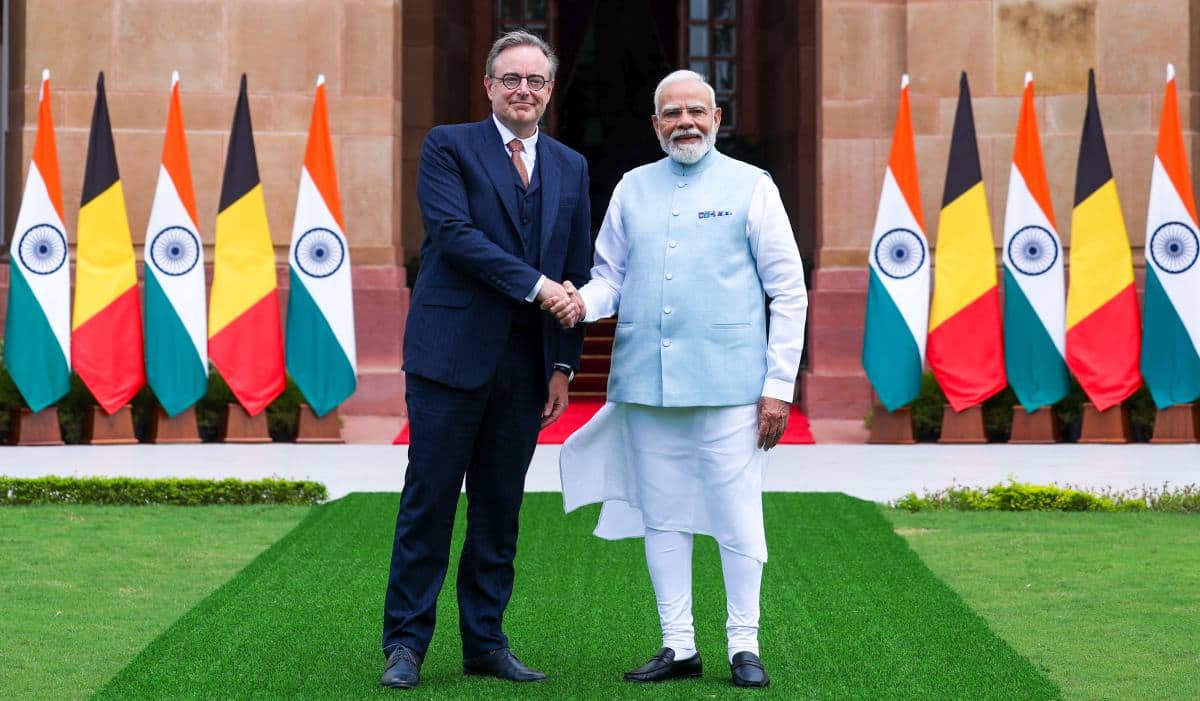
At the invitation of the Prime Minister of India, Shri Narendra Modi, the Prime Minister of the Kingdom of Belgium, H.E. Mr. Bart De Wever, is on an official visit to India from 2-4 September 2026. The Prime Minister of Belgium is accompanied by Belgium's Minister of Defence and Foreign Trade, H.E. Mr. Theo Francken, and a high-level delegation of officials and business leaders. This is Prime Minister De Wever's first visit to India since taking office in February 2025.
Prime Minister De Wever began his visit by paying homage to Mahatma Gandhi at Rajghat. Prime Minister De Wever then held bilateral talks with the Prime Minister of India, Shri Narendra Modi, first in a restricted format and later with their respective delegations. Their discussions ranged across the full length and breadth of the relationship between the two countries. Prime Minster Modi hosted a luncheon for Prime Minister De Wever and the visiting delegation.
The two leaders recalled the supreme sacrifice of more than 9,000 Indian soldiers in the Flanders Fields during the First World War. The two leaders also recalled that Belgium was among the first European countries to establish diplomatic relations with India in 1947. They noted that the partnership has since flourished on the foundations of shared democratic values, mutual trust, economic complementarities, and strong people-to-people ties. The leaders expressed their desire for further expanding and deepening this multifaceted relationship. The 80th anniversary of Belgium-India diplomatic relations in 2027 will give India and Belgium another historical occasion to celebrate the deepening and broadening of the bilateral relationship.
Both leaders welcomed the launch of the inaugural India-Belgium Strategic Dialogue in Brussels on 15 July 2026, co-chaired by External Affairs Minister of India and Deputy Prime Minister and Minister of Foreign Affairs of Belgium. Anchored in the wider India-EU Strategic Partnership, they noted that the Dialogue has established a regular and comprehensive mechanism to advance cooperation across trade and investment, green transition, technology, connectivity, defence, security, and people-to-people ties. In this context, they welcomed the forthcoming Foreign Office Consultations as a key platform for advancing the priorities identified under the Strategic Dialogue.
The two leaders reiterated their call for reformed and effective multilateralism, with the United Nations Charter at its center, to sustain an equitable and peaceful international order, address pressing global challenges and prepare the world for emerging developments, including in the technological and economic domains. The two leaders stressed, in particular, the urgent need for the reform of the United Nations Security Council in order to make it more representative of today’s world. Belgium reaffirmed its support for India’s candidature for permanent membership of a reformed and expanded United Nations Security Council. Both countries agreed to support each other's candidature for non permanent membership of the UN Security Council, India for the 2028-29 term and Belgium for the 2037-2038 term.
India-EU Strategic Partnership and the Free Trade Agreement
The two Prime Ministers reaffirmed the centrality of the India-EU Strategic Partnership to India-Belgium relations. They welcomed the successful conclusion of negotiations for the India-EU Free Trade Agreement during the India-EU Summit on 27 January 2026 and called for the conclusion of the negotiations on the EU-India Investment Protection Agreement and the Agreement on Geographical Indications at the earliest opportunity, with a view to further strengthening economic ties between India and the European Union.
Hailing the India-EU Free Trade Agreement as a historic milestone in the strategic partnership, the Leaders called for its timely implementation for realising the true potential for trade and investment collaboration through diversifying critical value chains and opening new markets.
The two Prime Ministers welcomed the significant progress made under the India-EU Trade and Technology Council, including its Ministerial Meeting held in Brussels in July 2026 towards forging a more integrated, resilient, and sustainable economic and technological partnership when trade and technologies are becoming increasingly intertwined. In this context, they reaffirmed their commitment to further strengthening co-operation among India, Belgium, and the European Union on trade, technology, economic security, and resilient supply chains.
Both sides also endorsed the Joint India–EU Comprehensive Strategic Agenda for 2030, aimed to further reinforce the strategic partnership by broadening and deepening India-EU cooperation, to deliver mutually beneficial, concrete and transformative outcomes for both partners and for the wider world. They also noted that signing of the India-EU Security and Defence Partnership will deepen strategic cooperation in areas of shared interests, including maritime security, defence industry and technology, cyber and hybrid threats, space and counter-terrorism.
Trade, Economic Cooperation and Investment
With Belgium as the 24th biggest economy in the world, and India's ambition to become a USD 10 trillion economy in the coming years, both leaders acknowledged abundant opportunities for mutually beneficial partnerships. Recognising the strong complementarities between their economies, the two Prime Ministers reaffirmed their commitment to deepening trade, investment and economic cooperation. In this context, they welcomed the steady expansion of bilateral economic ties and the growing diversification of sectors in bilateral trade, and expressed their determination to further strengthen cooperation across key sectors of shared interest, with a view to enabling the doubling of bilateral trade in the next 5 years.
The two Prime Ministers noted with satisfaction the successful Belgian Economic Mission to India in March 2025, led by Her Royal Highness Princess Astrid. They recognized the Mission as an important milestone in advancing bilateral economic engagement, fostering new partnerships between businesses and institutions, including an exchange on economic empowerment of women, and expanding cooperation in priority sectors, such as life sciences, pharmaceuticals and healthcare, energy and renewable energy, defence, aeronautics and space, logistics, transport and ports, cleantech and green engineering, chemistry, advanced materials and manufacturing, digital technologies and innovation. In this regard, they noted the strong potential of the India-Belgium partnership in the life sciences sector, building on the complementary strengths of both countries in pharmaceuticals, biotechnology, clinical research, innovation and advanced healthcare solutions, and encouraged closer collaboration between industry, academia and research institutions. Both leaders agreed to keep this momentum alive through regular high-level exchanges, including with Belgium's regional trade and investment agencies.
The two leaders expressed satisfaction at the growth and diversification of bilateral economic ties and welcomed expanding cooperation in areas such as semiconductors, chemicals, pharmaceuticals, defence industrial collaboration, critical minerals refining and recycling, sustainable industries, and nuclear energy, including by exploring emerging opportunities for cooperation involving private sector stakeholders. The two leaders further acknowledged the enduring importance of the diamond trade linking Antwerp with Mumbai and Surat and agreed to further strengthen this historic partnership while pursuing new avenues for economic engagement and shared growth.
They underlined the strategic importance of maritime and port cooperation between the two countries and welcomed opportunities to deepen collaboration in port development, logistics, connectivity, dredging and offshore wind infrastructure. In this context, they welcomed the planned participation of the Flemish Minister of Mobility and Ports, Annick De Ridder, to “Sagarmanthan: The Great Oceans Dialogue” in New Delhi in October 2026. They also welcomed the prospect for enhanced cooperation between APEC (the Antwerp/Flanders Port Training Centre) and India's Jawaharlal Nehru Port Authority (JNPA), particularly in areas of training needs identification and capacity building for officers and employees at all levels of management across the Indian port sector in particular and the maritime sector more broadly. They further acknowledged the continued contribution of Belgian dredging expertise to the development of India's port infrastructure and its potential role in supporting offshore renewable energy projects.
The two Prime Ministers welcomed the deepening cooperation between India and Belgium in research and higher education, including in astronomy, astrophysics and space technologies through the Belgo-Indian Network for Astronomy and Astrophysics (BINA). They also noted Belgium's contribution to several landmark astronomical facilities in India, including the Devasthal Optical Telescope, the Devasthal International Liquid Mirror Telescope, the Mount Abu Telescope and the Multi-Application Solar Telescope in Udaipur, reflecting the strength of bilateral scientific collaboration.
The two leaders welcomed the launch of the India-Belgium Investment Fast-Track Mechanism and recognized it as an important step towards further strengthening bilateral investment ties. They noted that the mechanism will serve as a dedicated platform to facilitate and expand both Belgian investments in India and Indian investments in Belgium, support businesses, address investment bottlenecks, and foster a more conducive environment for long-term economic cooperation between the two countries.
The two leaders also welcomed the ongoing engagement between the Federal Holding and Investment Company (SFPIM), Belgium’s Sovereign Wealth Fund and India’s National Investment and Infrastructure Fund (NIIF). They looked forward to formalising the collaboration between SFPIM-NIIF to help establish the Indo-Belgian economic and investment corridor. They also welcomed the contribution of the Belgian Investment Company for Developing Countries (BIO Invest) and agreed to explore potential cooperation between BIO Invest and NIIF in areas of mutual interest.
The two Prime Ministers reaffirmed the importance of the India-Belgium-Luxembourg Economic Union (BLEU) Joint Economic Commission as a key mechanism for advancing bilateral economic cooperation and looked forward to its 19th Session later this year.
Defence and Security Cooperation
Prime Minister Bart De Wever conveyed Belgium's solidarity with India in the fight against terrorism, including cross-border terrorism. He once again condemned the terrorist attack on innocent civilians in Pahalgam, Jammu & Kashmir, India in April 2025. Both leaders underscored their commitment to a comprehensive/global approach to counterterrorism and affirmed that terrorism, in any form and manifestation and anywhere, could never be justified, and called for its perpetrators to be held accountable in accordance with international law. They agreed that the international community must act together, against terrorists and terrorist entities including those designated by the UNSC 1267 sanctions regime, terrorist networks, their safe havens and their financing, including through the UN and FATF. The leaders called for strengthened international cooperation in preventing and combating terrorism, including through sanctions mechanisms at the national, regional and international levels. In this context, they expressed their intention to explore the establishment of a Belgium-India Joint Working Group on Counter-Terrorism with a view to enhancing bilateral cooperation in addressing evolving terrorist threats.
On defence cooperation, the two Prime Ministers welcomed the signing of the Letter of Intent between the two Ministries of Defence, establishing a framework for regular exchanges, staff talks, education and training, research cooperation, and defence-industrial partnerships. They noted that the agreement builds upon the understanding reached between the Defence Ministers of India and Belgium in March 2025 to institutionalize and further strengthen bilateral defence cooperation. The two leaders welcomed the steadily deepening engagement between the two defence establishments on maritime security, emerging technologies, education and military exchanges, and cooperation in the Indo-Pacific. In this context, they welcomed the planned visit of Belgian Frigate LEOPOLD I to India from 5 to 8 November 2026, the intention of the Belgian Defence College to organise its World Study Trip 2027 in India and the study tour by College of Defence Management, Secunderabad to Belgium in October 2026, as concrete opportunities to further strengthen exchanges and cooperation between the two defence establishments.
They also welcomed the appointment of a Defence Attache by Belgium in New Delhi and welcomed India's decision to appoint a resident Defence Attache in the Indian Embassy in Brussels in the near future. The two leaders welcomed the steadily deepening engagement between the two defence establishments on maritime security, emerging technologies, and cooperation in the Indo-Pacific.
The two Prime Ministers welcomed the growing defence-industrial cooperation between India and Belgium and noted that such partnerships were further strengthened during the Belgian Economic Mission to India in March 2025. Recognising the potential for further collaboration in defence manufacturing, technology, innovation, co-development and co-production, both leaders welcomed the signing of the multiple agreements and partnerships between the Belgian and Indian defence industries, and encouraged the industries on both sides to remain engaged.
The two leaders also noted the ongoing cooperation between the Flanders Fields Museum in Ypres and the Centre for Armed Forces Historical Research (CAFHR) in New Delhi, contributing to preserving and promoting the shared historical legacy of India and Belgium.
The two Prime Ministers welcomed the signing of the MoU between the Central Bureau of Investigation of India and the Federal Police of Belgium on cooperation in combating transnational organized crime, cybercrime, and related matters. They noted that the MoU would strengthen institutional linkages, facilitate information sharing, promote capacity building and the exchange of best practices, enhance cooperation in tracing fugitives, and deepen bilateral law enforcement cooperation in combating transnational organized crime, cybercrime, and related matters.
Green Transition, Emerging Technologies, Healthcare Cooperation and Startups
The two Prime Ministers welcomed the signing of the renewed MoU on Renewable Energy Cooperation between India and Belgium. They noted that the renewed MoU builds upon the cooperation established under the 2015 framework and the work of the Joint Working Group on Renewable Energy, and expands collaboration in key areas including green hydrogen, solar energy, energy storage, offshore wind energy, bio-energy, small hydropower and pumped storage plants.
The two countries welcomed the growing collaboration between India and Belgium in the field of green hydrogen, including industrial partnerships and knowledge exchange. They acknowledged cooperation under the Memorandum of Understanding between GH2 India, the Belgian Hydrogen Council, and Flanders Investment & Trade, as well as the active participation of Indian officials in the Egmont Institute's green hydrogen exchange programme in Brussels and reciprocal visits by government, industry, and research representatives from both countries. The leaders underscored the important role of India and Belgium in strengthening the green hydrogen value chain, including production, transportation, storage, and end-use applications, with a view to advancing decarbonisation, fostering innovation, enhancing energy security, and promoting sustainable economic growth.
Belgium and India reaffirm their commitment to the Paris Agreement its long-term goals, including the temperature goal, and its principles, including equity and common but differentiated responsibilities and respective capabilities, in the light of different national circumstances. They support a successful COP31 that advances implementation and results in enhanced action on the ground. They recognise that enhanced climate action, particularly in developing countries, is enabled by mobilising adequate, predictable and accessible climate finance from all sources, development and dissemination climate technologies and capacity-building, and underscore the importance of strengthening international cooperation in these areas. The two sides commit to strengthening climate adaptation, resilience and disaster preparedness. They further recognise the vital role of oceans and coastal ecosystems in supporting climate resilience, sustainable development and the well-being of coastal communities. Recognising the importance of strengthened ocean governance as a component of sustainable development and climate resilience, they underscored the importance of the Biodiversity Beyond National Jurisdiction (BBNJ) Agreement and broader international cooperation in maritime affairs.
The two leaders encouraged engagements between the Indian micro-electronics ecosystem, including semiconductor companies, ChipIn Centre, C-DAC, universities, and imec, Belgium. They expressed their support for these interactions to develop into deeper partnerships in semiconductor technologies, thereby contributing to the creation of resilient and advanced technology ecosystems in both countries.
The two leaders welcomed the participation of the Minister-President of the Government of Flanders in the AI Impact Summit hosted by India, noting that the visit underscored the growing importance of cooperation in artificial intelligence, emerging technologies, and innovation.
Both sides welcomed cooperation in the areas of startup incubation. In this regard, they agreed to continue collaboration between the MEITY Start Up Hub and Hub Brussels, as well as other startup hubs and skilling centers, fostering startup ecosystems, driven by supporting innovation-driven entrepreneurship, and enhancing digital skills development.
Connectivity, Mobility, Education, Culture and People-to-People Ties
Both leaders recognized the importance of underpinning people-to-people ties and connectivity with efficient visa services. In this context, they recognized the need for smooth and quick processing. As exchanges between India and Belgium are intensifying, visa processing capacity by diplomatic missions in Belgium and India will significantly increase. Given the specific need, both leaders welcomed the ongoing reinforcement of the Belgian visa delivery services in India.
Welcoming the signing of the EU MoU on Comprehensive Framework of Cooperation on Mobility and the launch of a pilot European Union Legal Gateway Office in India, the Leaders noted its role in promoting legal pathways for movement of professionals, skilled workforce and students and strengthen people-to-people ties between India and the EU. They agreed that as trade, investment, and people-to-people ties continue to grow, enhanced mobility of skilled professionals, students, researchers, and business travelers would be essential. Both leaders underscored the importance of strengthening connectivity and encouraged airline operators to explore the establishment of direct air connectivity between Belgium and India. They welcomed the ongoing cooperation between Belgian healthcare institutions and India in the healthcare sector, including initiatives facilitating the mobility of qualified nurses from India to Belgium, as well as the broader and thriving civil society cooperation between Belgium and India in the fields of healthcare and education. They encouraged continued discussions towards the signing of an MoU on Mobility and Migration.
Recalling the numerous academic partnerships formed during the Belgian Economic Mission, Prime Minister Modi invited leading Belgian Universities and premier academic institutions to open campuses in India under the New Education Policy of India. The two leaders encouraged the relevant authorities, institutions and industry stakeholders of both countries to explore cooperation between the skill development and Technical and Vocational Education and Training (TVET) ecosystems of India and Belgium, including through exchange of best practices, industry-responsive training, capacity building of trainers and assessors, apprenticeships and work-based learning, cooperation in emerging and future skills, and dialogue on the alignment and recognition of qualifications, with a view to enhancing employability and supporting mutually beneficial mobility of skilled professionals. The leaders also acknowledged the contribution of the Flemish Institute for Technological Research (VITO) in promoting research cooperation, innovation, and knowledge exchange with Indian partners. They welcomed cooperation between the Sushma Swaraj Institute of Foreign Service, and the Federal Public Service Foreign Affairs of Belgium in diplomatic training.
International Issues
The two Prime Ministers also exchanged views on major international developments, including recent developments in Ukraine and in West Asia. Regarding the war in Ukraine, both sides reaffirmed their support for efforts towards the achievement of a comprehensive, just and lasting peace through dialogue and diplomacy, in accordance with the principles of the United Nations Charter and international law. On West Asia, they discussed recent developments of concern in the region and underscored the importance of dialogue and diplomatic engagement to address challenges in a peaceful manner. They also stressed the importance of ensuring the safety and security of maritime routes and of maintaining safe and unimpeded maritime shipping.
The two Prime Ministers reaffirmed their shared commitment to further deepening and diversifying the India-Belgium Partnership, guided by mutual trust and a shared vision for peace, prosperity, and development. They agreed that the expanding bilateral partnership shall continue to be guided by a shared commitment to democracy, the rule of law, respect for human rights, gender equality, and a rules-based international order. Building on these foundations, they expressed confidence that the India-Belgium Partnership would continue to deliver tangible benefits for both peoples and the world and also contribute to strengthening collaboration between India and Europe in addressing shared global challenges.
In the context of the deepening and diversification of the India-Belgium partnership and the increasing India-Europe engagements and India-EU ties, Prime Minister Bart De Wever extended an invitation to Prime Minister Narendra Modi to undertake a bilateral visit to Belgium, at a mutually convenient time.