Integral to life and indispensable for comprehensive growth and development, water is key to India achieving its holistic vision of Viksit Bharat. In line with this perspective is Prime Minister Narendra Modi's Water Vision @2047, which places water at the centre of the inclusive development agenda.
It aims to ensure water security for the country by addressing key challenges, including the protection and improvement of water resources, along with emerging concerns such as climate change. Imbued with the spirit of conversation, cooperation, and care, this collective vision is enriched with the constructive involvement of people and active collaboration with states.
This participation has been streamlined by the Modi government via annual conferences and events on India's Water Vision @2047, bringing states/UTs and various stakeholders on a single platform. The idea is to deliberate upon a common strategy to ensure the sustainability of water resources.
The inaugural All India Annual State Ministers Conference on Water to Deliberate Water Vision @2047 took place in January 2023 and gave 22 recommendations. Apart from devising a unified and comprehensive water vision, these recommendations called for time-bound adaptation and mitigation strategies catering to both demand and supply side needs. Micro irrigation, piped distribution network, mapping of the health of water resources, inter-basin transfer of water, flood plain zoning, and water budgeting and management at the gram panchayat level also feature prominently in these recommendations. In addition, these recommendations also deal with water-use efficiency in different sectors of the economy, such as agriculture and industry. Agriculture, in particular, utilises 80% of the water available. Hence, it is of utmost importance that efficient farm practices such as cropping patterns and crop varieties and judicious on-farm water management are prioritised.
Following these recommendations, the All India Secretaries' Conference on Water Sustainability was held in January 2024. Based on five themes, including climate resilience, water governance, water use efficiency, role of reservoirs, and people's participation, the conference worked towards assessing actions undertaken on the 22 recommendations mentioned above, sharing of best practices and experiences across stakeholders, and evolving a shared water vision as we move ahead.
The Modi government has been conscious of the water sector's significant role in achieving the overarching goal of a developed India by 2047. Hence, PM Modi has given the 5P mantra—Political will, Public financing, Partnerships, Public Participation, and Persuasion for sustainability—guiding us in this ongoing journey.
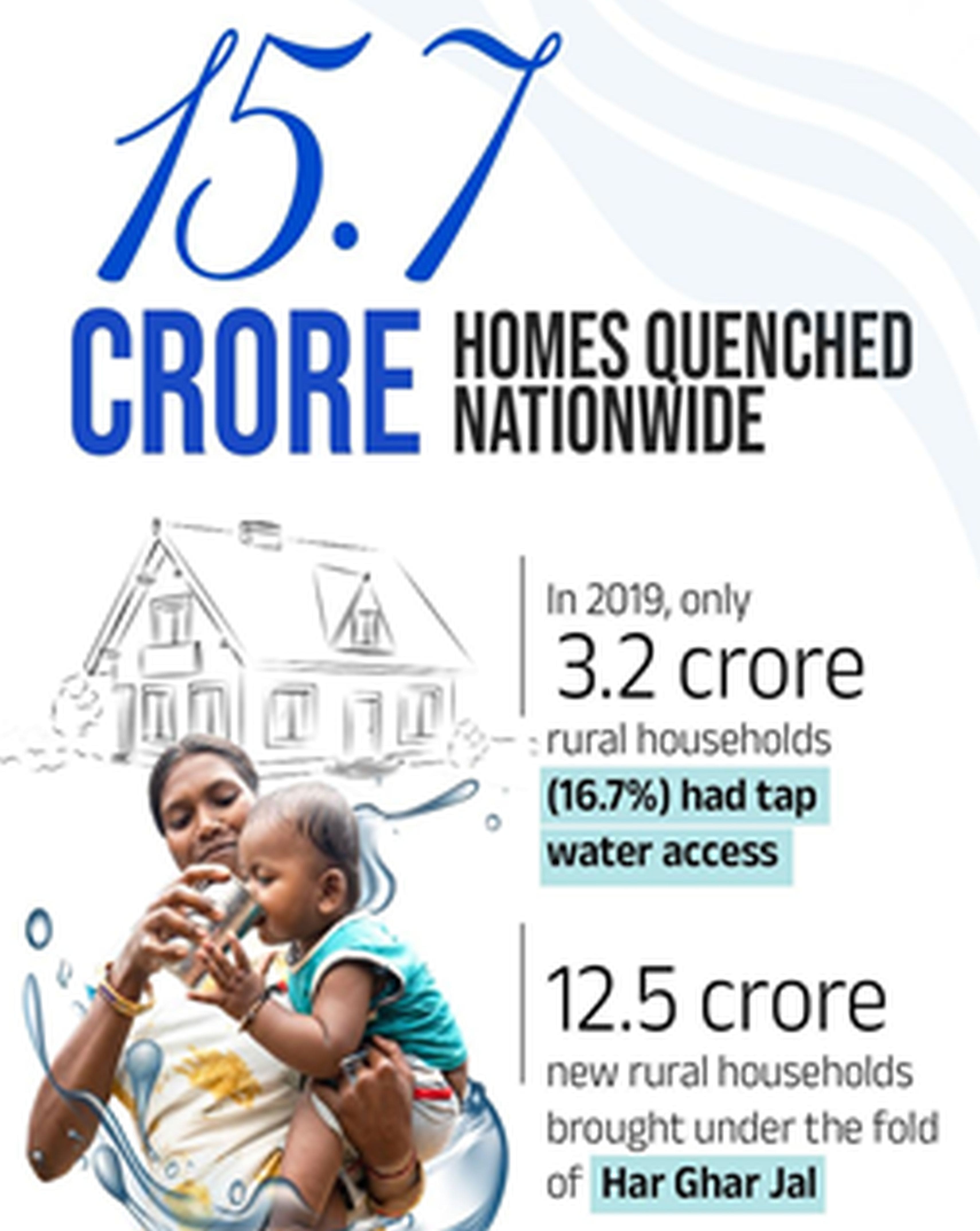
This mantra has underlined PM Modi's schemes and efforts in the last nine years. To begin with, the Jal Jeevan Mission is a transformative initiative aiming to provide tap water connections to all rural households. In the last four years, 13.91 crore households have been saturated with tap water connections, substantially upgrading rural lives.
On the other hand, the Amrit Sarovar aims to develop/rejuvenate 75 Amrit Sarovar (ponds) in each district across the country, leading to 50,000 ponds in total. Until Nov 2023, the government has commenced work on over 80,000 ponds, of which over 68,000 ponds have been dedicated to the people.
The 'Per Drop More Crop' initiative has significantly improved water-use efficiency in agriculture. To provide financial assistance to small and marginal farmers to adopt micro irrigation, the scheme has brought 83.06 lakh hectares of land under micro irrigation between 2015-16 and 2023-24.
The government is actively promoting organic and natural farming and incentivising crop diversification to ensure that farm activity is as sustainable as necessary.
For the conservation and augmentation of groundwater, the Modi government introduced the Atal Bhujal Yojana (ABY) in 2019 and the Master Plan for Artificial Recharge to Groundwater in 2020. ABY focuses on efficient groundwater management, including rainwater harvesting in water-stressed areas.
As water security in water deficit, water surplus and hilly region is one of the themes under the overall vision, the Modi government has undertaken peerless initiatives like the interlinking of rivers (Ken-Betwa link) and river rejuvenation (Namami Gange Mission) to ensure equitable health and availability of water resources.
The Jal Shakti Abhiyan: Catch the Rain is another unique awareness generation campaign of the Modi government with five focussed interventions, including rainwater harvesting and geo-tagging of water bodies.
The government has also displayed novelty in its water-shed development approach, including the revival of spring sheds in hilly areas with the active participation of local communities and works under MGNREGA. Moreover, the concept of a circular economy underscores the government's commitment to water conservation, as it integrates the treatment and recycling of water within the broader framework of wastewater and sewage treatment.
Water is an indispensable asset, functioning as the lifeblood that sustains ecosystems, communities, and economies. Its significance transcends mere sustenance, encompassing crucial sectors such as agriculture, industry, and energy production. The Modi government, attuned to the intrinsic value of water and conscious of the imperative for ensuring water security, has unequivocally demonstrated its dedication to sustainability and the holistic development of India. In embracing water as a vital resource, the country, under the leadership of Prime Minister Narendra Modi's government, exemplifies a commitment that resonates with the genuine essence of nation-building.