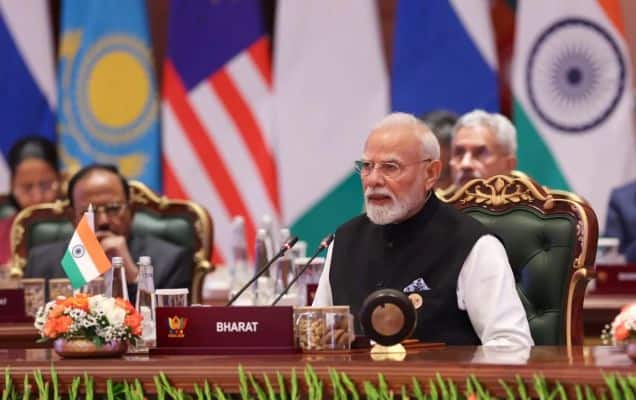
PM Narendra Modi partakes in ASEAN–India Summit and East Asia Summit on 21–22 November 2015
PM Modi inaugurates Torana Gate in Malaysia with PM Najib Razak
Indian & Malaysian leaderships welcome increasing two-way tourist movement
Indian & Malaysian leaderships express their commitment to democracy, pluralism and development
PM Modi, PM Razak witness signing of agreeemnets key sectors
India, Malaysia step up strategic partnership, expand economic, trade and cultural ties
Indian Cultural Centre in Kuala Lumpur to be named after Netaji Subhas Chandra Bose
Malaysia backs India's permanent membership of a reformed United Nations Security Council

At the invitation of The Honourable Dato' Sri Mohd Najib Tun Abdul Razak, Prime Minister of Malaysia, Prime Minister of India Shri Narendra Modi undertook an Official Visit to Malaysia on 23 November 2015. Earlier, Prime Minister Narendra Modi participated in the ASEAN–India Summit and East Asia Summit on 21–22 November 2015. The two Prime Ministers held official talks in Putrajaya and jointly inaugurated the Torana Gate in Brickfields, Kuala Lumpur, a gift from India to Malaysia, as a symbol of India-Malaysia Friendship.

During the official talks, which was held in a warm and cordial atmosphere, the two Prime Ministers acknowledged that India-Malaysia relations have made impressive strides in recent years. The dialogue mechanisms at Ministerial and Official level, supported by a wide range of agreements have also provided a framework to harness the full potential of the Strategic Partnership, established between the two countries in October 2010.

Both leaders also conveyed their condolences to the families of all those on board Malaysian Airlines flight MH 370. In this context, the Prime Minister of Malaysia recalled with appreciation the ready assistance provided by India in the search operations through the deployment of six ships and seven aircraft, including at Subang airbase in Malaysia.

The two leaders welcomed the increasing two-way tourist movement and recalled the close cultural and religious affinity of the people of the two countries, including the presence of a large Indian community in Malaysia, which is a positive factor in fostering and developing current and future linkages to imbue greater dynamism to the friendly relations between Malaysia and India.

Recalling their stake in promoting multiculturalism, the two leaders reaffirmed their commitment to democracy, pluralism and development.

The two leaders acknowledged the contribution made by Malaysia and India in promoting growth, economic development and stability in the Asia–Pacific region, and recognized each other’s responsibility in the promotion of peace, development and security of the region, and beyond, based on a convergence of political and socio-economic interests and aspirations.

The two Prime Ministers, while expressing satisfaction with the progress of bilateral relations over the years, reaffirmed their determination to take the Strategic Partnership between the two countries to the next level by deepening existing areas and exploring new areas of cooperation.

Both Prime Ministers then witnessed the signing of one Agreement on Cultural Exchange Programme for 2015-2020 and two Memoranda of Understanding (MoU) on Cooperation in Project Delivery and Monitoring, and Cooperation on Cyber Security.

In an effort to further broaden and deepen the relationship between the two countries, both leaders agreed to proceed with efforts to develop the Strategic Partnership between the two countries as follows:

Political Consultation

1. To hold regular Summits, including on the margins of multilateral events;

2. To arrange the next meeting of the Joint Commission headed by the Ministers of Foreign Affairs of the two countries, with the next meeting in New Delhi in the first half of 2016;

3. To arrange regular exchanges at the Cabinet level between the Ministers in charge of Trade & Industry, Transport, Public Works and Infrastructure, in line with the new developmental initiatives introduced by India, and the investment and trade opportunities opening up in each other’s country;

4. To hold regular Foreign Office Consultations between the Senior Officials of the Ministry of Foreign Affairs of Malaysia and the Ministry of External Affairs of India, to enable both countries to monitor the progress of bilateral cooperation, including on regional and strategic issues of mutual interest;

5. Reaffirmed their continued commitment to Parliamentary democracy and to promote further cooperation between the Parliaments of both countries, and underlined the importance of regular and enhanced exchange of visits between Parliamentarians from India and Malaysia;

Economic, Trade and Financial Areas

6. Reaffirmed their commitment to further strengthen bilateral trade and investment cooperation, and to deepen and widen their economic engagement, which has emerged as an important fulcrum of the strategic partnership;

7. Underlined the importance of holding regular meeting of the Ministers of Trade and Industry of both countries;

8. To promote joint collaboration, especially in infrastructure and construction sectors, and to facilitate joint projects and collaboration between the private sectors of the two countries, in line with the new developmental and business initiatives undertaken by India, such as the Make in India, Digital India, Smart Cities and Skill Development that offered significant investment opportunities for Malaysian businesses. The Prime Minister of India conveyed the steps being taken by the Government of India to provide a conducive environment for investors, and invited Malaysian investors to participate in economic activities for the mutual benefits of both countries;

9. Recognising the need to energise the activities of the high-level India-Malaysia CEOs’ Forum, called upon the CEOs’ Forum to develop specific recommendations to enhance business links in priority areas. They further urged the CEOs’ Forum to meet bi-annually and in a timely manner to ensure meaningful follow-up and implementation of recommendations;

10. Welcomed further contributions of Malaysian and Indian-owned financial institutions in both jurisdictions, which reflects the growing economic and financial linkages between the two countries;

11. Commended the contribution of IRCON over the past two decades on railway cooperation in Malaysia, and welcomed IRCON’s significant interest to participate in railway project in the future;

12. Encouraged public and private sector companies from both countries to pro-actively look at large investment opportunities at each other’s country. The two Prime Ministers welcomed the significant interest shown by Malaysian companies to partake in the business opportunities provided by India and their aspiration to invest in infrastructure projects;

13. Welcomed the contribution of Indian investment in Malaysia, in particular India IT firms, especially those located in Cyberjaya, and agreed to continue to promote greater engagement of Indian IT companies in Malaysia;

Defence and Security

14. Agreed to enhance defence exchanges through regular dialogue at various levels, including between the Defence Ministers, senior defence officials, Chiefs of the Armed Services and through Service-to-Service Staff Talks;

15. Agreed to convene the next India-Malaysia Defence Cooperation Meeting at Defence Secretary/Secretary General level;

16. Welcomed the outcome of the joint exercises HARIMAU SHAKTI and to upgrade the exercises to company level, and subsequently to tri-services exercises;

17. Agreed to set up the SU-30 Forum for cooperation in training, maintenance, technical support and safety-related issues, building on the assistance by India for successful completion of the SU 30 MKM training programme by Indian pilots in Malaysia;

18. Further agreed to promote joint collaboration on projects of mutual interest in the defence sector including in the areas of defence equipment and industry, research, training and capacity building;

19. Agreed to institute annual talks between the Heads of the Indian Coast Guards and the Malaysian Maritime Enforcement Agency including during Head of Asian Coast Guard Agencies Meeting (HACGAM).

20. Agreed to establish mechanism for sharing of information, including for Humanitarian Assistance and Disaster relief (HADR) and white shipping;

21. Agreed to establish linkages between the Centre for UN Peacekeeping of India (CUNPK) and Malaysian Peacekeeping Centre (MPC);

22. Expressed strong condemnation for terrorism in all its forms and manifestations, and called upon all States to reject terrorism and bring perpetrators of terrorism to justice. In this context, they welcomed the ongoing cooperation between the two countries on counter terrorism and agreed to further enhance cooperation in this direction;

23. Agreed to continue sharing of information and best practices to address the challenges posed by terrorism, and other traditional and non-traditional threats;

24. Reaffirmed that the two countries share a mutual interest in cooperating for peace, prosperity and security of the Asia-Pacific region and beyond;

25. Agreed to discuss further with a view to conclude the signing of the MoU on Transfer of Sentenced Prisoners, which act as an important humanitarian gesture towards sentenced prisoners;

Tourism and Education

26. Acknowledged the success of the Festival of India in Malaysia 2015, supported by the Malaysian Ministry of Culture and Tourism, the Indian Ministry of Culture and the Indian High Commission, and held for the first time in all major cities and States of Malaysia;

27. Reaffirming their desire to promote greater opportunities for students to pursue their higher studies in each other’s’ country, agreed to conclude a MoU on mutual recognition of Universities and degrees between India and Malaysia at the earliest;

28. Welcomed the additional contribution by India of Indian Rupees 50 million to the Indian Scholarship Trust Fund, managed by the High Commission of India in Kuala Lumpur, which has been operating since 1954 for deserving Malaysian Indian students;

29. Welcomed the renaming of the Indian Cultural Centre in Kuala Lumpur as "Netaji Subhash Chandra Bose Indian Cultural Centre”;

Human Resources

30. Welcomed the contribution of Indian workers to the Malaysian economy;

31. To further enhance mutually beneficial cooperation between the two countries in the field of labour through Joint Working Group Meeting, as well as exchanges of visits and information on latest policies, laws and regulations;

Health

32. Recognising the need to promote greater cooperation between the two countries in Ayurveda and other Indian systems of traditional medicine, Malaysia welcomed the deputation of an Ayurveda practitioner and two therapists from India under the Indian Technical and Economic Cooperation programme. The two sides also welcomed the gift of a Shirodara Yantra machine from the Government of India to Malaysia;

33. Agreed to receive a Siddha practitioner from India to Malaysia under the Indian Technical and Economic Cooperation programme;

Science and Technology

34. Sustainable Energy development has been a key component towards achieving energy security in the future with both Malaysia and India having actively pursued to increase renewable energy sources so as to strengthen their energy security while increasing energy access. Noting that, both sides agreed to set up a Joint Working Group on New and Renewable Energy at the earliest that would serve as a good platform for both countries to exchange ideas and forge mutually beneficial collaboration;

Public Administration

35. Noted the excellent ongoing cooperation between the Ministry of Personnel, Public Grievances and Pensions, India and Public Service Department, Malaysia under the MoU on Cooperation in the field of Public Administration and Governance. Following the 3rd Joint Working Group Meeting held in Kuala Lumpur on 28–30 September 2015, both sides will work on implementing the decisions made in the Meeting for fostering cooperation in English language training, Technical Vocational Education and Training (TVET), e-governance, training institute collaboration, retirement benefits management, taxation data and business intelligence, and project implementation and oversight;

36. Welcomed the proposal for both sides to establish cooperation in areas of performance management, project delivery and monitoring;

37. Welcomed the conclusion of the Bilateral Work Agreement between Malaysia and India that authorise spouses of diplomatic agents and members of the administrative and technical staff of diplomatic missions and spouses of consular officers at consular posts for employment in the respective receiving State on a reciprocal basis;

Regional and International Cooperation

38. Reaffirming the importance of strategic engagement of India in regional initiatives to shape an open, transparent and inclusive regional order and ASEAN’s centrality in the evolving regional architecture, welcomed the enhanced relations between ASEAN and India, especially since the elevation of the partnership to a strategic status at the ASEAN–India Commemorative Summit in 2012 in New Delhi;

39. Welcomed the adoption by ASEAN and India of the new Plan of Action (2016-2020) to implement the ASEAN–India Partnership for Peace, Progress and Shared Prosperity at the ASEAN–India Ministerial Meeting in Kuala Lumpur on 5 August 2015;

40. Welcomed the successful holding of the 27th ASEAN Summit and Related Summits and commemoration of the 10th Anniversary of the East Asia Summit in November 2015 in Kuala Lumpur, and further welcomed the 2015 Kuala Lumpur Declaration on the Establishment of the ASEAN Community and the Kuala Lumpur Declaration on the ASEAN 2025: Forging Ahead Together;

41. Welcomed the signing of the ASEAN–India Trade in Services and Investment Agreements, and took note of the progress towards finalising the Regional Comprehensive Economic Cooperation Partnership (RCEP) Agreement;

42. Stressed that the 70th anniversary of the United Nations is an occasion to urge for early reforms of the United Nations, including the reform of the UN Security Council. Malaysia took note of India’s aspiration for permanent membership of a reformed United Nations Security Council; and

43. Welcomed the post-2015 Development Agenda adopted by the United Nations with eradication of poverty by 2030 as its core objective.

The Prime Minister of India expressed his appreciation to the Prime Minister of Malaysia for the warm reception and hospitality extended to him and his delegation for the visit, and invited the Malaysian Prime Minister to undertake another visit to India at a mutually convenient date, which was accepted by the Prime Minister of Malaysia.

Explore More
Today, the entire country and entire world is filled with the spirit of Bhagwan Shri Ram: PM Modi at Dhwajarohan Utsav in Ayodhya

Popular Speeches

Today, the entire country and entire world is filled with the spirit of Bhagwan Shri Ram: PM Modi at Dhwajarohan Utsav in Ayodhya
UPI goes live at Eiffel Tower and French airports as India-France digital ties strengthen

Media Coverage

UPI goes live at Eiffel Tower and French airports as India-France digital ties strengthen
NM on the go

Nm on the go

Always be the first to hear from the PM. Get the App Now!
...
India-Slovakia Joint Statement
June 15, 2026

At the invitation of His Excellency Robert Fico, Prime Minister of the Slovak Republic, His Excellency Shri Narendra Modi, Prime Minister of the Republic of India, paid a State Visit to the Slovak Republic on 15 June 2026.

The visit is the first by an Indian Prime Minister to Slovakia since its independence in 1993, marking a historic milestone and charting a new course in the enduring friendship between the two nations. Since the establishment of diplomatic relations in 1993, India and Slovakia have developed a traditional friendship and multifaceted cooperation based on trust, equality and mutual respect.

Building on the historic nature of this visit and their shared commitment to deepen bilateral cooperation, the Prime Minister of the Republic of India and the Prime Minister of the Slovak Republic agreed to elevate the relationship to a Comprehensive Partnership between the Republic of India and the Slovak Republic. The Comprehensive Partnership aims to take bilateral relations to a new level, strengthen existing cooperation mechanisms and explore new avenues for deepening cooperation, both bilaterally and multilaterally.

Recognising the growing geopolitical, economic and technological importance of the Indo-Pacific, the two leaders acknowledged the value of a stronger partnership between India and Slovakia in support of mutually beneficial cooperation, regional connectivity, open international trade, freedom of navigation, peaceful resolution of disputes and a rules-based international order.

Both leaders underscored the importance of regular high-level exchanges and sustained political dialogue, and agreed to enhance exchanges of delegations at all levels. The two sides also agreed to enhance parliamentary exchanges, contacts and cooperation with a view to promoting greater mutual understanding and sharing of legislative experiences and best practices.

The leaders reaffirmed their commitment to multilateralism, with the United Nations at its core, and to a rules-based international order, while supporting comprehensive reforms of multilateral institutions, including the United Nations, particularly the United Nations Security Council, to make them more representative, inclusive, effective and reflective of contemporary geopolitical realities. The leaders stressed on the urgent need to expand the UN Security Council in both permanent and non-permanent categories. In this context, India appreciated Slovakia’s continued support for India’s permanent membership in a reformed and expanded UN Security Council. The two leaders also agreed to continue consultations and coordination on their respective candidacies in international organisations and to exchange views and cooperate closely in global forums, including the United Nations. The two leaders also discussed the importance of upholding the global nonproliferation architecture. Slovakia reaffirmed its constructive approach to India’s membership of the Nuclear Suppliers Group.

The leaders agreed to support the development of cooperation with regional groupings such as the Slavkov 3, Visegrad 4 and 3 Seas Initiative, including interconnected and mutually beneficial infrastructure projects that promote connectivity, sustainable economic growth and regional integration. The two sides further reaffirmed their commitment to a free, open, peaceful and prosperous Indo-Pacific, based on respect for international law, sovereignty and territorial integrity, including the United Nations Convention on the Law of the Sea.

The leaders underscored the importance of strengthening defence and security cooperation as one of the key pillars of the bilateral partnership. They agreed to encourage regular consultations and exchanges between their respective defence authorities to explore opportunities for enhanced collaboration, including in defence technologies, capacity building, research and development, and defence industrial cooperation. In this context, the leaders welcomed the signing of the Letter of Intent on Defence Cooperation between the two sides, which will foster mutually beneficial partnerships in the defence sector.

The leaders recognised the growing importance of strengthening cooperation in disaster risk reduction and resilience-building and agreed to enhance collaboration in the areas of resilient infrastructure, capacity building, knowledge sharing and institutional cooperation.

The leaders agreed to strengthen cooperation in the protection of critical information infrastructure and in preventing and countering cybercrime, while promoting an open, secure, accessible, stable, interoperable, resilient and peaceful digital space. The leaders also expressed their commitment to supporting each other in safeguarding information technology systems against emerging quantum threats to cryptography, including through preparedness for post-quantum security transitions. In this context, they noted that such cooperation would be further facilitated by the Memorandum of Cooperation signed in the field of critical infrastructure protection and postquantum cryptography.

The two leaders unequivocally condemned terrorism in all its forms and manifestations, including cross-border terrorism, and strongly condemned the heinous terrorist attack perpetrated in Pahalgam, Jammu and Kashmir, on 22 April 2025. They agreed to establish a Joint Working Group on Counter- Terrorism. They called for concerted international efforts to combat terrorism in a comprehensive and sustained manner. The leaders reaffirmed their commitment to strengthening bilateral and multilateral cooperation in counterterrorism, including within the framework of the United Nations, and called for strong and decisive action against terrorists and terrorist entities, including those designated by the United Nations Security Council 1267 Sanctions Committee, as well as their affiliates, proxies, sponsors, financiers and supporters. They further underscored the importance of holding perpetrators, organisers and sponsors of terrorist acts accountable and agreed to work closely towards the early finalisation and adoption of the Comprehensive Convention on International Terrorism (CCIT) within the United Nations framework.

Welcoming the conclusion of negotiations on the India–EU Free Trade Agreement in January 2026 and the new Joint India–EU Comprehensive Strategic Agenda, the two leaders noted that the FTA will unlock new opportunities for trade and investment and called for its early signing and timely implementation to realise the full potential of trade and investment cooperation by diversifying critical value chains and opening new markets.

The leaders agreed to further strengthen the role of the India–Slovakia Joint Economic Committee in identifying and promoting high-potential areas of economic cooperation between the two countries. They also committed to exploring avenues to significantly enhance bilateral trade and two-way investment across sectors such as automotive, electronics and other advanced manufacturing industries, leveraging Slovakia’s well-developed industrial ecosystem and India’s scale, innovation ecosystem and technological capabilities, with a particular focus on high value-added collaboration.

The two sides agreed to strengthen bilateral cooperation to achieve netzero emissions, focusing on the exchange of technologies for the green energy transition and promoting clean, reliable and resilient energy systems.

The leaders agreed to enhance cooperation in the energy sector with a view to promoting energy security, sustainability and resilience through diversification of energy sources, including nuclear energy and geothermal power. They expressed their intent to deepen collaboration through joint research, exchange of expertise and capacity-building initiatives in areas of mutual interest.

The leaders agreed to strengthen cooperation in the fields of meteorology and hydrology, including through the sharing of expertise and best practices in the efficient and sustainable management of water resources and dam safety. They further expressed their intent to promote collaboration in areas such as source sustainability, rural drinking water quality monitoring, water treatment technologies, capacity building and community participation, and underscored the importance of developing climate-resilient rural drinking water infrastructure to enhance water security and ensure sustainable access to safe drinking water.

Recognising connectivity as a strategic pillar of the partnership, the two sides underscored the importance of promoting joint ventures, technology transfer, innovation and skills development in the automotive and railway sectors, with a view to enhancing competitiveness and generating new employment opportunities. They further noted the potential of Slovakia’s position as a Central European transport hub and India’s large-scale manufacturing capabilities to boost trade, investment and connectivity. They also encouraged exploring of direct air connectivity between India and Slovakia to facilitate growing economic, business and people-to-people exchanges.

The two leaders appreciated the successful outcomes of the AI Impact Summit 2026 in Delhi, attended by H.E. Mr Peter Pellegrini, President of the Slovak Republic. The two sides welcomed the signing of the Memorandum of Understanding on Digital Technologies, which will provide a structured framework for deepening cooperation in the digital domain. They agreed to further strengthen collaboration in emerging areas such as artificial intelligence, semiconductors, start-ups, innovation ecosystems, research institutions and technology companies, with a view to fostering innovation-led growth and mutually beneficial partnerships. The two sides also agreed to explore cooperation in new and emerging technologies, including 5G use cases, 6G standardisation, Internet of Things (IoT) and machine-to-machine (M2M) applications.

The two leaders agreed to explore opportunities to strengthen cooperation between their respective space ecosystems in the field of satellite technology and its applications. They also underscored the importance of fostering exchanges between scientific and research institutions, as well as industry stakeholders, to encourage innovation and the development of advanced space technologies.

The leaders highlighted the need to maintain regular dialogue and deepen cooperation in the field of healthcare, with particular emphasis on pharmaceutical research and development, digital health solutions and the strengthening of human resources for health. The two sides also underscored the importance of sharing best practices in public health management and leveraging digital technologies to build more resilient, efficient and patientcentric healthcare systems, consistent with their respective national priorities.

The two leaders agreed to encourage enhanced mobility of students, academics and researchers, with particular emphasis on STEM and humanities disciplines, in order to promote deeper educational and scientific exchanges. They took note of the existing arrangements and collaborations between higher education institutions of the two countries and encouraged their further expansion and diversification. The two sides also welcomed the conclusion of a Memorandum of Understanding between the respective Ministries of Education in the field of higher education and research, which would provide a structured framework for strengthening academic linkages and fostering long-term institutional partnerships.

The leaders agreed to further promote cultural exchanges, tourism and people-to-people contacts with a view to deepening mutual understanding and strengthening the bonds of friendship between the peoples of India and Slovakia. They emphasized the importance of expanding cultural cooperation through regular exchanges of artists and cultural troupes, the organisation of exhibitions and participation in festivals, as well as by encouraging greater tourism flows in both directions. The leaders also welcomed the signing of the Memorandum of Understanding on Audio-visual Creation, which will provide a structured framework for collaboration in film and media production and further enhance cultural connectivity between the two countries.

The leaders expressed support for the orderly, safe and legal mobility of skilled professionals. They took note of the Comprehensive Framework of Cooperation on Mobility agreed between India and the European Union in January 2026. They welcomed the signing of the Memorandum of Understanding on Cooperation in the Field of Labour Migration to facilitate mobility and promote the exchange of information between the relevant authorities of India and Slovakia. The two sides also agreed to work towards the early conclusion of a Social Security Agreement, which would contribute to safeguarding the welfare and social protection of working professionals engaged in mobility between India and Slovakia.

The leaders noted that cooperation on consular matters remained an area of continued interest to both countries, given the growing movement of people and expanding people-to-people ties. In this context, they agreed to establish a mechanism for regular consular consultations between their respective consular authorities to facilitate cooperation on consular matters.

The leaders agreed to regularly review the implementation of the Comprehensive Partnership at the appropriate functional level.

Both leaders agreed that the present visit represents a significant step forward in transforming this India-Slovakia relationship and committed to taking bilateral relations forward into a new phase of engagement.

The Prime Ministers welcomed the announcements made and the MoUs signed, which are available on the MEA website.

Prime Minister Modi thanked Prime Minister Fico and the people of Slovakia for the warm hospitality extended to him and his delegation. Both leaders agreed to maintain the momentum of high-level exchanges.