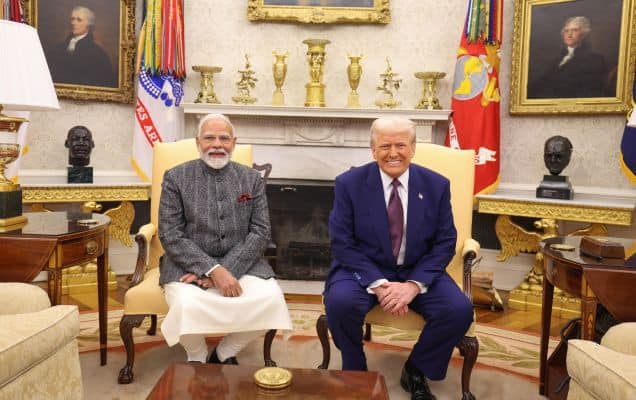
“India is the world’s oldest democracy; it is the mother of democracy.”
- Prime Minister Narendra Modi
Popular sovereignty is a concept that renders people the source of all political legitimacy. And democracy is the necessary condition that sustains popular sovereignty. In simplest terms, democracy is where governments are elected through competitive elections.
In India, democratic traditions date back to the Vedic Age, where representative bodies like sabha, samiti, and sansad find mention in texts like the Rigveda and Atharvaveda. The concept of dharma as embedded in both Ramayana and Mahabharata stands for governance for welfare of the people. The age of the Buddha features the Vajjis who were known for their system of republican governance.
Calling Bharat the mother of democracy, the Prime Minister himself has given a reference to an 1,100 years old Tamil inscription dating back to the reign of Chola king Parantaka I. “The inscription found there is like a local constitution for the gram sabha. It tells how the assembly should be run, what should be the qualification of members, what should be the process to elect the members, and how a member would be disqualified,” the PM said.
Needless to say, democracy has flourished as a resilient and enduring tradition throughout the nation’s history and geography. After independence, the Indian Constitution concretised this tradition, placing its faith in a parliamentary form of democracy based on Universal Adult Franchise—a right that didn’t exist in many countries of the West at the time. The Constitution itself provides for a third-tier of government—the Panchayati Raj—strengthening participative democracy at the grassroots level. Today these institutions of local self-government are galvanising a bottom-up approach, empowering local communities, especially by giving women an equal voice in the decision-making process.
Right from the first general elections in 1951 where over 80% of the Indian population was illiterate to this day where we have nearly 97 crore registered voters, which is more than double the entire European Union combined (40 crore)—India continues to take the world by surprise.
In terms of voter turnout, the 2019 general elections saw a voter participation of over 67%—the largest in India’s electoral history along with the highest ever turnout of women voters. Interestingly, this figure is higher than the voter turnout in the US presidential elections, which usually remains around 60%.
Free, fair, regular multi-party elections, the rise of leaders from marginalised sections such as women, farmers, backward classes, and minorities, the expanding foothold of regional parties and formation of coalition governments, progressive reforms such as the Electronic Voting Machines (EVMs), and a fiercely independent Election Commission—all add to the strong credentials of the Indian democracy.
Yet in the last ten years where people have elected (2014) and re-elected (2019) the Modi government to power, the losing sides backed by anti-India rhetoric both within and outside of the country have cried foul unwarrantedly. They have gone to the extent of projecting this decisive mandate of the people as ‘death of democracy’ and ‘rise of dictatorship’.
Such narratives are peddled and provided questionable legitimacy via international reports and rankings.
The Freedom in the World 2024 report by Freedom House, a US-based non-profit company, has called India ‘partly free’. V-Dem Institute’s Democracy Report 2024 says that India continues to emerge as one of the worst autocratisers. The Sweden-based Institute had designated India as an ‘electoral autocracy’ back in 2018. The Economist Intelligence Unit, on the other hand, had labelled India as a ‘flawed democracy’ in its Democracy Index 2022.
Although instrumental in setting global standards and furthering global peace and security, many of these international reports and indices are often based on distorted metrics, displaying an inherent bias in favour of so-called liberal democracies in the West. These tend to overlook the unique character and complexities of democratic processes in countries like India.
Many institutions concerning democracy often pontificate on human rights and freedom of speech and expression via their own yardsticks seemingly designed to suit vested interests. Religious polarisation, arrest of opposition leaders even though on the serious charges of corruption and misguided argument on majoritarianism often form their main planks.
Minorities in India, under PM Modi, are equal stakeholders in India’s growth and equal beneficiaries of government initiatives. According to a study, the poor and minorities are much more likely to vote in India than in the US, representing inclusivity of the Indian democracy as against its western counterparts.
Besides, the election of Narendra Modi and Droupadi Murmu demonstrates the dynamism of India's democracy, where individuals from humble backgrounds are also given equal opportunities to ascend to the highest offices in the country.
The arrest of opposition leaders even on serious charges of corruption are played out in narrative to defame India. Despite the fact that such arrests are as per the laws are subject to judicial review. If we were to apply the same logic as these international institutions, the United States operates under a two-party system, and considering the numerous legal cases against opposition leader Donald Trump, one could argue that America is also leaning towards electoral autocracy.
Therefore, such allegations stand on shaky ground. These are merely subtle attempts to question the intelligence of the Indian electorate and disregard the sanctity and scale of the Indian electoral process.
None of these institutions or indices take into account the tangible strides that India has experienced in the last ten years in terms of access to healthcare, housing, toilets, potable water, electricity or clean cooking fuel.
They tend to ignore India’s tremendous leaps in innovation and enterprise. The country has landed Chandrayaan-3 on the Moon’s south pole; is the 3rd largest startup ecosystem in the world; is slated to become the 3rd largest global economy; and stands as a global model for digital innovation and corruption-free, responsible governance.
Indeed, the world witnessed India's capacity to secure a global consensus, exemplified by the G20's New Delhi Declaration, amidst rising global insecurity and skepticism towards international law and processes.
Yet they would often place India in the company of countries like Afghanistan and Myanmar, one of which is ruled by the Taliban, an Islamic fundamentalist group, and the other is under military rule—both apt symbols of civil strife, instability, and worst humanitarian crises in the post-Cold War era. Such attempts at undermining India’s democratic credibility are arbitrary, unsubstantiated, and lack credibility themselves.
However, the Indian democracy receives its credibility from its people. In Modi’s India, the janata janardan reign supreme as they are the ultimate decision-makers.
And this credibility rests on PM Modi’s steadfast commitment to development, devoid of division and exclusion. This new model of development ensures jan bhagidaari, jan hissedaari aur jan zimmedaari.
With its faith in politics of development as against politics of appeasement and agenda, India has decided to create its own democracy ratings index in collaboration with the Observer Research Foundation. The index would serve as a rational counter to fallacious assumptions and sweeping narratives against the Indian democracy.
It would empower developing countries like India and those in the Global South to set global benchmarks on an equal footing with the West.
An opportunity in its own right, the index would also prove effective in showcasing the diverse traditions and complexities of democracies, making space for inclusivity in the global discourse on democracy.
As it is said, countries do not become suitable for democracy; rather, they become suitable through democracy. On that note, the Indian democracy continues to be the ‘world’s largest electoral movement of man and material’. It continues to evolve, standing true to its civilisational character while embracing ever-growing global acclaim.