Gujarat Government welcomes very important 2002 riots verdict

Published By : Admin | December 26, 2013 | 21:28 IST

Metropolitan Court upholds what Modi has been saying:

He and his Government were well meaning and effective in Godhra riots

The Spokesperson Minister and Finance Minister of Gujarat Government, Shri Nitin Patel; and Energy Minister, Shri Saurabh Patel; have welcomed the verdict of Metropolitan Court of Ahmedabad on 2002 riots. They said that Chief Minister Shri Narendra Modi had been given a complete clean chit by the judiciary; with the court accepting the closure report of the Supreme Court appointed and monitored SIT’s unprecedentedly comprehensive investigation. This is a historic verdict on Truth and Justice. 

Post the burning of Sabarmati express train at Godhra Railway station on 27th February, 2002 which resulted into death of 59 karsevaks including innocent children, men and women, riots broke out in the State of Gujarat. In the following few days, the members of the two community clashed at several places leading to killing of a number of persons and destruction of property. The Government machinery took immediate steps to control and prevent riots. The number of tear-gas shells exploded, the number of rounds fired by the police to control rioting and the number of deaths due to police firing is unprecedented. The number of places at which police saved large numbers of lives is also quite impressive. All measures were taken including calling of Army and arrest of number of people. With these actions, the police and the law enforcement agencies controlled the riots in about three days’. Relief and rehabilitation measures were also taken up in full swing. Relief measures were monitored by Honourable Governor of Gujarat, Leader of Opposition and the Cabinet Secretary of Government of India. 

An Inquiry commission was immediately appointed to inquire into the circumstances in which the riots took place, and the role of the Government machinery; and to suggest corrective actions. Justice Nanavati, a retired Supreme Court Judge was appointed as its chairman on the advice of the Supreme Court itself. 

Number of FIRs were registered and were taken up for investigation. Meanwhile NHRC and some NGO approached Honourable Supreme Court. The Supreme court constituted a Special Investigation Team (SIT) with Ex Director CBI as its Chairman. The SIT members were handpicked and appointed by the SC itself. 

Four years later on 8-6- 2006, Mrs Zakia Jaffri lodged an omnibus complaint making general allegations against 63 persons, but mainly targeting the Chief Minister.  

The State Police, at the highest level (DGP & ADGP), wanted to record the statement of the complainant. But in spite of repeated efforts, the complainant did not cooperate. Instead she moved the High Court of Gujarat. High court rejected the petition holding that the complainant already had the option of approaching the Magistrate under section 190 of CrPC. The complainant moved the Supreme Court of India. 

The Supreme Court directed the SIT to ‘look into’ this complaint as well. The SIT took up the complaint, recorded hundreds of statements and collected large number of materials. The SIT took evidence from various quarters, recorded statement of the accused and others concerned and cross examined witnesses. This also included the unprecedented grilling of the Chief Minister for around nine hours, which he willingly submitted to. From the day of entrusting the investigation to SIT to the final findings in 2011, thorough scrutiny of all dimensions of the riots as a whole was conducted. During this entire process, the SIT was closely monitored by the Supreme Court.   

At the end of the proceedings, the SIT submitted its report in April 2011 to the SC. It was a closure report giving a complete clean chit to Modi and his Government, categorically finding all allegations to be false; with which the SC agreed. However, the SC also directed the SIT to submit the report to the concerned Court. The Metropolitan Magistrate heard both the parties, and once again examined each and every issue raised by the complainant. 

Today, the Metropolitan Magistrate Court in Ahmedabad has delivered its order. 

This is the most investigated and closely monitored process for any riot situation in India. The State Government is satisfied that its sincere actions and the consistent stand of having done its best have been vindicated by an elaborate and thorough judicial process, under close scrutiny of the Hon. Supreme Court of India. 

Highlights of the Judicial Process

  • This order is the conclusive judgment in the Godhra riot cases involving the Gujarat Chief Minister Shri Narendra Modi.
  • Since now Mr. Modi is the PM candidate of BJP, this order assumes special significance.
  • The background of the entire investigation dates back to June 2006 when Mrs. Jakia Jafri filed a complaint alleging conspiracy by the Chief Minister.
  • The DGP of Gujarat entrusted the enquiry to a high ranking officer of ADP rank.
  • Mrs. Jakia Jafri did not cooperate with the enquiry. Instead, supported by Teesta Setalvad, she approached the High Court of Gujarat demanding registration of FIR and investigation by an independent agency.
  • The Gujarat HC rejected the petition holding that the petitioner can approach appropriate Magistrate under section 190 of CrPC.
  • Thereafter, Mrs. Jafri approached the Supreme Court of India. The SC without going into the details of the complaint directed the SIT to look into the complaint and take steps as required in law.
  • It is to be mentioned that the SIT was already in place in which top ranking police officers handpicked by the SC were members.
  • The SIT headed by Dr. Raghvan, Ex-CBI Director, directed Sri Malhotra ex-DIG CBI to carry out entire investigation in this regard.
  • The SIT conducted investigation on each and every allegation contained in the complaint involving the CM of Gujarat and 62 others.
  • For the first time in the history of riots in India, the SC has closely monitored investigation on a generalised complaint directed mainly against a Chief Minister.
  • The SIT recorded hundreds of statements, collected large number of documents and submitted periodic report to the SC.
  • For first time ever in India, the Chief Minister was personally grilled by SIT for 9 hours.
  • The concerned bench of the SC comprising Justice Aftab Alam, Justice Jain who have retired and also the present Chief Justice of India, considered each and every report submitted by the SIT.
  • Having satisfied with the investigation of SIT, the SC issued its final order on 12-9-2011.
  • From the day of entrusting the investigation to SIT to the final findings in 2011, thorough scrutiny of all evidence concerning all incidents of riots were conducted.
  • The SIT covered everything in the course of inquiry on the complaint.
  • As per the direction of the Supreme Court, the SIT filed its report before the Metropolitan Magistrate.
  • The complainant submitted her protest petition and almost year long proceeding took place.
  • The Metropolitan Magistrate heard both the parties and examined each and every issue raised by the complainant.
  • The final order on the much awaited case is likely which will be historic.

Explore More
Today, the entire country and entire world is filled with the spirit of Bhagwan Shri Ram: PM Modi at Dhwajarohan Utsav in Ayodhya

Popular Speeches

Today, the entire country and entire world is filled with the spirit of Bhagwan Shri Ram: PM Modi at Dhwajarohan Utsav in Ayodhya
7 hyper local foods that PM Modi made popular via speeches, social media and Mann ki Baat

Media Coverage

7 hyper local foods that PM Modi made popular via speeches, social media and Mann ki Baat
NM on the go

Nm on the go

Always be the first to hear from the PM. Get the App Now!
...
Fulfilling public aspirations is the core objective of this budget and the resolution of this government: PM Modi
March 09, 2026
India is working today on a vision of preventive and holistic health: PM
In recent years, the country’s health infrastructure has strengthened, with medical colleges opening in hundreds of districts and health services reaching every village through Ayushman Bharat and Arogya Mandirs: PM
Our Yoga and Ayurveda are becoming popular across the entire world: PM
We must accelerate linking our education system with the real-world economy and increase our focus on AI, automation, digital economy and design-driven manufacturing: PM
India is moving towards an innovation-driven economy: PM
As we prepare for futuristic technologies today; it is crucial that no daughter is held back due to a lack of opportunities: PM
In recent years, sports have been seen as a key pillar of national development; initiatives like Khelo India have energised the sports ecosystem and sports infrastructure is being strengthened nationwide: PM

Friends,

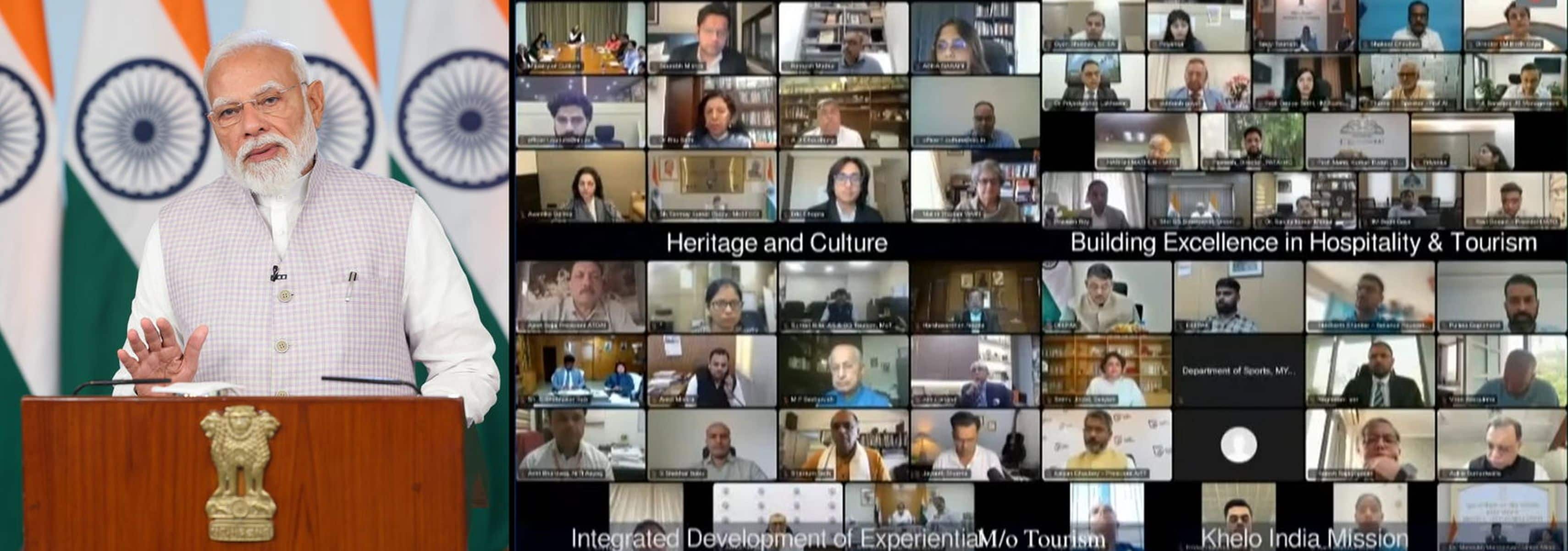
In this series of post-budget webinars, today marks the fourth and most significant one. Fulfilling aspirations of people is not merely a subject of discussion-it is the core objective of this budget and the firm resolve of this government. Education, Skill, Health, Tourism, Sports, and Culture are fundamental sectors that serve as the major means of fulfilling these aspirations. Therefore, in this webinar, we are deliberating on these crucial dimensions. For the implementation of budget announcements, the thoughts and suggestions of all experts, policymakers, scholars, entrepreneurs, and my young companions present here are extremely important. I warmly welcome and greet you all in this fourth session of the budget webinar.

Friends,

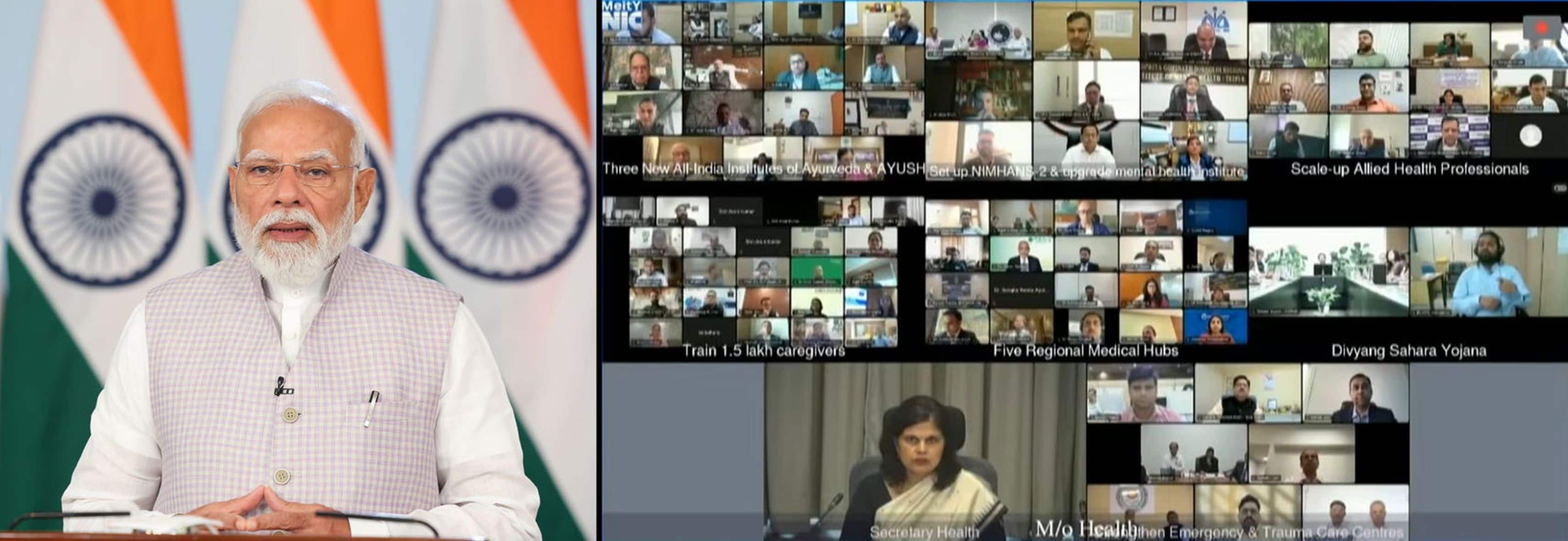
India today is working on a vast vision for preventive and holistic health. In recent years, the country’s health infrastructure has been strengthened, with hundreds of new medical colleges opening across districts. Through the Ayushman Bharat scheme and wellness centers, healthcare services have expanded to villages nationwide. Our yoga and Ayurveda are gaining popularity across the world. You will certainly discuss various aspects of this, but I would like to highlight one important subject-the care economy. In the coming decade, the number of senior citizens in the country will rise rapidly. Moreover, even today, many countries across the world face a huge demand for caregivers. Therefore, in the health sector, new skill-based employment opportunities are emerging for millions of youth. I urge the health sector experts present in this webinar to suggest new training models and partnerships so that the training ecosystem in the country can be further strengthened.

Friends,

Closely related to this is the subject of telemedicine. Today, a large number of people in remote areas are benefiting from it, and trust in it is steadily growing. However, I believe there is still a great need to increase awareness and ease of access in this area.

Friends,

Over the past decade, a major transformation has taken place in the mindset of the country. Today, beyond the boundaries of villages, towns, and cities, every young Indian wants to do something new, driven by the spirit to achieve. This new mindset of the new generation is the nation’s greatest strength, its most valuable capital for a bright future. To capitalize on this, we must continuously modernize and upgrade our education system. The new education policy has laid the necessary foundation for this. Now, it is essential that our curriculum remains updated according to market needs! We must accelerate the process of linking our education system with the real-world economy. We need to place greater focus on subjects like AI and automation, digital economy, and design-driven manufacturing.

Friends,

The country is consistently working to connect education with employment and enterprise. New models like university townships reflect this approach. Today, India is promoting the A.V.G.C. sector-Animation, Visual Effects, Gaming, and Comics. India is moving towards an innovation-driven economy. Many academicians and academic institutions are connected to this webinar today. I urge you to deliberate on developing your campuses as centers of industry collaboration and research-driven learning. This will provide students with real-world exposure and strengthen the skill ecosystem.

Friends,

A very important subject is STEM-Science, Technology, Engineering, and Mathematics. It is a matter of great pride that the number of daughters showing interest in STEM subjects is steadily increasing in our country. As we prepare for futuristic technologies, it is crucial that no daughter is held back due to lack of opportunities. In this webinar, you must discuss this direction. We need to place greater emphasis on increasing women’s participation. We must build a research ecosystem where young researchers have full opportunities to experiment and work on new ideas.

Friends,

Youth power becomes national power only when it is healthy, disciplined, and full of self-confidence. That is why, in recent years, sports have been seen as an important stream of national development. Initiatives like Khelo India have infused new energy into the sports ecosystem of the country. Sports infrastructure is being strengthened across the nation. In this webinar, you must deliberate on some key questions: How can talent be identified more accurately even from small towns and villages? How can structured financial support for thousands of athletes be improved? And thirdly, how can our sports bodies be made more professional? In the coming years, the Commonwealth Games will be held in India, and the country is striving to host the Olympics. In such a scenario, we must identify young athletes at an early age and nurture them, only then will India be able to raise its flag high in international competitions.

Friends,

Tourism and culture play a major role in creating new employment opportunities. When tourism grows in a place, the branding of that location or city also increases. This accelerates the overall development of that city. India has no shortage of historical sites. But for a long time, tourism remained confined to a few select destinations. Now, we are focusing on developing tourist destinations across every corner of the country.

Friends,

In this webinar, you must discuss a holistic approach to strengthening India’s tourism ecosystem. Your suggestions on trained guides, hospitality skills, digital connectivity, community participation, cleanliness, tourism, and related subjects will be very important.

Friends,

When institutions, industry, and academia work together, the pace of transformation accelerates. I am confident that this series of post-budget webinars will provide concrete direction for the future. Such efforts will further strengthen the foundation of a developed India. And friends, it is a very pleasant experience that due to the tradition of webinars, after the budget and especially during implementation, I have been told that this year, lakhs of people connected to these subjects-experts, beneficiaries, and those involved in the system-have actively participated in the webinars. Our officials have informed me that excellent and practical suggestions are coming in. This means not only solutions to problems but also new energy and new momentum to move forward with confidence. I say this is a very delightful experience of the webinars. All those who participated in these webinars are worthy of appreciation and gratitude. Once again, I extend my best wishes and heartfelt thanks to all of you.

Namaskar!