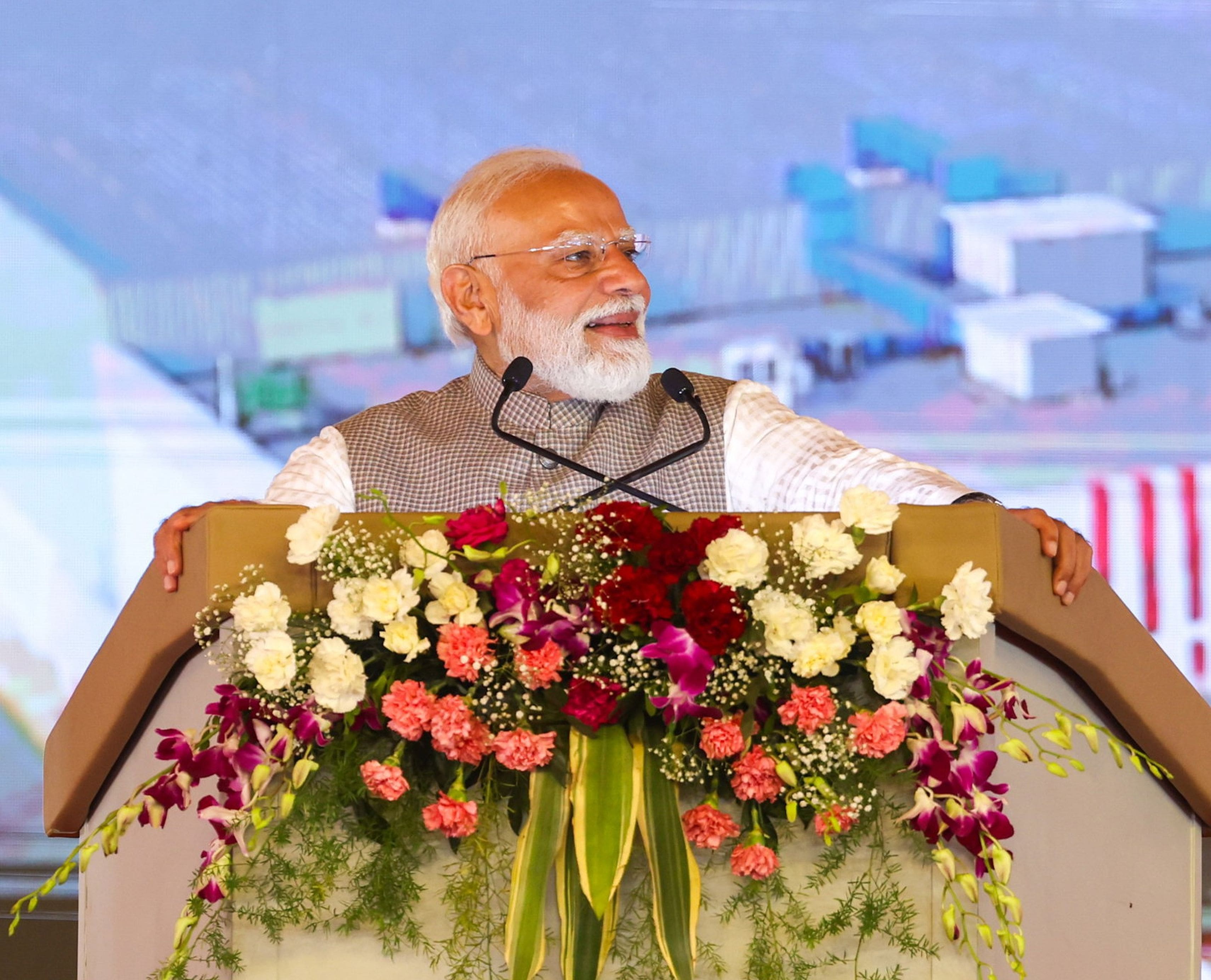
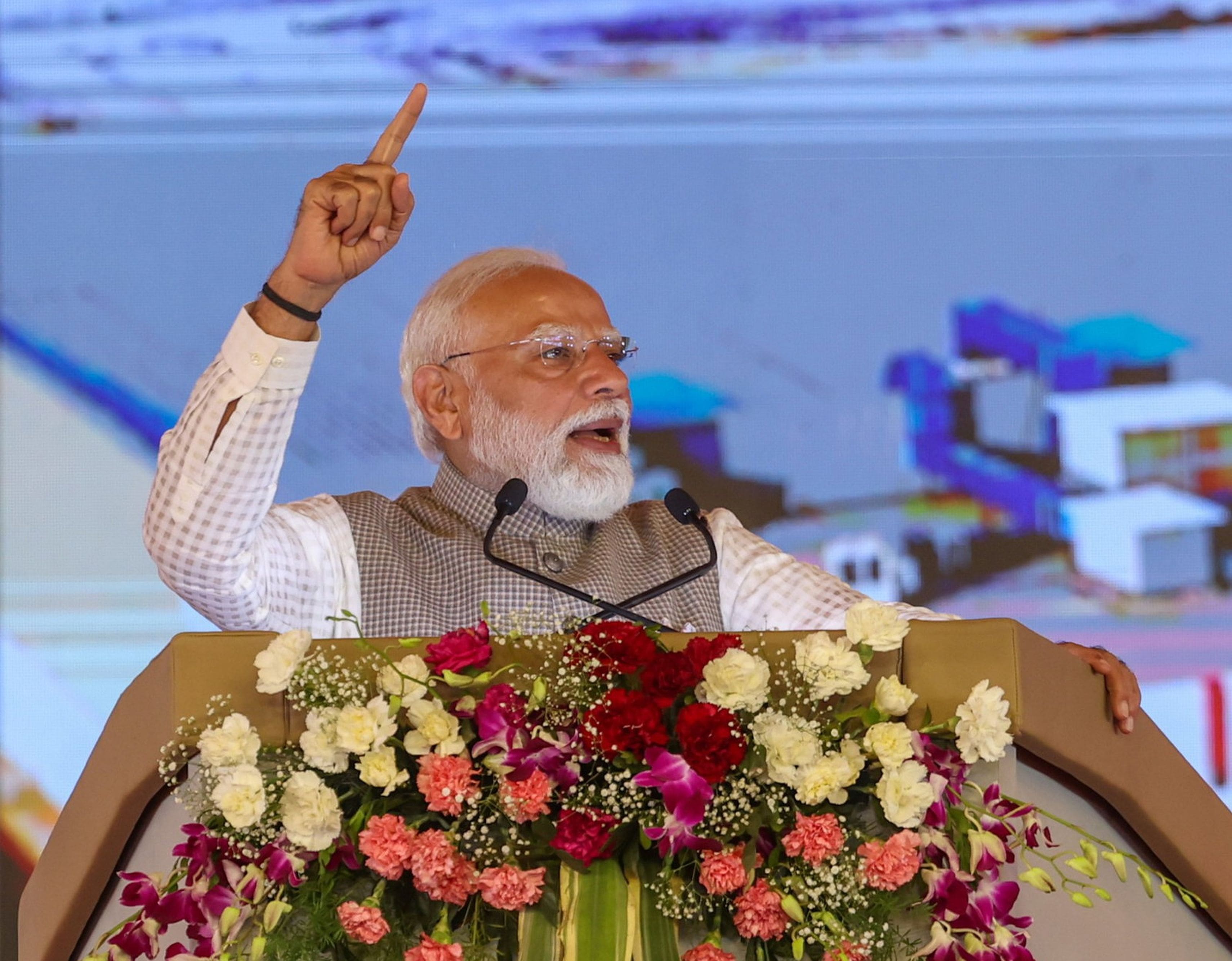
Place : Mahatma Mandir, Gandhinagar, Date: 17th August, 2013
My friends from the cabinet on the dice, Sri Bhupendrasinh Ji Chudasama, Sri Jayanti Bhai, Hon. Minister from Haryana, Sri Dharambir Ji, Minister of State Sri Govind Bhai, All the officials from the Central Government, the administrative officers from various states and all my fellow Indians dedicated to rural development..!
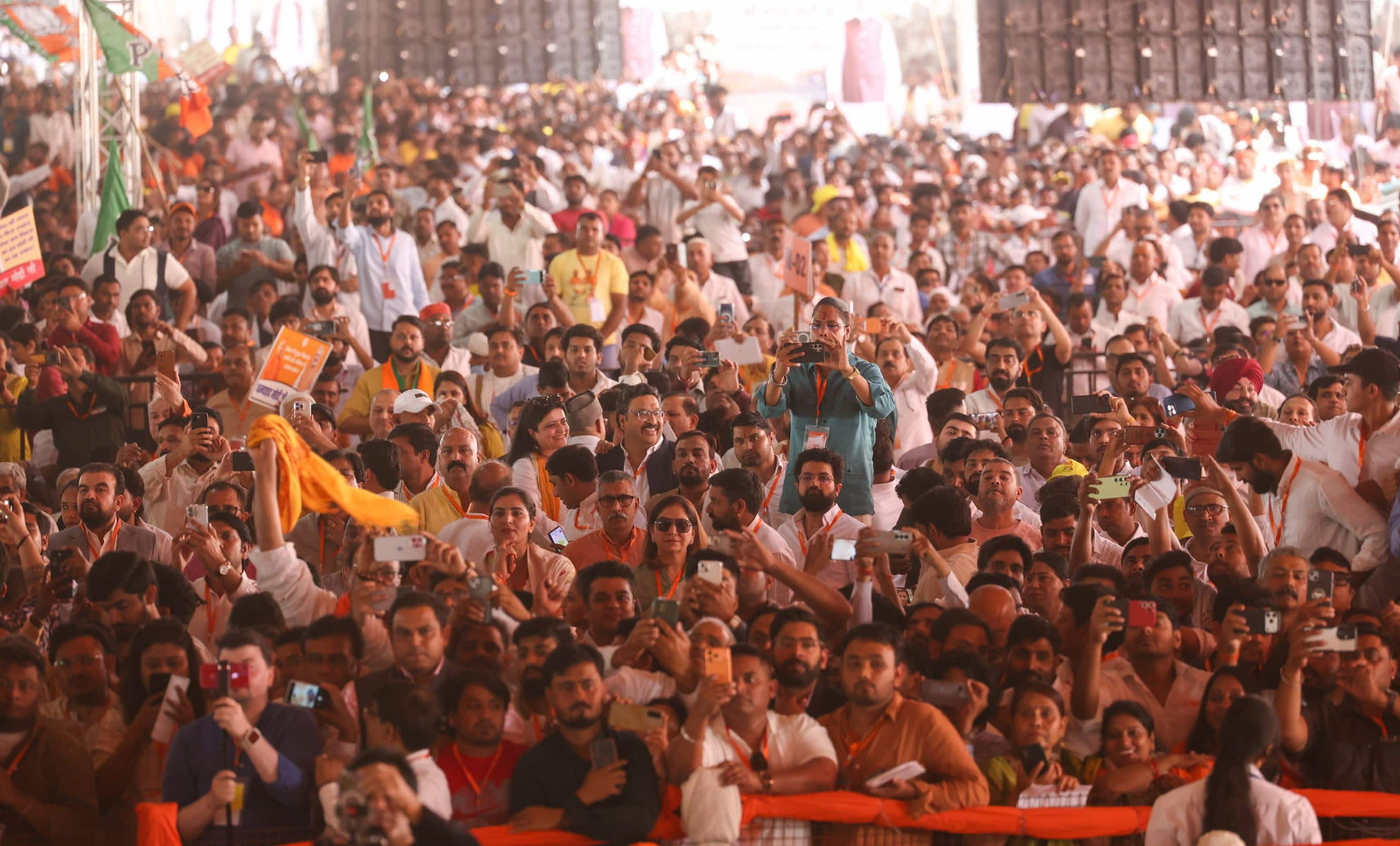
Today at this Mahatma Mandir, I can see a miniature of rural India. Around 5000 representatives from 26 States and 4 Union Territories are present here in this event and thus I can say that a miniature of rural India is sitting here in front of me. I welcome you all on this holy land of divine personalities like Sardar Patel, Mahatma Gandhi and Dayanand Saraswati..! Such a huge gathering from every corner of the nation on invitation of a state is a matter of pride and satiation for us..!
The basic idea behind organizing this programme was that the year 2012-13 is the golden jubilee year of Panchayati Raj system. Before 50 years from now Gujarat initiated steps to implement Panchayati Raj System. And whenever Panchayati Raj system is discussed, the first name that comes to our mind is of Balwantrai Mehta, in whose leadership, because of whose thought process a blueprint of Panchayati Raj system was chalked out and slowly and steadily it developed. Today all of us from across the nation who work in this area, will come together, discuss and contribute our experience and knowledge to find ways to strengthen the Panchayati raj system, to catalyze the pace of our rural development, to elaborate our concept of rural development, to bring about a change in the quality of rural life with our conception of rural development, to reach the new standards and level of living and I am sure that the diverse representation here will motivate us all and will give us opportunity for novel excitement and enthusiasm..!
Whenever rural development is discussed, it is natural to remember Mahatma Gandhi. It has been quite a long time since Mahatma Gandhi’s departure; even then with all my experience I can say that the philosophy that Bapu had in rural development it is 100% relevant and applicable even today. If we could have realized and implemented Bapu’s theory of Gram Swaraj in letter and spirit, then today probably we would have left even the urban provinces far beyond in case of development..! The place where we are sitting and discussing, is the place called ‘Mahatma Mandir’. When Gujarat was celebrating its golden Jublee then with the thought that some infra should be developed in Gandhi on the name of Gandhi, the idea of Mahatma Mandir evolved. The room in which we are right now, it is a part that is associated with an incidence that will make any Indian proud. It was completed in only 180 days..! This will be considered to be a miracle in our country, but this is a proof of the potential that is present in the common man of our nation. If this potential is used in the right manner and spirit, it can yield miraculous results. Otherwise even constructing your house wall in 180 days is difficult and this entire memorial was built in 180 days..! And I am requesting you all; I am not talking about the entire memorial, but of this part of it. The entire memorial is huge. Another specialty of it is that, when we were to lay the foundation stone for it, we called village heads from al of Gujarat and requested them to get holy soil and water of their village and put it into the foundation. We requested all the states for their soil and water; we requested all the countries of the world where Indians reside for their pious soil and water. So in a way, in the foundation of this building, the soil of all the villages of Gujarat, of all the states of India, of all the nations of the world is present, since Gandhi Ji was a universal human, so when a memorial being constructed in his memory, the world should be associated with it in some way, we tried to realize that imagination..!

In the same manner, you just saw a film; we are going to build a statue of Sardar Patel. It will be the largest statue in the world, double the height of ‘Statue of Liberty’. We can’t forget three things about Sardar Patel. He was an Iron Man, a Farmer and worked endlessly for the unity of this nation, and thus his statue will be named as ‘Statue of Unity’..! He brought entire nation together, got all the kings and empires in the mainstream of India. He was a farmer, he played a vital role in connecting the farmers with Mahatma Gandhi’s movement. The Satyagrah of Bardoli is still famous in the world. And he was an iron man, a great man with strong resolutions. And this is why when Sardar Patel’s statue will be built, we want to join entire India and farmers to it, and since we want to reconcile the iron man, we have decided to ask for iron from every village of India before starting the construction of ‘Statue of Unity’..! One piece from every village, there are 7 lakh villages in India that means we will ask for 7 lakh pieces of iron. But if someone says that there is a very old sword in our village, take it..! Or if someone says that we have a cannon, take it, it will suffice for entire statue, then No..! We want the iron that a farmer uses in his fields as a tool for agriculture, because he was farmer. Because he was iron man and worked for the unity of the nation, so we want to collect iron from 7 lakh villages, melt it and use it in this project, so that every Indian feels that in this grand memorial somewhere even my village is present..! We are trying to ignite the feeling of national unity through this ‘Statue of Unity’..! We are going to try to reach to all the villages of Gujarat, every state of India after 31st of October, and ask for help from people of every village there and through that we want to present this offering to our great nation..!
For rural autonomy, Mahatma Gandhi has guided us with a very distant vision. It used to be Gandhi Ji’s wish that there should be hygiene in the village, education in the village, health in the village, employment and self dependence in the village and villages should be free from untouchability syndrome. These were the basic things that Gandhi Ji continuously said to us. Even today if we take in view Gandhi Ji’s viewpoints and emphasize on them, then I do not believe that people will think to migrate from villages to the cities, in fact urban people will want to migrate towards the rural areas, and this is my belief..!
We will have to give rights to the villages, will have to connect villages in the economic decision making process. Here in Gujarat, if the Gram Panchayat had to spend some money, them lot of time was wasted in correspondence only. We decided that for any work up to 5 lakh rupees, the village committee should take decisions and go ahead with it..! They do not have to reach the upper levels for that..! And the villagers will do the right things..! In Gujarat, we conducted a small experiment for the tribal villages. It is famous in entire nation as Gujarat pattern and wherever in the nation tribal area development is being considered, Gujarat pattern is used as a model, a benchmark. In this Gujarat pattern, we allocated individual budget for tribal area development and we constituted committees in tribal village and asked those committees to decide that what is needed in the village. If we think to decide sitting in Gandhinagar to provide them with something, the villager says that he needs something more badly. Then the government says, no this is what we have decided for you, and you will have to do this, and because of this no work is done, they are left in the midway and the money involved is wasted..! We have given rights to the villagers in the tribal belt and we have experienced that the developmental objectives decided by those tribal committees, they are really important for them, and they like those work and the entire village knows that this is going to be done for them, so there is guarantee for transparency. Everyone stays vigilant on what works are being done for the villages. Is it being done according to the budget allocated to it, and thus every penny is used. And from last ten years I will say that works that involved millions and trillions are done through these tribal committees..! Total decentralization..! They are given guidelines and asked to perform and they did perform. And thus the more we focus on decentralization of rural development, the more authority we grant them with, the more responsibilities we assign them, better is the speed of the work and the results are also achieved..!
Reconstruction after the earthquake was a giant challenge for us. If we would have tried to take every decision from Gandhinagar, then I don’t think that we could have done things on such large scale. But what did we do..? We strategized that after the earthquake we need to bring normalcy to people’s life and if we could start the schools, this normalcy could be achieved more easily, the environment will change if the kids will start going to the schools..! So first of all we started the schools in tents itself..! Then what we did..? School buildings were demolished, kids had no books to study, nothing was left… We constituted committees in the villages, selected 10-12 most influential people of the village for it and told them that you have to construct the schools, this is the design and fund..! We constituted material bank, and from those material banks they could avail iron, cement, bricks, and whatever else was needed. If masons are required, then we opened training centers for masons, so that they can send their children to these training centers. Masons were trained and we informed the villages that this is your money, you complete the tasks. Our experience was that people finished the task of schools rebuilding before the time. Government thought of three rooms, they made four..! If we asked to work in 200 sq. meters, they worked in 250 sq. meters and donated land of their own village..! If we asked for single storey, they made it double storey..! Because it was for the children of the village, there did not have any callous approach because it was related to their kid’s future..! And Friends, I am proud to say that those people, their own houses were demolished, but those villagers when assigned with this social responsibility, they made much better schools than government ever could do and much earlier than government could made Not only this, today when there is a lot discussion about corruption, at that time when every family had suffered some loss and everyone needed help, even at that time and in those circumstances, those village committees returned the money that was left with them after the construction was done..! Friends, this is not a small incidence..! This is the echo of the soul of our Indian villages..! Honesty and integrity are still alive in the villages of our country, and if we recognize and accept this potential, and if we give them the power, then an example of what kind of change we can bring about is present before us..!

The Panchayati Raj system..! The importance that is there in the country for the Lok Sabha, it should be the same for Gram Sabha as well, the Gram Sabha should not be considered to be inferior to the Lok Sabha..! If Lok Sabha defines the future of the nation, Gram Sabha defines the future of the village..! Gram Sabha should be given honour, every word of it should be respected, and their opinions should be taken seriously. And when in this entire system, when Gram Sabha is not just a ritual, but becomes a lively unit of it, it’s thought process forces the state to ponder, then I believe that the decisions of the state can’t be against the rural thought process, there can be a difference in the pace, but contradiction, that is not possible. And if we all move together in one direction we can meet the newer heights of development in no time..!
I became Chief Minister for the first time in 2001..! I took the charge on 7th October and my first press conference was held on 11th October, which is also the birthday of Jay Prakash Narayan Ji, and on that day I made two announcements. First, that we increase the importance of Gram Sabha, will link them with regulations to improve them and the second was that, at that time in 10,000 villages in the state the Panchayat electoral were scheduled. It was the era just after the earthquake. We were financially broken in a way. Cyclone, Drought, Earthquake… and God knows what all natural calamities were knocking our doors. Hopelessness was all around, Gujarat was literally under the blanket of death, and it was felt as if we would never be able to stand again..! And at that time 10,000 villages had to face elections. We kept a small intervention and that was ‘Samras Gram’..! And this thought was a resultant of Mahatma Gandhi’s views. Acharya Vinoba Bhave always used to say that in Lok Sabha elections, the villages don’t turn into enemies, Assembly elections don’t sow the seeds of rivalry, but when Panchayat elections are held, in the every house of the village bitterness dwells, married daughters are turned back to their maternal homes, the village splits into two, every one indulges in death rivalry, the development of village is completely demolished and thus Vinobha Ji used to say that assembly and Lok Sabha elections can be understood, but why can’t the Gram Panchayat elections be held unanimously..? Why can’t the villages come together and decide..? Friends, for this we formulated ‘Samras Gram’ scheme. Under this Samras Gram plan, we announced that villages that will come together and following all the norms of reservation, create their villages, we will give them development allowance of 2 lakh rupees..! I remember, at time I was highly criticized, attacked, people even said that he is undemocratic. Now I was new as CM, I got attacked from all the sides, everyone took the opportunity and came to meddle. With God’s grace I didn’t falter. I am a child of the land of Sardar Patel, and thus do not know faltering..! So I challenged them..! I said 51-49 is democracy, 60-40 is democracy, 80-20 also is democracy then why can’t 100-0 be considered democracy..? This is the complete form of democracy if there is a unanimous decision..! And today I am proud to say that in the first attempt there were 45% units that swore to become a ‘Samras Gram’ and got connected in the journey of development..! And a result of it was that those who used to win the election they used to become arrogant that they defeated the other party and then they used to ignore the area of other contestant. When they got elected unanimously, the arrogance had no space to come in, in fact they became more dedicated to the village, started respecting entire village, started taking decision for the satisfaction of entire village..! The entire work culture, the viewpoint got changed..! And this experience is still continuing in our state. The fundamental idea was of Gandhi Ji, which was brought to light by Vinoba Ji, but even today there are Samras Villages in Gujarat and almost 40-50% villages form their governing body unanimously..!
Not only this, a few villages said that this time there is women reservation for Sarpanch in their village, so villagers decided that if the head is a woman, all the members will also be females, they will give them the opportunity to work..! Friends, today when we talk of women empowerment, in Gujarat there are more than 250 villages where without any regulations, the men of the village decided that they will not take any posts, the entire village committee will constitute of women, and they will operate and develop the village..! More than 250 villages are there, where not even one male member is there in this business. And when it was decided so we also said that even the Patwari (village revenue officer) will be a female..! We formed a separate committee which can further guide and help our Women Panchayats. And I am surprised Friends, what Gandhi Ji once said is today said by women of the village..!
Once, a women delegation came to meet me from Kheda district. They were the selected representatives of Panchayat and they used to run Panchayat in their village, there was not even one male member. The Sarpanch was a woman, not very educated, hardly 7th or 8th passed..! And she was sitting very confidently. In front of the CM, I found her more confident than the CM himself..! I was so proud that when I asked them that you are elected as the Sarpanch, what will you do? I thought they will say that we will make our village hygienic, will try to build unity in the village..! But, I was amazed Friends, they gave the agenda that no agenda can be better than it, they said we want to do something that after five years there should not be even one poor in the village..! Women from a village, who were not educated more than 7th or 8th standard, their dream was to do something for their village that there is not even one poor man in the village within 5 years..! I asked that how will you do that..? They said they want to start some small employment, some financial schemes..! They did not come to me to ask for funds for the roads, they were not there for exemption of water or electricity tax..! They said give us some scheme so that our villages become financially strong, if there will be employment in the village no one will be poor there..! I believe that the dream that that women had, even the biggest Government in India can’t have a bigger dream than that..!
Friends, just imagine that how the people at the smallest place in our country work..! I have seen it, a headwomen of a village come to meet me, as its representative. I asked her, what is your scheme..? She gave me a very interesting answer; she said that we have decided that we will make every house in our village have toilets. There will not even be one house without toilet in the village, there should not even be one family whose women have to go out in the open for toilet and live a life of embarrassment..! Friends, even after so many years of independence, isn’t it painful that our mothers and sisters have to go out in the open for toilet..? It is shameful..! They can’t go out in broad daylight, so they suffer all the day, get ill but wait for the dark..! A country like us that vouches to fulfill Gandhi Ji’s dreams..! And this is why I gave a slogan. And the kind of image that I have, people might also get offended. I said, ‘First toilets, then temples’ (Pahele Shauchalay, Baad me Devalay)..! Friends, it takes great courage but I insisted saying that ‘First toilets, then temples’..! Can’t we take a resolution that we will try to get toilets built in every house of our villages..? In Gujarat, we have started a movement, we have completed 80-90% of the task, and we will finish soon whatever is left..!
Friends, we have said something in context of rural development. There should also be an element of responsibility. This charity trend in the country, keep donating the money..! Why..? Because there is no other objective left except winning the elections..! Friends, there should be solid development, that can strengthen people to stand on their own and that allows the village’s own economy to grow..! If that does not happen, we will keep investing but there will be no results. We gave a small suggestion to the villages that you start a sanitation tax in the village, but the leaders of the villages they are not ready for that, why? Because we will lose next elections..! I said stop worrying about the elections, worry about the village..! Implement tax on sanitation, very small amount like a paisa or two. You do not need to make it huge, but inculcate the habit and I will give you grants matching to the tax and you give priority to hygiene in the village..! Friends, things can be changed..!
You see, today animal husbandry is a major source of employment in our villages. But are there any arrangements for these cattle..? No one even thinks about it..! And because of lack of any arrangements for them, the village systems turn into anomaly. We have started a small experiment, animal hostel..! Now it is understandable to have hostel for students, but can there be a hostel for animals..? We did that..! They are nearby; tomorrow probably some of you are going to visit there..! Government gave land near the village, and around 900 animals of the village live in that hostel. Now, not even one animal stands outside the house. Earlier what used to happen..? A small house and some space in front of it and there are four animals, then even the poor animals used to change their daily routines, they used to adjust..! Because of less space, 2 animals used to stand and two used to sleep and then they used to rotate their place, the other two used to sleep while the first two stood..! Friends, if we look in the details, even these animals are so sensible, two used to sleep while two stood. They do not have space, can’t be tied at someone else’s house, so what will it do..? With development of animal hostel, all the animals came there. Women used to worry for the animals 24 hours and not for their kids. Animals became first priority and kids second because there was the feeling of sympathy, motherly attachment, the culture of animal care and foremost that the animals were their source of income..! Kids afterwards, animals first, this was the condition and the females were also engaged in it. Friends, we brought about a change in it. Now what, they go to the hostel for 3-4 hours, take care of the animals, yield milk, feed them and the rest is taken care of by the servants there. The entire hostel is managed only with 4 servants and the females remain free. Now they are engaged in some other tasks, can take care of the kids, the village remains clean , all the hygiene problems are solved, and along with it fertilizer, gas, milk and electricity production in the hostel..! There has been 20% increment in the income of the village, 20%..! Friends, this is not a small thing..! Can’t we make every village a ‘Gobar Bank’ (cow dung accumulation)..? All the cow dung of the village is collected at a bank, like we deposit money in the bank, and at the end of the year, according to the volume of cow dung, fertilizer is given back to them..! With this cow dung, gas should be produced and the income that it generates is circulated in the village..! We need to focus on making villages self sufficient and we should develop villages as center of economic activities. The dream of Gram Rajya is fulfilled only when the village itself becomes a hub of economical and originative activities..!
Friends, today the manufacturing sector of India is getting limited within the urban areas and people also think that it is okay..! Friends, if we want to develop a country like India, then we will have to construct a complete network in the villages though small scale and cottage industries and if we can ensure that the required material reaches there then getting markets available is not very difficult. But if there is skill, resources, raw material, infrastructure, sufficient power supply, then there is enough strength in the village and it can contribute to development of the country, and there are many other things except farming that can be done in the villages..!
Well, in our state we started a drive of 24 hours electricity supply to the villages, ‘Jyotigram Yojna’..! And I am happy that Madhya Pradesh Government took the similar drive ahead by the name of ‘Atal Jyoti Yojna’. Even Madhya Pradesh will probably become able to supply 24 hours electricity in the near future. They have succeeded doing this in many a district. When electricity reaches a village it does not only take light to the house, it brings a new philosophy to life, it comes to illuminate the life..! When we launched the Jyotigram Yojna, we also directed that what other technologies can be introduced with electricity to the villages. The potter, who used to work manually earlier, has started using electricity now. The washermen have started using electricity instead of coal. Carpenters etc, they started using electricity to improve their productivity. With the advent of electricity in the village life, the facilities for value addition have increased. The farmer used to grow green chilly earlier, now he can make red pepper and process it red chili powder and sell it in the market. With the material with which he used to make 3 lakh rupees, now he makes more than 20-22 lakh rupees with it. Friends, we need to emphasize on value addition in the case of agriculture. If we produce milk and sell it, we earn fewer profits than what we make if we process that milk to make some product from it. If we sell potato we make less money but selling wafers, we earn much more. If we sell mangoes we earn less, but if we sell mango pickle we earn much more. How can the farmer add value easily and the more we will focus on rural economical encouragement, the more prosperous our country will be..! The village itself can convert its burden of unemployment into employment, can bear the financial burden, that potential is there in our villages..!
Friends, there is need of major reforms in the law as well. Many of you will not know, but there is a rule in our nation, but from last 60-70 years no government has followed it, no one fulfilled that tradition and it is the bad luck of this nation that no one raised a voice on it..! All the rules and policies that were developed are known as Todarmal’s reforms. There is one tradition and rule is that in every thirty years, all the land that is there should be measured once, the direction of the piece of land should be defined, it’s area should be calculated, it’s ownership should be fixed, the condition of that land should be checked. It should happen once in every 30 years. Friends, today I have to say this with a sad heart that this has not been done in last 100 years..! Because of that, if 50 years back there was a field on a land and then the river changed its path to it and today there is a river there but in the government documents, it is still a field, why..? Friends, today I can say with satisfaction that Gujarat is the first state that started a massive drive of measuring land. We are using satellite system and other modern technologies. Who is the owner of the land, how much land is his, what corner is in which direction, the land has a well, a pond in it, how far is it from the river etc.? And the details of entire village are disclosed to them and if anyone has any objection, they can get it noted. In this way an entire blueprint is being sketched stating that how much land is of the village, how much of it is in farmer ownership, how much is in other’s ownership etc. If we do not know about our property, our premise, we can’t formulate strategies. And these days this work is going on very successfully in Gujarat..!
Friends, there are some outdated laws, because of which our farmer is very distressed. We have taken revolutionary steps in the direction of reforms. Friends, reforms are being discussed in our nation, but the boundaries of these reforms are attached with money, these reforms are more focused on motivating the large scale industries. Friends, if reforms are needed in the real sense then it’s priority should be what reforms are we bringing for the benefit of rural population, what is our way of solving their difficulties, what can we do to liberate our rural populace from the obsolete systems, this should be our emphasis. And the biggest hurdle for this to happen is the laws of revenue, and people are scared changing the laws of revenue because they are 200-300 years old. There is need of change in these laws..!
There was a ‘Tukda Dhara’ in our state. Our farmer was highly distressed because he had a small piece of land, as the land kept being distributed in sons, grandsons, brothers, uncles, etc. and ultimately small pieces of land were left behind..! If he had to sell that piece of land then the rule says that he can sell it to only the adjacent owner, he can’t sell it to anyone else. And the neighbor they used to exploit such people quoting lesser prices than the market..! And that poor man, now whether he keeps the land or sells it, it is of no use. Now this was because of a law..! We terminated that ‘Tukda Dhara’, and today they can sell their piece of land to anyone they want to. He needed to take permission of the Collector and now there is no need for that, you are the owner, do whatever you want to..! And because of this, he can now get the price that he wanted to and his compulsion came to an end..!
Friends, earlier there was a law that if a father wants to distribute the land amongst his sons, daughters, children, etc. then that too had to be registered and the registration tax used to be huge, sometimes ten thousand, sometimes twelve thousand, sometimes fifteen thousand..! And the man used to think that we are a family only, so let’s just write a chit, and no other legal proceedings were done and after 20-25 years if there used to be a conflict in the family and when the matter was taken to the court, that chit was not considered. Why did they do so..? They did so to save 10-15 thousand rupees, because of the trust they had within family..! Friends, the time kept changing, and because of it the friction of families increased so much in the courts that all the strength of families is exhausted in paying lawyer’s fees. We changed the law. We said that if there is blood relation and if land is being transferred within the family, then no tax has to be paid, just pay 100 rupees and you can change ownerships..! Everything is documented now and there is no dilemma in the families..!
Friends, there is rapid development going on. Land is required for developmental work. To build roads land is needed, to build hospitals land is needed, to build schools land is needed, if people have to build houses land is needed..! But sometimes when government acquires land, then a family or two lose their entire land. What will that poor man do..? A farmer who has 5 acres of land and all of it is taken for a government project, what will he do? We took a decision that the day when his land be acquired, on the same day we will give him an extra letter of his right as a farmer. Though he does not have the land, but he his right as a farmer continues. And within next two years, if he buys a land nearby, then he will be registered as a farmer permanently. We arranged that his rights as a farmer remain intact..! And because of that our farmersget money and their right as a farmer also continues and by buying cheaper land he can become owner of 15 acre land instead of 5 acre that he had earlier..! If the government fulfills the requirement of common man, specially the more we simplify these land laws, the quicker we reform, the more we liberate our farmers from crisis, the villages will become more dispute-free..!
Friends, the way we visualized ‘Samras Gram’ in Gujarat, in the same way we conceptualized ‘Gokul Gram Yojna’. Under this ‘Gokul Gram Yojna’, we emphasized on rural infrastructure. We decided on minimum 8-10 items. Every village should have a panchayat hopuse, a road to reach there, every village should have panchwati, should have drinking water arrangements… We decided on 8-10 such infrastructure related parameters and worked on every village for Gokul Gram. We completed this task in almost all the villages. Then we thought that though they are villages but their thinking is not of villagers, we need to understand this fundamental change. Structure wise, from the point of view of population, they are villages, but with the view of thinking they are not behind the cities in any way. The rural youth thinks the same way the urban youth does..! The rural woman thinks the same way the urban woman does..! It is not that there are beauty parlours in the cities only, today I am seeing beauty parlours running in the villages of Gujarat also..! The thinking has reached, Friends. Whether we believe or not, the seeds of change have rooted in the minds and thus now when we design the development models, we need to understand the aspirations of rural people. We will have to develop facilities according to their hopes and aspirations..!
When we did Jyotigram, there was a great change in the life of the villages, change dwelled in the situation of migrating from the village to the city. After that we started ‘E-Gram Vishwa Gram’..! In India, Gujarat is the only state with broadband connectivity and optical fiber network in all its villages..! All the facilities that are available to the city residents like internet, mobile, computer, video conference, everything we have provided to the villagers. Today the village of Gujarat talks to their relatives in the U.S. on skype, shows all the family events to them. There is a wedding there, if the relatives have not come, then they attend the wedding online. This change has come in the rural life. They also have been benefited with the technology, this change has come. I have seen such villages where there are CCTV cameras in the crematorium and if someone is being cremated in the village and their family could not come from abroad, then he attends the funeral from there. In this way, the will of learning the technology evolves in people. If we want rural development, we need to make the latest technology available to them..! And this is not very expensive. The more communication technology we will provide them, the villages will stop splitting; there will be a new change in the rural life. The thought process that has changed in them, the villages will also change in its accordance and we will compliment it, and for that we started the ‘E-Gram Vishwa Gram’ scheme. After this technology was set, we started using it for long distance education for children. If there is no good teacher in the village, then we can teach them from Gandhinagar in their classes. The technology paid well and there was improvement in kid’s education. This can be done..!
Not only this, usually for a villager it is a problem that whom should he complain to..? Because for villagers that Patwari himself is their CM..! If he does not want the village can have no good. If the villager has to complain, who should he go to, how will he..? He does not even know where to go. Friends, we made a couple of reforms. First, we introduced ATVT concept in the golden Jublee year of Panchaytai Raj system; that stands for ‘Apna Taluka, Vibrant Taluka’..! First the unit was district, they used to take the decisions, now we have clubbed two districts and started a new body to plan and implement an have increased the decentralization and another thing that we have formed a rule that the suggestions that come in the Gram Sabha, how to use these suggestions as foundation for development. And in this entire structure, by introducing ATVT concept we have tried to strengthen the rural system..!
Friends, we have done one more thing. I believe that the biggest strength of democracy is ‘Grievance Redressal System’. How can we give solution to the problems of common man, how can we handle his grievance, the better system we have for it, stronger will be the democracy..! And thus, we have started ‘Swagat Online’ programme, which has been awarded by the Unite Nations..! Every villager can file his complaint online. He does not need to come to the city, district or post from his village. Friends, today lakhs of such complaints are being solved online. And we empowered our villages so much that if problem of some village or some villager is not solved in the village, he straight away goes to the Collector Office or District Magistrate’s court..! They have no shoes in feet, are wearing torn clothes, are muddled, are uneducated, but they look confidently looks in the eye of the DM and says Saab, will you do it or not, or I will go online. As soon as he says online, the collector stands up and asks him to sit and reverently enquires about his problem..! This is the power of technology..! We can empower rural people through technology and this empowerment makes them responsible to bring about the change..!
Friends, we did one more thing like Samras Gram..! We planned a scheme. Friends, even today it is difficult for the world to understand us. The people who are brought up with western thought process, whether they are from our own country, they do not know the power of our nation..! Friends, such a huge nation, 7 lakh villages, a population of 125 crore and today new hustles of law and order rise everyday..! In all this, this is also a country where in 7 lakh villages there are only 50,000 police stations..! And with only 50,000 police stations, this country feels safe, the villages feel safe, why..? Because staying and living together is in our blood, in our culture, it is our great heritage..! We do not stay right because of the policemen’s stick but because of our culture. If we are going in the right direction, it is not because we are bound by some law but because it is our culture. Otherwise, such a huge nation, no one will be ready to believe that a country of 7 lakh villages has only 50,000 Police Stations, and still this country is going on..! This is the power of common man, and to identify this power we started a drive called ‘Teerth Gram - Paavan Gram’..! The village wherein no court case has been there in last three years, has had no F.I.R. lodged in last three years, we give those villages certificate of ‘Paavan Gram’ and give them special allowances for development. The village that has not got any such case reported in last five years, we certify them as ‘Teerth Gram’ and give them more allowance. And Friends, today there are many such villages in Gujarat, where there have been no conflicts since 5 years, no F.I.R. has been lodged, no problems have been there and some villages suffered because of the F.I.R.s that were lodged because of accidents, just because of that some villages did not qualify to be ‘Teerth Gram’..! So now we are changing the law that in case of F.I.R.s lodged of complaints, they will not be held from availing the benefits, because an accident is an accident. Friends, if we give them the required motivation, people are more than happy to live with peace and harmony..! ‘Paavan Gram’ and ‘Teerth Gram’ are those concepts that give a new model of development to villages..!
Friends, the center of reformation should be villages, it should be the common rural man, the villages should be made part of decision making, the more we keep these fundamental things in mind, then when today we are celebrating 50 years of Panchayati Raj, then only our systems will be strengthen, our villages will be strengthened, our country will be strengthened. When our country will become a center of production then our country will move ahead in the direction of manufacturing sector, there will be more employment opportunities in the villages, then only unemployment will be evicted from our nation. When villages will become more prosperous financially, then India will also achieve prosperity and thus when for financial prosperity we make villages the unit and move ahead then we can contribute a lot. With these words once again I welcome you all..! I am sure that today and tomorrow we will keep discussing and adding value to the arena of the rural development and Panchayati Raj system. Once again lots of best wishes to you all..!