The Cabinet Committee on Economic Affairs (CCEA) chaired by the Prime Minister Shri Narendra Modi, has approved the increase in the Minimum Support Prices (MSP) for all mandated Kharif Crops for Marketing Season 2022-23.

Government has increased the MSP of Kharif Crops for Marketing Season 2022-23, to ensure remunerative prices to the growers for their produce and to encourage crop diversification, as provided in the table below.

Minimum Support Prices for all Kharif crops for Marketing Season 2022-23

(₹ per quintal)

Crop


MSP 2014-15

MSP 2021-22


MSP 2022-23

Cost* of production 2022-23

Increase in MSP (Absolute)

Return over cost (in per cent)

Paddy (Common)

1360

1940


2040

1360

100

50

Paddy (Grade A)^

1400

1960


2060

-

100

-

Jowar (Hybrid)

1530

2738


2970

1977

232

50

Jowar (Maldandi)^

1550

2758


2990

-

232

-

Bajra

1250

2250


2350

1268

100

85

Ragi

1550

3377


3578

2385

201

50

Maize

1310

1870


1962

1308

92

50

Tur (Arhar)

4350

6300


6600

4131

300

60

Moong

4600

7275


7755

5167

480

50

Urad

4350

6300


6600

4155

300

59

Groundnut

4000

5550


5850

3873

300

51

Sunflower Seed

3750

6015


6400

4113

385

56

Soyabean (yellow)

2560

3950


4300

2805

350

53

Sesamum

4600

7307


7830

5220

523

50

Nigerseed

3600

6930


7287

4858

357

50

Cotton (Medium Staple)

3750

5726


6080

4053

354

50

Cotton (Long Staple)^

4050

6025


6380

-

355

-

 *Refers to cost which includes all paid out costs such as those incurred on account of hired human labour, bullock labour/machine labour, rent paid for leased in land, expenses incurred on use of material inputs like seeds, fertilizers, manures, irrigation charges, depreciation on implements and farm buildings, interest on working capital, diesel/electricity for operation of pump sets etc., miscellaneous expenses and imputed value of family labour.

^ Cost data are not separately compiled for Paddy (Grade A), Jowar (Maldandi) and Cotton (Long staple)

The increase in MSP for Kharif Crops for Marketing Season 2022-23 is in line with the Union Budget 2018-19 announcement of fixing the MSP at a level of at least 50 percent over the All-India weighted average Cost of Production, aiming at reasonably fair remuneration for the farmers. It is notable that, return over MSP for bajra, tur, urad sunflower seed, soybean and groundnut is more than 50 percent over the All-India weighted average Cost of Production at 85%, 60%, 59%, 56% , 53% and 51% respectively.

Concerted efforts have been made over the last few years to realign the MSP in favour of oilseeds, pulses and coarse cereals to encourage farmers to shift larger area under these crops and adopt best technologies and farm practices, to correct demand – supply imbalance.

As per 3rd Advance Estimates for 2021-22, production of Foodgrains in the country is estimated at record 314.51 million tonnes which is higher by 3.77 million tonnes than the production of foodgrain during 2020-21. The production during 2021-22 is higher by 23.80 million tonnes than the previous five years’ (2016-17 to 2020-21) average production of foodgrains.


Explore More
Today, the entire country and entire world is filled with the spirit of Bhagwan Shri Ram: PM Modi at Dhwajarohan Utsav in Ayodhya

Popular Speeches

Today, the entire country and entire world is filled with the spirit of Bhagwan Shri Ram: PM Modi at Dhwajarohan Utsav in Ayodhya
How PLI schemes, design in India and manufacturing excellence are transforming the architectural lighting industry

Media Coverage

How PLI schemes, design in India and manufacturing excellence are transforming the architectural lighting industry
NM on the go

Nm on the go

Always be the first to hear from the PM. Get the App Now!
...
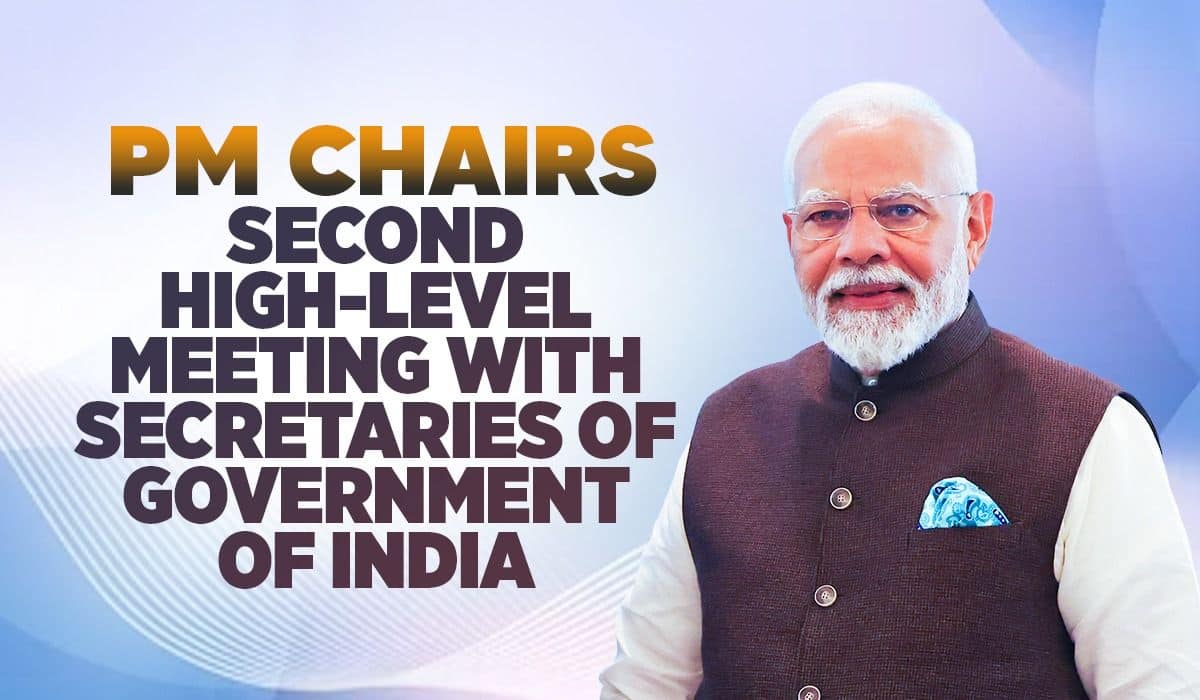
Prime Minister Narendra Modi Chairs Second High-Level Meeting with Secretaries of Government of India
July 28, 2026
Sectors discussed: Finance and Economy, Commerce and Industry, and Technology
PM emphasises the need to break both horizontal and vertical silos within the Government
PM emphasises the importance of technological self-reliance and building domestic capabilities in critical sectors
PM encourages greater participation of young innovators and entrepreneurs in cybersecurity ecosystem
PM Stresses Proactive Outreach on Strategic Sectors to Counter Misinformation
PM says Govt must always remain youthful, dynamic and forward-looking, continuously adapting to new challenges and opportunities with agility and innovation
Secretaries share experiences and perspectives on key initiatives, emerging opportunities and implementation challenges

Prime Minister Shri Narendra Modi chaired the second high-level meeting with Secretaries to the Government of India at his residence at 7, Lok Kalyan Marg earlier today. He reviewed the future action agenda of Ministries and Departments dealing with Finance and Economy, Commerce and Industry, and Technology sectors. The meeting focused on accelerating progress towards the goals of Viksit Bharat.

Prime Minister called for a strong focus on team building across Ministries and Departments, urging officers to work with a shared sense of purpose. He emphasised the need to break both horizontal and vertical silos within the Government so that departments function in close coordination and deliver integrated outcomes.

Highlighting the importance of citizen-centric governance, Prime Minister said that the people of India must remain at the centre of governance. He reminded that every decision and policy should be guided by the interests and aspirations of the common citizen.

Prime Minister stressed that while India is making significant investments in infrastructure, equal priority must be given to developing indigenous technologies. He underscored the importance of technological self-reliance and building domestic capabilities in critical sectors.

Prime Minister underlined that energy security is closely linked with national security, economic stability and citizens’ welfare. Prime Minister said India must achieve self-reliance in the energy sector through innovation, diversification and accelerated capacity creation.

Emphasising that reforms are not merely a fashionable term but a continuous necessity for effective governance, Prime Minister stressed the need to reform processes, improve work culture and strengthen institutional efficiency.

Prime Minister said that growing use of technology must be accompanied by a strong focus on cybersecurity to safeguard digital systems and infrastructure. He stressed the need for constant vigilance against emerging cyber threats. He called for encouraging greater participation of young innovators and entrepreneurs in the cybersecurity ecosystem and emphasised that it should evolve into a nationwide movement.

Prime Minister also emphasised the importance of proactive communication on strategic sectors where the country is undertaking major initiatives, to counter misinformation and unfounded fears surrounding such efforts.

Prime Minister says that new academic courses should be planned in partnership with industry to equip the workforce with skills required by emerging and future industries. He also observed that a government must always remain youthful, dynamic and forward-looking, continuously adapting to new challenges and opportunities with agility and innovation.

The meeting featured detailed discussions by Secretaries on the progress, priorities and implementation issues across their respective domains. The meeting was attended by the Cabinet Secretary, Secretaries of key Ministries and Departments, and senior officials from the Prime Minister’s Office.