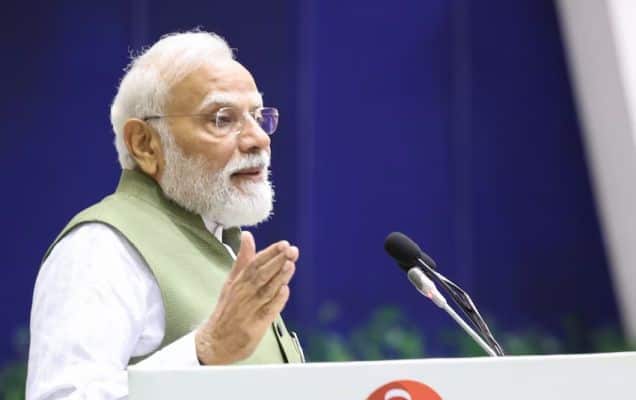
The Union Cabinet chaired by the Prime Minister, Shri Narendra Modi, yesterday approved the launch of the Urban Challenge Fund (UCF) with a total Central Assistance (CA) of Rs. One lakh crore. CA will cover 25% of the project cost, subject to raising minimum 50% of the project cost from market. This will lead to a total investment of Rs. Four lakh crore in urban sector in next five years, marking a paradigm shift in India’s urban development approach from grant- based financing to market-linked, reform-driven and outcome-oriented infrastructure creation.
The Urban Challenge Fund will leverage market finance, private participation and citizen- centric reforms for delivery of high-quality urban infrastructure. The Fund aims to build resilient, productive, inclusive and climate-responsive cities, positioning those as key driver of the country’s next phase of economic growth.
The Fund will be operational from FY 2025–26 to FY 2030–31, with an extendable implementation period up to FY 2033–34. It gives effect to the Government’s vision announced in Budget 2025–26 to implement proposals relating to Cities as Growth Hubs, Creative Redevelopment of Cities, and Water and Sanitation.
Salient Features of the Urban Challenge Fund:
- A minimum of 50 per cent of project financing have to be mobilised from market sources, including municipal bonds, bank loans and Public–Private Partnerships (PPPs). The remaining share may be contributed by States, Union Territories (UTs), Urban Local Bodies (ULBs) or other sources.
- Projects will be selected through a transparent and competitive challenge mode, ensuring support to high-impact and reform-oriented proposals.
- There will be a strong thrust on reforms across Urban Governance, Market & Financial systems, Operational efficiency, and Urban Planning
- Private sector participation will be encouraged through structured risk-sharing frameworks and benchmarking of service delivery standards
- A dedicated ₹5,000 crore corpus will enhance the creditworthiness of 4223 cities including Tier- II and Tier-III cities, particularly for first-time access to market finance.
- Positioning ULBs as Bankable Asset Class.
Credit Repayment Guarantee for Smaller Cities:
In order to facilitate first-time access to market finance for all Cities/ULBs in Northeastern & Hilly States and smaller ULBs (<1,00,000 population) in other States/UTs, a Credit Repayment Guarantee Scheme of ₹5,000 crore has been approved. The scheme will provide a Central guarantee of up to ₹7 crore or 70 per cent of the loan amount (whichever is lower) for first-time loans. On successful repayment of first loan, central guarantee of ₹7 crore or 50 per cent of the loan amount (whichever is lower) will be provided. This will effectively support projects of minimum Rs.20 crore for the first time and Rs.28 crore for subsequent projects in smaller cities.
Challenge-Based Project Selection:
Projects under the Fund will be selected through a challenge-based framework including transformative impact, sustainability & reform orientation. Funding will be linked to reforms, milestones and clearly defined outcomes. Continuation of reforms will be a prerequisite for further fund release. Paperless monitoring of projects and reforms will be facilitated through a single digital portal of the Ministry of Housing and Urban Affairs.
Project Verticals:
Cities as Growth Hubs, identification of city regions, important economic nodes, integrated spatial economic & transit planning - including greenfield and semi-greenfield developments, and development along transit and economic corridors, urban mobility, critical infrastructure projects to enhance economic competitiveness;
Creative Redevelopment of Cities, covering renewal of central business districts and heritage cores, brownfield regeneration, Transit Oriented Development and retrofitting of legacy infrastructure, Climate resilience, disaster mitigation and countermagnets to decongest the existing cities in Northeastern & Hilly States; and
Water and Sanitation, including upgradation of water supply, sewerage and stormwater systems, Rurban infrastructure, water grids and integrated solid waste management, including legacy waste remediation, focusing on swachhata.
Coverage:
The Fund will cover:
- All cities with a population of 10 lakh or more (2025 estimates);
- All State and Union Territory capitals not covered above; and
- Major industrial cities with a population of 1 lakh or more.
Additionally, all ULBs in hilly States, North-Eastern States, and smaller ULBs with population below 1 lakh will be eligible for support under the Credit Repayment Guarantee Scheme. In principle all cities will be covered under UCF
Reform-Linked Funding Framework:
Funding under the Urban Challenge Fund is anchored to a comprehensive reform agenda covering:
- Governance and digital reforms;
- Market and financial reforms to strengthen creditworthiness;
- Operational reforms for improved service delivery and utility efficiency;
- Urban planning and spatial reforms, including transit-oriented development and green infrastructure; and
- Project-specific reforms with defined Key Performance Indicators (KPIs), third-party verification and sustainable Operation & Maintenance mechanisms.
Outcome Orientation:
- Projects will be evaluated on their ability to deliver transformative outcomes- economic, social and climate, including revenue mobilization, private investment, job creation and, improved safety, inclusiveness, service equity and cleanliness.
- The Urban Challenge Fund is expected to catalyse large-scale private investment, strengthen urban governance, and accelerate the creation of future-ready cities aligned with national development priorities.